What is a bicycle helmet?
A bicycle helmet is a protective headgear specifically designed to reduce the severity of head injuries in the event of a fall or collision while riding a bicycle. First introduced in the 1970s in the United States, early versions were made of leather (“hairnet” helmets) or hard-shell plastic, but evolved into lightweight, impact-absorbing EPS foam designs with improved ventilation and features like MIPS to manage rotational forces. Over time, helmets became essential in cycling culture due to increasing urban traffic and competitive sport demands, and are now mandated by law for certain age groups or regions in countries like Australia, Canada, the U.S., and parts of Europe, playing a vital role in promoting rider safety, reducing fatalities, and encouraging responsible biking habits.
What are bicycle helmets made of?
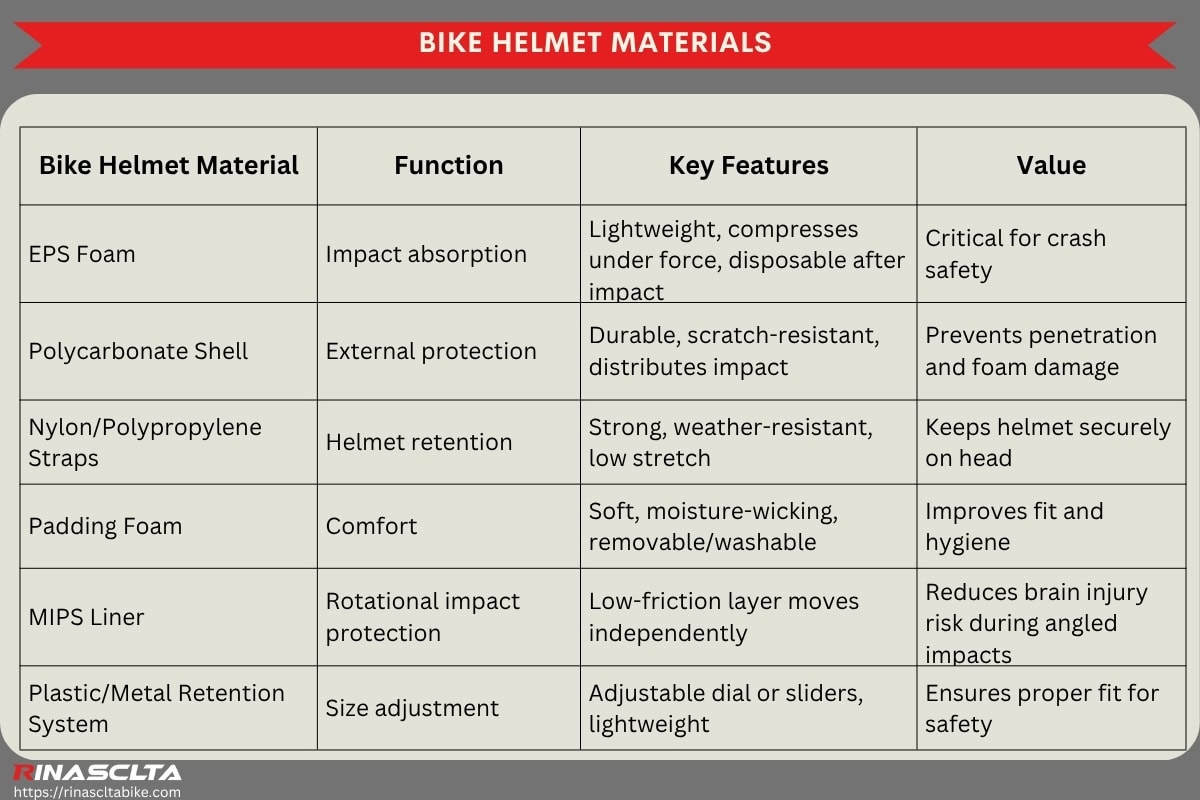
Bicycle helmets are commonly made of EPS foam, polycarbonate shell, nylon or polypropylene straps, padding foam, MIPS liners, and plastic or metal retention systems—each material is selected to balance impact absorption, durability, weight, ventilation, comfort, and cost, ensuring rider protection and compliance with international safety standards.
- EPS foam (Expanded Polystyrene): Acts as the core impact-absorbing layer, compressing on impact to reduce force transferred to the skull.
- Polycarbonate shell: A tough outer layer that protects the EPS foam from punctures and distributes impact energy over a broader area.
- Nylon or polypropylene straps: Lightweight, strong materials used to secure the helmet firmly to the rider’s head without stretching or breaking.
- Padding foam (often polyurethane): Adds comfort and moisture-wicking inside the helmet while slightly aiding minor shock absorption.
- MIPS liner (Multi-directional Impact Protection System): A slip-plane layer inside the helmet that reduces rotational forces during angled impacts.
- Plastic or metal retention systems: Adjustable mechanisms (like dial-fit systems) that allow secure and customized fitting for different head sizes.


| Bike Helmet Material | Function | Key Features | Value |
| EPS Foam | Impact absorption | Lightweight, compresses under force, disposable after impact | Critical for crash safety |
| Polycarbonate Shell | External protection | Durable, scratch-resistant, distributes impact | Prevents penetration and foam damage |
| Nylon/Polypropylene Straps | Helmet retention | Strong, weather-resistant, low stretch | Keeps helmet securely on head |
| Padding Foam | Comfort | Soft, moisture-wicking, removable/washable | Improves fit and hygiene |
| MIPS Liner | Rotational impact protection | Low-friction layer moves independently | Reduces brain injury risk during angled impacts |
| Plastic/Metal Retention System | Size adjustment | Adjustable dial or sliders, lightweight | Ensures proper fit for safety |
How are bicycle helmets made?
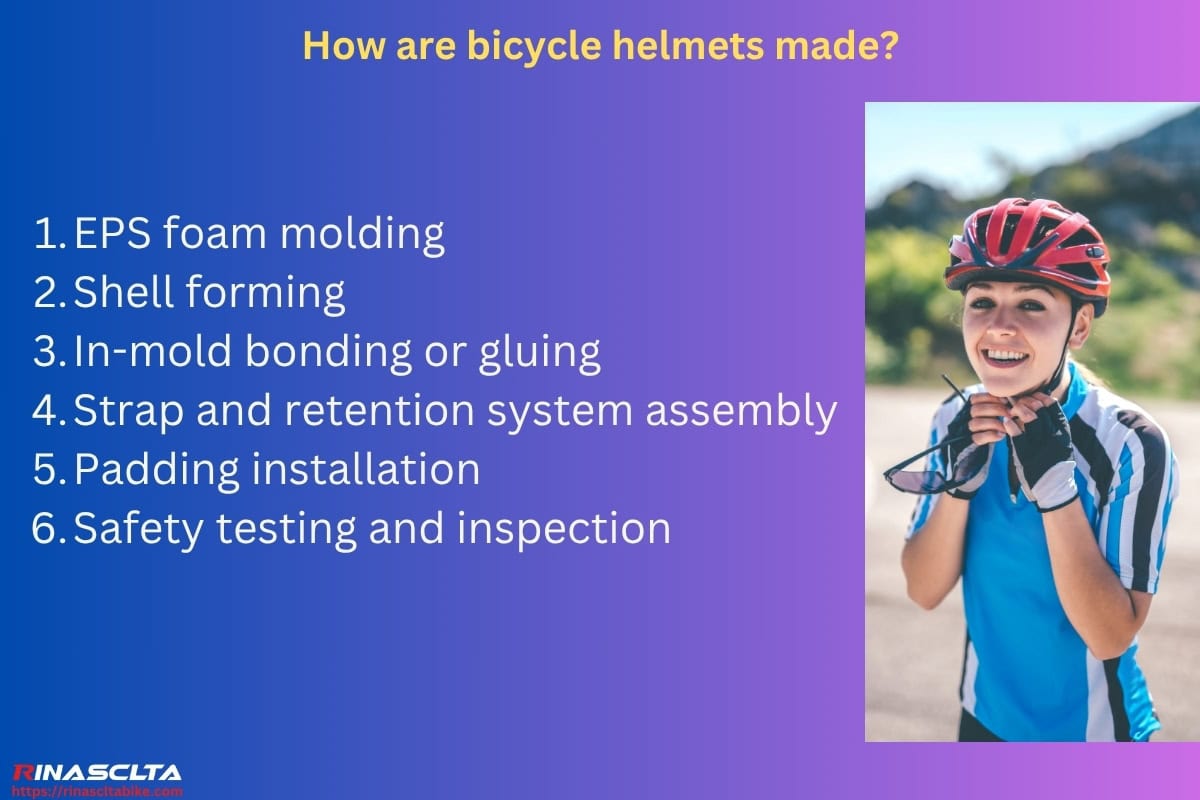
Bicycle helmets are made through a step-by-step process including EPS foam molding, shell forming, in-mold bonding or gluing, assembly of straps and retention systems, installation of padding, and safety testing—each step ensures the helmet is safe, comfortable, and compliant with international standards like CPSC, EN 1078, or AS/NZS.
- EPS foam molding: Expanded polystyrene beads are expanded with steam and compressed into molds to form the shock-absorbing core that protects the skull during impacts.
- Shell forming: Thin polycarbonate sheets are thermoformed using heat and vacuum into aerodynamic shapes that provide puncture resistance and durability.
- In-mold bonding or gluing: The EPS core is fused directly with the shell in-mold (common in modern helmets) or glued afterward to enhance structural strength and reduce weight.
- Strap and retention system assembly: Adjustable nylon or polypropylene straps and rear dial systems are added to secure the helmet snugly to the rider’s head.
- Padding installation: Comfort pads made of polyurethane foam are attached to the inside of the helmet to wick sweat, cushion pressure points, and improve fit.
- Safety testing and inspection: Each helmet undergoes standardized lab testing for impact resistance, strap integrity, and overall durability to meet safety certifications.
How do bicycle helmets work?
Bicycle helmets work by absorbing and dissipating impact energy during a crash to protect the rider’s head from traumatic brain injury or skull fractures—this is achieved through a combination of a crushable EPS foam liner that compresses on impact and a rigid polycarbonate shell that spreads the force and resists penetration. Bicycle helmets also incorporate features like ventilation channels for cooling, aerodynamic shapes for reduced drag, adjustable retention systems for a secure fit, and optional technologies like MIPS to reduce rotational forces during angled impacts, making them essential for both safety and performance across all cycling disciplines.
How does a bicycle helmet protect your head?
Bicycle helmets protect your head by reducing the force of impact transmitted to your skull and brain during a crash through energy absorption and distribution—the EPS foam liner compresses to absorb linear impact energy, while the outer polycarbonate shell spreads the force over a larger surface and prevents penetration. Bicycle helmets may also feature MIPS (Multi-directional Impact Protection System) or similar slip-plane technologies that allow slight rotational movement between the head and helmet, reducing harmful rotational forces that can cause concussions or brain injuries during angled collisions.
How effective are bicycle helmets?
Bicycle helmets are highly effective, reducing the risk of serious head injury by up to 60% and traumatic brain injury by as much as 53%, according to global safety studies. Their effectiveness depends on factors such as proper fit, helmet type, certification compliance (e.g., CPSC, EN 1078), use of technologies like MIPS, and whether the helmet is in good condition and correctly worn during impact.
Why were bicycle helmets invented?
Bicycle helmets were invented to protect cyclists from head injuries caused by crashes, falls, and collisions with vehicles or obstacles, especially as cycling speeds increased and urban traffic became more dangerous. The first modern versions appeared in the 1970s, driven by rising awareness of head trauma in competitive cycling and road riding, prompting the need for impact-absorbing materials like EPS foam and hard shells to reduce fatalities and severe injuries—eventually leading to regulated safety standards and widespread adoption in both recreational and professional cycling.
Why are cycling helmets important?
Cycling helmets are important because they significantly reduce the risk of head and brain injuries by absorbing impact energy during crashes, falls, or collisions—making them a critical layer of protection for all cyclists. They help prevent concussions, skull fractures, and traumatic brain injuries, especially in high-speed or high-traffic environments, and are often legally required in many countries to promote safety and reduce healthcare burdens.
Types of bicycle helmets
Types of bicycle helmets can be categorized based on gender and age, design style, bike discipline, and integrated safety technology, each tailored to specific rider needs, anatomy, or performance and protection demands. This classification system helps cyclists choose the right helmet for comfort, safety, and efficiency depending on riding style, terrain, and modern innovations.
Helmet types based on gender and age
Helmet types based on gender and age include adult men, adult women, youth, and kids’ helmets—this classification exists to ensure proper fit, comfort, head shape compatibility, and design preferences suited to different ages and anatomies for maximum safety and usability.
- Adult men: Typically larger in size with more neutral or rugged styling, often designed for road, MTB, or commuting use.
- Adult women: Often shaped slightly narrower, with smaller shell sizes and color or design options tailored for women, while still meeting the same safety standards.
- Youth: Sized for pre-teens and early teens, combining child-friendly designs with more advanced features like MIPS for developing riders.
- Kids: Designed for smaller heads (usually ages 3–10), with extended coverage, fun graphics, and simplified retention systems for easier use and improved safety.
Helmet types based on design
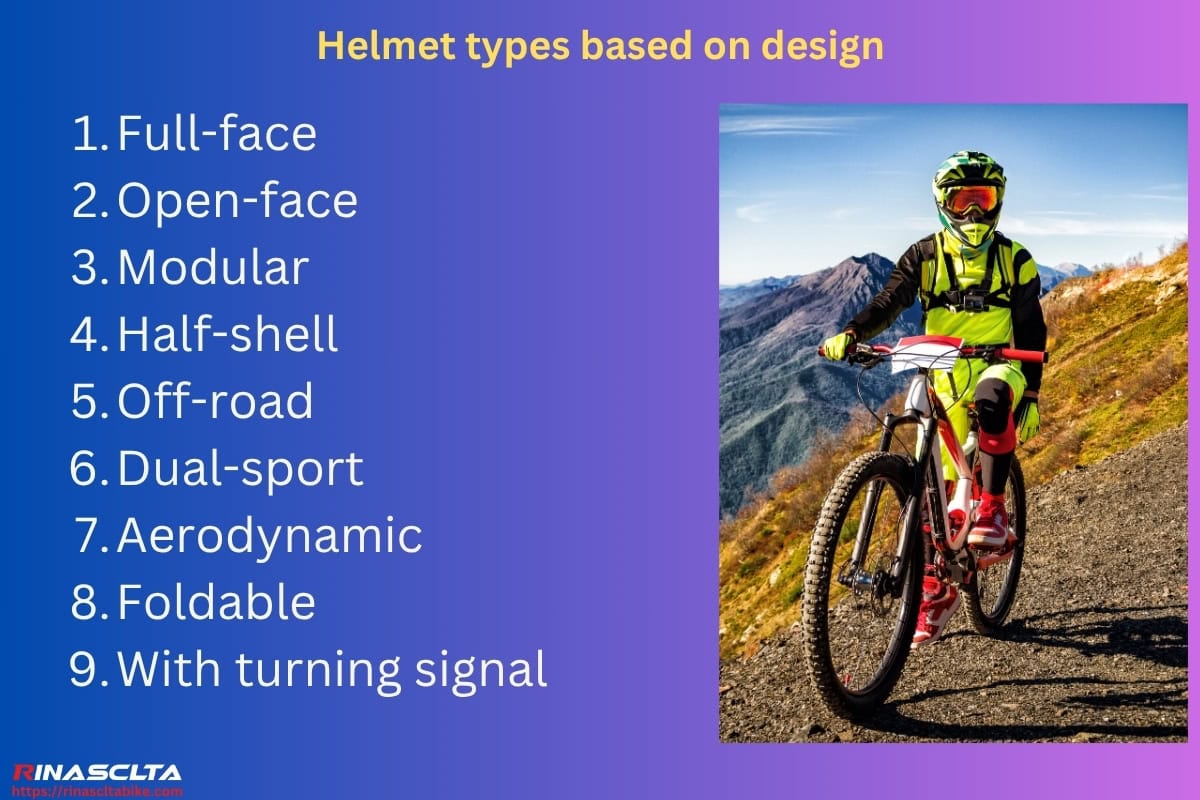
Helmet types based on design include full-face, open-face, modular, half-shell, off-road, dual-sport, aerodynamic, foldable, and helmets with built-in turning signals—this classification is based on the level of protection, riding discipline, functionality, and convenience each design provides, allowing riders to match their helmet to their safety needs and riding conditions.
- Full-face: Offers complete head and chin protection with a fixed chin bar, ideal for downhill, enduro, or BMX riding.
- Open-face: Covers the top, sides, and back of the head but leaves the face exposed, commonly used for road, gravel, and casual commuting.
- Modular: Combines full-face protection with a flip-up chin bar, providing versatility for mixed on/off-road or touring cyclists.
- Half-shell: Covers only the top portion of the head and forehead, typically used in urban or casual cycling, but with limited coverage.
- Off-road: Designed for dirt, trail, or BMX riding with enhanced ventilation, visors, and rugged construction for unpredictable terrain.
- Dual-sport: A hybrid between road and off-road helmets, featuring visors, enhanced airflow, and compatibility with goggles for adventure and gravel riders.
- Aerodynamic: Sleek and smooth in shape, optimized for reduced drag in racing and time trial disciplines, often with minimal venting.
- Foldable: Built with collapsible or segmented structures for compact storage, ideal for urban commuters and space-conscious riders.
- With turning signal: Integrated with LED indicators or smart tech to enhance visibility and safety in traffic, particularly useful for commuters and e-bike users.
Helmet types based on bike types
Helmet types based on bike types include road, time trial, mountain, cross-country, downhill, enduro, gravel, kids, commuting, e-bike, and fitness helmets—this classification is designed to match the helmet’s structure, ventilation, coverage, and safety features to the specific demands of each cycling discipline for optimal performance and protection.
- Road: Lightweight with ample ventilation and aerodynamic shaping, made for speed and long-distance rides on paved roads.
- Time trial: Extremely aerodynamic with minimal vents and teardrop shapes to reduce wind resistance for competitive racing against the clock.
- Mountain: Built with enhanced coverage, visor attachments, and rugged shells to withstand rough trails and impacts.
- Cross-country: Lightweight and well-ventilated with a secure fit, optimized for endurance, climbing, and efficient riding on variable off-road terrain.
- Downhill: Full-face design with reinforced structure for maximum impact protection on steep, technical descents and high-speed runs.
- Enduro: Combines trail comfort and downhill protection, often with a removable chin bar and good ventilation for climbing and aggressive descents.
- Gravel: A hybrid between road and mountain helmets, balancing ventilation, extended coverage, and optional visors for mixed terrain riding.
- Kids: Designed for smaller heads with extra safety padding, fun graphics, and simplified adjustments for young riders.
- Commuting: Comfortable, durable, often with visibility features like reflectors or integrated lights, built for daily use in traffic.
- E-bikes: Certified for higher speed standards (e.g., NTA 8776), offering enhanced impact protection and often added rear coverage.
- Fitness: Versatile and lightweight helmets used for casual exercise rides, urban cycling, or recreational training sessions.
Helmet types based on safety technology
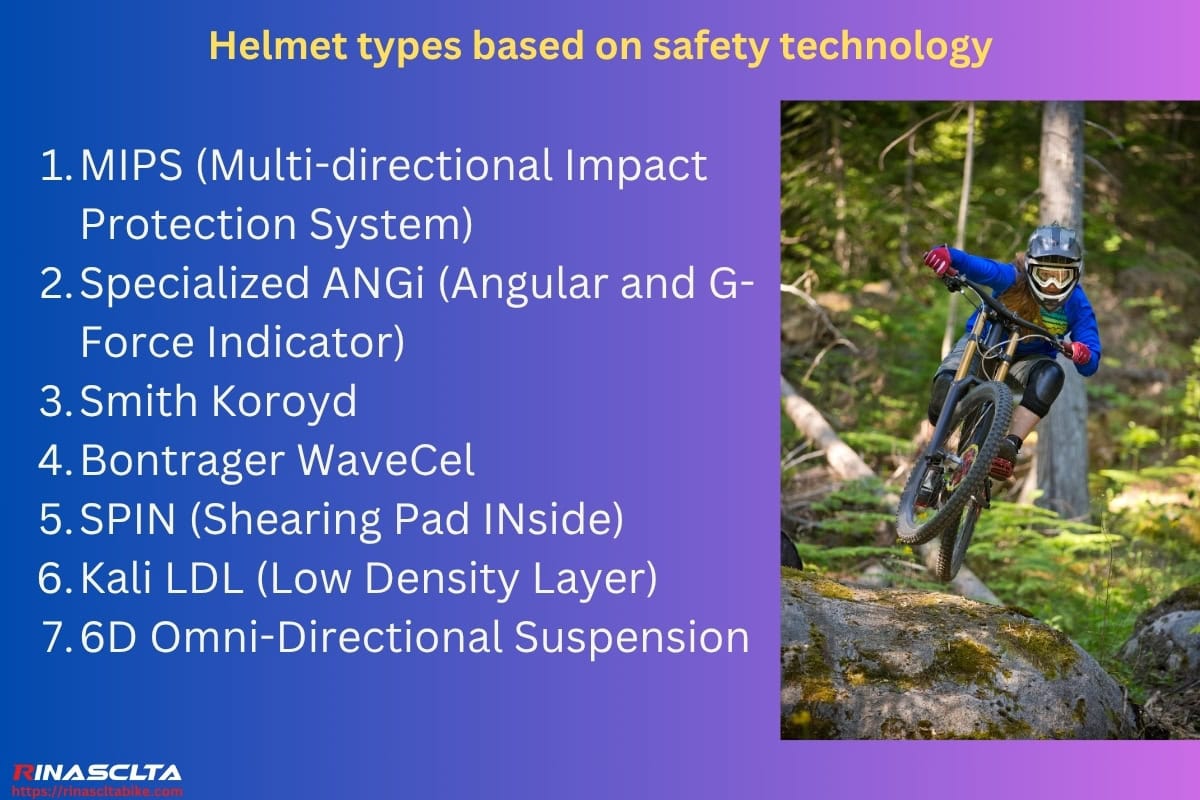
Helmet types based on safety technology include MIPS, Specialized ANGi, Smith Koroyd, Bontrager WaveCel, and other proprietary impact-reduction systems—this classification focuses on how each helmet mitigates different forces during a crash, particularly rotational impacts, offering enhanced brain protection beyond traditional EPS foam.
- MIPS (Multi-directional Impact Protection System): This system uses a low-friction inner layer that allows the helmet to slide slightly upon angled impact, reducing rotational forces to the brain.
- Specialized ANGi (Angular and G-Force Indicator): Integrates a crash sensor that connects to an app and notifies emergency contacts with your location if a crash is detected.
- Smith Koroyd: Replaces traditional foam in some areas with a honeycomb-like polymer tube structure that crumples evenly on impact, absorbing energy more efficiently.
- Bontrager WaveCel: Features a collapsible cellular structure inside the helmet that flexes, crumples, and glides to reduce both linear and rotational forces during a crash.
- SPIN (Shearing Pad INside): Used by POC, this system uses silicone-injected pads that allow for slight movement to reduce rotational forces, similar to MIPS but pad-based.
- Kali LDL (Low Density Layer): Combines soft gel inserts with dual-density foam to reduce both low-speed and rotational impact forces.
- 6D Omni-Directional Suspension: A floating dual-shell system linked by elastomer dampers to absorb both linear and angular energy, primarily used in motocross but adapted for MTB.
How do I know if a helmet is safe?
You can know if a helmet is safe by checking for certifications like CPSC (USA), EN 1078 (Europe), or ASTM standards, along with the presence of advanced safety technologies such as MIPS, WaveCel, or Koroyd. You can also refer to independent safety ratings like the Virginia Tech Helmet Ratings, which test helmets under real-world crash simulations and score them based on impact protection performance—helmets with 5-star ratings from Virginia Tech are considered among the safest.
How does Virginia Tech test its helmets?
Virginia Tech tests its helmets using an independent, scientific protocol that involves 24 controlled impact tests per helmet to simulate real-world crash conditions for cyclists.
Each helmet is evaluated with a drop tower test that replicates helmet-to-ground impact scenarios at six different impact locations and at both medium and high energy levels, using linear acceleration and rotational velocity sensors to calculate concussion risk. These risks are then weighted based on how frequently such impacts occur in real accidents. The combined weighted risks generate an overall STAR (Summation of Tests for the Analysis of Risk) score, where a lower score means better performance. This system, developed under the Bicycle Helmet STAR protocol (2018) by Bland, McNally, and Rowson, ensures an objective, manufacturer-independent rating system specifically tailored to cycling conditions—not directly comparable to other sports.
How do you choose a bicycle helmet?
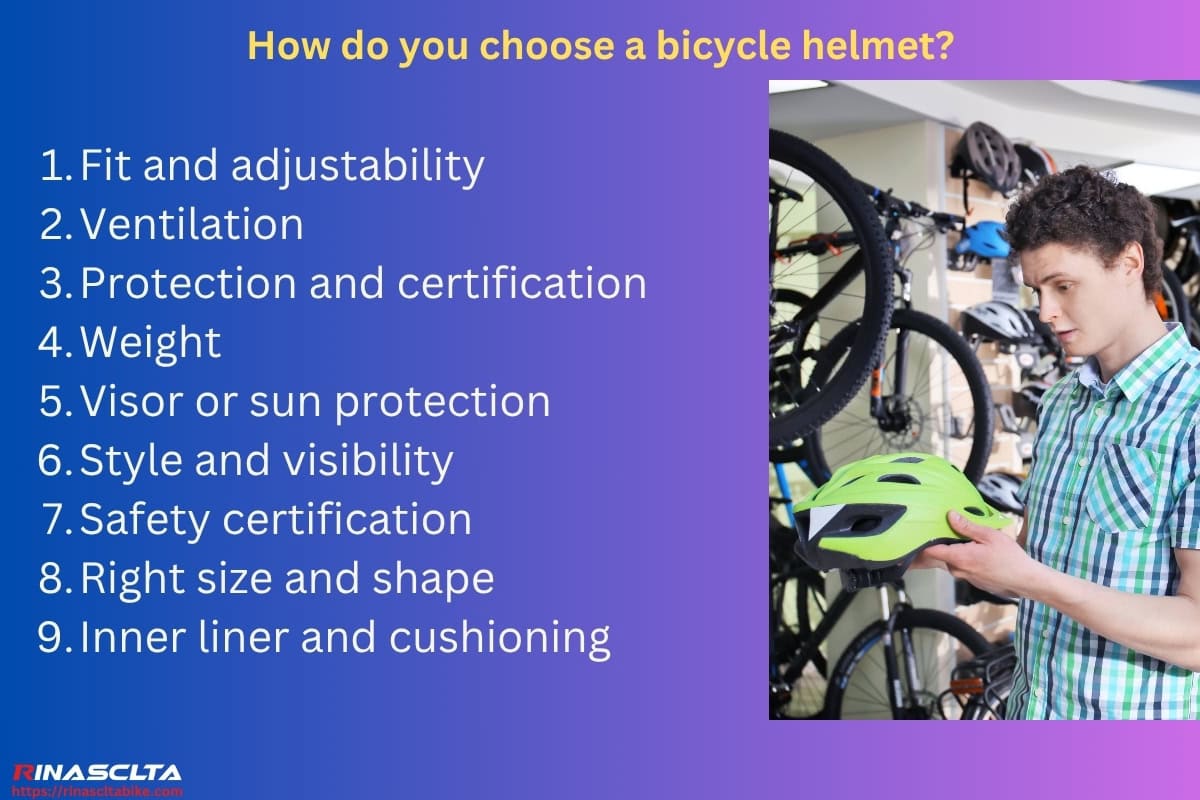
You can choose a bicycle helmet by considering features such as fit and adjustability, ventilation, protection and certification, weight, visor or sun protection, style and visibility, inner liner and cushioning, and the right size and shape—each of which directly impacts safety, comfort, and performance while riding.
- Fit and adjustability: Ensures the helmet stays securely in place with minimal movement using dial systems, straps, and retention cages.
- Ventilation: Provides airflow through vents to keep your head cool during rides, especially in hot weather or long climbs.
- Protection and certification: Confirms the helmet meets safety standards (e.g., CPSC, EN 1078) to offer reliable impact absorption.
- Weight: A lighter helmet reduces neck fatigue on long rides and enhances overall comfort, particularly for road cyclists.
- Visor or sun protection: Shields your eyes from glare, rain, and debris—common in mountain biking and commuting.
- Style and visibility: Bright colors and reflective elements increase your visibility to others, especially in low-light conditions.
- Safety certification: Indicates that the helmet has passed impact tests and meets regulatory standards for crash protection.
- Right size and shape: Matches your head dimensions and shape (round or oval) for a secure and comfortable fit.
- Inner liner and cushioning: Absorbs sweat, improves comfort, and enhances shock absorption in case of a crash.
What is a good bicycle helmet?
A good bicycle helmet is one that offers certified safety protection (such as CPSC, EN 1078, or ASTM), features a secure and adjustable fit, provides effective ventilation, includes modern impact-reduction technology like MIPS or WaveCel, and suits your specific riding style and conditions. It should also have a comfortable inner liner, be lightweight enough for long rides, and offer visibility enhancements like reflective details or bright colors—ensuring both impact performance and rider comfort are maximized for road, mountain, or commuter use.
What is the best bicycle helmet for road bike?
The best bicycle helmet for road biking is one that combines aerodynamic design, certified safety standards (like CPSC or EN 1078), lightweight construction, and high ventilation with modern safety technologies such as MIPS or WaveCel. It should also offer a snug and adjustable fit, a moisture-wicking liner, and possibly eyewear integration or a sleek profile to reduce drag—making it ideal for speed-focused performance on paved roads over long distances.
What is the best bicycle helmet for mountain bike?
The best bicycle helmet for mountain biking is a trail-rated or enduro-style helmet that offers extended rear and side coverage, safety certifications (such as CPSC, ASTM F1952, or EN 1078), and advanced impact protection technologies like MIPS, Koroyd, or WaveCel. It should include features like a secure fit system, adjustable visor, strong ventilation, and compatibility with goggles or action cameras—ensuring maximum protection and comfort on technical trails, steep descents, and rough terrain.
What is the best bicycle helmet for gravel bike?
The best bicycle helmet for gravel biking is a lightweight, well-ventilated helmet that combines the aerodynamic efficiency of a road helmet with the extended coverage and rugged protection of a trail helmet. It should meet safety certifications like CPSC or EN 1078, feature impact-reduction technologies such as MIPS or WaveCel, and offer comfort-focused elements like a moisture-wicking liner, adjustable fit system, and visor compatibility—ideal for mixed-terrain endurance rides where both speed and off-road safety matter.
What is the best bicycle helmet for city bike?
The best bicycle helmet for a city bike is a commuter-style helmet that emphasizes safety, comfort, and visibility in urban environments. It should have CPSC or EN 1078 certification, include features like integrated lights or reflective elements, a secure and adjustable fit system, and urban-friendly styling; additional benefits may include MIPS for rotational impact protection, ventilation suited for low-speed riding, and weather-resistant finishes—making it ideal for daily commutes, stop-and-go traffic, and variable weather conditions.
What is the best bicycle helmet for kid bike?
The best bicycle helmet for a kid bike is a youth-specific helmet that meets safety standards (like CPSC or EN 1078), fits securely with an adjustable retention system, and offers full head coverage with child-friendly comfort features. It should include soft padding, ample ventilation, and playful yet visible designs, and may also incorporate MIPS technology for added protection—ensuring both impact safety and daily usability for young riders whether they’re on balance bikes, training wheels, or junior MTBs.
How much does a bicycle helmet weigh?
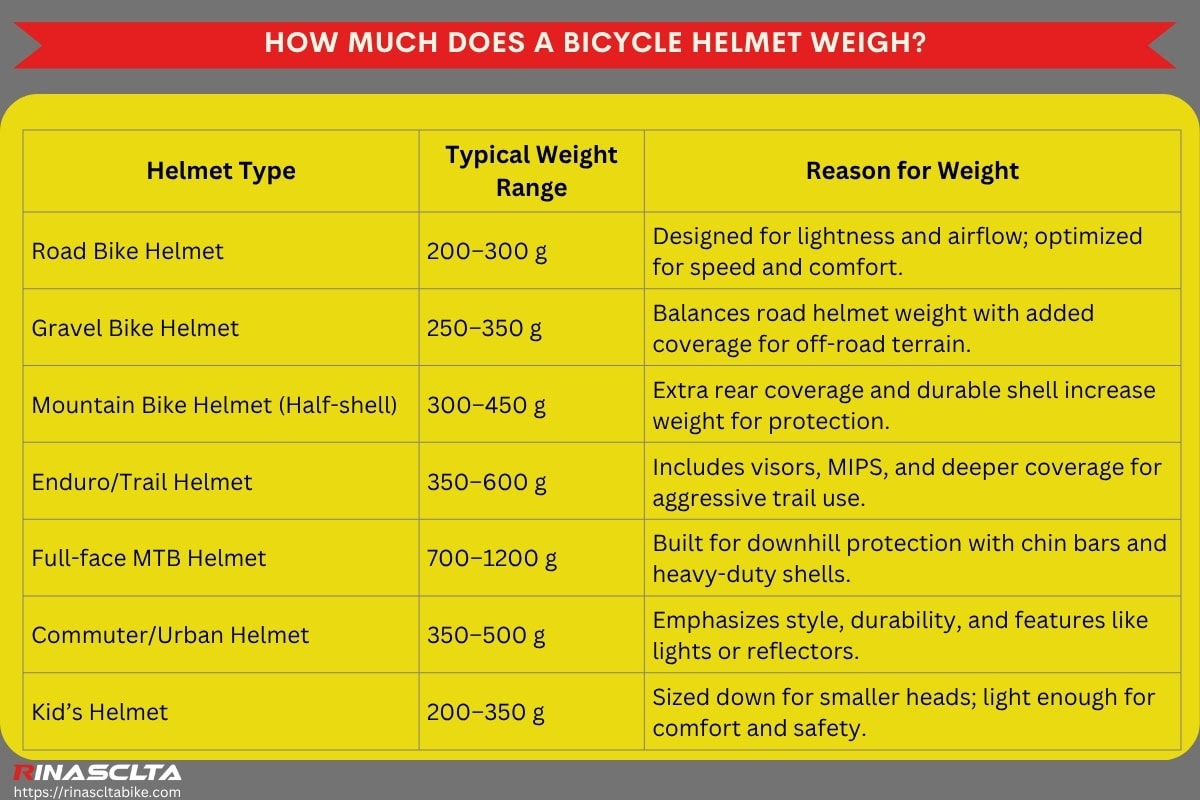
A bicycle helmet typically weighs between 200 grams and 1200 grams depending on its type, purpose, and construction materials. Lightweight road helmets focus on aerodynamics and ventilation, while mountain and full-face helmets prioritize impact protection and coverage, resulting in higher weights.
| Helmet Type | Typical Weight Range | Reason for Weight |
| Road Bike Helmet | 200–300 g | Designed for lightness and airflow; optimized for speed and comfort. |
| Gravel Bike Helmet | 250–350 g | Balances road helmet weight with added coverage for off-road terrain. |
| Mountain Bike Helmet (Half-shell) | 300–450 g | Extra rear coverage and durable shell increase weight for protection. |
| Enduro/Trail Helmet | 350–600 g | Includes visors, MIPS, and deeper coverage for aggressive trail use. |
| Full-face MTB Helmet | 700–1200 g | Built for downhill protection with chin bars and heavy-duty shells. |
| Commuter/Urban Helmet | 350–500 g | Emphasizes style, durability, and features like lights or reflectors. |
| Kid’s Helmet | 200–350 g | Sized down for smaller heads; light enough for comfort and safety. |
What is the safest road bike helmet?
The safest road bike helmet is one that combines high safety ratings—such as a 5-star Virginia Tech Helmet Rating—with advanced impact protection technologies like MIPS, WaveCel, or Koroyd, while also meeting CPSC and EN 1078 certifications. The Bontrager XXX WaveCel, for example, is often cited as one of the safest due to its collapsible cellular structure that absorbs both linear and rotational forces, earning top scores in independent crash tests—making it ideal for high-speed road cycling where head protection and crash dynamics matter most.
Is a lighter road bike helmet better?
Yes, a lighter road bike helmet is better when weight savings, ventilation, and long-distance comfort are priorities—especially for racing and endurance rides—but it may compromise slightly on coverage or durability compared to heavier, more robust models. Lightweight helmets (often around 200–250 g) reduce neck fatigue and improve aerodynamics, yet may include fewer impact-absorbing materials or features like reinforced shells unless designed with advanced materials such as carbon fiber or polycarbonate blends.
How do you fit a bicycle helmet?
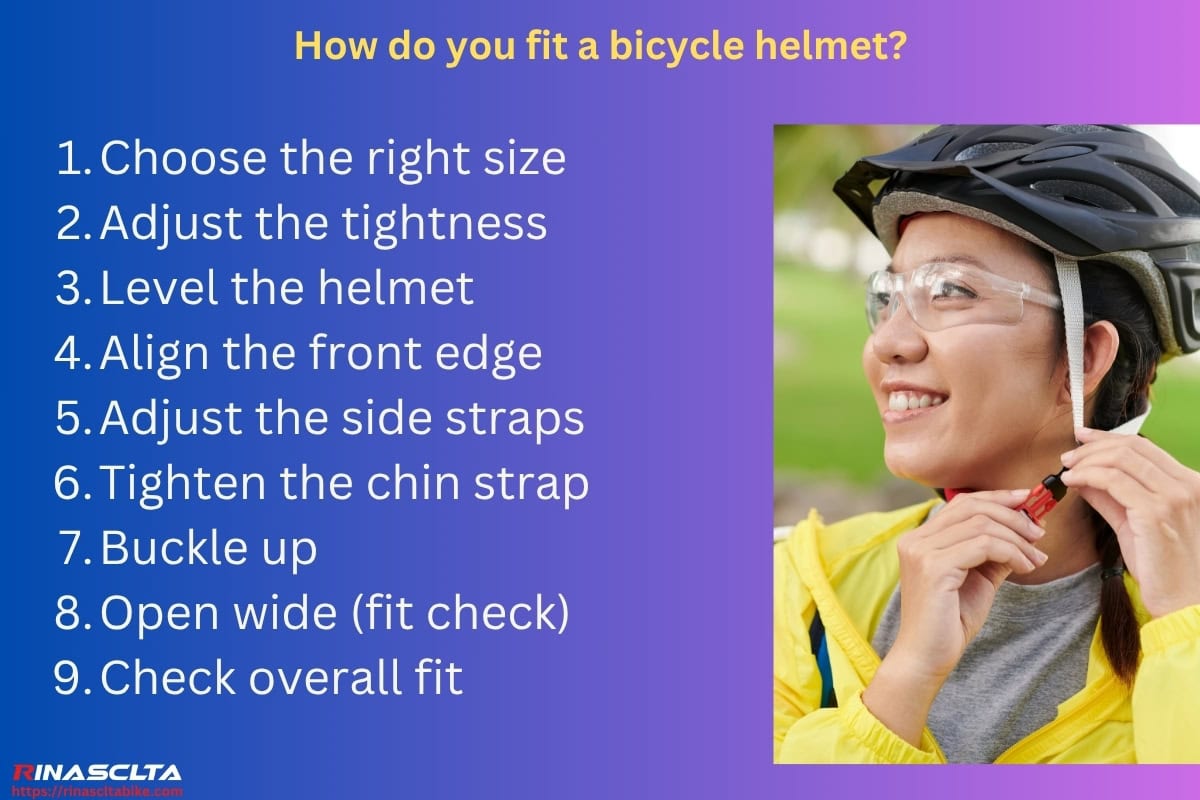
You can fit a bicycle helmet by choosing the right size, adjusting the fit system (tightness), leveling the helmet, aligning the front edge, adjusting the side straps, tightening the chin strap, buckling up, and checking overall snugness and comfort.
- Choose the right size: Measure your head circumference (typically in cm) and select a helmet that fits within that size range for proper coverage and safety.
- Adjust the tightness: Use the rear dial or fit system to snugly tighten the helmet around your head without causing pressure points.
- Level the helmet: Position the helmet so it sits level on your head, with the front edge about 1–2 fingers (around 1 inch) above your eyebrows to protect the forehead.
- Align the front edge: Make sure the front doesn’t tilt too far back or forward—protecting the forehead is crucial in a crash.
- Adjust the side straps: Form a “Y” shape just below your ears by sliding the side buckles to sit evenly on each side.
- Tighten the chin strap: Buckle it and tighten until only one or two fingers fit between the strap and your chin, ensuring it’s snug but comfortable.
- Buckle up: Secure the chin strap and make sure it stays fastened even with jaw movement or head turning.
- Open wide (fit check): Open your mouth wide—if the helmet pulls down slightly, it’s snug enough; if not, tighten the straps more.
- Check overall fit: Shake your head; the helmet should stay stable and not rock side to side or front to back—indicating a secure fit.
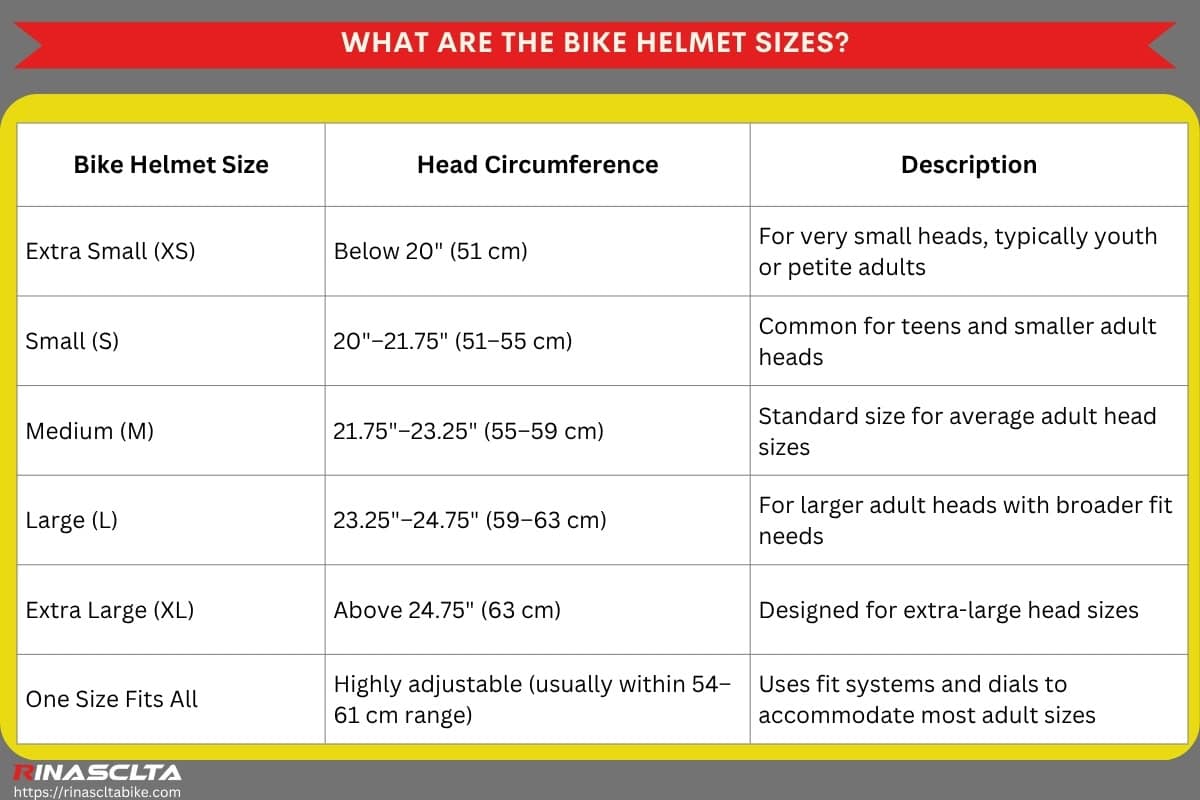
What are the bike helmet sizes?
Bike helmet sizes typically include Extra Small, Small, Medium, Large, Extra Large, and One Size Fits All, based on the head circumference in inches or centimeters. These sizes exist to accommodate the natural variation in adult and child head shapes and sizes, ensuring both comfort and safety. An accurate fit is essential for proper impact protection, stability, and retention, especially during crashes or high-speed rides.
| Bike Helmet Size | Head Circumference | Description |
| Extra Small (XS) | Below 20″ (51 cm) | For very small heads, typically youth or petite adults |
| Small (S) | 20″–21.75″ (51–55 cm) | Common for teens and smaller adult heads |
| Medium (M) | 21.75″–23.25″ (55–59 cm) | Standard size for average adult head sizes |
| Large (L) | 23.25″–24.75″ (59–63 cm) | For larger adult heads with broader fit needs |
| Extra Large (XL) | Above 24.75″ (63 cm) | Designed for extra-large head sizes |
| One Size Fits All | Highly adjustable (usually within a 54–61 cm range) | Uses fit systems and dials to accommodate most adult sizes |
How do you measure bicycle helmet size?
You can measure bicycle helmet size using a flexible measuring tape to find the circumference of your head, then match that measurement to the helmet size chart provided by the manufacturer.
- Wrap a flexible tape around your head: Place the tape about 1 inch (2.5 cm) above your eyebrows and ears, going around the widest part of your head—this ensures forehead protection and a snug fit.
- Note the measurement in centimeters: Helmet sizes are typically listed in centimeters (e.g., 54–58 cm), so record your exact head circumference for accuracy.
- Compare with sizing charts: Check the brand’s sizing chart, as small, medium, and large can vary between manufacturers, and match your measurement to the corresponding size.
- Try the helmet on if possible: Fit can vary by helmet shape, so trying it on ensures the shell shape fits your head type (round vs. oval).
- Adjust the fit system: Even within the size range, use the retention system (dial or straps) to fine-tune the helmet to your head.
How do you measure head for a bicycle helmet?
You can measure your head for a bicycle helmet by using a soft measuring tape to wrap around the widest part of your head—typically 1 inch (2.5 cm) above your eyebrows and ears—recording the circumference in centimeters to match with helmet sizing charts. A tailor’s measuring tape works best, but you can also use a string and ruler; most adult helmet sizes range from 51–65 cm, and getting an accurate measurement ensures both comfort and safety in the event of impact.
How tight should a bicycle helmet be?
A bicycle helmet should be snug enough that it does not move more than 1–2 cm in any direction when you shake your head, but not so tight that it causes pressure points, headaches, or restricts blood flow. This balance ensures proper cervical spine alignment, concussion prevention, and effective impact absorption without discomfort—too loose compromises protection, while too tight can lead to temporal pressure and even mild vascular compression.
How do you adjust a bicycle helmet?
You can adjust a bicycle helmet by leveling it on your head, tightening the fit system (usually a dial at the back), positioning the side straps into a “Y” shape just below the ears, and securing the chin strap snugly under your chin—ensuring the helmet stays stable and comfortable without restricting movement. This involves fine-tuning parts like the retention system, chin buckle, webbing sliders, and internal padding to maintain optimal fit, protection, and airflow.
How do you tell if a bicycle helmet fits?
You can tell if a bicycle helmet fits by ensuring it sits level on your head, covers the forehead about 1 inch (2.5 cm) above the eyebrows, doesn’t move more than 1–2 cm when you shake your head and feels snug without causing pressure or pain. A properly fitting helmet will pass the “two-finger test” (between the helmet and your eyebrows, and under the chin strap), with side straps forming a clear “Y” shape just below each ear, ensuring both comfort and effective impact protection.
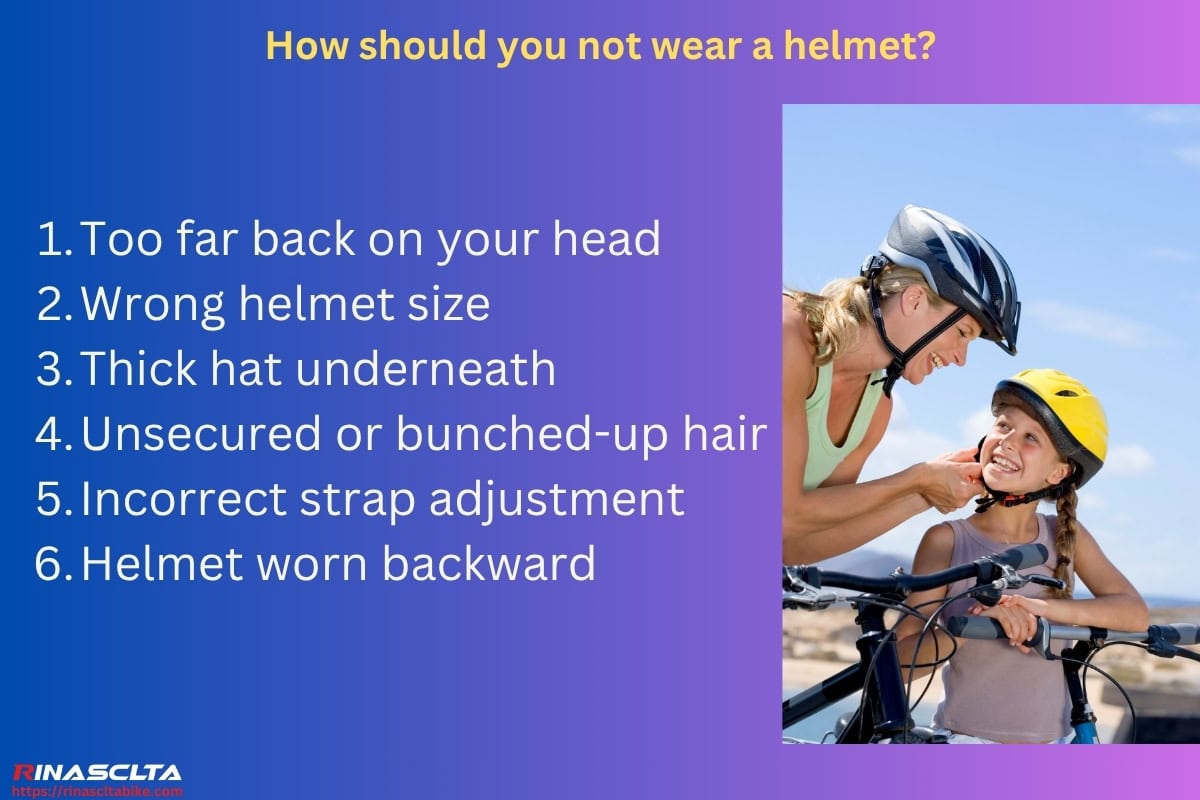
How should you not wear a helmet?
You should not wear a helmet incorrectly because improper positioning, poor fit, or incorrect strap adjustment can significantly reduce its protective performance during a crash, increase the risk of head injury, and void safety certifications. Proper helmet use ensures that energy is dispersed across impact zones, and correct alignment protects vital areas like the frontal lobe, occipital bone, and temporal region.
- Too far back on your head: Wearing the helmet tilted back exposes your forehead and increases the risk of frontal injury in a fall.
- Wrong helmet size: An oversized or undersized helmet can shift during impact and fail to protect your skull properly.
- Thick hat underneath: Adding bulky layers beneath the helmet compromises fit and prevents the retention system from working as designed.
- Unsecured or bunched-up hair: Loose hair or ponytails can affect how the helmet sits, causing poor alignment and discomfort.
- Incorrect strap adjustment: Loose or uneven straps won’t hold the helmet in place during sudden movements or crashes.
- Helmet worn backward: Wearing it back to front misaligns safety zones, disrupts the aerodynamic shape, and eliminates the visor or back coverage functions.
How do you clean a bicycle helmet?
You can clean a bicycle helmet by removing the inner pads and straps, washing them separately with mild soap, wiping the helmet shell with a soft cloth and soapy water, rinsing all parts thoroughly, air-drying everything completely, and reassembling carefully—these steps ensure hygiene, material longevity, and consistent safety performance. This helps eliminate bacteria, sweat buildup, and grime without damaging the helmet’s structure or coatings.
- Remove pads and straps: You can detach the inner padding and chin straps to clean sweat, dirt, and bacteria from high-contact areas.
- Wash pads separately: You can soak the pads in warm water with a mild detergent (like baby shampoo) to preserve the foam integrity and remove odors.
- Wipe shell with soft cloth and soapy water: You can gently clean the EPS or polycarbonate shell using a microfiber cloth and diluted soap to avoid scratches and protect the outer coating.
- Avoid harsh chemicals: You should never use solvents or bleach, as they can degrade foam and plastic, reducing the helmet’s structural integrity.
- Rinse thoroughly with clean water: You can rinse all components with lukewarm water to remove soap residue that might cause skin irritation or odor buildup.
- Air-dry completely out of direct sunlight: You can lay the helmet and pads on a towel in a shaded, well-ventilated area to dry naturally—UV rays and heat can warp the materials.
- Reassemble carefully: You can reinstall the pads and straps once dry, ensuring proper fit and functionality of the retention system and cushioning.
Does MIPS affect helmet sizing?
No, MIPS does not significantly affect helmet sizing because it is a low-friction liner integrated inside the helmet that moves independently to reduce rotational forces, but it may create a slightly snugger fit depending on brand and model. While most manufacturers design MIPS-equipped helmets to match standard sizing charts, riders with borderline measurements or a preference for looser fits might notice a slight difference in internal volume and should try on both MIPS and non-MIPS versions to ensure comfort and secure fit.
Can I have a ponytail or wear a hat with a helmet?
Yes, you can wear a ponytail or a hat with a helmet if the helmet is designed with a ponytail port or accommodates thin, snug-fitting headwear like a cycling cap—but it must not interfere with the helmet’s fit, retention system, or safety certification. A bulky hat or improperly positioned hair can prevent the helmet from sitting level on your head or compromise strap tension and the function of technologies like MIPS, which rely on close contact with your scalp to reduce rotational forces.
Are bicycle helmets effective?
Yes, bicycle helmets are effective because they reduce the risk of head injury by up to 85%, absorbing and dispersing impact forces through materials like EPS foam and safety tech like MIPS, significantly lowering the chance of skull fractures and concussions during crashes.
Are bicycle helmets important?
Yes, bicycle helmets are important because they provide critical protection in the event of falls or collisions, safeguarding the brain from traumatic injury, and are especially essential in high-speed or urban riding environments with greater accident exposure.
Is a bicycle helmet harder than a skull?
Yes, a bicycle helmet is harder than a skull because its outer polycarbonate shell is engineered to resist penetration and distribute impact forces, while the inner foam compresses to reduce g-force transmission, protecting the softer, more fragile human skull and brain tissue.
Is it illegal to ride a bicycle without a helmet?
Yes, in some places it is illegal to ride without a helmet because a state or national traffic laws mandate helmet use for children, teens, or all ages, especially in Australia, parts of the U.S., and New Zealand, where helmet compliance is enforced for safety.
Do you have to wear a helmet on a bicycle?
Yes, you have to wear a helmet if you’re in a region or jurisdiction where it is legally required, or participating in races, events, or group rides that mandate it, but in many countries, helmet use is strongly recommended but not mandatory for adults.
Who is required to wear a bicycle helmet?
In many countries, children and teenagers are required to wear a bicycle helmet by law, while adult requirements vary by region. For example:
- In the United States, riders under 18 are required to wear helmets in many states (e.g., California, New York), enforced under state traffic safety laws.
- In Australia and New Zealand, helmet use is mandatory for all ages on public roads, based on national road safety regulations.
- In the UK and most of Europe, helmets are not legally required, but strongly recommended for children and sports riders, guided by standards like EN 1078.
- In Canada, helmet laws differ by province, often requiring riders under 18 or 16 to wear certified helmets (e.g., CSA, CPSC).
Compliance is based on local helmet laws, age, location (road vs trail), and event participation, and failure to follow can lead to fines or denied event entry.
Is wearing a bicycle helmet the law?
Yes, wearing a bicycle helmet is the law in many places because governments aim to reduce injury-related healthcare costs and fatalities; laws vary by age group and location, such as California (under 18) or Finland (recommended for all).
Can I ride a bicycle without a helmet?
Yes, you can ride a bicycle without a helmet if your local laws don’t require it for your age or riding type, but it’s strongly discouraged due to the high risk of head trauma in any crash, even at low speeds.
Are Bike Helmets Suitable for All Ages?
Yes, bike helmets are suitable for all ages because they are made in a variety of sizes, shapes, and styles—including toddler, youth, adult, and senior-specific designs—with adjustable fit systems and safety standards like CPSC, EN1078, or ASTM for proper protection at every life stage.
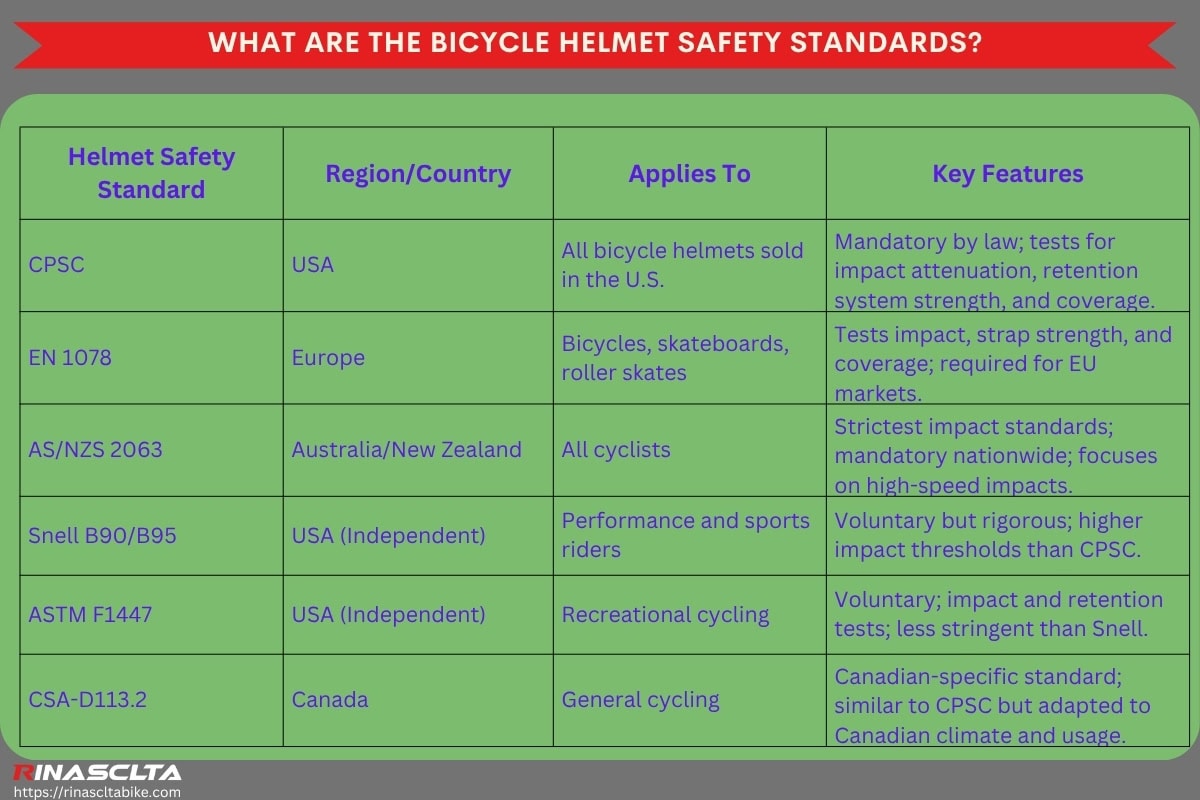
What are the bicycle helmet safety standards?
Bicycle helmet safety standards include CPSC (USA), EN 1078 (Europe), AS/NZS 2063 (Australia/New Zealand), Snell B90/B95 (USA), ASTM F1447 (USA), and CSA-D113.2 (Canada)—these standards exist to ensure helmets meet specific criteria for impact protection, strap strength, retention, and coverage based on regional regulations and riding conditions.
They are critical because they determine how much force a helmet can absorb, how well it stays on during impact, and what testing protocols are used to simulate real-world crashes, helping riders select gear that genuinely protects them.
| Helmet Safety Standard | Region/Country | Applies To | Key Features |
| CPSC | USA | All bicycle helmets sold in the U.S. | Mandatory by law; tests for impact attenuation, retention system strength, and coverage. |
| EN 1078 | Europe | Bicycles, skateboards, roller skates | Tests impact, strap strength, and coverage; required for EU markets. |
| AS/NZS 2063 | Australia/New Zealand | All cyclists | Strictest impact standards; mandatory nationwide; focuses on high-speed impacts. |
| Snell B90/B95 | USA (Independent) | Performance and sports riders | Voluntary but rigorous; higher impact thresholds than CPSC. |
| ASTM F1447 | USA (Independent) | Recreational cycling | Voluntary; impact and retention tests; less stringent than Snell. |
| CSA-D113.2 | Canada | General cycling | Canadian-specific standard; similar to CPSC but adapted to Canadian climate and usage. |
Do bicycle helmets prevent head injury?
Yes, bicycle helmets prevent head injury because they are designed to absorb impact forces during crashes, reducing the risk of skull fractures and brain trauma by 45–85% depending on the crash severity, rider speed, and helmet fit.
How much is a bicycle helmet?
A bicycle helmet typically costs between USD 30–300 / EUR 25–270 / GBP 20–250, depending on the helmet’s design, safety features, intended use, and brand reputation. Entry-level commuter or kids’ helmets start around USD 30, while mid-range models with improved ventilation and comfort range from USD 60–120, and high-performance road, MTB, or MIPS-equipped helmets can reach USD 200–300+ due to advanced materials, aerodynamic design, and crash-tested safety technologies.
Are bicycle helmets DOT approved?
No, bicycle helmets are not DOT approved because DOT (Department of Transportation) certification applies only to motorcycle helmets, which must meet higher impact and penetration standards than those required for bicycles.
Can you wear a motorcycle helmet on a bicycle?
Yes, you can wear a motorcycle helmet on a bicycle if you want extra protection, but it is not recommended because motorcycle helmets are significantly heavier, less ventilated, and can cause neck fatigue and reduced peripheral vision during pedaling.
Can I use a bicycle helmet for skiing?
No, you should not use a bicycle helmet for skiing because ski helmets must meet ASTM F2040 or EN 1077 standards to protect against cold, hard snow and high-speed falls, whereas bike helmets are tested for different impact angles and temperatures.
Can I Use a BMX Helmet for Mountain Biking?
Yes, you can use a BMX helmet for mountain biking if it meets appropriate standards, but it is ideal to use a mountain bike-specific helmet with better ventilation, coverage, and MIPS or similar rotational impact protection systems for trail safety.
Do bicycle helmets expire?
Yes, bicycle helmets expire because materials like EPS foam and plastic degrade over time due to UV exposure, sweat, and wear—manufacturers generally recommend replacing helmets every 5 years, or immediately after a crash or visible damage.
How long do bicycle helmets last?
Bicycle helmets typically last between 3 to 5 years, depending on usage, exposure to sunlight, sweat, moisture, and accidental impacts. Bicycle helmet lifespan is primarily determined by the degradation of EPS foam (expanded polystyrene) and outer shell materials, which lose their protective integrity over time due to UV radiation, thermal cycling, and general wear—even if the helmet hasn’t been involved in a crash. Most manufacturers, including Giro, Bell, and Specialized, and safety organizations like the Snell Foundation, recommend replacement every 5 years, or immediately after a significant impact, even if there is no visible damage.
How long are bicycle helmets good for?
Bicycle helmets are generally good for 3 to 5 years, as the EPS foam liner and polycarbonate shell degrade over time due to UV exposure, sweat, heat, and material fatigue. Even without visible damage, aging reduces impact absorption performance, which is why safety organizations and most manufacturers recommend replacing your helmet every 5 years, or immediately after a crash.
How often should I replace my bicycle helmet?
You should replace your bicycle helmet every 3 to 5 years, even if it hasn’t been involved in a crash, because exposure to sunlight (UV rays), sweat, heat, and general wear degrade the EPS foam and polycarbonate shell over time. This degradation reduces the helmet’s ability to absorb impact and meet current safety standards—especially if used frequently, stored improperly, or subjected to harsh weather.
Bike helmet brands and manufacturers
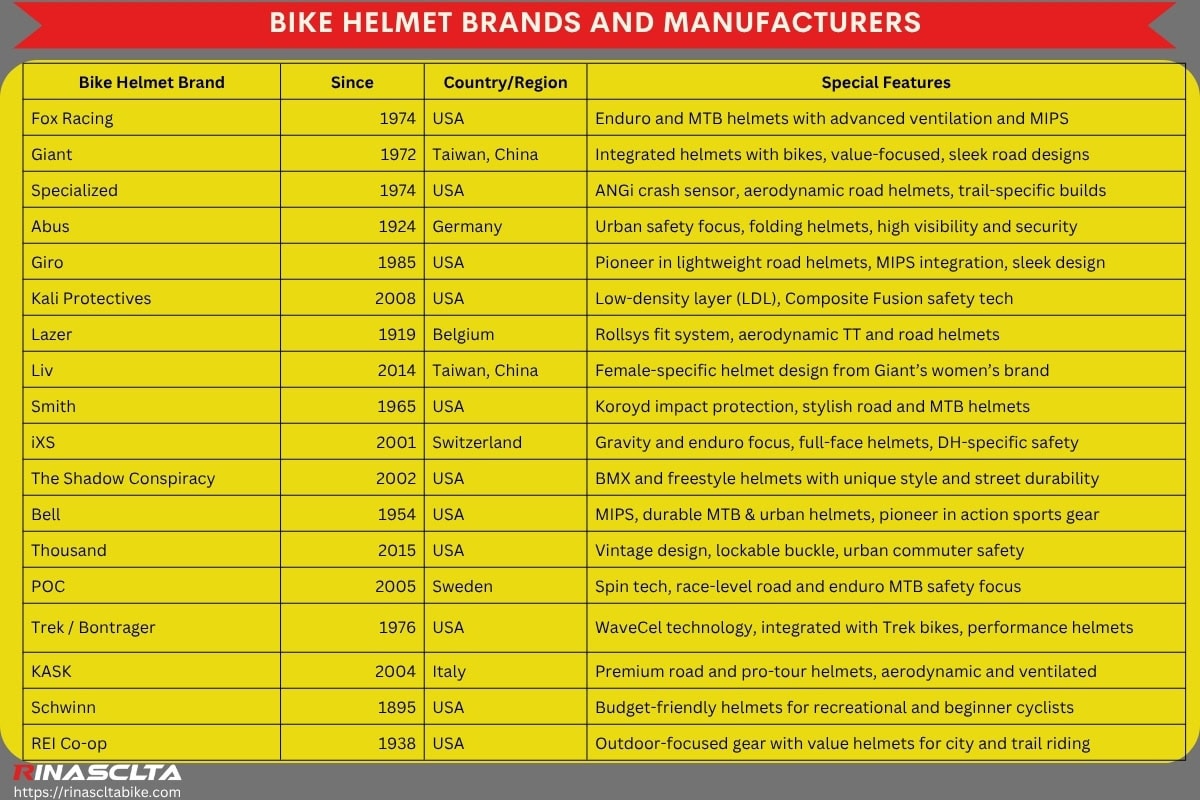
Bike helmet brands and manufacturers play a crucial role in rider safety, innovation, and comfort. Over the decades, companies from the U.S., Europe, and Asia have developed proprietary technologies like MIPS, Koroyd, WaveCel, and aerodynamic shaping to meet evolving road, mountain, urban, and commuter cycling demands. Each brand brings a unique focus—some prioritize style and urban utility, while others lead in race-grade performance, ventilation, and impact protection. Knowing their origin, specialties, and design philosophy can help riders make better purchasing decisions aligned with their cycling discipline and safety needs.
| Bike Helmet Brand | Since | Country/Region | Special Features |
| Fox Racing | 1974 | USA | Enduro and MTB helmets with advanced ventilation and MIPS |
| Giant | 1972 | Taiwan, China | Integrated helmets with bikes, value-focused, sleek road designs |
| Specialized | 1974 | USA | ANGi crash sensor, aerodynamic road helmets, trail-specific builds |
| Abus | 1924 | Germany | Urban safety focus, folding helmets, high visibility and security |
| Giro | 1985 | USA | Pioneer in lightweight road helmets, MIPS integration, sleek design |
| Kali Protectives | 2008 | USA | Low-density layer (LDL), Composite Fusion safety tech |
| Lazer | 1919 | Belgium | Rollsys fit system, aerodynamic TT and road helmets |
| Liv | 2014 | Taiwan, China | Female-specific helmet design from Giant’s women’s brand |
| Smith | 1965 | USA | Koroyd impact protection, stylish road and MTB helmets |
| iXS | 2001 | Switzerland | Gravity and enduro focus, full-face helmets, DH-specific safety |
| The Shadow Conspiracy | 2002 | USA | BMX and freestyle helmets with unique style and street durability |
| Bell | 1954 | USA | MIPS, durable MTB & urban helmets, pioneer in action sports gear |
| Thousand | 2015 | USA | Vintage design, lockable buckle, urban commuter safety |
| POC | 2005 | Sweden | Spin tech, race-level road and enduro MTB safety focus |
| Trek / Bontrager | 1976 | USA | WaveCel technology, integrated with Trek bikes, performance helmets |
| KASK | 2004 | Italy | Premium road and pro-tour helmets, aerodynamic and ventilated |
| Schwinn | 1895 | USA | Budget-friendly helmets for recreational and beginner cyclists |
| REI Co-op | 1938 | USA | Outdoor-focused gear with value helmets for city and trail riding |