


Why Quality Control Matters in Carbon Bike Frameset Manufacturing?
Quality control matters in carbon bike frameset manufacturing because carbon fiber structures are highly dependent on fiber orientation, resin distribution, compaction pressure, curing temperature, bonding accuracy, and layup consistency, meaning even small production defects can significantly affect frame strength, stiffness, fatigue life, impact resistance, and rider safety. Unlike metal frames that often show visible deformation before failure, carbon frames can develop internal problems such as voids, delamination, dry spots, resin-rich areas, fiber wrinkles, poor bonding, or hidden impact damage, making systematic inspection and testing essential throughout the manufacturing process. Since the large-scale adoption of carbon bicycle frames in the 1990s and early 2000s, factories have moved from simple visual checks and destructive sample testing toward advanced quality systems involving ultrasonic inspection, X-ray analysis, coordinate measuring systems, fatigue simulation rigs, impact testing, and ISO 4210 certification, especially as global OEM and ODM production expanded across China(mainland and Taiwan), Vietnam, and Southeast Asia.
For manufacturers, strong quality control directly reduces warranty claims, product recalls, repair costs, rejected batches, shipping losses, and brand reputation damage, while helping maintain consistency across mass production and custom projects. For B2B clients such as bicycle brands, distributors, and private-label buyers, quality assurance provides confidence that the framesets meet required safety standards, dimensional tolerances, road testing performance, and long-term durability expectations before reaching consumers. Modern factories now combine incoming material inspection, in-process QC checkpoints, post-curing inspection, laboratory testing, and real-world road or fatigue testing to verify frame reliability under conditions such as sprinting loads, pothole impacts, braking forces, torsional stress, and repetitive vibration cycles, because failures in the field can lead not only to financial loss but also to serious legal liability and loss of consumer trust in the brand.
The Carbon Frameset Quality Control Workflow
The carbon frameset quality control workflow typically includes raw material inspection, layup verification, molding inspection, alignment inspection, surface inspection, and final assembly inspection, because carbon bicycle manufacturing depends on precise control of fiber orientation, resin content, molding pressure, curing consistency, dimensional accuracy, and structural integrity throughout the entire production process. Unlike metal frame manufacturing, carbon composite production is highly process-sensitive, meaning defects introduced during early stages such as prepreg storage, ply cutting, or mold compaction can remain hidden until the frame experiences fatigue, impact, or road stress during real-world riding, making a multi-stage QC workflow essential for ensuring safety, consistency, and compliance with standards such as ISO 4210, EN standards, and CPSC regulations.
| QC Workflow Step | Main Focus | Key Features | Common Tools / Methods | Requirements & Standards |
| Raw material inspection | Carbon prepreg quality and storage condition | Verifies fiber type, resin content, storage temperature, expiration date, moisture control | Resin content testing, freezer storage monitoring, material certificates | Material traceability, supplier QC, prepreg handling protocols |
| Layup verification | Fiber orientation and ply sequence accuracy | Ensures correct carbon layup schedule, overlap, and reinforcement placement | Layup templates, ply books, laser guides, operator checklists | Design compliance, structural consistency, engineering specifications |
| Molding inspection | Compaction, curing, and mold integrity | Checks pressure distribution, bladder inflation, curing consistency, and void prevention | Autoclave monitoring, pressure sensors, temperature logs, mold inspection | Controlled curing cycle, void minimization, process repeatability |
| Alignment inspection | Frame geometry and dimensional tolerance | Confirms frame straightness, dropout alignment, BB alignment, and symmetry | Alignment jigs, CMM measurement, laser alignment systems | Geometry tolerance, assembly compatibility, ISO dimensional requirements |
| Surface inspection | Cosmetic quality and visible defect detection | Identifies scratches, pinholes, resin-rich areas, cracks, paint defects, and sanding issues | Visual inspection, light inspection, ultrasonic testing | Cosmetic standards, defect classification, paint quality standards |
| Final assembly inspection | Functional compatibility and safety verification | Verifies hardware fit, torque specs, threading, bonding quality, and assembly interfaces | Torque tools, gauge tools, threading inspection, fit testing | ISO 4210, assembly tolerances, safety and performance requirements |
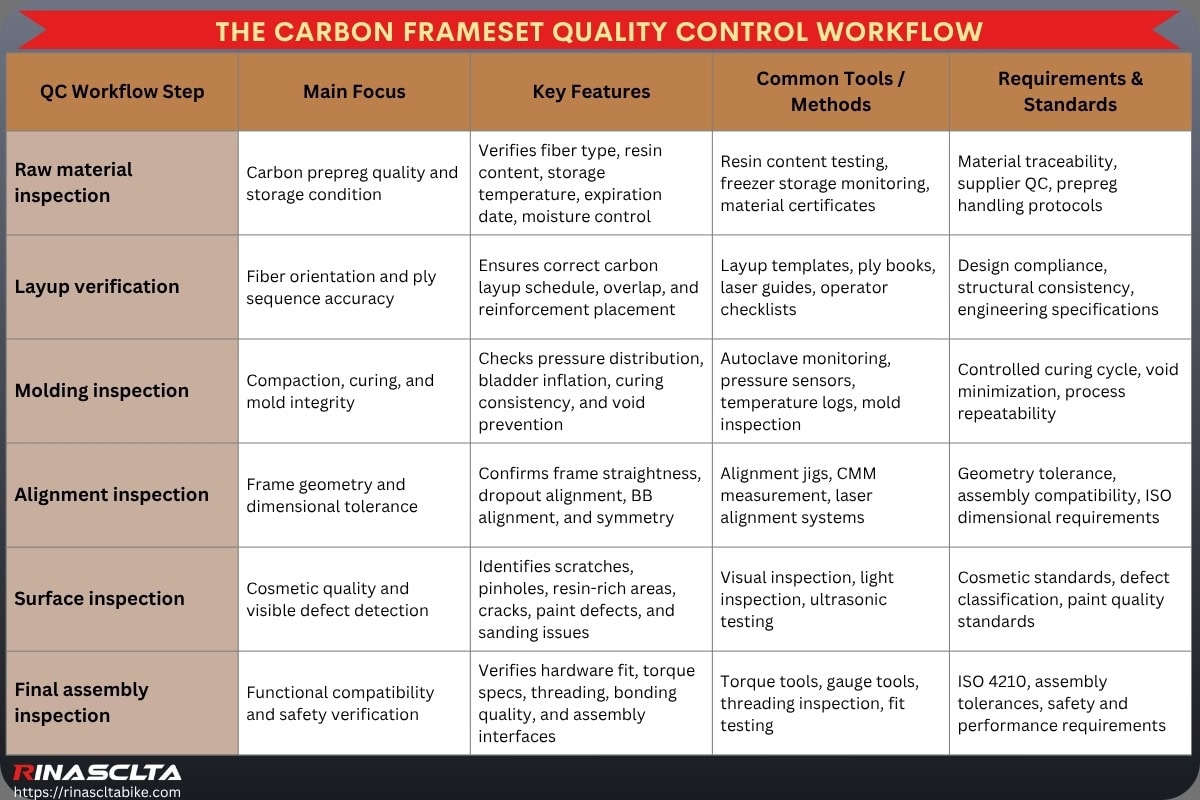

Together, these quality control stages form a complete manufacturing verification system that helps factories minimize structural defects, production inconsistency, warranty risks, and customer complaints, while ensuring that carbon framesets meet both engineering performance targets and international bicycle safety standards before shipment to brands, distributors, and end consumers.
Raw material inspection
Raw material inspection in carbon bike frameset manufacturing is the first quality control stage used to verify that all incoming composite materials meet the required mechanical, chemical, dimensional, and storage specifications before production begins. Because carbon frames rely heavily on the consistency of carbon fiber prepreg, resin systems, core materials, bonding adhesives, and metallic inserts, even small deviations in raw material quality can lead to defects such as voids, delamination, weak bonding, inconsistent stiffness, premature fatigue failure, or curing problems later in the manufacturing process. Modern factories therefore establish incoming QC procedures based on engineering drawings, supplier certificates, material datasheets, ISO quality systems, and internal manufacturing tolerances to ensure batch consistency and traceability throughout production.
| Inspection Area | Main Purpose | Checkpoints | Common Tools / Methods | Key Requirements / Standards |
| Carbon prepreg inspection | Verify fiber and resin quality | Fiber type, resin content, ply thickness, surface contamination, expiration date | Material datasheets, calipers, resin content testing, visual inspection | Correct modulus grade, stable resin ratio, traceability records |
| Storage condition inspection | Prevent resin degradation and premature curing | Freezer temperature, humidity, storage duration, thaw cycle control | Temperature loggers, humidity meters, barcode tracking systems | Controlled cold storage, FIFO inventory management |
| Resin system inspection | Ensure curing consistency and bonding performance | Resin viscosity, curing temperature range, chemical stability | DSC testing, viscosity testing, supplier certification review | Compatible curing profile, stable mechanical properties |
| Core material inspection | Verify structural reinforcement materials | Density, thickness consistency, crush resistance | Density testing, thickness gauges, compression testing | Lightweight structure with consistent mechanical performance |
| Adhesive and bonding material inspection | Ensure reliable bonding between components | Shelf life, bonding strength, contamination | Bond strength testing, visual inspection, batch tracking | Stable adhesive performance and compatibility |
| Metallic insert inspection | Confirm dimensional accuracy and corrosion resistance | BB inserts, dropout inserts, threaded hardware tolerances | Thread gauges, calipers, hardness testing | Proper fitment and assembly compatibility |
| Surface cleanliness inspection | Prevent contamination before layup | Oil, moisture, dust, fiber damage | Clean-room inspection, lint-free wipe testing | Clean handling and contamination-free surfaces |
| Supplier documentation verification | Maintain traceability and compliance | COA (Certificate of Analysis), batch numbers, supplier QC records | ERP systems, document audit | ISO quality traceability and supplier compliance |
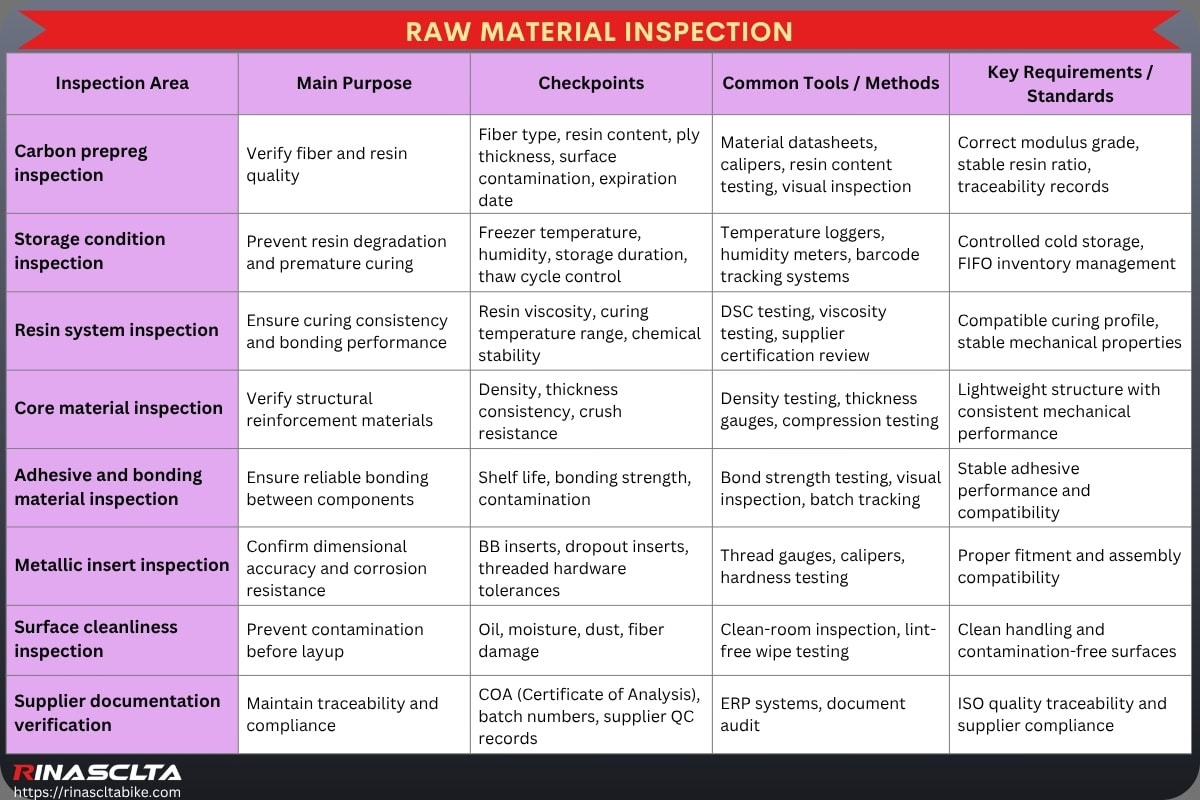
The raw material inspection process usually follows a structured workflow starting with incoming batch registration and traceability labeling, followed by visual inspection, dimensional verification, storage condition checks, laboratory sampling tests, and supplier documentation review before materials are released to production. Advanced factories may additionally perform sample laminate curing tests, ultrasonic analysis, or tensile coupon testing on selected batches to verify that the prepreg and resin system can achieve the required strength, stiffness, impact resistance, and fatigue performance specified for the carbon frameset design.
Layup verification
Layup verification is the quality control process used to confirm that carbon fiber plies are placed in the correct orientation, sequence, overlap, location, and quantity according to the engineering layup schedule before molding and curing. Because carbon bike frames derive their structural properties directly from the arrangement of the composite layers, incorrect layup can cause major problems such as reduced stiffness, weak impact resistance, uneven stress distribution, torsional instability, delamination, premature fatigue failure, or inconsistent ride characteristics. Modern carbon frame factories therefore use standardized layup verification systems based on engineering drawings, ply books, CAD layup maps, structural simulation data, and manufacturing SOPs to ensure every frame matches the intended mechanical design.
| Verification Area | Main Purpose | Checkpoints | Common Tools / Methods | Key Requirements / Standards |
| Ply orientation verification | Ensure correct fiber direction | 0°, ±45°, 90° orientation accuracy, alignment consistency | Laser projection systems, angle templates, ply maps | Structural stiffness and load-path accuracy |
| Ply sequence verification | Confirm correct stacking order | Correct ply order, reinforcement layer position, overlap sequence | Ply books, digital work instructions, barcode tracking | Engineering layup schedule compliance |
| Material placement verification | Ensure accurate placement of reinforcement areas | BB shell, head tube, chainstay, seat tube reinforcement location | Positioning templates, reference markings, CAD guides | Consistent structural reinforcement |
| Ply count verification | Prevent missing or extra layers | Total ply quantity, local reinforcement count | Operator checklist, digital counting systems | Weight and strength consistency |
| Overlap and gap inspection | Prevent stress concentration and weak bonding | Ply overlap width, gap spacing, edge alignment | Visual inspection, measurement gauges | Uniform compaction and structural continuity |
| Wrinkle and bridging inspection | Avoid internal structural defects | Fiber wrinkles, trapped air, bridging near corners | Manual inspection, lighting inspection | Smooth laminate surface and proper consolidation |
| Foreign contamination inspection | Prevent bonding defects | Dust, oil, moisture, damaged fibers | Clean-room inspection, lint-free wipe checks | Clean layup environment |
| Cut pattern verification | Ensure correct prepreg dimensions | Shape accuracy, edge quality, trimming precision | CNC cutting systems, templates, visual inspection | Dimensional consistency |
| Layup traceability verification | Maintain manufacturing records | Operator ID, batch tracking, production timestamp | MES systems, barcode systems | Full process traceability and QC audit compliance |
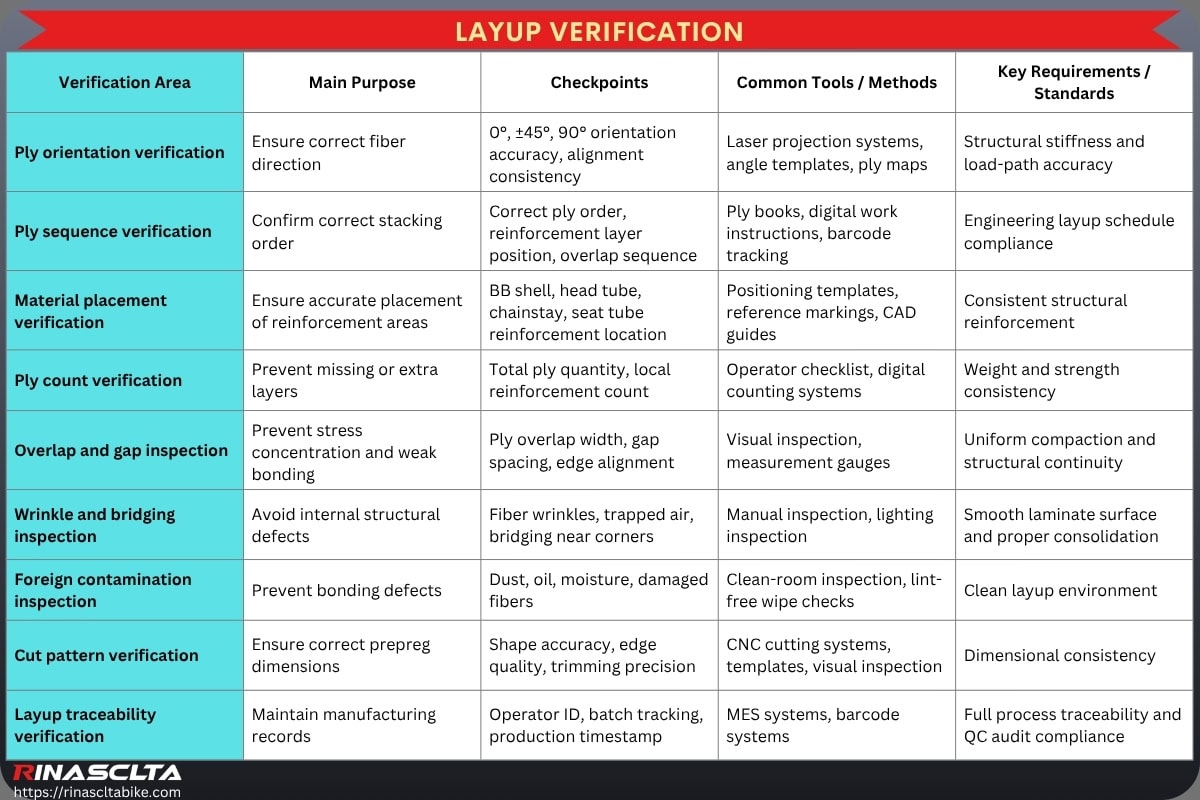
The layup verification workflow usually begins after prepreg materials are thawed and prepared, where operators follow a detailed ply book or digital layup instruction system that specifies the exact placement and orientation of each carbon layer. During the process, inspectors or automated systems verify critical checkpoints such as fiber angle alignment, ply overlap, reinforcement zones, and surface smoothness, especially around high-stress areas like the bottom bracket shell, head tube junction, seat cluster, chainstay bridge, and dropout interfaces. Advanced factories increasingly use technologies such as laser-guided layup projection, RFID material tracking, automated ply cutting, and digital MES monitoring systems to reduce human error and improve consistency across high-volume carbon frameset production.
Proper layup verification is one of the most important stages in carbon bike manufacturing because the mechanical behavior of the finished frame—such as torsional stiffness, vertical compliance, fatigue resistance, impact performance, and ride feel—is determined primarily by the carbon fiber architecture established during this stage. A single misplaced or missing ply may not be visible after molding and painting, but it can significantly compromise long-term structural performance, making layup verification a critical control point for both product safety and manufacturing reliability.
Molding inspection
Molding inspection is the quality control process used to verify that the carbon frame molding and curing stages are completed under the correct pressure, temperature, compaction, tooling, and resin flow conditions to ensure the laminate consolidates into a structurally sound composite frame. Because carbon bike frames are formed by compressing layered prepreg materials inside precision molds during curing, any inconsistency in the molding process can create defects such as voids, delamination, resin-rich zones, dry spots, fiber distortion, bladder wrinkles, incomplete compaction, wall-thickness inconsistency, or bonding failure, all of which can significantly reduce frame strength, fatigue life, and impact resistance. Modern factories therefore perform molding inspection based on engineering curing specifications, mold design parameters, process SOPs, pressure-temperature curves, and composite manufacturing standards to maintain structural consistency across production batches.
| Inspection Area | Main Purpose | Checkpoints | Common Tools / Methods | Key Requirements / Standards |
| Mold condition inspection | Ensure tooling accuracy and surface integrity | Mold wear, scratches, contamination, dimensional accuracy | Visual inspection, CMM measurement, mold maintenance logs | Stable geometry and surface consistency |
| Mold alignment inspection | Prevent dimensional distortion during curing | Mold closure accuracy, positioning consistency | Alignment pins, fixture inspection, precision gauges | Correct frame geometry and tolerance |
| Bladder inspection | Ensure proper internal compaction | Bladder placement, leakage, wrinkles, inflation pressure | Air pressure testing, leak detection, visual inspection | Uniform laminate compaction |
| Preform positioning inspection | Verify layup placement before mold closure | Ply shift, reinforcement alignment, fold prevention | Visual inspection, positioning templates | Accurate laminate structure |
| Pressure control inspection | Ensure proper laminate consolidation | Inflation pressure, pressure stability, compaction consistency | Pressure sensors, autoclave monitoring systems | Controlled void reduction and bonding quality |
| Temperature control inspection | Verify curing cycle consistency | Heating rate, curing temperature, dwell time, cooling rate | Thermocouples, curing data loggers, thermal monitoring systems | Resin curing compliance |
| Resin flow inspection | Prevent dry spots and resin pooling | Resin distribution, overflow consistency, trapped air | Visual inspection, ultrasonic inspection, sample cut sections | Uniform resin consolidation |
| Vacuum inspection (if applicable) | Remove trapped air and volatile gases | Vacuum level, leak rate, vacuum hold stability | Vacuum gauges, leak detectors | Low porosity and improved laminate quality |
| Wall thickness inspection | Ensure structural consistency | Tube thickness, local reinforcement thickness | Ultrasonic thickness gauges, section analysis | Consistent strength-to-weight ratio |
| Post-curing inspection | Confirm structural integrity after curing | Deformation, warping, internal defects | Ultrasonic testing, tap testing, X-ray inspection | Structural reliability and defect minimization |
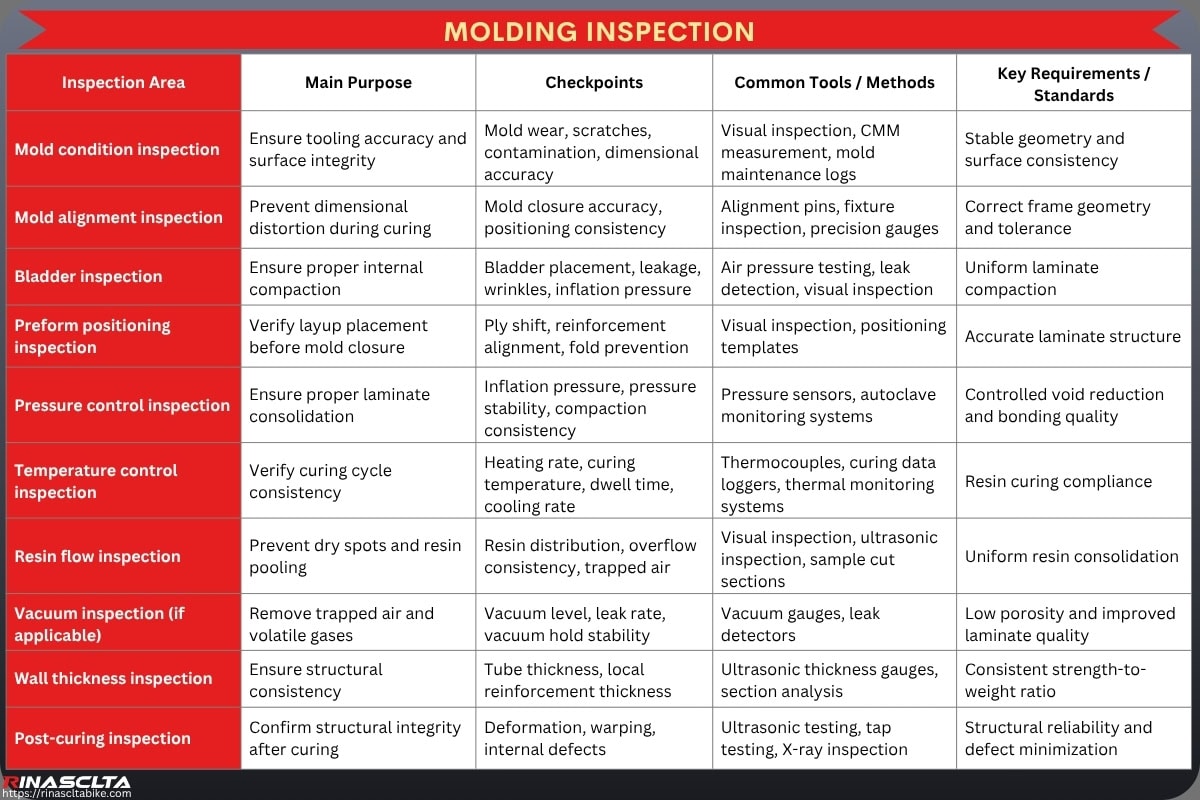
The molding inspection workflow begins before curing, where inspectors verify the condition of the mold tooling, bladder system, and carbon preform positioning before the mold is closed. During curing, factories continuously monitor temperature curves, internal pressure, vacuum levels, and resin flow behavior using automated data logging systems to ensure the composite laminate reaches the required glass transition temperature (Tg), resin consolidation level, and compaction quality specified by the engineering process. After demolding, the frame undergoes additional inspections for surface integrity, dimensional stability, laminate consistency, and internal defect detection, especially around high-stress regions such as the head tube junction, bottom bracket shell, seat cluster, and chainstay interfaces.
Advanced carbon frame manufacturers increasingly use technologies such as autoclave curing systems, EPS molding cores, internal latex bladders, RTM (Resin Transfer Molding), ultrasonic scanning, thermal imaging, and digital process monitoring systems to improve molding consistency and reduce manufacturing defects. Since molding directly determines the frame’s final fiber consolidation, wall thickness distribution, stiffness characteristics, and fatigue resistance, this stage is considered one of the most critical quality control checkpoints in modern carbon bicycle production.
Alignment inspection
Alignment inspection is the quality control process used to verify that the carbon bike frameset maintains the correct geometry, symmetry, dimensional tolerance, and structural alignment after molding and curing. Because carbon composite manufacturing involves multiple stages of layup, molding, curing, trimming, bonding, and machining, small deviations during production can lead to problems such as misaligned dropouts, uneven rear triangle geometry, bottom bracket offset, head tube deviation, wheel tracking issues, poor drivetrain alignment, brake rotor rubbing, unstable handling, or premature bearing wear. Modern factories therefore perform alignment inspection based on engineering drawings, CAD geometry data, frame tolerance specifications, assembly compatibility requirements, and international standards such as ISO 4210 to ensure every frameset meets precise dimensional targets before painting and assembly.
| Inspection Area | Main Purpose | Checkpoints | Common Tools / Methods | Key Requirements / Standards |
| Head tube alignment inspection | Ensure steering geometry accuracy | Head tube centerline, angular deviation, concentricity | Alignment gauges, CMM systems, laser measurement | Stable handling and fork compatibility |
| Bottom bracket alignment inspection | Verify drivetrain positioning | BB shell parallelism, thread accuracy, shell centering | BB gauges, bore gauges, threading inspection tools | Efficient drivetrain alignment |
| Rear dropout alignment inspection | Ensure rear wheel tracking accuracy | Dropout spacing, symmetry, axle plane alignment | Dropout gauges, alignment fixtures, laser systems | Proper wheel installation and tracking |
| Rear triangle symmetry inspection | Prevent frame tracking imbalance | Chainstay and seatstay symmetry, centerline consistency | Frame alignment tables, digital measurement systems | Balanced load distribution and handling |
| Fork alignment inspection | Ensure steering and braking consistency | Fork blade symmetry, steerer alignment, dropout position | Fork alignment tools, laser inspection | Stable steering and braking performance |
| Disc brake mount alignment inspection | Verify brake interface accuracy | Flatness, rotor centering, mounting parallelism | Facing tools, precision gauges | Brake rotor alignment and reduced rubbing |
| Derailleur hanger alignment inspection | Ensure accurate shifting performance | Hanger straightness, dropout interface alignment | Derailleur hanger alignment gauges | Smooth drivetrain shifting |
| Frame centerline inspection | Confirm overall frame symmetry | Wheel tracking line, front-to-rear alignment | Laser alignment systems, frame tables | Stable riding characteristics |
| Dimensional tolerance inspection | Verify geometry specification compliance | Stack, reach, tube angles, wheelbase, spacing | CMM measurement, digital calipers, geometry fixtures | Engineering drawing compliance |
| Bonded interface inspection | Ensure alignment of bonded structures | Insert positioning, bonding concentricity | Bore gauges, ultrasonic inspection | Assembly precision and structural reliability |
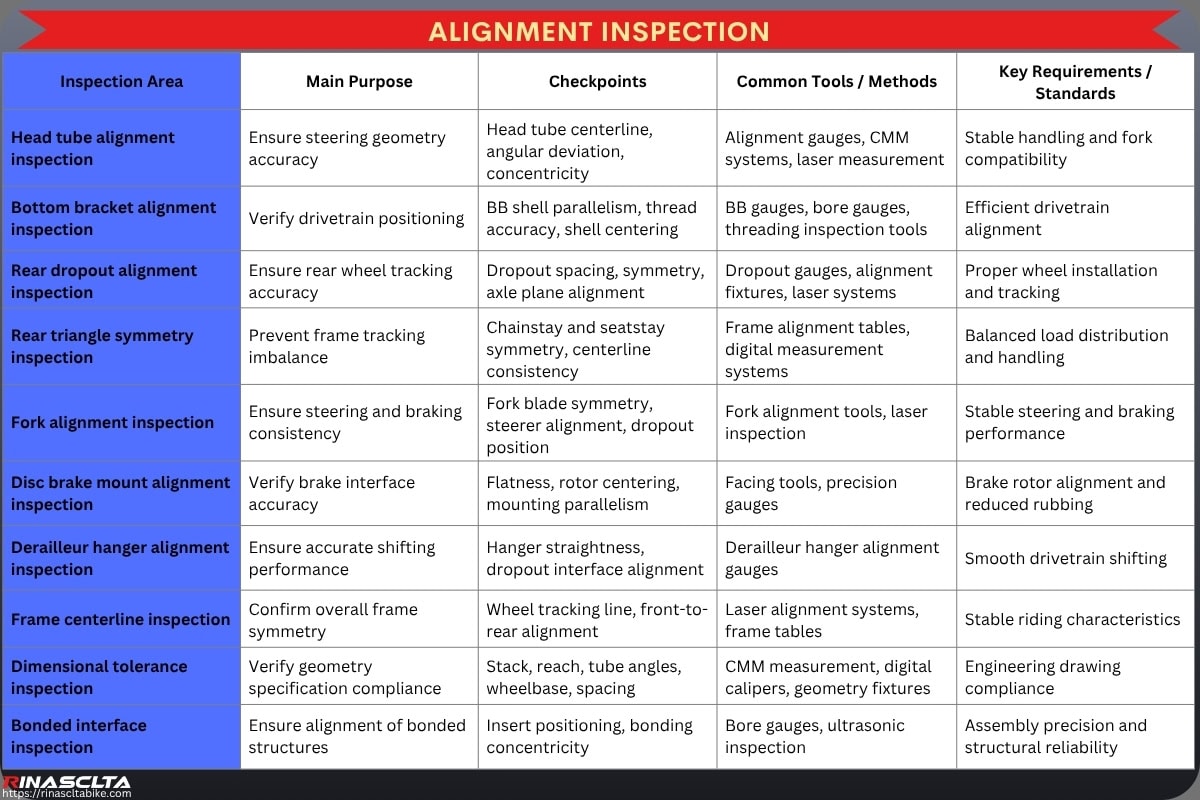
The alignment inspection workflow usually begins after the frame has completed demolding, trimming, machining, and bonding operations, where the frameset is mounted onto a dedicated frame alignment fixture or coordinate measurement system (CMM). Inspectors then measure critical reference points such as the head tube axis, bottom bracket centerline, rear dropout spacing, derailleur hanger position, brake mount alignment, and overall frame symmetry against engineering tolerances defined in the CAD model and production drawings. High-end factories often use laser alignment systems, digital scanning equipment, and automated coordinate measuring machines to detect even small deviations that may not be visible during visual inspection.
Accurate alignment inspection is essential because even minor geometric deviations can significantly affect handling stability, drivetrain efficiency, wheel tracking, braking performance, tire clearance, and bearing longevity once the bicycle is assembled and ridden under load. For B2B clients and bicycle brands, proper alignment control also reduces downstream assembly issues, warranty claims, retailer adjustments, and customer complaints, making this stage a critical link between carbon frame manufacturing precision and real-world riding performance.
Surface inspection
Surface inspection is the quality control process used to evaluate the external condition, cosmetic finish, and visible structural indicators of a carbon bike frameset after molding, trimming, sanding, painting, or finishing operations. Because carbon bicycle frames are highly dependent on laminate integrity, resin distribution, surface consolidation, and finishing quality, external surface defects can indicate deeper manufacturing problems such as voids, resin starvation, delamination, fiber distortion, improper curing, sanding damage, paint adhesion failure, or hidden impact defects. Modern factories therefore perform surface inspection based on cosmetic standards, engineering tolerances, paint specifications, laminate quality requirements, and customer acceptance criteria, especially for OEM and high-end performance framesets where appearance and structural reliability are equally important.
| Inspection Area | Main Purpose | Checkpoints | Common Tools / Methods | Key Requirements / Standards |
| Visual laminate inspection | Detect visible composite defects | Fiber wrinkles, pinholes, resin-rich areas, dry spots, waviness | LED lighting inspection, magnification tools, visual QC stations | Smooth and defect-free laminate surface |
| Paint surface inspection | Verify coating quality and consistency | Paint thickness, color consistency, orange peel, runs, contamination | Paint thickness gauges, gloss meters, color comparison tools | Uniform cosmetic finish |
| Scratch and impact inspection | Identify physical damage during handling | Scratches, dents, chips, transport damage | Visual inspection, touch inspection | No structural or cosmetic damage |
| Sanding quality inspection | Prevent structural over-sanding | Exposed fibers, uneven sanding, edge thinning | Surface profile gauges, visual inspection | Controlled material removal |
| Bond line inspection | Verify visible bonding quality | Adhesive overflow, bonding gaps, edge consistency | Visual inspection, borescope inspection | Proper adhesive coverage and joint quality |
| Clear coat inspection | Ensure finish durability and appearance | Surface smoothness, gloss level, coating adhesion | Gloss meters, adhesion testing | Long-term cosmetic durability |
| Decal and graphics inspection | Verify branding accuracy and finish | Alignment, bubbling, peeling, print defects | Visual inspection, alignment templates | Branding consistency |
| Surface flatness inspection | Detect warping or uneven surfaces | Tube surface consistency, local deformation | Straight edges, laser scanning | Geometric consistency |
| Internal surface inspection (if accessible) | Detect hidden laminate irregularities | Resin pooling, trapped materials, bladder marks | Borescopes, internal cameras | Internal laminate quality |
| Non-destructive defect inspection | Detect subsurface structural defects | Delamination, internal voids, hidden cracks | Ultrasonic testing, tap testing, thermal imaging | Structural integrity verification |
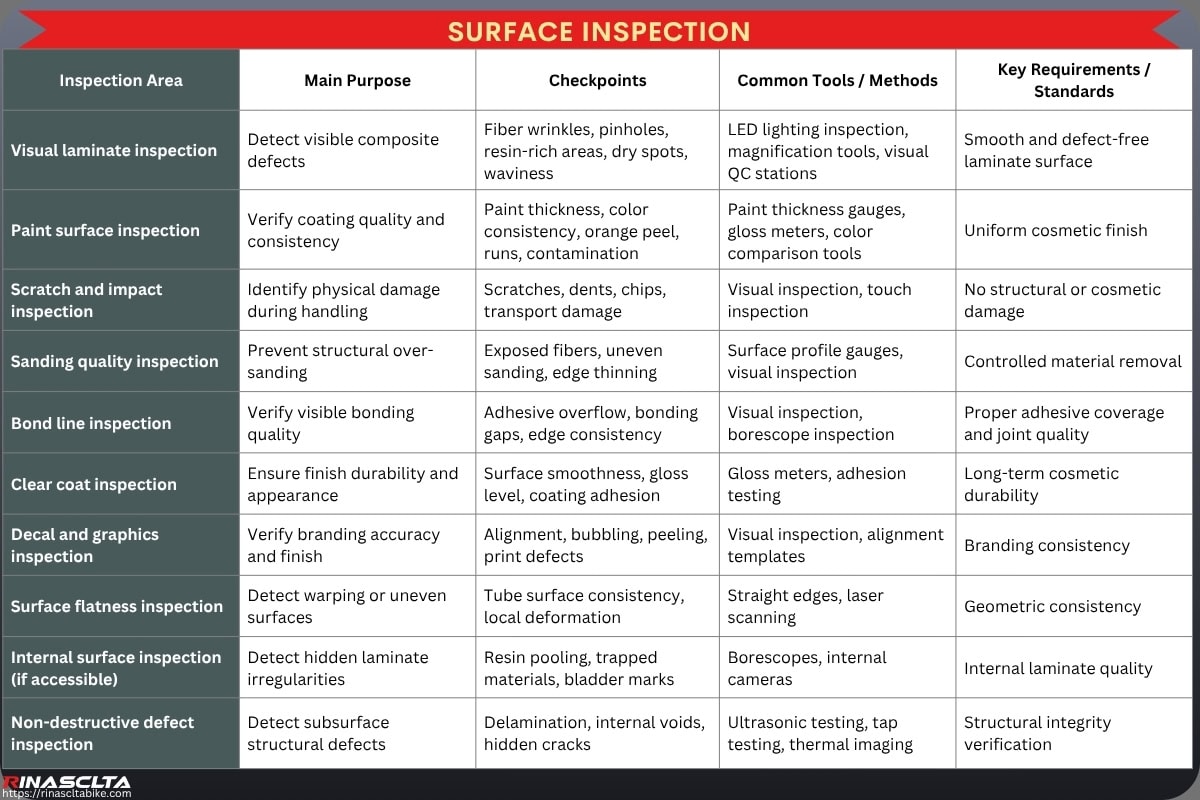
The surface inspection workflow usually begins after the frame completes demolding, trimming, machining, sanding, and painting, where trained inspectors examine the frame under controlled lighting conditions to identify both cosmetic and structural warning signs. Inspection checkpoints focus heavily on high-stress and visually sensitive areas such as the head tube junction, bottom bracket shell, seat cluster, chainstay bridge, fork crown, and bonded interfaces, where manufacturing defects are more likely to occur. Advanced factories often combine standard visual inspection with ultrasonic scanning, tap testing, borescope analysis, thermal imaging, and digital surface scanning systems to detect hidden defects that may not be visible externally.
Surface inspection is especially important in carbon bike manufacturing because cosmetic imperfections can sometimes indicate deeper composite issues that affect fatigue resistance, impact performance, and long-term structural reliability. For premium bicycle brands and B2B customers, surface quality also directly influences consumer perception, retail presentation, warranty risk, and brand reputation, making cosmetic and structural surface inspection one of the final critical checkpoints before packaging and shipment.
Final assembly inspection
Final assembly inspection is the last quality control stage in carbon bike frameset manufacturing used to verify that all structural interfaces, hardware installations, dimensional tolerances, and functional assembly points meet the required engineering specifications, safety standards, and customer requirements before packaging and shipment. Because carbon framesets involve multiple post-processing operations such as machining, bonding, threading, painting, insert installation, and component fitting, even small assembly errors can cause issues such as poor drivetrain alignment, bearing misfit, brake rubbing, creaking noise, torque failure, headset play, wheel tracking problems, or premature component wear once the bicycle is fully assembled. Modern factories therefore conduct final assembly inspection based on CAD drawings, assembly SOPs, torque specifications, OEM customer standards, ISO 4210 requirements, and functional fitment criteria to ensure the finished frameset is fully compatible with downstream bicycle assembly and real-world riding conditions.
| Inspection Area | Main Purpose | Checkpoints | Common Tools / Methods | Key Requirements / Standards |
| Bottom bracket interface inspection | Verify drivetrain fit and alignment | BB shell tolerance, thread accuracy, press-fit concentricity | BB gauges, bore gauges, threading tools | Drivetrain compatibility and alignment |
| Headset assembly inspection | Ensure steering system compatibility | Bearing fit, compression alignment, headset preload | Headset presses, bearing gauges, torque tools | Smooth steering and bearing stability |
| Rear derailleur hanger inspection | Verify shifting accuracy | Hanger straightness, dropout alignment | Derailleur hanger alignment gauges | Accurate drivetrain shifting |
| Disc brake mount inspection | Ensure brake system alignment | Rotor centering, mount flatness, caliper alignment | Facing tools, alignment gauges | Reduced brake rub and braking stability |
| Axle and dropout inspection | Confirm wheel installation accuracy | Dropout spacing, thru-axle fitment, axle threading | Precision calipers, axle gauges | Stable wheel retention |
| Seatpost interface inspection | Verify seat tube compatibility | Seat tube diameter, insertion depth, clamping surface quality | Bore gauges, fit testing tools | Secure seatpost installation |
| Cable routing inspection | Ensure internal routing functionality | Tube clearance, routing smoothness, liner positioning | Routing tools, borescopes | Clean assembly and low cable friction |
| Torque verification inspection | Prevent assembly-related damage | Bolt torque values, clamping consistency | Digital torque wrenches | Safe hardware installation |
| Bonded insert inspection | Verify bonded component integrity | Insert alignment, adhesive quality, bonding strength | Visual inspection, ultrasonic testing | Reliable structural bonding |
| Frame protection inspection | Prevent shipping and handling damage | Paint protection, packaging integrity, edge coverage | Visual inspection, packaging checklist | Cosmetic and structural preservation |
| Functional assembly test | Simulate real assembly conditions | Wheel fitment, fork installation, drivetrain compatibility | Mock assembly fixtures, fitment jigs | Full component compatibility |
| Serial number and traceability inspection | Maintain production tracking | Serial marking, QR labels, production records | Barcode systems, ERP systems | Manufacturing traceability compliance |
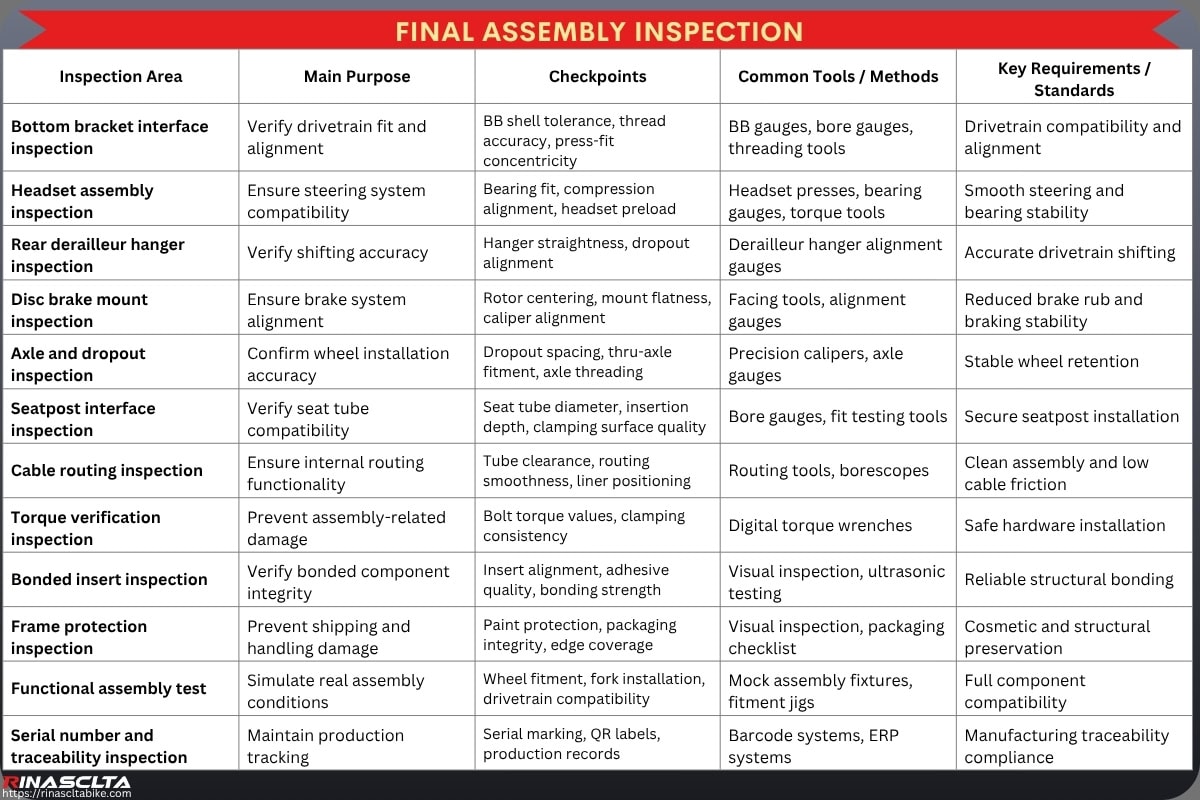
The final assembly inspection workflow typically begins after the frame has completed all major manufacturing and finishing operations, including painting, machining, bonding, threading, and surface inspection. Inspectors perform both dimensional verification and functional fitment testing by installing reference components such as forks, headsets, thru-axles, bottom brackets, derailleurs, brake calipers, and wheels to confirm that all interfaces align correctly and operate within specification. Torque-sensitive areas such as the seatpost clamp, derailleur hanger, bottle cage mounts, brake mounts, and integrated cockpit interfaces are also carefully checked to prevent assembly failures or damage during final bicycle assembly.
Advanced factories often integrate digital torque tracking systems, coordinate measurement machines (CMM), laser alignment systems, borescopes, and automated QC databases into final assembly inspection to improve consistency and traceability across production batches. For B2B bicycle brands and OEM clients, this stage is critical because it directly affects downstream assembly efficiency, warranty performance, retailer setup quality, and consumer riding experience, making final assembly inspection the last safeguard before the carbon frameset enters the global supply chain.
Common Carbon Frameset Manufacturing Defects
Common carbon frameset manufacturing defects include voids, delamination, misalignment, resin pooling, and paint defects, because carbon bicycle production depends on highly controlled processes involving fiber orientation, resin distribution, compaction pressure, curing consistency, tooling accuracy, and finishing quality. Unlike metal manufacturing, carbon composite defects are often process-related and may remain partially hidden until the frame experiences fatigue stress, impact loading, vibration cycles, thermal expansion, or real-world road conditions, making defect detection and prevention critical for maintaining structural integrity, rider safety, dimensional accuracy, cosmetic consistency, and long-term durability in modern carbon bike manufacturing.
| Defect Type | Key Features | Main Causes | How to Fix | How to Avoid | Common Tools / Methods |
| Voids | Small internal air pockets or gaps inside laminate layers | Poor compaction, trapped air, insufficient vacuum, incorrect curing pressure | Local repair, resin injection, laminate replacement, rejection of severe cases | Proper vacuum control, bladder pressure management, controlled curing cycle | Ultrasonic testing, X-ray inspection, tap testing, thermal imaging |
| Delamination | Separation between carbon laminate layers or bonded sections | Impact damage, poor bonding, contamination, incorrect curing | Structural repair with re-bonding or laminate replacement | Controlled layup process, clean bonding surfaces, proper resin curing | Ultrasonic scanning, borescope inspection, acoustic tap testing |
| Misalignment | Incorrect frame geometry or component interface positioning | Mold shift, tooling error, improper fixturing, machining deviation | Realignment (limited cases), re-machining, frame rejection | Precision fixtures, laser alignment systems, geometry verification | CMM systems, alignment gauges, laser measurement tools |
| Resin pooling | Excess resin accumulation creating heavy or brittle areas | Excess resin flow, poor laminate consolidation, uneven pressure | Sanding, cosmetic correction, rejection if structural impact exists | Controlled resin content, proper compaction pressure, optimized mold design | Visual inspection, ultrasonic thickness measurement |
| Paint defects | Cosmetic imperfections such as bubbles, runs, peeling, or orange peel | Poor surface prep, contamination, incorrect paint curing, humidity issues | Repainting, sanding, polishing, localized refinishing | Controlled paint booth environment, surface cleaning, curing control | Paint thickness gauges, gloss meters, visual QC lighting |
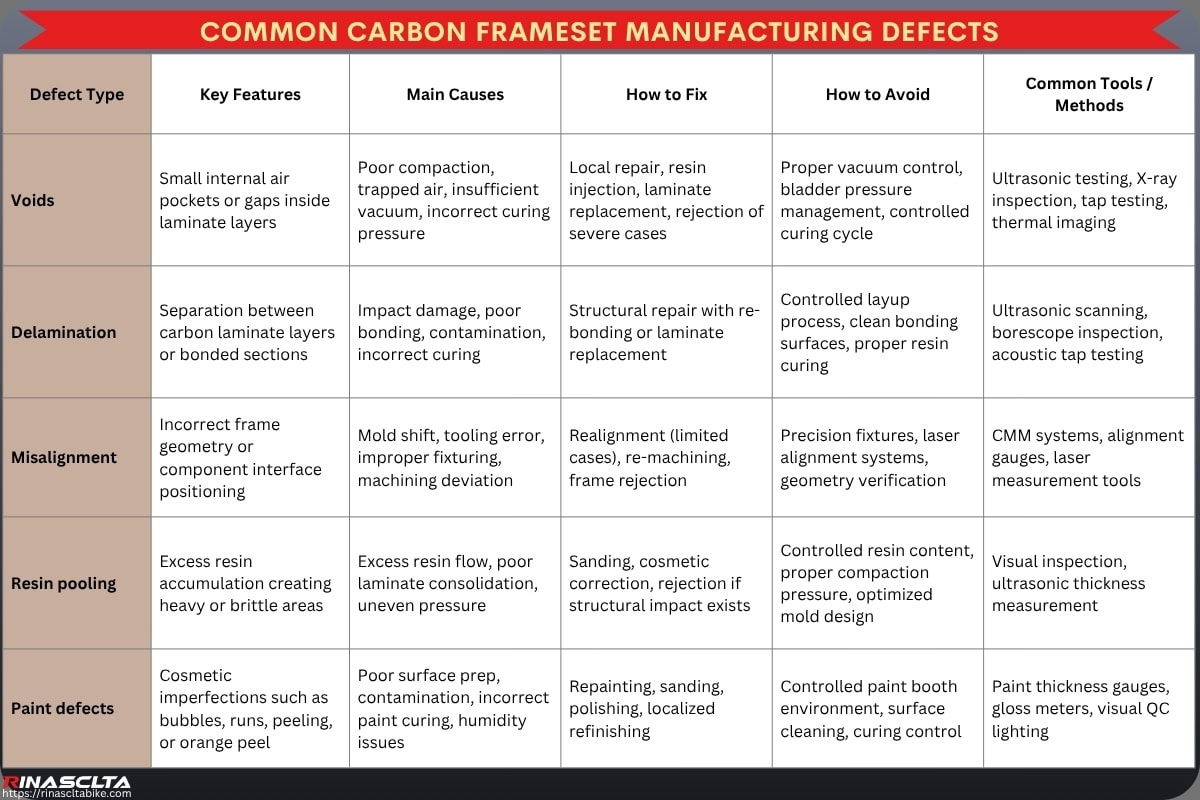
In practice, these defects are closely connected to earlier manufacturing stages such as raw material handling, layup verification, molding inspection, curing control, trimming, machining, and painting, meaning effective defect prevention requires an integrated quality control system across the entire production workflow. Advanced carbon frame factories therefore combine non-destructive testing (NDT), process monitoring, operator training, automated inspection systems, and ISO-based manufacturing procedures to reduce defect rates, improve production consistency, and minimize warranty and recall risks for B2B bicycle brands and OEM clients.
Voids
Voids are one of the most common and critical defects in carbon bike frameset manufacturing, referring to small trapped air pockets, gas bubbles, or empty spaces inside the composite laminate structure that form during layup, molding, or curing. Because carbon frames rely on dense and uniform bonding between carbon fibers and resin matrix systems, voids interrupt load transfer inside the laminate and reduce the frame’s overall strength, stiffness, fatigue resistance, impact performance, and long-term durability. In severe cases, excessive void content can lead to crack initiation, delamination, localized weakness, premature fatigue failure, or catastrophic structural failure under road vibration, sprint loads, or impact conditions. Most high-end composite manufacturing standards attempt to keep void content below approximately 1–2% laminate volume, especially in high-stress bicycle frame areas such as the bottom bracket shell, head tube junction, chainstay bridge, and seat cluster.
| Inspection / Control Area | Explanation | Main Causes | Checkpoints | Common Tools / Methods | Prevention & Control |
| Air entrapment during layup | Air becomes trapped between prepreg layers during ply placement | Poor layup technique, wrinkles, rapid placement, insufficient debulking | Ply overlap smoothness, trapped air visibility | Roller compaction tools, vacuum debulking systems | Careful ply consolidation and staged debulking |
| Insufficient compaction pressure | Laminate does not compress fully during curing | Low bladder pressure, weak vacuum, uneven mold pressure | Pressure curve consistency, bladder expansion | Pressure sensors, autoclave monitoring systems | Stable molding pressure and bladder control |
| Improper resin flow | Resin cannot fully wet fibers or displace trapped gases | Incorrect resin viscosity, rapid curing, uneven heating | Resin distribution consistency, dry zones | Thermal monitoring, resin flow simulation | Controlled curing cycle and resin management |
| Vacuum leakage | External air enters the laminate during curing | Damaged vacuum bag, seal failure, hose leakage | Vacuum pressure drop, leak rate | Vacuum gauges, leak detectors | Vacuum integrity testing before curing |
| Moisture contamination | Moisture evaporates during curing and forms gas pockets | Improper prepreg storage, humidity exposure | Storage temperature and humidity logs | Humidity meters, freezer monitoring systems | Controlled cold storage and handling |
| Excessive curing speed | Resin gels before trapped air can escape | Fast heating ramps, unstable curing profile | Temperature ramp consistency | Thermocouples, curing data loggers | Optimized cure schedule |
| Mold geometry complexity | Sharp corners or tight sections trap air more easily | Complex tube junctions and reinforcement zones | Junction compaction quality | Simulation software, borescopes | Improved mold venting and layup design |
| Poor debulking process | Air remains between laminate stacks before molding | Skipping intermediate vacuum compaction | Laminate flatness before molding | Vacuum debulking systems | Multiple staged debulking cycles |
The void inspection process usually begins during layup and molding stages, where operators visually inspect laminate consolidation while monitoring vacuum pressure, bladder inflation pressure, mold closure consistency, resin behavior, and curing temperature curves. After curing, factories use both visual and non-destructive inspection methods to detect hidden internal voids. Common techniques include ultrasonic testing (UT), acoustic tap testing, thermal imaging, X-ray inspection, micro-section cutting, and computed tomography (CT scanning) for advanced analysis. Ultrasonic inspection is one of the most widely used methods because voids disrupt sound-wave transmission inside the laminate, allowing inspectors to identify areas with abnormal density or poor consolidation.
Modern carbon bike factories reduce void formation through a combination of controlled prepreg storage, clean-room layup environments, optimized resin systems, staged vacuum debulking, precision bladder molding, autoclave or EPS molding technologies, and tightly controlled curing cycles. Advanced OEM factories also implement MES process tracking systems, digital curing logs, automated pressure monitoring, and operator certification programs to improve manufacturing consistency across large production volumes. Since voids often remain invisible externally while significantly weakening the internal composite structure, they are considered one of the most important hidden defects in high-performance carbon bicycle manufacturing.
Delamination
Delamination is a serious composite defect in carbon bike frameset manufacturing where adjacent carbon laminate layers separate from each other or lose bonding integrity, causing the structure to behave as multiple disconnected layers instead of a unified composite system. Because carbon bicycle frames rely on strong bonding between carbon fibers, resin matrix systems, bonded inserts, and reinforcement layers, delamination significantly reduces load transfer efficiency, torsional stiffness, fatigue resistance, and impact strength, especially in high-stress areas such as the head tube junction, bottom bracket shell, chainstay interfaces, seat cluster, and bonded dropout regions. Unlike visible cracks in metal frames, delamination may initially remain hidden beneath the surface while progressively expanding under repeated road vibration, sprint loads, impacts, or thermal cycling, eventually leading to structural instability or catastrophic failure.
| Inspection / Control Area | Explanation | Main Causes | Checkpoints | Common Tools / Methods | Prevention & Control |
| Poor interlaminar bonding | Weak adhesion between laminate layers | Inadequate resin flow, contamination, low curing pressure | Bonding consistency between plies | Ultrasonic inspection, section analysis | Controlled curing pressure and clean layup |
| Impact-induced separation | External impacts cause internal layer separation | Crash damage, transport impact, stone strikes | High-stress junction inspection | Tap testing, thermal imaging, ultrasonic scanning | Protective reinforcement and impact-resistant layup |
| Contaminated bonding surfaces | Dust, oil, moisture, or debris prevent proper adhesion | Improper handling or clean-room failure | Surface cleanliness before layup | Lint-free wipe inspection, contamination checks | Controlled clean-room environment |
| Incorrect curing cycle | Improper temperature or pressure weakens resin bonding | Under-curing, over-curing, unstable thermal profile | Cure temperature and dwell time verification | Thermocouples, curing log systems | Controlled cure schedule management |
| Fiber wrinkling and bridging | Uneven laminate contact creates localized weak zones | Poor layup around complex mold geometry | Wrinkle inspection near corners and junctions | Visual inspection, borescopes | Improved layup techniques and mold design |
| Voids and trapped air | Internal air pockets weaken interlayer bonding | Poor vacuum control or insufficient debulking | Vacuum consistency and laminate consolidation | Vacuum gauges, ultrasonic testing | Multi-stage debulking and vacuum monitoring |
| Excessive sanding or machining | Post-processing damages outer laminate layers | Aggressive finishing operations | Surface thickness and exposed fiber inspection | Ultrasonic thickness gauges | Controlled finishing procedures |
| Bonded joint failure | Adhesive separation between bonded frame sections | Incorrect adhesive application or curing | Adhesive spread and insert positioning | Borescope inspection, bond testing | Proper adhesive handling and curing control |
| Fatigue-induced propagation | Repeated loading enlarges existing micro-separations | High cyclic stress and vibration | Fatigue-prone area monitoring | Fatigue testing rigs, NDT inspection | Reinforced layup and stress optimization |
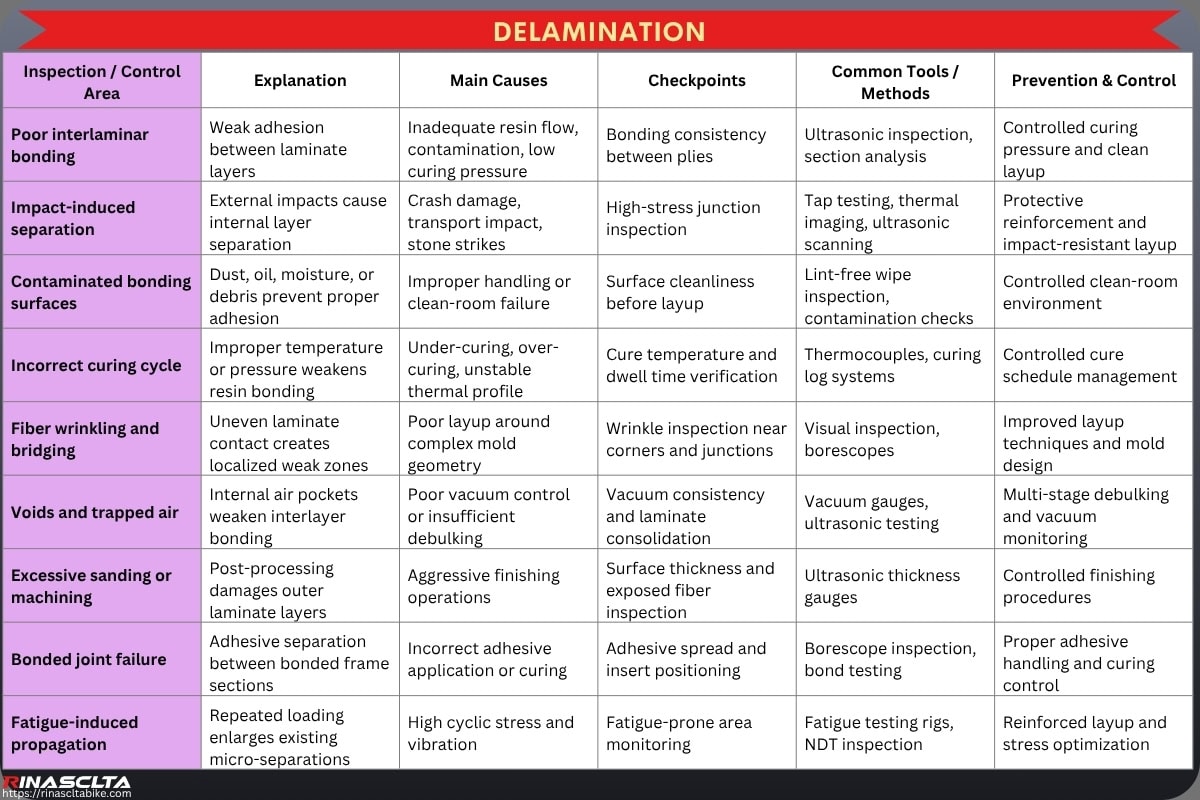
The delamination inspection process usually begins during layup and molding verification, where inspectors monitor surface cleanliness, ply consolidation, resin distribution, curing consistency, and laminate compaction quality to minimize bonding defects before the frame is cured. After molding, factories use multiple non-destructive testing (NDT) methods to detect hidden layer separation, especially in structurally sensitive areas. The most common method is ultrasonic testing (UT), where high-frequency sound waves are transmitted through the laminate; delaminated zones reflect or scatter sound differently than fully bonded composite material. Additional inspection methods include acoustic tap testing, thermal imaging, X-ray inspection, borescopes, CT scanning, and destructive coupon testing for process validation and laboratory analysis.
Modern carbon bike manufacturers reduce delamination risk through a combination of controlled prepreg storage, clean-room layup environments, optimized resin chemistry, staged vacuum debulking, precision bladder molding, controlled autoclave or EPS curing systems, and digital process monitoring. Engineering teams also use finite element analysis (FEA), fatigue simulation, and stress mapping to optimize fiber orientation and reinforcement placement around high-load areas where delamination risk is highest. Since delamination can remain partially invisible while progressively weakening the frame under real-world riding conditions, it is considered one of the most critical structural defects in high-performance carbon bicycle manufacturing and one of the primary reasons for advanced NDT quality control systems in premium OEM production.
Misalignment
Misalignment in carbon bike frameset manufacturing refers to any deviation from the intended frame geometry, centerline symmetry, component interface position, or structural alignment defined in the engineering design. Because modern bicycle frames depend on extremely precise relationships between the head tube, bottom bracket shell, rear dropouts, brake mounts, fork interface, and wheel tracking line, even small alignment errors can negatively affect handling stability, drivetrain efficiency, shifting accuracy, braking performance, bearing life, tire clearance, and overall ride quality. In carbon composite production, misalignment can occur during multiple stages such as layup positioning, mold closure, curing, bonding, trimming, machining, or assembly, making alignment inspection one of the most important dimensional quality control processes in high-end carbon bicycle manufacturing.
| Inspection / Control Area | Explanation | Main Causes | Checkpoints | Common Tools / Methods | Prevention & Control |
| Head tube misalignment | Steering axis deviates from frame centerline | Mold shift, incorrect fixture setup, curing distortion | Head tube angle, concentricity, centerline deviation | Laser alignment systems, CMM measurement | Precision fixtures and mold calibration |
| Bottom bracket misalignment | BB shell positioned off-axis or uneven | Bonding error, machining deviation, mold movement | BB shell parallelism and centering | BB gauges, bore gauges, alignment fixtures | Accurate machining and fixture control |
| Rear dropout misalignment | Rear axle interfaces not parallel or symmetrical | Mold distortion, trimming error, bonding shift | Dropout spacing and wheel tracking | Dropout alignment gauges, frame tables | Controlled mold stability and alignment checks |
| Rear triangle asymmetry | Chainstay or seatstay geometry differs side-to-side | Uneven layup, thermal distortion, bonding inconsistency | Symmetry relative to frame centerline | Laser scanning, geometry fixtures | Balanced layup and controlled curing |
| Fork alignment deviation | Fork blades or steerer tube not aligned | Tooling wear, curing distortion | Steerer alignment and dropout symmetry | Fork alignment gauges, laser tools | Accurate fork fixturing |
| Brake mount misalignment | Disc or rim brake interfaces positioned incorrectly | Machining error, bonded insert shift | Rotor centering and mount flatness | Facing tools, precision gauges | Controlled machining tolerance |
| Derailleur hanger misalignment | Hanger angle affects shifting accuracy | Dropout distortion, machining inconsistency | Hanger straightness and axle plane alignment | Derailleur hanger alignment gauges | Precise dropout machining |
| Mold closure distortion | Mold halves shift during curing | Tool wear, uneven pressure, fixture instability | Mold seam consistency and frame symmetry | Mold inspection tools, pressure monitoring | Mold maintenance and pressure control |
| Bonded insert offset | Bonded hardware not positioned correctly | Adhesive shift, incorrect jig positioning | Insert concentricity and interface alignment | Bore gauges, visual inspection | Controlled bonding procedures |
| Thermal curing deformation | Uneven thermal expansion distorts geometry | Incorrect curing profile, uneven heat distribution | Post-curing geometry measurement | Thermal monitoring systems, CMM inspection | Stable cure cycle management |
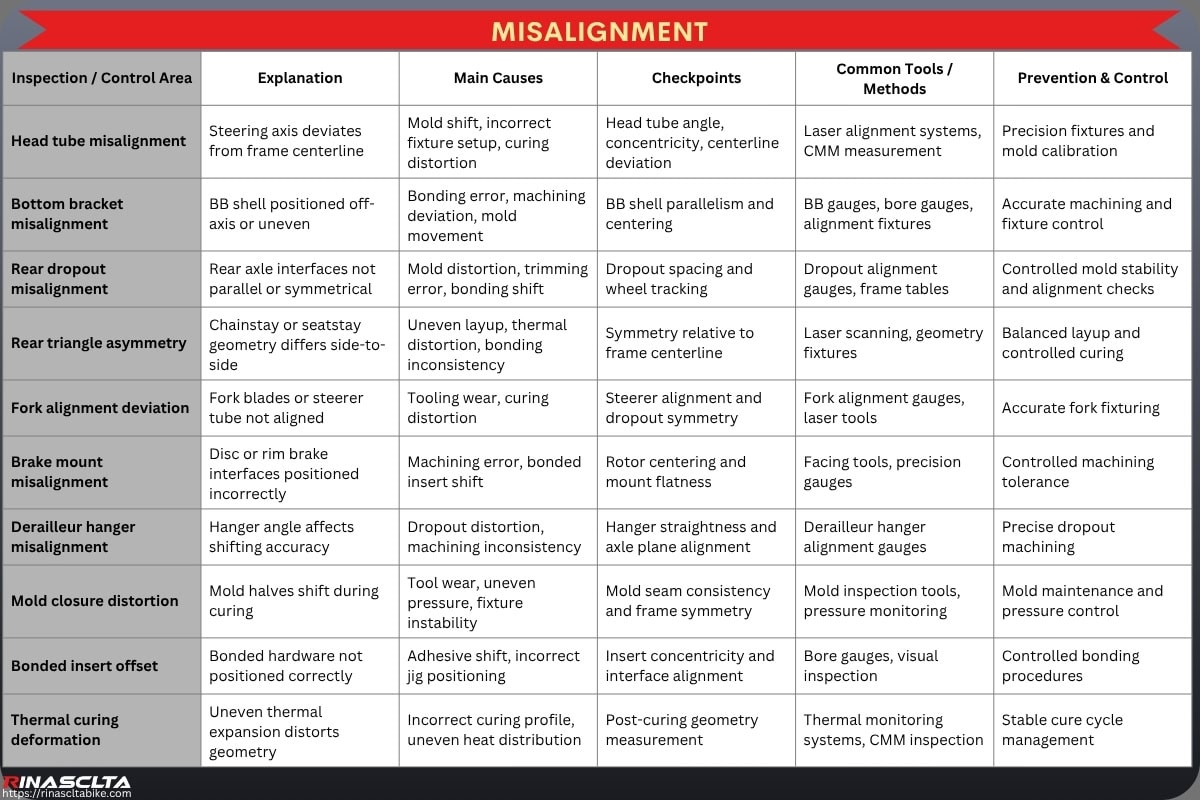
The misalignment inspection workflow generally begins after the frame completes demolding, trimming, bonding, and machining operations, where the frameset is mounted onto a dedicated alignment table, geometry fixture, or coordinate measuring machine (CMM). Inspectors measure critical reference points including the head tube axis, bottom bracket centerline, rear dropout spacing, derailleur hanger alignment, fork interface, brake mount flatness, and overall frame symmetry against engineering CAD data and manufacturing tolerance specifications. Advanced factories often use laser alignment systems, digital scanning equipment, 3D coordinate measurement systems, and automated geometry verification software to detect deviations as small as fractions of a millimeter.
Misalignment prevention depends heavily on maintaining stable control across the entire production process, including accurate layup positioning, rigid tooling systems, controlled curing temperatures, precise machining fixtures, calibrated molds, and standardized bonding procedures. High-end manufacturers also implement SPC (Statistical Process Control), MES tracking systems, fixture calibration schedules, and automated digital QC systems to reduce dimensional variation across mass production. Because alignment directly affects downstream bicycle assembly, wheel tracking, steering behavior, drivetrain performance, and rider safety, misalignment defects are treated as critical quality issues in OEM carbon frameset manufacturing and are closely monitored throughout both production and final assembly inspection stages.
Resin pooling
Resin pooling is a composite manufacturing defect where excessive resin accumulates in localized areas of a carbon bike frameset during molding and curing, creating uneven resin-rich zones inside or on the surface of the laminate structure. Because carbon composites achieve optimal mechanical performance through a carefully controlled balance between carbon fiber reinforcement and resin matrix content, excessive resin concentration reduces the effective fiber-to-resin ratio and can negatively affect stiffness-to-weight ratio, impact resistance, fatigue life, laminate consistency, and overall structural efficiency. Resin pooling commonly appears around complex frame junctions such as the bottom bracket shell, head tube intersections, seat cluster, chainstay bridge, and molded corners, where resin flow becomes difficult to control during compaction and curing.
| Inspection / Control Area | Explanation | Main Causes | Checkpoints | Common Tools / Methods | Prevention & Control |
| Excess resin accumulation | Resin gathers in localized laminate areas | Excess prepreg resin content, poor resin flow control | Resin-rich visible zones, uneven laminate density | Visual inspection, ultrasonic testing | Controlled prepreg specification and resin content |
| Poor laminate compaction | Fibers fail to consolidate evenly | Low molding pressure, bladder inconsistency | Compaction uniformity, laminate thickness variation | Pressure sensors, wall thickness gauges | Stable bladder pressure and compaction control |
| Improper vacuum evacuation | Trapped air alters resin flow behavior | Weak vacuum system, leakage | Vacuum consistency and air evacuation quality | Vacuum gauges, leak detectors | Vacuum integrity verification |
| Complex mold geometry | Tight corners cause resin migration and accumulation | Sharp junctions, abrupt tube transitions | Junction consolidation consistency | Mold flow simulation, borescopes | Optimized mold and layup design |
| Incorrect curing cycle | Resin viscosity changes unevenly during curing | Rapid heating, unstable temperature ramp | Cure temperature profile consistency | Thermocouples, curing data loggers | Controlled thermal ramp and dwell cycles |
| Fiber wrinkling or bridging | Uneven laminate contact redirects resin flow | Poor layup technique, difficult mold shapes | Wrinkle detection and ply contact quality | Visual inspection, borescopes | Improved layup consolidation |
| Excessive prepreg overlap | Too many overlapping plies increase local resin concentration | Incorrect layup schedule execution | Overlap thickness and reinforcement zones | Ply templates, thickness measurement | Accurate ply placement verification |
| Bladder deformation | Uneven internal pressure redistributes resin | Bladder folding, leakage, expansion inconsistency | Internal compaction uniformity | Air pressure testing, bladder inspection | Proper bladder installation and maintenance |
| Surface finishing distortion | Resin-rich zones appear during sanding or painting | Uneven laminate density | Surface texture and sanding consistency | Surface profile gauges, gloss meters | Controlled finishing procedures |
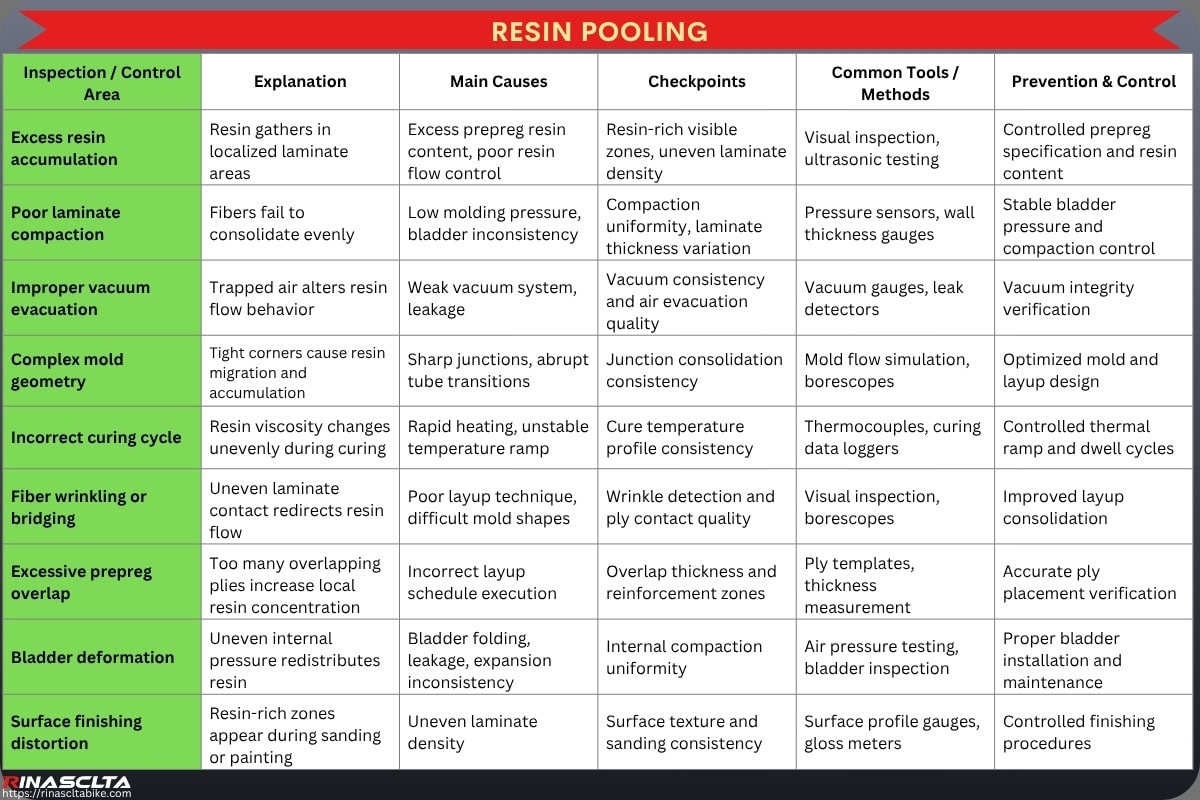
The resin pooling inspection process usually begins during layup and molding verification, where operators monitor fiber placement, overlap consistency, vacuum quality, bladder positioning, and laminate consolidation before the mold is closed. During curing, technicians continuously track temperature curves, internal pressure, resin flow behavior, and compaction stability to ensure the resin distributes evenly throughout the laminate structure. After demolding, inspectors examine both external surfaces and internal laminate quality using methods such as visual inspection, ultrasonic scanning, thermal imaging, wall-thickness measurement, borescope inspection, and section analysis to identify resin-rich zones that may indicate poor consolidation.
Advanced carbon bike manufacturers reduce resin pooling through a combination of optimized prepreg systems, precise resin-content control, staged vacuum debulking, stable bladder molding pressure, controlled cure cycles, EPS molding technology, mold-flow simulation software, and digital process monitoring systems. Engineering teams also carefully design the carbon layup schedule and mold geometry to improve resin distribution around high-complexity frame junctions. Since resin pooling often increases frame weight while reducing laminate efficiency and consistency, controlling this defect is essential for achieving the desired balance between lightweight performance, stiffness, durability, and production repeatability in high-performance carbon frameset manufacturing.
Paint defects
Paint defects in carbon bike frameset manufacturing refer to cosmetic or coating-related imperfections that appear during or after the painting, clear coating, curing, decal application, or finishing processes. Although many paint defects primarily affect appearance, they can also indicate deeper manufacturing problems such as surface contamination, poor laminate preparation, resin instability, sanding damage, moisture entrapment, or curing inconsistency, which may eventually influence coating durability, corrosion protection of inserts, consumer perception, warranty claims, and brand reputation. In premium carbon bicycle manufacturing, paint quality is especially important because modern framesets often use high-gloss finishes, exposed carbon weave, multi-layer graphics, matte coatings, UV-resistant clear coats, and lightweight paint systems, making even small defects highly visible under retail lighting and customer inspection.
| Inspection / Control Area | Explanation | Main Causes | Checkpoints | Common Tools / Methods | Prevention & Control |
| Orange peel | Uneven textured paint surface resembling citrus skin | Incorrect spray viscosity, poor atomization, improper curing | Surface smoothness and gloss uniformity | Gloss meters, LED inspection lighting | Controlled spray parameters and booth temperature |
| Paint runs and sags | Excess paint flows downward before curing | Over-application, low viscosity, improper spray angle | Vertical surface consistency | Visual inspection, paint thickness gauges | Controlled paint thickness and spray speed |
| Pinholes and bubbles | Small holes or trapped gas bubbles in coating | Solvent entrapment, moisture contamination, resin outgassing | Bubble formation near joints and curves | Magnification inspection, visual QC stations | Controlled drying and substrate preparation |
| Fish eyes / craters | Circular defects where paint fails to adhere evenly | Oil, silicone, grease, contamination | Surface contamination before spraying | Surface cleanliness testing, tack cloth inspection | Clean-room paint environment |
| Paint peeling / delamination | Coating separates from substrate or primer | Poor adhesion, improper sanding, curing incompatibility | Adhesion consistency at edges and inserts | Adhesion testing, cross-hatch testing | Proper primer preparation and curing control |
| Color inconsistency | Uneven shade or mismatch between frames | Incorrect mixing ratio, unstable spraying conditions | Color matching and layer consistency | Spectrophotometers, color reference panels | Standardized paint mixing procedures |
| Clear coat defects | Uneven gloss or transparent coating failure | Improper curing, contamination, humidity changes | Gloss level and optical clarity | Gloss meters, UV inspection | Stable curing and humidity control |
| Dust nibs and contamination | Foreign particles trapped in paint layers | Dirty spray booth, airborne contamination | Surface particle inspection | Clean-room inspection, filtered airflow systems | Controlled paint booth cleanliness |
| Sand-through defects | Exposed carbon fibers due to excessive sanding | Aggressive finishing or uneven sanding pressure | Surface thickness and fiber exposure | Thickness gauges, visual inspection | Controlled sanding process |
| Decal and graphic defects | Misalignment, bubbling, lifting, or print distortion | Poor decal application, trapped air, curing mismatch | Graphic positioning and adhesion | Alignment templates, visual inspection | Standardized decal installation procedures |
| Matte finish inconsistency | Uneven texture or gloss variation on matte coatings | Uneven coating thickness, curing variation | Surface texture consistency | Gloss meters, lighting inspection | Controlled spray overlap and curing |
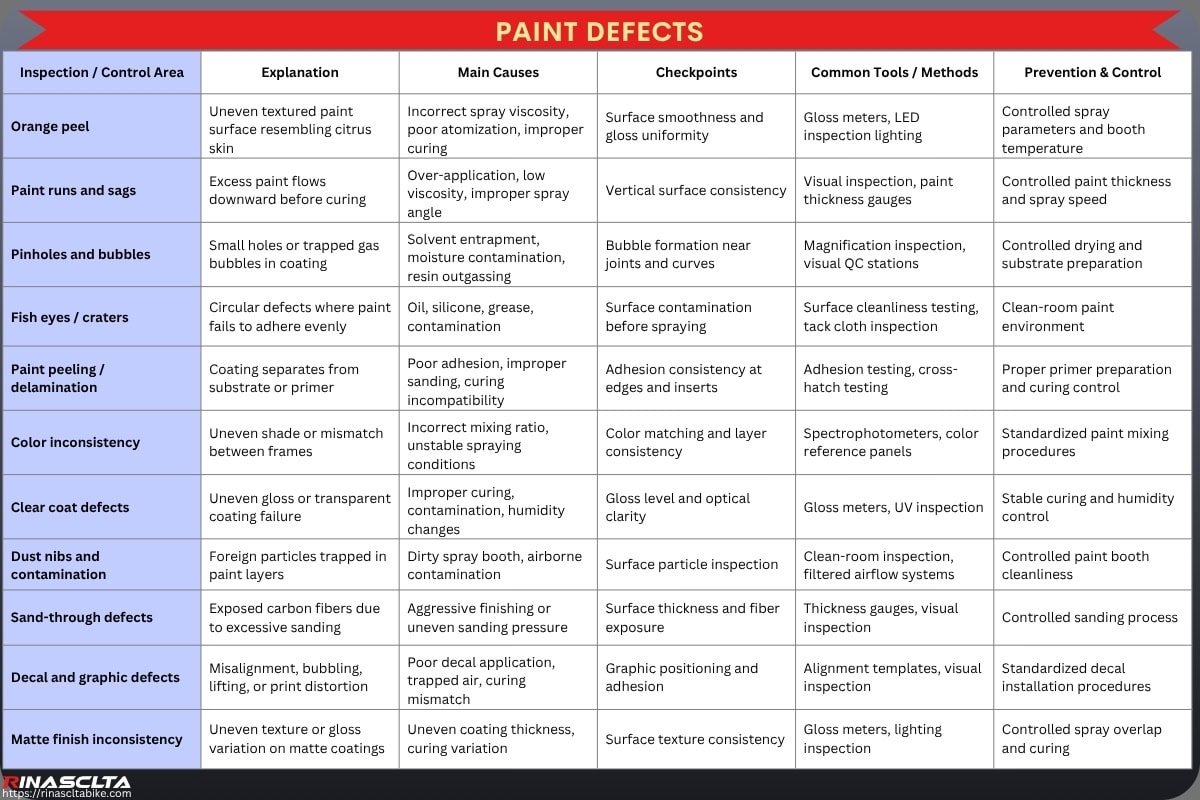
The paint defect inspection workflow usually begins after the frame completes surface preparation, sanding, primer coating, and cleaning, where inspectors verify that the laminate surface is free from contamination, exposed fibers, moisture, or uneven sanding marks before painting starts. During painting, operators monitor critical process parameters such as paint viscosity, spray pressure, nozzle atomization, booth temperature, humidity, flash-off time, coating thickness, and curing temperature to maintain coating consistency across production batches. After curing, the frame undergoes detailed visual inspection under controlled lighting conditions to identify cosmetic defects, especially around visually sensitive areas such as the head tube junction, bottom bracket shell, tube transitions, logo zones, and clear-coated exposed carbon sections.
Advanced carbon bike factories use technologies such as automated spray systems, filtered clean-room paint booths, digital paint mixing systems, infrared curing ovens, UV inspection lighting, spectrophotometers, gloss meters, and paint thickness gauges to improve finish consistency and reduce rejection rates. Since paint quality strongly influences consumer perception, retail presentation, OEM brand identity, and premium product positioning, high-end bicycle brands often establish extremely strict cosmetic acceptance standards for paint inspection, even when the underlying composite structure remains mechanically acceptable.
Carbon Bike Frameset Strength & Durability Testing
Carbon bike frameset strength and durability testing typically includes fatigue testing, impact testing, stiffness testing, and real-world simulation testing, because carbon composite bicycle frames must withstand complex combinations of cyclic loading, road vibration, torsional stress, rider power transfer, crash forces, and environmental conditions throughout their service life. Unlike static material evaluation alone, these testing systems are designed to verify how the complete frameset behaves under realistic riding conditions, helping manufacturers validate structural integrity, laminate design, safety margins, fatigue life, ride characteristics, compliance targets, and long-term durability before mass production and market release.
| Testing Type | Main Purpose | Key Features | How to Perform | How Data Helps Manufacturing | Common Tools / Machines | Common Standards |
| Fatigue testing | Evaluate long-term durability under repeated loading | Simulates millions of riding cycles on frame structure | Repeated cyclic loads applied to BB, seatpost, fork, or head tube | Identifies weak laminate zones, improves fatigue resistance and layup design | Servo-hydraulic fatigue rigs, cyclic loading machines, strain gauges | ISO 4210, EN 14781, CEN standards |
| Impact testing | Measure resistance to sudden impact or crash loads | Simulates collisions, potholes, rock strikes, and crash events | Controlled weight or force dropped onto frame or fork sections | Optimizes reinforcement placement and impact resistance | Drop-weight impact testers, pendulum impact systems, high-speed cameras | ISO 4210 impact protocols, CPSC requirements |
| Stiffness testing | Measure structural rigidity and power transfer efficiency | Evaluates torsional, lateral, and vertical stiffness | Controlled force applied while measuring deformation and deflection | Tunes ride feel, pedaling efficiency, handling balance, comfort | Torsional stiffness rigs, deflection measurement systems, laser sensors | Internal engineering standards, comparative benchmarking |
| Real-world simulation testing | Replicate actual riding conditions and combined loads | Simulates road vibration, sprinting, braking, cornering, terrain stress | Multi-axis dynamic loading based on rider data and field analysis | Validates complete frame durability and riding behavior | Multi-axis simulation rigs, vibration tables, telemetry systems | ISO validation procedures, OEM validation protocols |
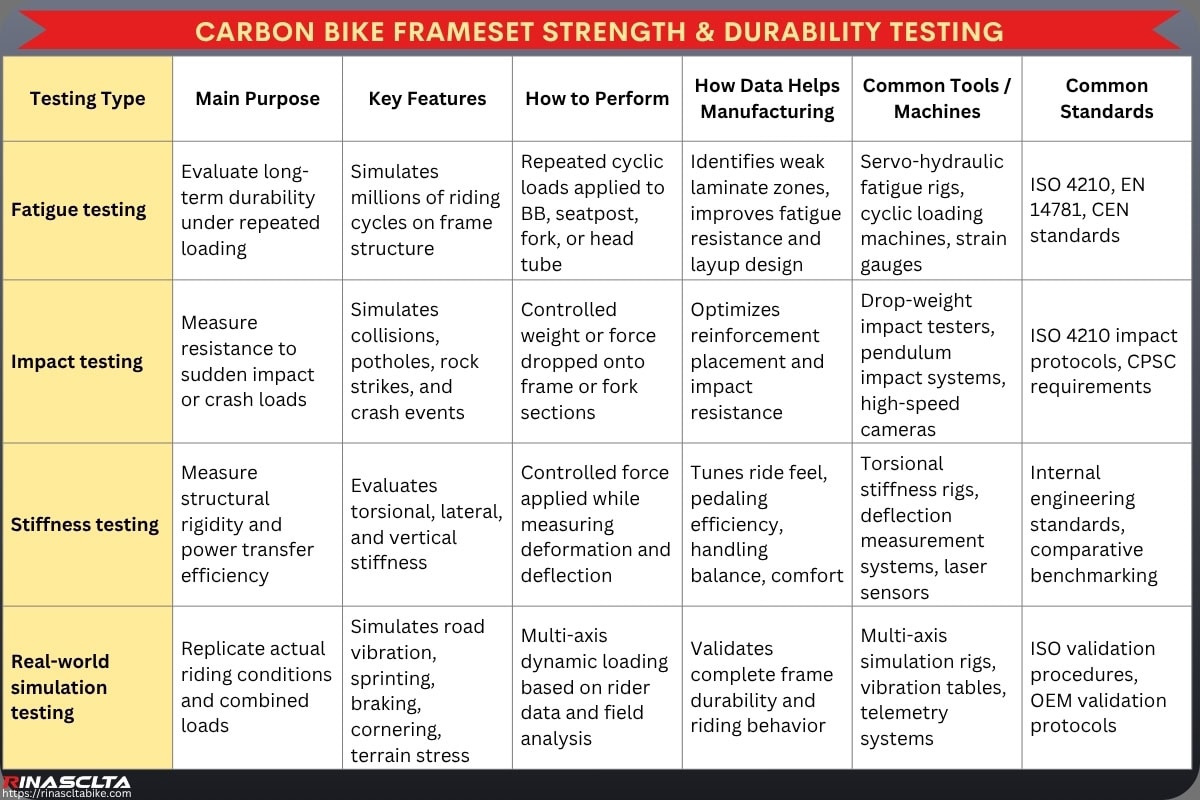
These testing systems are closely integrated with modern carbon frame engineering workflows involving finite element analysis (FEA), laminate optimization, material characterization, and digital simulation models, allowing manufacturers to continuously refine fiber orientation, wall thickness, reinforcement zones, resin systems, and frame geometry based on real performance data. For OEM factories and B2B bicycle brands, strength and durability testing also plays a critical role in reducing warranty risk, product recalls, liability exposure, and long-term failure rates, while ensuring compliance with international safety standards and maintaining consistent product quality across large-scale production.
Fatigue testing
Fatigue testing is one of the most important durability validation processes in carbon bike frameset manufacturing, used to evaluate how a frame behaves under repetitive cyclic loading over long periods of simulated riding use. Unlike static strength testing, which measures maximum force before failure, fatigue testing focuses on how the carbon laminate structure responds to millions of repeated stress cycles generated by pedaling, road vibration, braking, sprinting, climbing, cornering, and rider movement. Because carbon composites can gradually develop microcracks, delamination, resin fatigue, bonding degradation, and stiffness loss under cyclic stress, fatigue testing is essential for verifying long-term structural reliability, especially in high-load areas such as the bottom bracket shell, head tube junction, seat tube cluster, chainstay bridge, and rear dropout interfaces.
Modern fatigue testing is usually based on international standards such as ISO 4210, EN standards, CEN protocols, CPSC requirements, and internal OEM engineering specifications, with test parameters adjusted according to bicycle category (road, gravel, MTB, e-bike, cargo bike) and intended rider weight class. Most high-end carbon bicycle manufacturers additionally apply internal safety factors above minimum regulatory requirements to simulate aggressive riding conditions and extended product lifespan expectations.
| Fatigue Test Area | Main Purpose | Typical Test Method | Common Load / Cycle Values | Key Checkpoints | Common Tools / Machines | Evaluation Criteria |
| Pedaling fatigue test | Simulate repetitive pedaling loads at BB area | Alternating lateral and vertical crank loads | 50,000–250,000+ cycles depending on standard | BB stiffness retention, crack formation, laminate integrity | Servo-hydraulic fatigue rigs, strain gauges | No structural failure or excessive deformation |
| Vertical frame fatigue test | Simulate rider body weight and road vibration | Repeated vertical load applied through seatpost | 100,000–500,000+ cycles | Seat tube, top tube, seatstay fatigue resistance | Vertical fatigue testing machines | No cracking, delamination, or geometry shift |
| Head tube fatigue test | Simulate steering and front-end impacts | Cyclic horizontal force applied to fork/head tube | 50,000–150,000+ cycles | Head tube bonding, steering stiffness, junction integrity | Multi-axis fatigue rigs | No separation or stiffness loss |
| Rear triangle fatigue test | Simulate drivetrain and rear wheel stress | Repeated lateral and torsional loading | Variable cyclic load profiles | Chainstay and dropout durability | Dynamic loading systems | No dropout or stay failure |
| Fork fatigue test | Simulate braking and steering loads | Cyclic fore-aft loading through fork | Standardized cyclic force testing | Fork crown, steerer, dropout stability | Fork fatigue test rigs | No structural fracture |
| Combined load fatigue test | Simulate real-world multi-directional riding loads | Multi-axis dynamic load simulation | Combined cyclic loading profiles | Whole-frame structural interaction | Multi-axis simulation platforms | Stable long-term structural performance |
| E-bike fatigue test (if applicable) | Simulate higher torque and system weight | Increased cyclic loading and vibration | Higher force and cycle counts | Motor mount and BB reinforcement durability | High-load servo systems | Compliance under e-bike stress conditions |
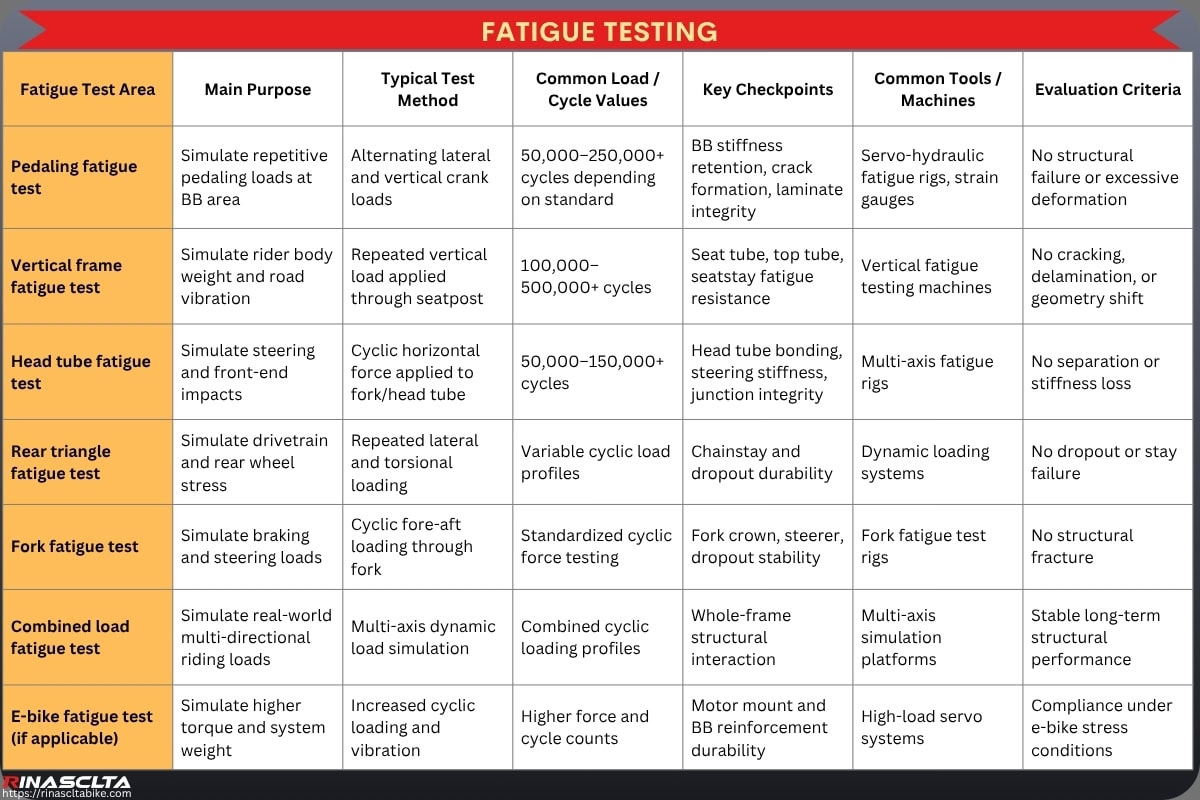
The fatigue testing process generally begins by mounting the frameset onto a dedicated fatigue test rig or servo-hydraulic simulation machine, where actuators apply repeated loads to critical structural areas according to a predefined test protocol. Engineers first define the testing parameters based on the frame category, rider weight targets, intended use conditions, and required certification standards. During testing, sensors continuously monitor variables such as deflection, strain, displacement, crack initiation, stiffness reduction, vibration response, and load consistency, while high-cycle fatigue systems may run continuously for several days or weeks depending on the required cycle count.
Typical fatigue testing rider-weight assumptions often range from approximately 75–120 kg system weight depending on bicycle category and intended use, while aggressive MTB or e-bike testing may use significantly higher dynamic load multipliers to simulate extreme riding conditions. Throughout the test, inspectors regularly check for early signs of fiber cracking, resin fracture, delamination, joint separation, insert loosening, geometry distortion, paint cracking, or stiffness degradation, particularly around high-stress junctions. After completion, the frame often undergoes additional ultrasonic inspection, X-ray analysis, dimensional verification, and destructive section analysis to evaluate hidden structural damage that may not be externally visible.
Advanced carbon bike manufacturers increasingly combine physical fatigue testing with finite element analysis (FEA), digital twin simulation, telemetry-based rider data collection, and strain mapping systems to optimize carbon layup architecture and improve durability without excessive weight gain. Since fatigue performance directly influences warranty rates, rider safety, product lifespan, brand reputation, and international certification approval, fatigue testing is considered one of the most critical validation stages in modern carbon frameset engineering and OEM production.
Impact testing
Impact testing is a critical validation process in carbon bike frameset manufacturing used to evaluate how a frame or fork responds to sudden high-energy loads and crash-type forces that occur during real-world riding situations such as pothole strikes, rock impacts, curb hits, crashes, hard landings, or frontal collisions. Unlike fatigue testing, which focuses on long-term cyclic durability, impact testing measures the frame’s ability to absorb and redistribute short-duration forces without catastrophic structural failure. Because carbon composites behave differently from metals under impact loading—often failing through fiber fracture, matrix cracking, delamination, local crushing, or laminate separation rather than gradual bending—impact testing is essential for validating rider safety, structural integrity, and damage tolerance in high-performance bicycle framesets.
Modern impact testing is generally based on standards such as ISO 4210, EN standards, CPSC regulations, DIN protocols, and internal OEM validation procedures, with testing severity adjusted according to bicycle category including road bikes, gravel bikes, MTB, downhill bikes, and e-bikes. High-end manufacturers often apply internal safety margins significantly above minimum certification requirements to simulate aggressive riding conditions and real-world accident scenarios.
| Impact Test Area | Main Purpose | Typical Test Method | Common Load / Energy Values | Key Checkpoints | Common Tools / Machines | Evaluation Criteria |
| Frontal impact test | Simulate collision or curb strike at front end | Weighted mass dropped onto fork/front wheel area | Approx. 20–50+ kg impact mass depending on category | Head tube integrity, fork crown strength, steering area damage | Drop-weight impact rigs, high-speed cameras | No catastrophic fracture or steering separation |
| Falling mass frame impact test | Simulate top-tube or downtube strike | Controlled impactor dropped onto frame surface | Specified impact energy (Joules) based on standard | Local crushing, delamination, crack propagation | Instrumented drop towers, force sensors | Controlled damage without structural collapse |
| Bottom bracket impact test | Simulate rock strike or landing force | Direct impact applied to BB region | Variable energy and impact geometry | BB shell integrity, laminate crushing | Pendulum impact testers, load cells | No structural separation |
| Rear triangle impact test | Simulate chainstay or dropout impact | Side or vertical impact on rear structure | Category-specific force levels | Dropout alignment and stay integrity | Impact hammers, high-speed video systems | No major geometry shift |
| Fork impact test | Simulate braking and frontal shock loads | Dynamic impact force through fork system | Standardized impact mass and velocity | Steerer tube and dropout integrity | Fork impact rigs, strain gauges | No fork fracture or separation |
| Side impact test | Simulate crash or lateral strike | Side-directed impact on frame sections | Controlled lateral impact energy | Tube denting, laminate cracking | Side-impact rigs, acoustic sensors | No unsafe crack propagation |
| Stone strike simulation | Simulate debris or trail impacts | Small focused impact on vulnerable zones | Smaller concentrated impact energy | Surface cracking and paint damage | Instrumented impact tools | Controlled cosmetic or local damage only |
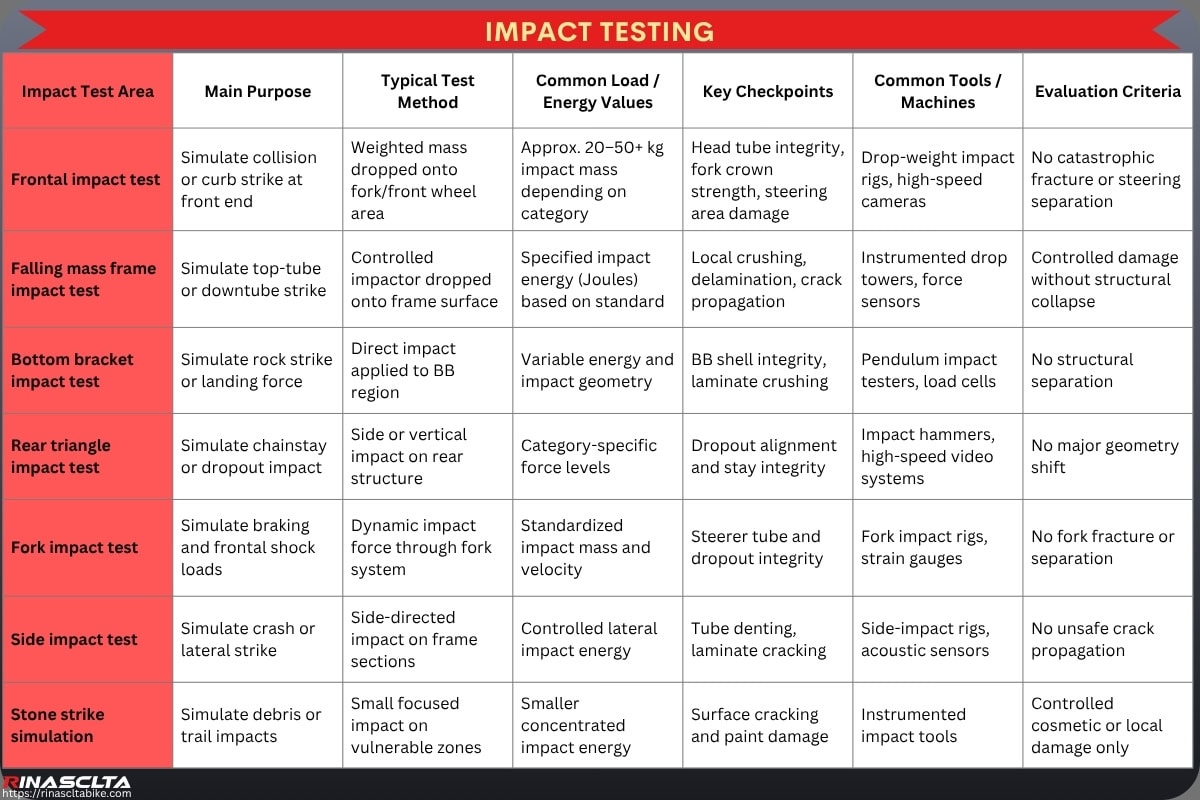
The impact testing process typically begins by mounting the frame or fork onto a dedicated impact test fixture that reproduces real-world bicycle loading conditions while controlling the direction and energy of the impact event. Engineers first determine the testing parameters based on the bicycle category, rider weight assumptions, intended terrain, and certification requirements. The impact energy is then generated using systems such as drop-weight towers, pendulum impact devices, hydraulic actuators, or instrumented falling masses, while sensors record variables including force, acceleration, displacement, strain response, crack propagation, and energy absorption behavior during the event.
Typical impact testing assumptions often include rider system weights ranging from approximately 75–120 kg, with MTB, downhill, gravel, and e-bike categories generally requiring significantly higher impact energy levels due to harsher riding environments and greater dynamic loads. After each test, inspectors evaluate the frameset for visible and hidden damage using methods such as visual inspection, ultrasonic testing, tap testing, thermal imaging, X-ray scanning, borescopes, and dimensional alignment verification, focusing especially on high-stress areas including the head tube junction, bottom bracket shell, fork crown, seat cluster, and dropout interfaces.
Advanced carbon bike manufacturers increasingly integrate physical impact testing with finite element analysis (FEA), crash simulation software, strain mapping systems, and telemetry-based field data to improve laminate architecture and reinforcement placement without excessive weight increases. Since impact resistance directly affects rider safety, crash survivability, warranty claims, liability risk, and brand reputation, impact testing has become one of the most important structural validation procedures in modern carbon bicycle engineering and OEM quality assurance systems.
Stiffness testing
Stiffness testing is used to measure how much a carbon bike frameset deflects under controlled loads, showing how efficiently the frame transfers pedaling power, resists twisting, maintains steering precision, and balances comfort with performance. Unlike fatigue or impact testing, stiffness testing is usually not about breaking the frame, but about quantifying bottom bracket stiffness, head tube stiffness, torsional stiffness, lateral stiffness, vertical compliance, fork stiffness, and rear triangle stiffness against engineering targets, rider weight assumptions, frame size, bicycle category, and internal OEM standards.
| Stiffness Test Area | Main Purpose | How to Test | Typical Load / Test Setup | Key Checkpoints | Common Tools / Machines | How Data Helps Manufacturing |
| Bottom bracket stiffness | Measure pedaling power transfer | Clamp the frame and apply lateral or torsional force at the crank/BB area | Controlled force applied near BB shell or crank arm position | BB deflection, laminate flex, insert stability | BB stiffness rig, load cells, dial gauges, laser displacement sensors | Optimizes layup around BB shell, down tube, chainstays, and seat tube |
| Head tube stiffness | Measure steering precision and front-end rigidity | Fix the frame and apply side or torsional load through the head tube/fork interface | Load applied through fork dummy axle or steering axis | Head tube deflection, fork interface movement, tube junction stability | Head tube stiffness rig, torque arm, displacement sensors | Improves handling stability and reinforcement around head tube/top tube/down tube |
| Torsional stiffness | Measure resistance to frame twisting | Apply opposing forces between front triangle, rear triangle, and BB area | Frame fixed at axle points while torque is applied | Twist angle, frame symmetry, load-path behavior | Torsion test rig, angle sensors, strain gauges | Helps tune frame responsiveness and cornering stability |
| Lateral stiffness | Measure side-to-side frame resistance | Apply side load to BB, saddle area, or rear axle | Category-specific lateral load based on internal standard | Side deflection, rear triangle flex, dropout stability | Lateral load rig, laser sensors, CMM reference points | Reduces power loss, brake rub, and drivetrain movement |
| Vertical compliance | Measure comfort and vibration response | Apply vertical load through saddle, seatpost, or rear axle | Simulated rider load and road vibration input | Seat tube deflection, seatstay compliance, comfort response | Vertical compliance rig, vibration table, accelerometers | Tunes ride comfort without sacrificing safety or stiffness |
| Fork stiffness | Measure braking and steering stability | Apply fore-aft or lateral loads through fork blades and steerer | Load applied at dropout or axle interface | Fork blade deflection, steerer movement, brake alignment | Fork stiffness rig, load cells, displacement gauges | Improves braking stability, handling accuracy, and fork safety |
| Rear triangle stiffness | Measure drivetrain and rear wheel stability | Apply lateral/torsional force through rear axle or dropout | Rear axle fixed or loaded under controlled force | Dropout movement, chainstay/seatstay deflection | Rear triangle fixture, laser displacement sensor | Improves wheel tracking, shifting accuracy, and disc brake alignment |
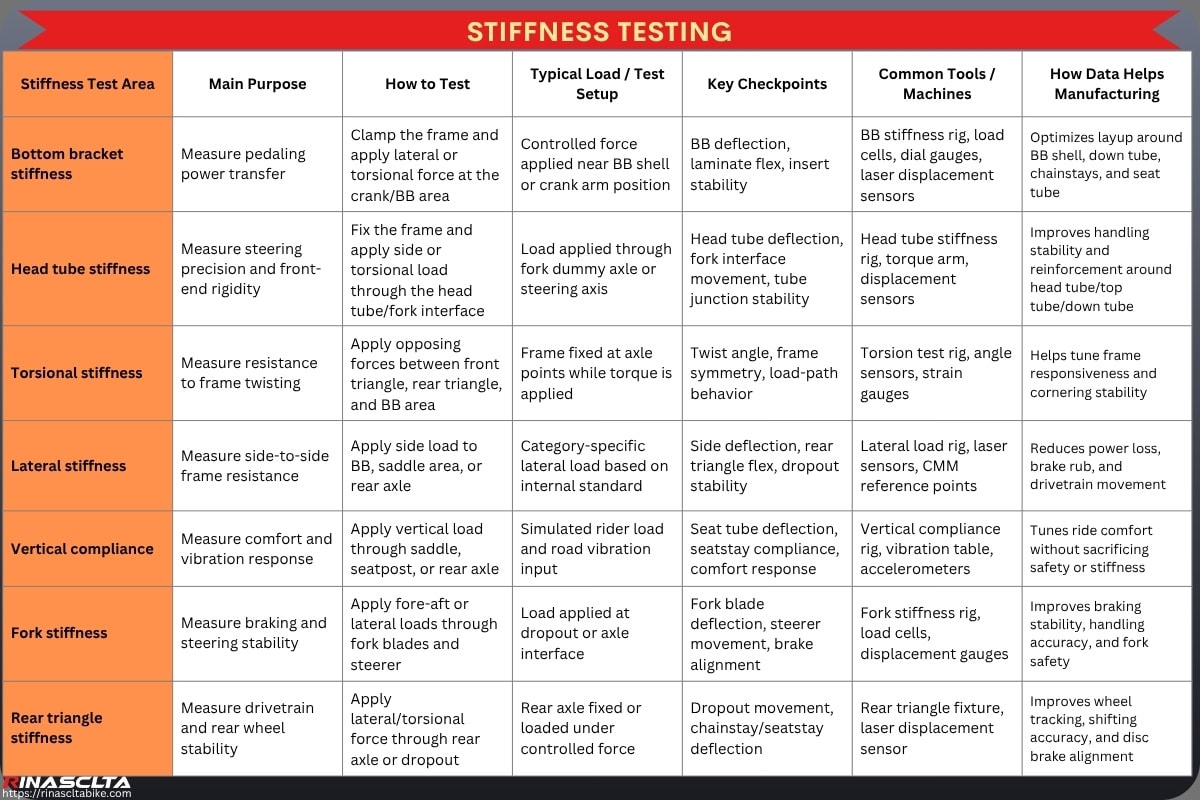
The stiffness testing process usually begins by mounting the frameset into a calibrated test fixture using reference points such as the front axle, rear axle, bottom bracket shell, head tube, fork interface, and seatpost area, then applying a controlled force or torque while measuring frame deflection with load cells, strain gauges, dial indicators, laser displacement sensors, accelerometers, or digital data acquisition systems. Test values are normally based on engineering drawings, frame size, intended rider weight, bike category, target ride feel, internal benchmark frames, and OEM performance requirements, and while there is no single universal stiffness number for every carbon frame, manufacturers often compare results across production batches to ensure consistency and to prevent frames that feel too soft, too harsh, or structurally unbalanced.
The key checkpoints include repeatability of deflection values, left-right symmetry, BB shell stability, head tube junction movement, rear dropout displacement, fork tracking, and stiffness retention after fatigue or impact testing, because stiffness data helps engineers refine carbon layup schedules, fiber orientation, wall thickness, reinforcement zones, resin systems, and mold design. For B2B clients, stiffness testing provides measurable value by proving that framesets deliver consistent power transfer, handling precision, braking stability, comfort targets, and product positioning, while also reducing warranty risk caused by excessive flex, poor alignment, creaking interfaces, or inconsistent ride quality across production batches.
Real-world simulation testing
Real-world simulation testing is an advanced durability and performance validation process used to reproduce actual riding conditions experienced by carbon bike framesets during road riding, gravel riding, mountain biking, sprinting, braking, climbing, cornering, descending, vibration exposure, and impact events. Unlike isolated laboratory tests such as simple fatigue or stiffness testing, real-world simulation combines multi-directional dynamic loads, variable frequencies, vibration patterns, rider movement, and terrain-specific stress profiles into a single integrated testing system that more accurately represents how a bicycle behaves during real use. Because modern carbon frames are optimized for extremely lightweight performance while still meeting strict durability and safety targets, manufacturers increasingly rely on real-world simulation testing to validate laminate behavior, long-term structural integrity, ride characteristics, and failure resistance before mass production.
| Simulation Test Area | Main Purpose | How to Test | Typical Load / Simulation Parameters | Key Checkpoints | Common Tools / Machines | How Data Helps Manufacturing |
| Road vibration simulation | Reproduce repetitive road surface vibration | Multi-axis vibration input through wheel contact points | Variable-frequency vibration cycles | Crack initiation, joint stability, stiffness retention | Hydraulic vibration tables, accelerometers | Optimizes fatigue resistance and ride comfort |
| Sprint and power simulation | Simulate high rider torque and acceleration loads | Dynamic lateral and torsional force through BB/crank area | High-torque cyclic load patterns | BB stability, drivetrain stiffness, laminate response | Servo-hydraulic actuators, strain gauges | Improves pedaling efficiency and power transfer |
| Braking simulation | Reproduce repeated braking forces and load transfer | Cyclic braking loads through fork and rear triangle | Fore-aft dynamic loading cycles | Fork crown integrity, brake mount stability | Brake simulation rigs, force sensors | Enhances braking safety and structural reinforcement |
| Cornering simulation | Simulate lateral leaning and steering loads | Multi-directional side loading during dynamic movement | Variable lateral torsional force input | Head tube stiffness, wheel tracking stability | Multi-axis simulation rigs | Refines handling behavior and frame balance |
| Off-road terrain simulation | Reproduce gravel and MTB terrain impact patterns | Combined vibration and impact loading sequences | Randomized terrain force profiles | Chainstay durability, dropout integrity | Terrain simulation platforms, shaker systems | Improves off-road durability and impact resistance |
| Rider weight simulation | Simulate different rider body weights and riding styles | Variable vertical and dynamic load application | Approx. 75–120+ kg equivalent system loads | Seat tube response, frame deflection consistency | Hydraulic loading systems | Validates performance across rider categories |
| Long-distance endurance simulation | Reproduce extended riding lifecycle conditions | Continuous multi-axis cyclic loading over long durations | Millions of dynamic load cycles | Fatigue propagation and stiffness degradation | High-cycle endurance rigs | Predicts long-term product lifespan |
| E-bike torque simulation | Simulate motor-assisted loading conditions | Combined rider and motor torque cycling | Higher torque and vibration profiles | Motor mount durability and BB reinforcement | High-load dynamic simulation rigs | Validates e-bike structural reinforcement |
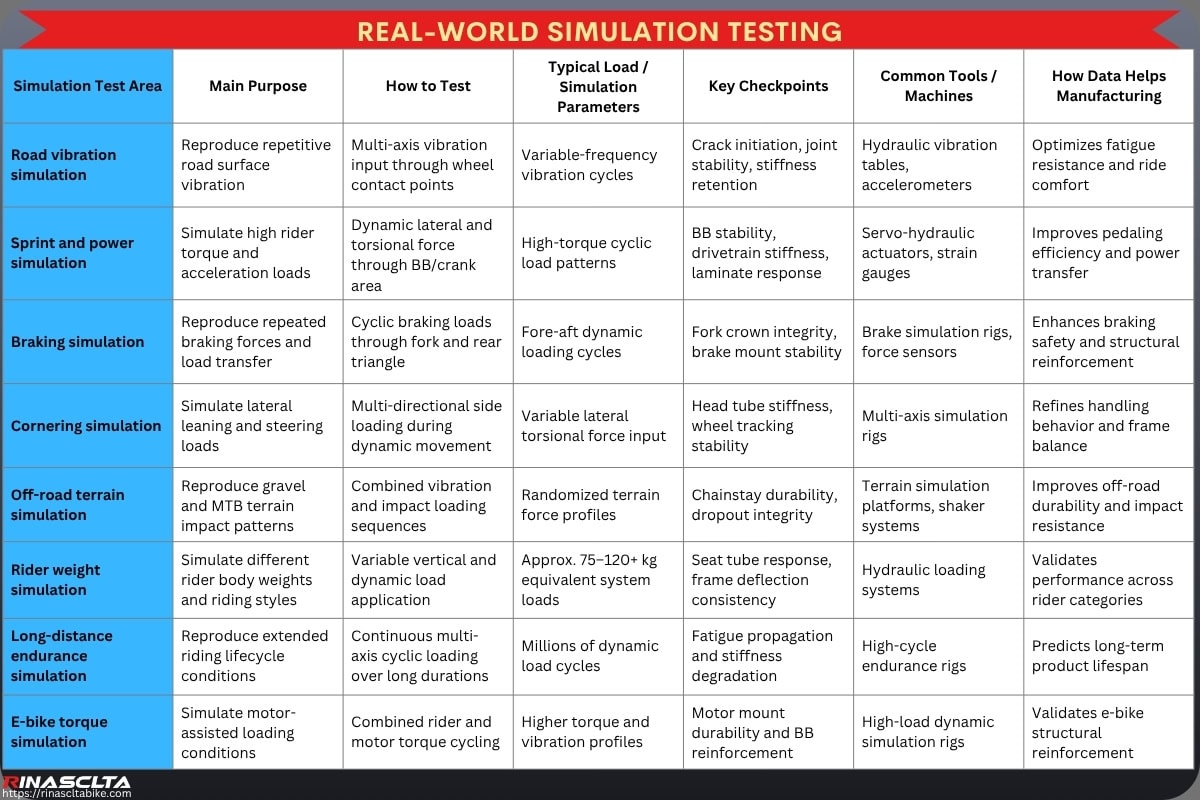
The real-world simulation testing process generally starts by collecting or defining real riding load data using methods such as telemetry sensors, strain gauges, accelerometers, rider force mapping, GPS ride analysis, and field testing on actual bicycles. Engineers then convert this real-world data into programmable load profiles for advanced multi-axis servo-hydraulic simulation systems, which apply simultaneous vertical, lateral, torsional, braking, and vibration loads to the frameset under controlled laboratory conditions. These systems can continuously reproduce realistic riding patterns for hundreds of thousands or even millions of cycles while monitoring variables such as strain distribution, displacement, vibration response, crack initiation, stiffness retention, laminate behavior, and geometry stability.
Typical rider and system-weight assumptions usually range from approximately 75–120 kg, with higher safety multipliers used for aggressive MTB, downhill, cargo bike, and e-bike categories. The test duration and cycle count depend on the bicycle category and internal OEM durability targets, with some simulation programs running continuously for several days or weeks to replicate years of riding exposure. During and after testing, inspectors evaluate the frameset using visual inspection, ultrasonic scanning, X-ray analysis, tap testing, dimensional alignment measurement, stiffness retesting, and destructive section analysis to identify hidden damage or progressive structural degradation.
Advanced carbon frame manufacturers increasingly integrate real-world simulation with finite element analysis (FEA), digital twin modeling, AI-assisted load prediction, machine learning analysis, telemetry databases, and automated process feedback systems to accelerate frame development and improve manufacturing precision. Since this testing method closely replicates actual rider use conditions, it provides extremely valuable data for optimizing carbon layup schedules, reinforcement placement, tube profiles, wall thickness distribution, resin systems, vibration damping characteristics, and overall ride quality, while also helping OEM brands reduce warranty risk, field failures, product recalls, and long-term durability uncertainty in modern carbon bicycle production.
Non-Destructive Carbon Bike Frameset Inspection Methods
Non-destructive carbon bike frameset inspection methods commonly include tap testing, ultrasonic testing, and X-ray inspection, because carbon composite defects such as voids, delamination, resin-rich zones, fiber distortion, hidden cracks, bonding failures, and internal impact damage are often difficult or impossible to detect through visual inspection alone. Since carbon bicycle frames depend heavily on the integrity of the internal laminate structure and bonded interfaces, manufacturers use non-destructive testing (NDT) methods to evaluate hidden structural conditions without cutting, damaging, or destroying the frameset, allowing factories to maintain production efficiency while ensuring safety, durability, dimensional consistency, and compliance with OEM and international quality standards.
| Inspection Method | Main Purpose | Key Features | How to Perform | How Data Helps Manufacturing | Common Tools / Machines | Common Standards / References |
| Tap testing | Detect localized delamination or voids | Simple acoustic-based inspection using sound variation | Surface is lightly tapped while inspector listens for tonal changes | Quickly identifies potential laminate separation or weak zones | Tap hammers, acoustic sensors, trained operator inspection | Internal QC procedures, aerospace composite inspection practices |
| Ultrasonic testing (UT) | Detect internal defects and laminate inconsistencies | Uses high-frequency sound waves to analyze internal structure | Ultrasonic probe scans frame while software analyzes wave reflection and attenuation | Identifies voids, delamination, bonding defects, wall-thickness variation | Ultrasonic flaw detectors, phased-array UT systems, coupling gels | ASTM composite NDT standards, aerospace UT practices |
| X-ray inspection | Visualize hidden internal structural conditions | Produces internal imaging of laminate and bonded sections | Frame is exposed to controlled X-ray radiation for structural imaging | Detects cracks, voids, insert misalignment, fiber distortion, foreign material | Industrial X-ray systems, digital radiography, CT scanners | Industrial radiographic inspection standards |
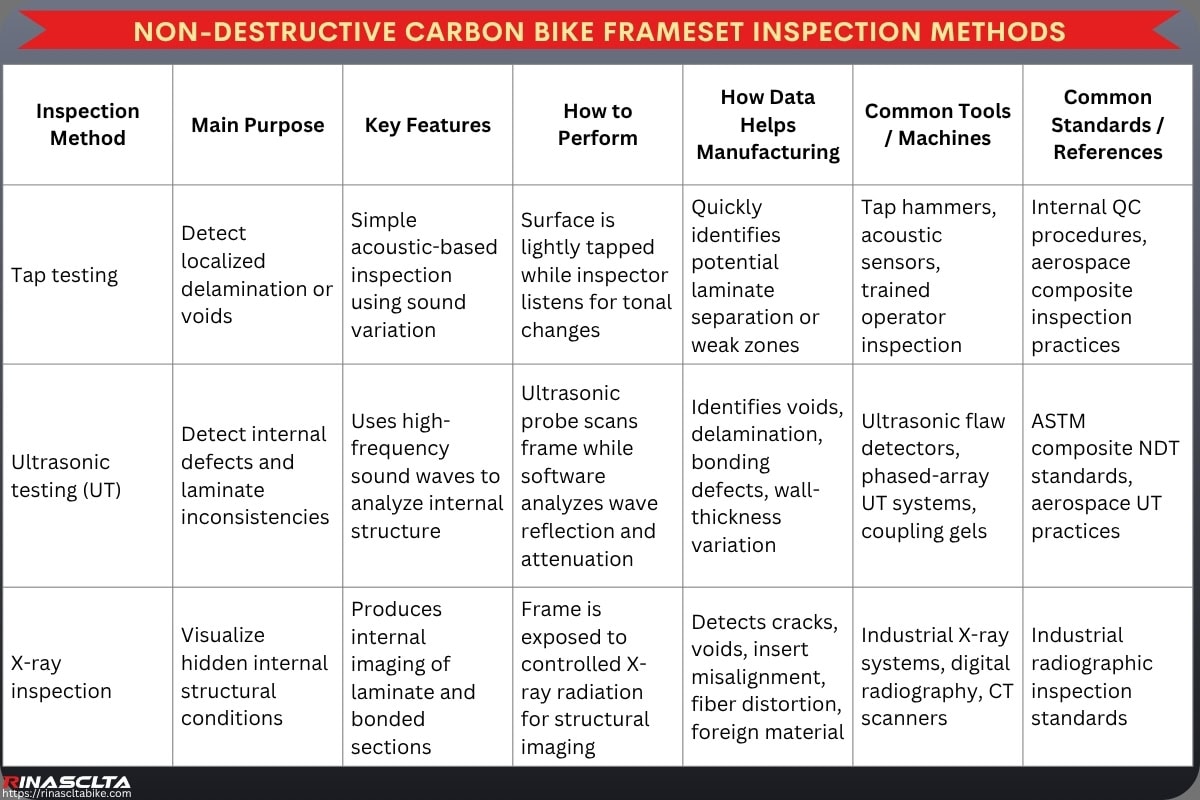
These NDT methods are especially important in carbon bike manufacturing because many structural defects develop internally during layup, molding, curing, bonding, machining, transport, or impact events, while remaining partially invisible on the surface. Advanced OEM factories often integrate NDT systems into multiple stages of production and validation workflows—including incoming QC, post-curing inspection, failure analysis, fatigue testing validation, warranty investigation, and prototype development—to improve laminate consistency, optimize carbon layup architecture, reduce rejection rates, and maintain long-term product reliability across large-scale carbon frameset manufacturing.
Tap testing
Tap testing is a simple but widely used non-destructive inspection (NDT) method in carbon bike frameset manufacturing that detects internal defects by analyzing the acoustic response and vibration behavior of the composite structure when lightly tapped. Because carbon composites transmit sound and vibration differently depending on laminate integrity, areas with defects such as delamination, voids, crushed core material, bonding failure, internal cracking, or resin separation produce a noticeably different sound compared to properly consolidated laminate regions. A healthy carbon structure usually produces a sharp, crisp, and high-frequency sound, while defective areas often generate a dull, hollow, muted, or low-frequency tone due to reduced internal stiffness and disrupted load transfer within the laminate.
Tap testing is commonly used during post-curing inspection, warranty evaluation, crash damage analysis, prototype validation, and final QC inspection, especially in areas that are difficult to evaluate visually. Although it is considered less precise than ultrasonic or X-ray inspection, it remains valuable because it is fast, low-cost, portable, and highly effective for detecting larger delaminations or local structural separation in production and service environments.
| Inspection Area | Main Purpose | How to Perform | Key Checkpoints | Common Tools / Methods | Detection Capability | Limitations |
| Head tube junction | Detect delamination and impact damage near steering loads | Lightly tap around tube intersections while listening for tonal variation | Hollow sound, vibration inconsistency, localized damping | Tap hammer, coin tap, acoustic tap device | Delamination, bonding separation | Small defects may be difficult to detect |
| Bottom bracket shell | Inspect high-stress pedaling area | Systematic tapping around BB junction and chainstay connection | Tone change, resonance reduction | Phenolic hammer, electronic acoustic sensor | Internal laminate separation | Thick laminate may reduce sensitivity |
| Seat cluster and seat tube | Detect cracks and local laminate failure | Tap along seat tube and junction areas | Dull response and reduced resonance | Manual tap testing, acoustic monitoring | Localized structural weakness | Requires experienced inspector |
| Chainstay and seatstay areas | Inspect drivetrain and impact-prone zones | Sequential tapping along stay structures | Acoustic inconsistency and vibration change | Coin tap, lightweight composite hammer | Impact damage and voids | Difficult in complex geometry |
| Fork crown and steerer | Evaluate steering-related structural integrity | Tap around crown and steerer interface | Sound damping or hollow resonance | Acoustic tap system | Delamination near bonded sections | Limited depth resolution |
| Bonded insert areas | Detect adhesive failure or insert separation | Tap around BB inserts, dropout inserts, brake mounts | Hollow sound near bonding interface | Precision tap inspection | Bond failure and insert looseness | Limited quantitative measurement |
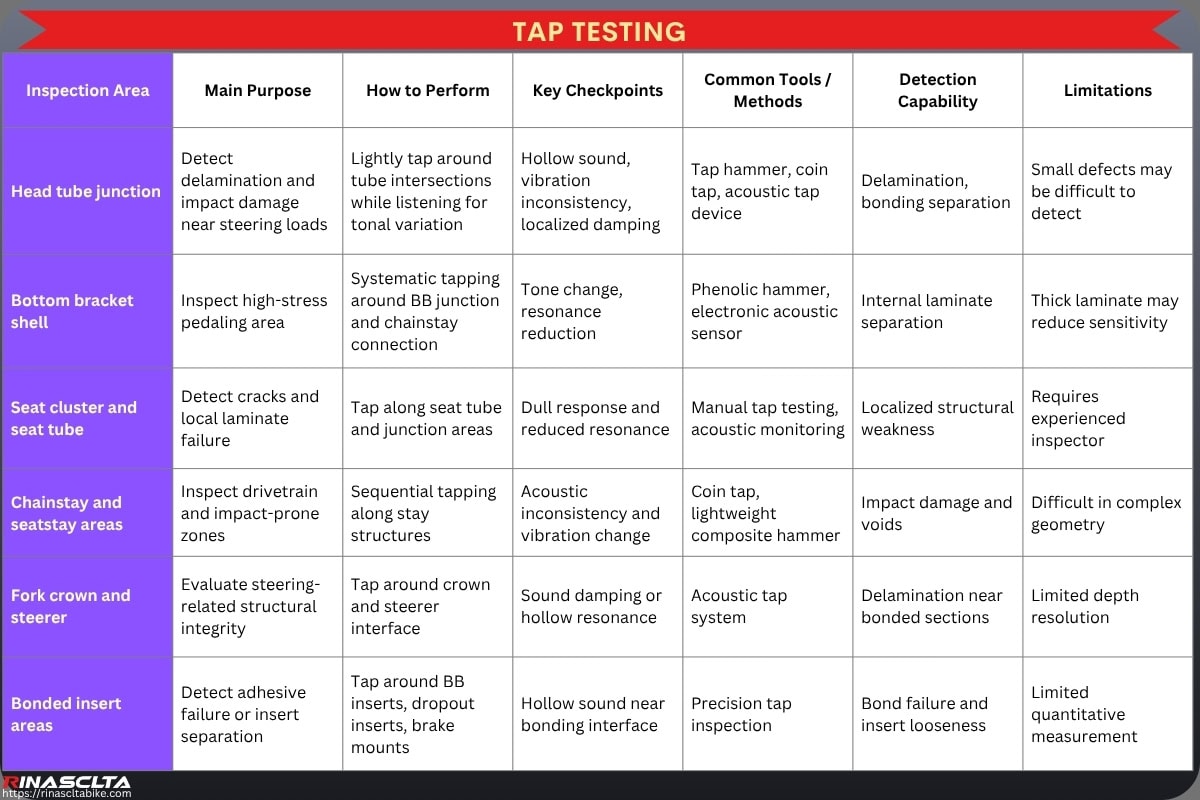
The tap testing process generally starts by placing the frameset in a stable inspection position under controlled acoustic conditions. Inspectors then use a lightweight tap hammer, coin, phenolic striker, or electronic acoustic device to gently tap the frame surface in a systematic grid pattern while carefully listening to the resulting sound and feeling vibration feedback through the tool or hand. Inspection is usually concentrated around structurally sensitive regions such as the head tube junction, bottom bracket shell, chainstay bridge, seat cluster, fork crown, and bonded interfaces, where delamination and impact damage are more likely to occur.
In advanced production environments, electronic tap testing systems may combine acoustic sensors, digital frequency analysis, vibration measurement, and waveform comparison software to reduce operator subjectivity and improve consistency. However, traditional manual tap testing still depends heavily on inspector training and experience because the method is largely comparative—inspectors compare suspicious areas against known healthy laminate sections to identify abnormal acoustic behavior.
Tap testing does not usually provide exact quantitative defect dimensions or depth information, and it is less effective for detecting very small voids, deeply buried defects, or complex multi-layer damage compared to ultrasonic or X-ray systems. For this reason, manufacturers often use tap testing as a rapid screening method, followed by more advanced NDT techniques if abnormal acoustic responses are detected. Despite its simplicity, tap testing remains an important inspection tool in carbon bike manufacturing because it provides a fast and efficient way to identify potential structural problems before frames enter final assembly, testing, shipping, or warranty evaluation.
Ultrasonic testing
Ultrasonic testing (UT) is one of the most advanced and widely used non-destructive inspection (NDT) methods in carbon bike frameset manufacturing, used to detect hidden internal defects by transmitting high-frequency sound waves through the composite structure and analyzing how those waves are reflected, absorbed, scattered, or transmitted inside the laminate. Because carbon bicycle frames are composed of layered composite materials with complex internal structures, many critical defects such as voids, delamination, dry spots, resin-rich zones, fiber waviness, bonding failure, internal cracks, wall-thickness variation, and impact damage may remain invisible externally while significantly reducing structural performance. Ultrasonic testing allows manufacturers to inspect these internal conditions without cutting or damaging the frame, making it a critical quality control tool for high-end carbon composite production.
The inspection principle is based on acoustic wave propagation: properly consolidated carbon laminate transmits ultrasonic waves consistently, while defects create changes in wave reflection, attenuation, time-of-flight, amplitude, or signal continuity. These signal variations are interpreted by trained inspectors or software systems to identify the location, size, and severity of internal structural defects. Ultrasonic testing is commonly used during post-curing inspection, prototype validation, fatigue test evaluation, crash damage analysis, incoming QC verification, and final production inspection in premium OEM carbon bicycle manufacturing.
| Inspection Area | Main Purpose | How to Perform | Key Checkpoints | Common Tools / Machines | Detection Capability | Limitations |
| Head tube junction | Detect delamination and high-stress laminate defects | Ultrasonic probe scans around tube intersections using coupling medium | Signal reflection changes, wave attenuation | Portable UT flaw detector, phased-array UT system | Delamination, voids, bonding defects | Complex geometry can reduce signal quality |
| Bottom bracket shell | Inspect heavily reinforced drivetrain area | Multi-angle ultrasonic scanning around BB shell | Internal laminate continuity and wall thickness | UT probes, digital signal analyzer | Resin pooling, dry spots, internal cracks | Thick laminate reduces penetration depth |
| Chainstay and seatstay areas | Detect fatigue and impact-related damage | Sequential scan along stay structures | Signal consistency and defect localization | Linear scanning systems, phased-array UT | Fatigue cracking and fiber separation | Curved sections complicate scanning |
| Fork crown and steerer | Evaluate steering-related structural integrity | Probe scans around crown, steerer, and bonded joints | Reflection discontinuities and laminate separation | High-frequency UT probes | Bonding defects and hidden cracks | Small-radius geometry affects coupling |
| Bonded insert interfaces | Detect adhesive failure and insert separation | Focused scanning around inserts and interfaces | Bond line continuity and interface integrity | Precision UT probes | Insert debonding and adhesive gaps | Metal inserts may distort signals |
| Seat cluster and top tube | Inspect rider load and compliance zones | Full laminate sweep scan | Layer continuity and local damage | Automated scanning systems | Localized delamination and impact damage | Thin laminates may create signal noise |
| Entire frame laminate mapping | Create full structural inspection profile | Automated phased-array scanning across frame | Defect mapping and thickness consistency | Robotic phased-array UT systems | Comprehensive laminate analysis | Expensive and time-consuming |
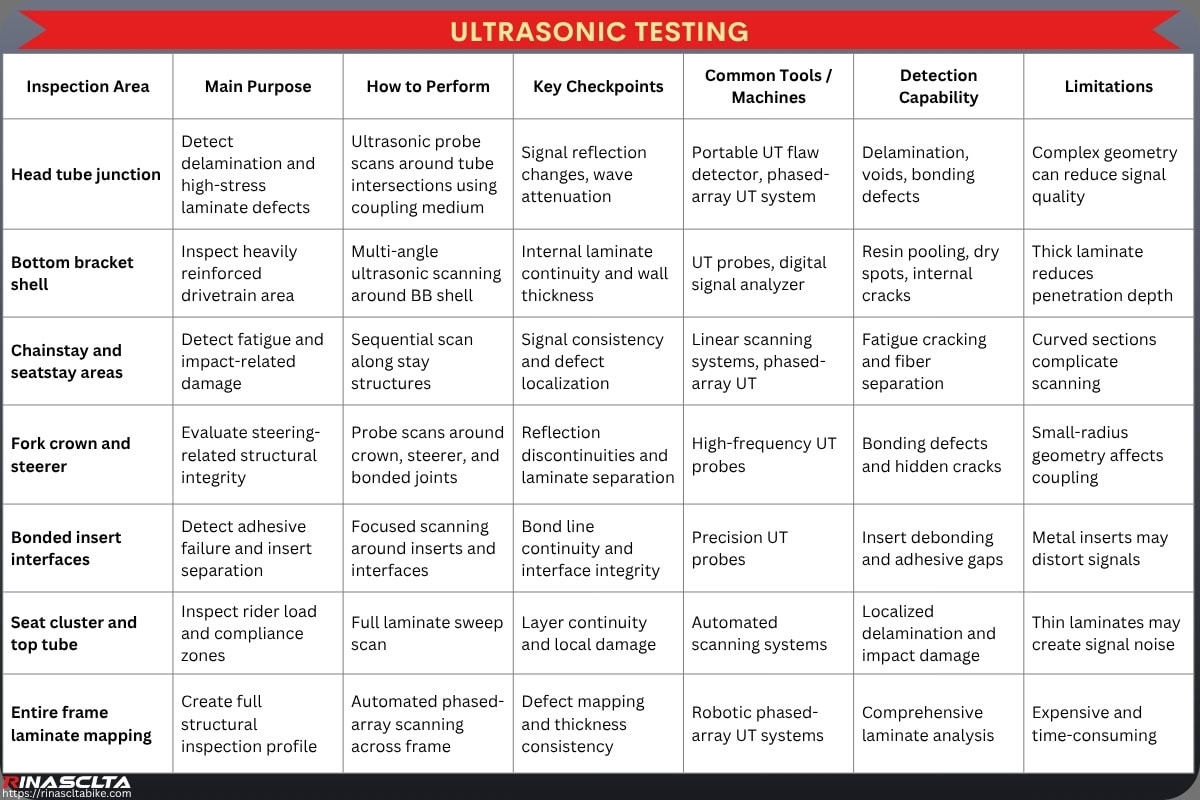
The ultrasonic testing process generally begins by preparing the frame surface and applying a coupling medium (gel, water, or specialized fluid) to allow efficient sound-wave transmission between the ultrasonic probe and the carbon surface. The inspector then moves the probe systematically across the frame while the UT system sends and receives high-frequency acoustic pulses through the laminate structure. Advanced systems display real-time data such as A-scan, B-scan, or C-scan imaging, showing signal reflections, material thickness, internal discontinuities, and possible defect locations inside the composite.
Modern carbon bike factories often use multiple UT techniques depending on the inspection requirement, including:
- Conventional pulse-echo ultrasonic testing
- Through-transmission ultrasonic testing
- Phased-array ultrasonic testing (PAUT)
- Automated robotic UT scanning
- Immersion ultrasonic systems for laboratory analysis
Key checkpoints during ultrasonic inspection include:
- Laminate continuity
- Delamination detection
- Void content evaluation
- Bond line integrity
- Fiber consolidation quality
- Wall-thickness consistency
- Impact damage assessment
- Junction reinforcement integrity
Advanced phased-array systems can generate detailed internal laminate maps that help engineers evaluate defect size, depth, and orientation much more accurately than manual inspection methods.
Ultrasonic testing is usually performed according to internal OEM QC procedures and broader industrial composite NDT references derived from ASTM, aerospace composite inspection standards, ISO procedures, and advanced manufacturing QC systems. However, the method also has limitations: very complex tube junctions, thick reinforced sections, highly curved surfaces, and metal inserts can interfere with signal interpretation, while accurate analysis requires highly trained operators and calibrated equipment.
Despite these limitations, ultrasonic testing provides enormous value in carbon bike manufacturing because it allows factories to detect hidden structural defects before frames enter fatigue testing, final assembly, shipment, or consumer use, significantly reducing warranty claims, safety risks, field failures, and production inconsistency. As carbon bicycle construction becomes increasingly lightweight and structurally optimized, ultrasonic inspection has become one of the most important high-level quality assurance tools in modern OEM carbon frameset production.
X-ray inspection
X-ray inspection is an advanced non-destructive testing (NDT) method used in carbon bike frameset manufacturing to visualize the internal structure of the composite laminate using X-ray radiation and radiographic imaging systems. Unlike visual inspection or simple acoustic methods, X-ray inspection allows manufacturers to directly examine hidden internal conditions inside the frame, making it highly effective for detecting defects such as voids, delamination, fiber distortion, resin pooling, dry spots, foreign material contamination, bonding failure, insert misalignment, internal cracking, and wall-thickness inconsistency without cutting or destroying the frameset. Because modern carbon bicycle frames use complex multi-layer laminate structures and heavily reinforced tube junctions, many structural problems can remain invisible externally while significantly affecting durability, stiffness, fatigue resistance, and rider safety, making X-ray inspection one of the highest-level QC validation tools in premium composite manufacturing.
The inspection principle is based on differential X-ray absorption: denser or structurally different materials absorb radiation differently, creating contrast variations in the radiographic image. Properly consolidated carbon laminate produces relatively uniform imaging, while defects create irregular density patterns, discontinuities, shadows, or contrast variations that can be analyzed by trained inspectors or imaging software. In advanced OEM production, X-ray inspection is commonly used during prototype development, failure analysis, post-impact inspection, process validation, warranty investigation, and high-end production QC auditing, especially for critical structural areas.
| Inspection Area | Main Purpose | How to Perform | Key Checkpoints | Common Tools / Machines | Detection Capability | Limitations |
| Head tube junction | Detect hidden structural irregularities in high-load steering zone | Position frame under X-ray source and capture radiographic image | Laminate continuity, reinforcement uniformity, voids | Industrial X-ray system, digital radiography | Voids, delamination, fiber distortion | Dense overlaps reduce image clarity |
| Bottom bracket shell | Inspect heavily reinforced drivetrain structure | Multi-angle imaging around BB shell | Resin pooling, insert alignment, laminate density | High-resolution digital X-ray system | Internal cracking and bonding defects | Thick laminate complicates penetration |
| Bonded insert areas | Verify insert placement and bonding integrity | Focused imaging around inserts and interfaces | Adhesive coverage and insert concentricity | Micro-focus X-ray systems | Insert separation and adhesive gaps | Metal inserts may create scattering artifacts |
| Chainstay and seatstay regions | Detect impact and fatigue-related damage | Linear or rotational imaging scan | Crack propagation and internal separation | Rotational radiography systems | Hidden cracks and laminate defects | Narrow structures require precise positioning |
| Fork crown and steerer | Evaluate front-end structural integrity | Multi-directional X-ray imaging | Steerer bonding and crown reinforcement | Digital radiography and CT systems | Delamination and local crushing | Complex geometry affects image interpretation |
| Entire frame structural mapping | Create comprehensive internal laminate profile | Automated multi-angle radiographic scanning | Wall-thickness consistency and defect distribution | CT scanning systems, robotic X-ray platforms | Full internal structural visualization | Very expensive and time-intensive |
| Prototype failure analysis | Investigate internal failure mechanisms | High-resolution radiographic imaging after testing | Crack origin and damage propagation | Industrial CT scanners | Detailed root-cause analysis | Mainly used for engineering analysis |
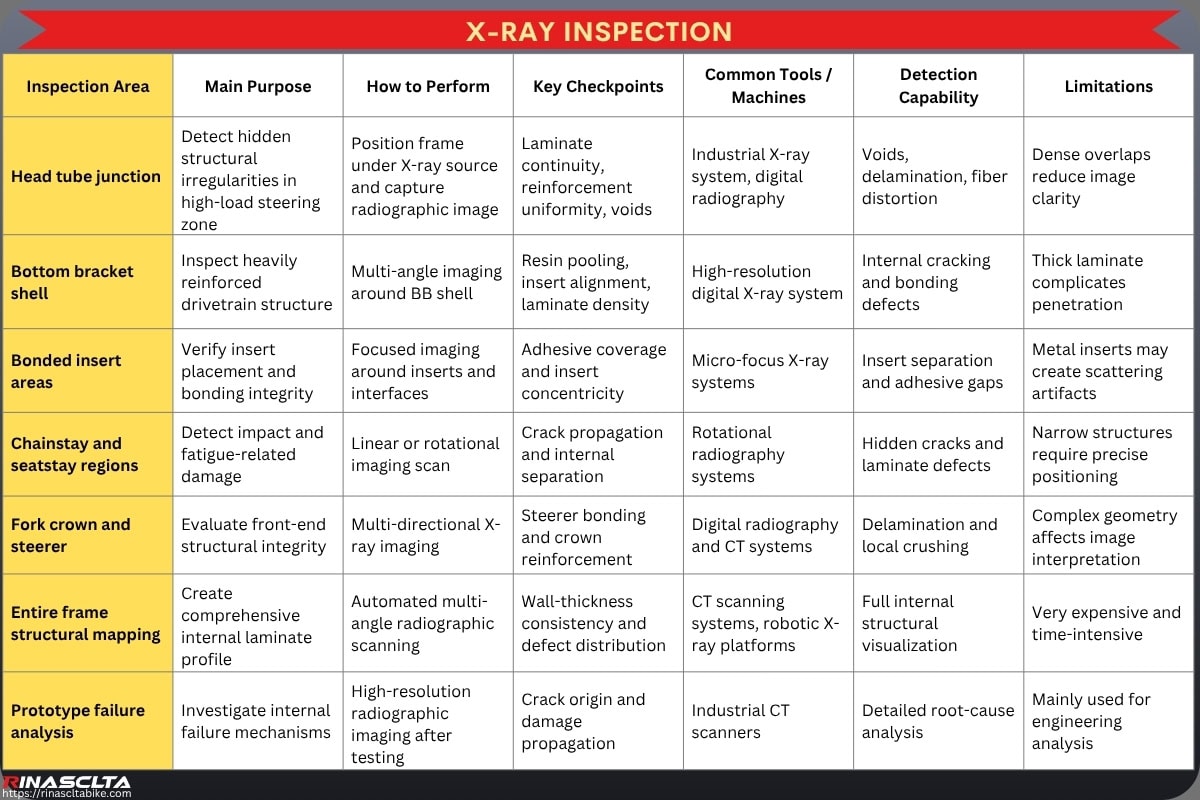
The X-ray inspection process generally begins by positioning the carbon frame or selected frame section between an X-ray source and a digital detector panel or radiographic film system. The machine emits controlled X-ray radiation through the composite structure while detectors capture differences in material density and internal structure. Advanced systems generate high-resolution digital images that inspectors analyze for abnormal patterns such as dark spots, inconsistent density, irregular fiber orientation, trapped air pockets, resin-rich zones, broken fibers, or adhesive discontinuities.
Modern carbon bike factories may use several X-ray technologies depending on inspection complexity:
- Standard industrial radiography
- Digital radiography (DR)
- Computed radiography (CR)
- Micro-focus X-ray systems
- Computed tomography (CT scanning)
- 3D volumetric CT reconstruction systems
CT scanning is especially valuable because it creates a full three-dimensional model of the internal laminate structure, allowing engineers to analyze defect size, depth, orientation, and interaction with surrounding layers much more precisely than conventional 2D imaging.
Key checkpoints during X-ray inspection typically include:
- Laminate density consistency
- Void distribution
- Fiber alignment quality
- Reinforcement placement
- Bonded insert positioning
- Adhesive coverage
- Wall-thickness variation
- Crack propagation
- Foreign material contamination
- Junction consolidation quality
The inspection standards are usually based on internal OEM quality systems, aerospace composite inspection references, industrial radiographic standards, and advanced engineering QC protocols derived from organizations such as ASTM, ISO, aerospace NDT procedures, and industrial composite manufacturing guidelines.
Despite its extremely high inspection capability, X-ray inspection also has limitations. The equipment is expensive, highly specialized, requires radiation safety procedures, and demands trained inspectors for image interpretation. Thick composite sections, overlapping reinforcement zones, and metal inserts can also create imaging artifacts that complicate analysis. Because of cost and processing time, many manufacturers reserve full X-ray inspection for prototype validation, engineering development, failure analysis, high-risk production batches, and premium flagship framesets rather than scanning every production unit.
Even with these limitations, X-ray inspection provides enormous value in modern carbon bike manufacturing because it allows factories to identify hidden structural defects before frames enter fatigue testing, certification, assembly, shipment, or consumer use, helping reduce warranty claims, catastrophic failures, product recalls, and long-term liability risk while improving laminate optimization and production consistency in advanced carbon composite bicycle engineering.
Bicycle Industry Testing Standards
The bicycle industry commonly uses ISO standards, EN standards, and UCI requirements to ensure that bicycles and carbon framesets meet accepted levels of safety, durability, structural integrity, dimensional consistency, and competition compliance across global markets. These standards became increasingly important as bicycle manufacturing evolved from small regional production into a highly globalized OEM industry during the late 20th and early 21st centuries, especially with the rise of carbon composite frames, lightweight performance bicycles, e-bikes, and international product distribution. Modern manufacturers, OEM factories, distributors, and racing organizations rely on these standards to reduce safety risks, warranty failures, legal liability, product recalls, and certification barriers, while also ensuring that bicycles can withstand real-world riding stresses such as fatigue loading, impact forces, braking loads, vibration cycles, and rider weight variations.
| Feature / Comparison Area | ISO Standards | EN Standards | UCI Requirements |
| Full name | International Organization for Standardization | European Norm / European Committee for Standardization | Union Cycliste Internationale |
| Main purpose | Global bicycle safety and durability standardization | European market safety and regulatory compliance | Professional racing equipment legality and approval |
| Why it exists | Standardize bicycle safety across global manufacturing and export markets | Harmonize bicycle safety regulations within the European Union | Ensure fairness, safety, and equipment consistency in competition |
| Main focus | Structural safety, durability, and mechanical performance | Consumer protection and EU regulatory compliance | Race legality, geometry control, and aerodynamic restrictions |
| Primary industry use | OEM factories, global brands, testing laboratories | European distributors, manufacturers, retailers | Professional race teams, race organizers, performance brands |
| Typical bicycle categories | Road, gravel, MTB, city, trekking, e-bike | Road, MTB, urban, trekking, commuter bicycles | Road racing, track, cyclocross, MTB competition bikes |
| Structural fatigue testing | Extensive cyclic fatigue testing required | Similar fatigue testing aligned with EU regulations | Limited direct fatigue testing focus |
| Impact testing | Mandatory impact and load testing | Mandatory impact and safety testing | Limited impact testing requirements |
| Stiffness testing | Often included in engineering validation | Sometimes included through OEM validation | Primarily geometry and aerodynamic evaluation |
| Real-world durability validation | Yes, through fatigue and load simulation | Yes, through safety-oriented testing | Limited, mainly race-use validation |
| Geometry requirements | General dimensional tolerances | Safety-related geometry compliance | Strict race geometry restrictions |
| Aerodynamic restrictions | Minimal | Minimal | Strict aerodynamic shape limitations |
| Minimum bike weight rule | No minimum weight requirement | No minimum weight requirement | Traditional 6.8 kg minimum race weight rule |
| Carbon frame relevance | Validates laminate durability and safety | Supports consumer market approval | Ensures race-legal carbon frame design |
| Main testing areas | Frame, fork, handlebar, wheels, seatpost, braking systems | Similar to ISO with EU safety alignment | Frame geometry, tube profiles, dimensions |
| Certification / approval goal | Global product reliability and safety compliance | EU legal market compliance | UCI race homologation approval |
| Common related terms | ISO 4210, fatigue cycles, impact resistance, safety certification | EN 14781, CE compliance, EU safety standards | UCI homologation, race legality, aerodynamic compliance |
| Value for manufacturers | Reduces warranty risk and improves global market acceptance | Enables access to EU bicycle markets | Allows framesets to be used in professional competition |
| Value for consumers | Improves safety, durability, and reliability | Improves legal safety compliance and product trust | Ensures race-approved performance equipment |
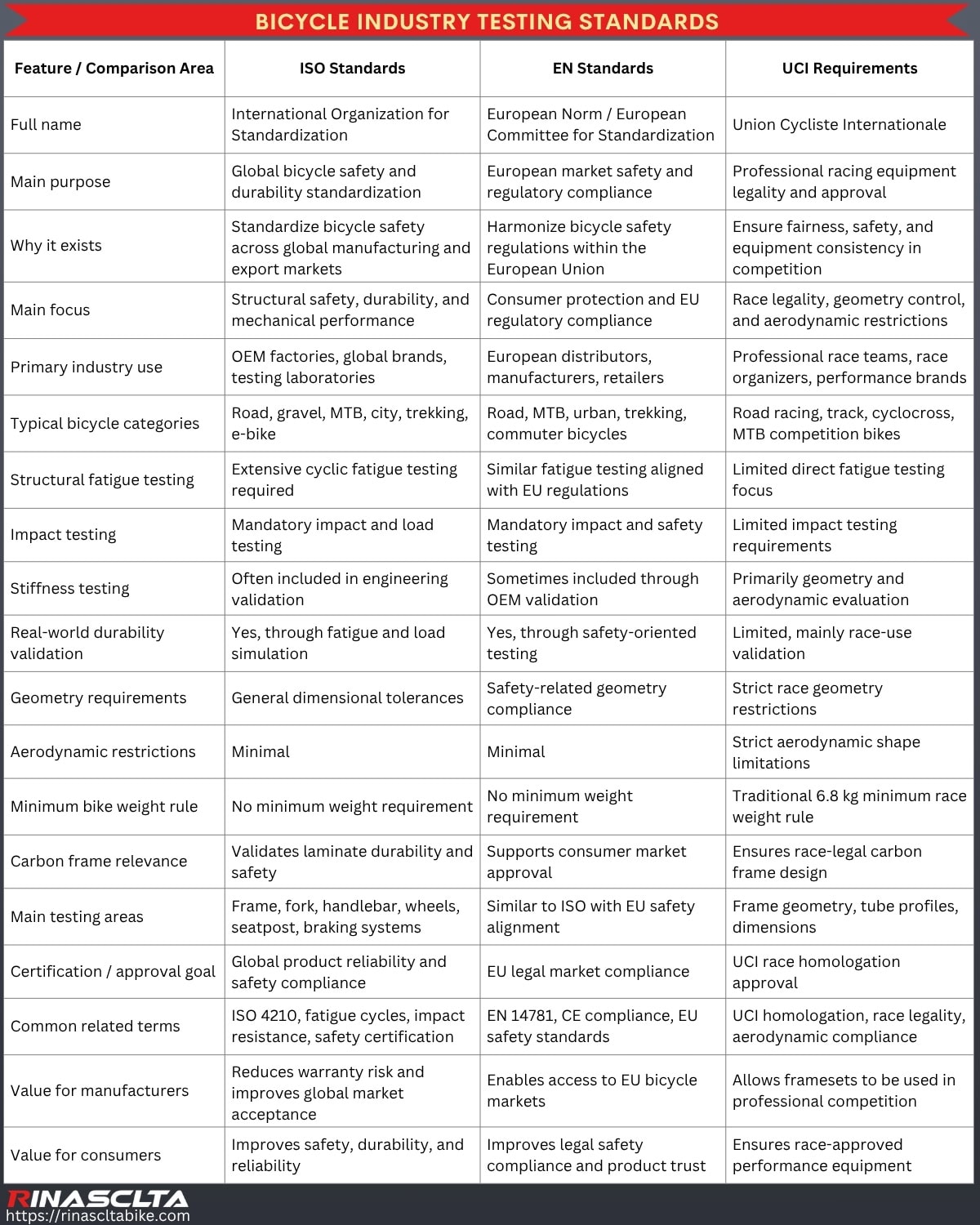

In practice, modern carbon bike manufacturers often design and test framesets to satisfy multiple standards simultaneously, especially when producing for international B2B clients and premium global bicycle brands. For example, a high-end carbon road frameset may undergo ISO fatigue testing, EN market compliance validation, and UCI homologation approval at the same time, ensuring that the product meets requirements for global retail distribution, rider safety, and professional racing eligibility while maintaining consistent manufacturing quality across large-scale OEM production.
ISO standards
ISO bicycle standards—especially ISO 4210—are internationally recognized safety and performance standards developed by the International Organization for Standardization to ensure that bicycles and bicycle components meet minimum requirements for structural integrity, rider safety, durability, braking performance, and mechanical reliability. These standards became increasingly important as the bicycle industry expanded globally during the late 20th century, particularly with the growth of mass OEM production, carbon composite frames, high-performance bicycles, e-bikes, and international export markets. ISO standards provide manufacturers, OEM factories, testing laboratories, distributors, and bicycle brands with a unified technical framework for validating products under controlled laboratory conditions before they reach consumers.
The most important bicycle-related standard is ISO 4210, which applies to most adult bicycles and covers complete-bike and component-level safety testing. The standard defines testing procedures, loading conditions, fatigue cycles, impact energies, dimensional tolerances, braking requirements, and structural performance criteria to ensure bicycles can withstand realistic riding stresses such as pedaling loads, road vibration, braking forces, curb impacts, steering forces, and rider weight variations. Manufacturers commonly use ISO 4210 together with internal OEM testing protocols, EN standards, and category-specific engineering requirements during carbon bike frameset development and certification.
| ISO Standard / Section | Main Purpose | Key Requirements | Typical Testing Areas | Common Tools / Machines | Main Value for Manufacturing |
| ISO 4210-1 | Terms and definitions | Standardizes bicycle safety terminology and classification | Bicycle categories and definitions | Documentation systems | Creates unified technical language |
| ISO 4210-2 | Safety requirements for bicycles | Defines general structural and safety requirements | Frame, fork, wheels, brakes, controls | Dimensional gauges, QC systems | Establishes baseline product safety |
| ISO 4210-3 | Common test methods | Standardizes mechanical testing procedures | Fatigue, impact, load testing | Test rigs, force sensors, fatigue systems | Ensures consistent testing methodology |
| ISO 4210-4 | Braking test methods | Validates braking performance and stopping capability | Dry/wet braking, heat performance | Brake dynamometers, rolling test rigs | Improves rider safety and braking reliability |
| ISO 4210-5 | Steering test methods | Evaluates handlebar and steering durability | Handlebar fatigue, stem strength | Cyclic loading rigs, torque testers | Prevents steering system failure |
| ISO 4210-6 | Frame and fork test methods | Tests frame and fork structural durability | Fatigue, impact, frontal force tests | Servo-hydraulic fatigue rigs, impact towers | Validates carbon frame durability |
| ISO 4210-7 | Wheel and rim test methods | Verifies wheel structural integrity | Radial fatigue, impact resistance | Wheel fatigue rigs, spoke tension meters | Improves wheel safety and consistency |
| ISO 4210-8 | Pedal and drivetrain testing | Tests pedal retention and crank durability | Pedaling fatigue and load testing | Pedaling simulators, cyclic load rigs | Validates drivetrain reliability |
| ISO 4210-9 | Saddle and seatpost testing | Evaluates rider-support components | Vertical fatigue and impact testing | Vertical load rigs | Prevents seat-related structural failure |
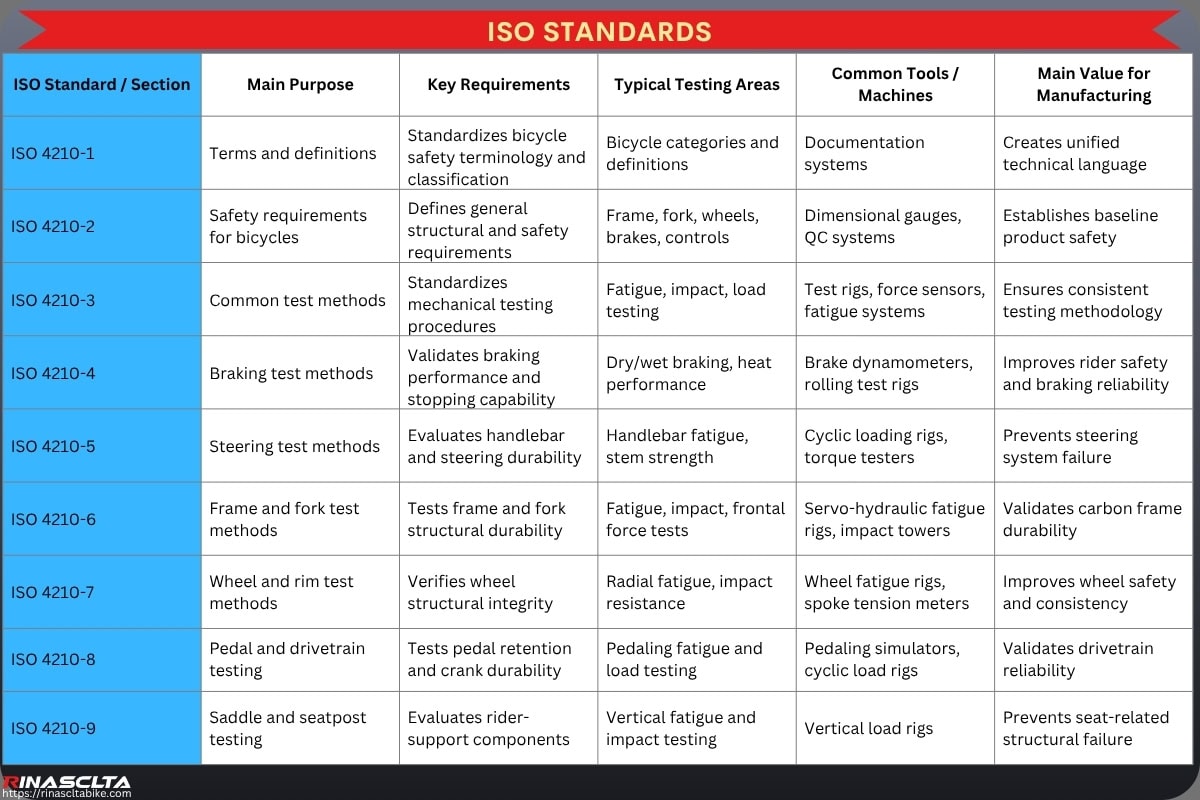
ISO bicycle testing uses advanced tools and equipment such as:
- Servo-hydraulic fatigue testing systems
- Multi-axis loading rigs
- Drop-weight impact machines
- Strain gauges and load cells
- Laser displacement sensors
- Coordinate Measuring Machines (CMM)
- Brake dynamometers
- Accelerometers and telemetry systems
- Ultrasonic and X-ray inspection systems for post-test analysis
For carbon bike frameset manufacturers, ISO standards provide enormous value because they help reduce warranty claims, product recalls, legal liability, structural failures, and production inconsistency, while improving international market acceptance and consumer trust. Most premium OEM factories and bicycle brands use ISO-based testing not only for certification purposes but also as part of their internal engineering development process to optimize carbon layup schedules, reinforcement zones, wall thickness distribution, stiffness tuning, and long-term durability performance in modern carbon composite bicycle manufacturing.
EN standards
EN bicycle standards are European safety and performance standards developed by the European Committee for Standardization (CEN) to ensure bicycles and bicycle components sold within the European market meet minimum requirements for mechanical safety, structural durability, braking performance, dimensional consistency, rider protection, and product reliability. These standards became especially important as the European bicycle industry expanded during the late 20th century alongside the growth of international OEM manufacturing, carbon composite frames, e-bikes, and cross-border product distribution within the European Union. EN standards provide a harmonized technical framework that helps manufacturers, distributors, retailers, OEM factories, and testing laboratories comply with European product safety regulations while reducing risks related to product recalls, warranty failures, liability claims, and unsafe consumer products.
Many modern EN bicycle standards are now closely aligned or integrated with ISO bicycle standards—especially ISO 4210—but EN standards remain highly important because they are directly connected to European market compliance, CE-related safety expectations, and EU consumer protection systems. The standards define detailed requirements for testing methods, fatigue durability, impact resistance, braking performance, dimensional tolerances, assembly safety, and component reliability under realistic riding conditions such as road vibration, rider loads, braking forces, curb impacts, steering stress, and long-term cyclic fatigue.
| N Standard | Main Purpose | Main Requirements | Typical Testing Areas | Common Tools / Machines | Main Industry Value |
| EN ISO 4210 series | General bicycle safety and performance standards for adult bicycles | Structural durability, fatigue resistance, impact strength, braking safety, dimensional compliance | Frame fatigue, fork impact, wheel retention, braking systems, steering systems | Servo-hydraulic fatigue rigs, impact towers, brake dynamometers, CMM systems | Enables European market access and improves product safety consistency |
| EN 14764 (historical city/trekking bicycle standard) | Safety requirements for city and trekking bicycles | Durability, comfort-bike safety, urban riding load validation | Frame fatigue, braking, cargo loading | Cyclic load rigs, vibration systems | Urban and trekking bicycle safety validation |
| EN 14766 (historical MTB standard) | Safety testing for mountain bicycles | Off-road impact resistance and fatigue durability | MTB fatigue and impact simulation | Impact testing systems, fatigue rigs | MTB structural safety compliance |
| EN 14781 (historical road racing bicycle standard) | Performance and safety requirements for road bicycles | Lightweight frame durability and road-racing load resistance | Road-bike fatigue, fork testing, wheel testing | Multi-axis fatigue rigs, stiffness rigs | Road-bike performance validation |
| EN 15194 | Electric pedal-assist bicycle (EPAC/e-bike) safety standard | Electrical safety, motor system reliability, structural durability | E-bike fatigue, battery safety, electrical integration | Electrical test benches, high-load fatigue systems | Required for legal e-bike sales in EU markets |
| EN 17404 | Cargo bike safety standard | High-load durability and cargo stability | Cargo frame fatigue, braking under load | Heavy-duty cyclic loading systems | Cargo bike structural safety and compliance |
| EN wheel and component standards | Validate bicycle component safety | Rim durability, spoke integrity, pedal retention, seatpost safety | Component fatigue and impact testing | Wheel fatigue rigs, torque testers | Improves complete-bike reliability |
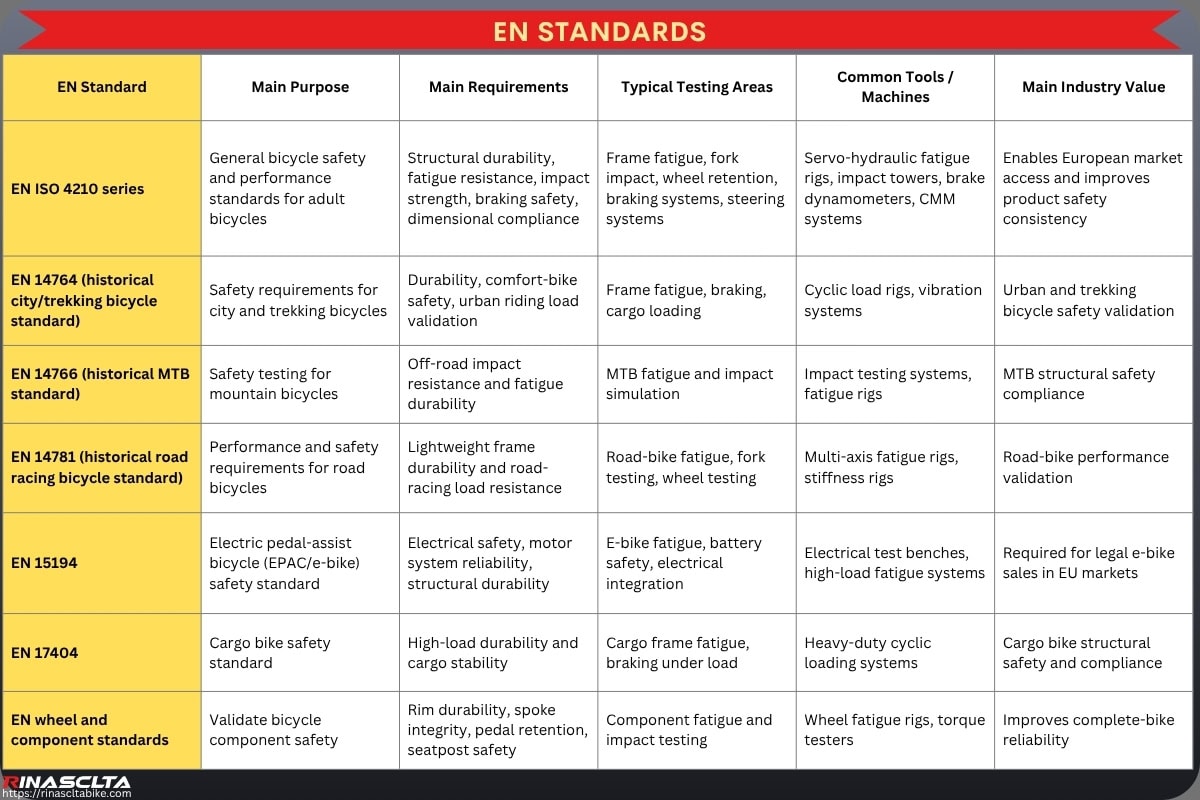
For carbon bike frameset manufacturers, EN standards provide significant value because they help ensure bicycles meet the safety expectations required for distribution within European markets while supporting consistent OEM production quality across global supply chains. Compliance with EN standards also helps manufacturers improve structural reliability, laminate durability, assembly consistency, braking safety, rider confidence, and long-term product lifespan, while reducing exposure to legal liability, warranty claims, field failures, and market-access restrictions in the highly regulated European bicycle industry.
UCI requirements
UCI requirements are technical regulations established by the Union Cycliste Internationale to control the legality, safety, geometry, and equipment design of bicycles used in sanctioned competitive cycling events such as road racing, track cycling, cyclocross, mountain biking, and time trials. Unlike ISO or EN standards, which primarily focus on consumer safety and structural durability, UCI regulations are designed to ensure fair competition, rider safety, equipment consistency, aerodynamic control, and technological balance within professional racing. These requirements became increasingly important during the late 20th century as bicycle technology rapidly evolved with the introduction of carbon fiber frames, aerodynamic tube shapes, monocoque construction, deep-section wheels, integrated cockpits, and ultra-lightweight race bikes, which created concerns about competitive fairness and rider safety in elite racing.
Modern UCI requirements are defined mainly in the UCI Technical Regulations and Equipment Approval systems, which specify rules for frame geometry, tube dimensions, aerodynamic design, wheel configuration, component positioning, minimum bicycle weight, saddle placement, handlebar reach, and approved racing equipment. Manufacturers producing high-end carbon race framesets for professional competition must design products to satisfy these regulations in addition to passing structural testing standards such as ISO 4210 and EN safety requirements.
| UCI Requirement Area | Main Purpose | Key Requirements | Typical Inspection / Validation | Common Tools / Methods | Main Industry Value |
| Minimum bicycle weight | Prevent unsafe ultra-lightweight race bikes | Traditional minimum complete-bike weight of 6.8 kg | Official race weigh-in | Precision digital scales | Ensures structural safety and equipment fairness |
| Frame geometry regulations | Standardize racing bicycle dimensions | Double-triangle frame concept, dimensional limits | Geometry measurement and homologation | Geometry fixtures, CMM systems | Maintains race-bike design consistency |
| Tube shape restrictions | Limit excessive aerodynamic advantages | 3:1 aspect-ratio rule (historically), approved tube profiles | Aerodynamic profile inspection | Profile gauges, CAD review | Controls aerodynamic optimization |
| Saddle position regulations | Maintain rider positioning fairness | Saddle setback and positioning limits | Saddle position measurement | Measurement jigs, laser alignment | Standardizes rider ergonomics |
| Handlebar and extension regulations | Control aerodynamic rider positions | Extension length and cockpit dimension limits | Cockpit geometry inspection | Alignment tools, dimensional gauges | Balances aerodynamic fairness and safety |
| Time-trial and track equipment approval | Regulate highly aerodynamic equipment | Specific homologation requirements for TT and track bikes | UCI approval review process | CAD submission, wind tunnel validation | Controls advanced race technology |
| Wheel regulations | Ensure wheel safety and fairness | Wheel structural requirements and approved designs | Visual and dimensional inspection | Wheel measuring tools | Maintains race equipment reliability |
| Frame homologation | Approve frames for professional competition | UCI approval for elite-level racing frames | Documentation review and physical inspection | Digital submission systems, prototype evaluation | Allows participation in UCI-sanctioned events |
| Rider safety regulations | Reduce dangerous equipment designs | Structural integrity and positioning safety limits | Technical commissaire inspection | On-site race inspection tools | Improves rider protection during competition |
| Branding and equipment visibility | Ensure equipment traceability and compliance | Manufacturer identification and visible markings | Visual compliance inspection | Inspection protocols | Improves regulatory enforcement |
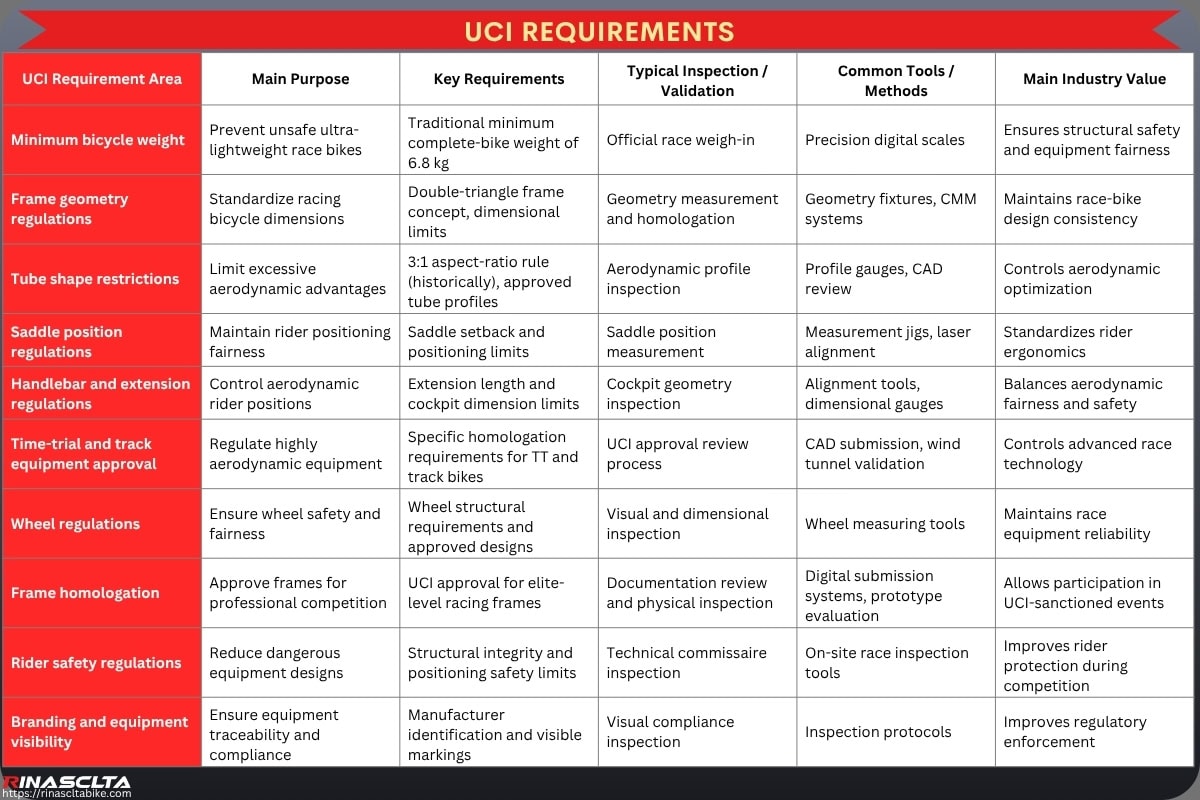
UCI equipment approval and inspection often involve multiple stages including:
- CAD geometry submission
- Prototype evaluation
- Dimensional verification
- Physical frame inspection
- Aerodynamic profile validation
- Race-day technical inspection
- Weight verification
- Component position measurement
Manufacturers commonly use advanced engineering and validation tools such as:
- CAD and CFD simulation software
- Wind tunnel testing systems
- Coordinate Measuring Machines (CMM)
- Laser alignment systems
- Precision geometry fixtures
- Aerodynamic scanning tools
- Digital homologation databases
- Precision scales and dimensional gauges
For carbon bike frameset manufacturers, UCI compliance provides major commercial and technical value because it allows framesets to be legally used in professional racing, WorldTour competition, Olympic events, UCI-sanctioned championships, and elite amateur races. UCI approval also strongly influences product marketing and brand positioning, since many consumers associate UCI-approved equipment with high performance, elite engineering, aerodynamic optimization, and professional-level quality. As a result, many premium carbon road bike brands develop frames specifically around UCI regulations while simultaneously balancing aerodynamics, stiffness, lightweight construction, durability, and rider fit requirements within the constraints of professional competition rules.
How to Evaluate a Carbon Bike Manufacturer’s QC System?
To evaluate a carbon bike manufacturer’s QC system, B2B buyers should ask whether the factory controls every stage from raw material traceability, prepreg storage, layup verification, molding parameters, NDT inspection, fatigue testing, impact testing, alignment inspection, surface inspection, and final assembly inspection to shipment, because a strong QC system is not only about checking finished frames but about preventing defects throughout the entire manufacturing workflow. Signs of strong manufacturing quality include documented SOPs, batch records, material certificates, curing logs, ultrasonic or X-ray inspection capability, ISO/EN testing reports, calibrated fixtures, trained inspectors, failure analysis records, and clear defect classification standards, while traceability is especially important because it allows brands to track each frameset back to its carbon fiber batch, resin system, layup operator, mold number, curing cycle, inspection results, and serial number, reducing warranty risk, improving recall control, protecting brand reputation, and giving buyers confidence that the supplier can deliver consistent structural safety and long-term production reliability.
Questions buyers should ask
When evaluating a carbon bike manufacturer, buyers should ask detailed quality-control and production questions because carbon composite manufacturing quality depends heavily on process consistency, traceability, engineering validation, operator skill, material control, and inspection capability, not just appearance or price. A professional supplier should be able to clearly explain their testing standards, defect-control procedures, inspection workflow, curing process, material sourcing, production records, and warranty handling system, since these directly affect frame safety, durability, consistency, long-term reliability, and OEM brand reputation.
| Buyer Question | Main Purpose |
| What carbon fiber and resin systems do you use? | Verify material quality, supplier consistency, and engineering level |
| Do you use Toray, Mitsubishi, or other certified prepreg suppliers? | Evaluate raw material traceability and premium material sourcing |
| How do you control prepreg storage temperature and expiration dates? | Confirm resin stability and prevention of material degradation |
| Do you have documented layup schedules and SOPs? | Check manufacturing consistency and repeatability |
| How is layup verification performed during production? | Evaluate control of fiber orientation and ply accuracy |
| What molding process do you use (EPS, bladder molding, autoclave, RTM)? | Understand structural quality and consolidation capability |
| Do you monitor curing temperature and pressure digitally? | Verify process control and curing consistency |
| What non-destructive testing methods do you use? | Assess ability to detect hidden internal defects |
| Do you perform ultrasonic or X-ray inspection? | Evaluate advanced QC capability for carbon composites |
| What fatigue testing standards do your frames pass? | Confirm long-term durability validation |
| Are your frames tested according to ISO 4210 or EN standards? | Verify international safety compliance |
| Do you perform impact testing and real-world simulation testing? | Check crash resistance and real riding durability validation |
| How do you inspect frame alignment and geometry accuracy? | Evaluate dimensional precision and assembly compatibility |
| What is your acceptable defect rate or QC rejection standard? | Understand manufacturing quality expectations |
| Do you maintain serial-number traceability for every frame? | Confirm production traceability and recall capability |
| Can you provide material certificates and test reports? | Verify documented engineering validation |
| How are warranty claims and failure analysis handled? | Evaluate after-sales responsibility and engineering support |
| Do you keep production and curing records for each batch? | Confirm process traceability and accountability |
| How are workers trained for carbon layup and QC inspection? | Assess operator skill and process reliability |
| Can buyers audit the factory or inspect production lines? | Verify manufacturing transparency and actual QC implementation |
| How do you control cosmetic quality and paint inspection? | Evaluate surface finish consistency and premium product standards |
| What percentage of production undergoes full QC inspection? | Understand inspection coverage and sampling policy |
| Do you perform destructive testing on sample frames? | Confirm validation of structural performance beyond visual QC |
| How do you prevent voids, delamination, and resin pooling? | Evaluate process engineering and defect prevention systems |
| What equipment do you use for fatigue and stiffness testing? | Assess engineering investment and technical capability |
| Can you support custom geometry and engineering validation? | Evaluate OEM development capability and engineering flexibility |
| Which brands or markets do you currently manufacture for? | Understand production experience and market positioning |
| How do you package and protect frames during shipment? | Reduce transport damage and logistics-related claims |
| What is your average warranty return rate? | Measure real-world product reliability and QC effectiveness |
| How do you manage continuous QC improvement and defect analysis? | Evaluate long-term manufacturing maturity and quality culture |
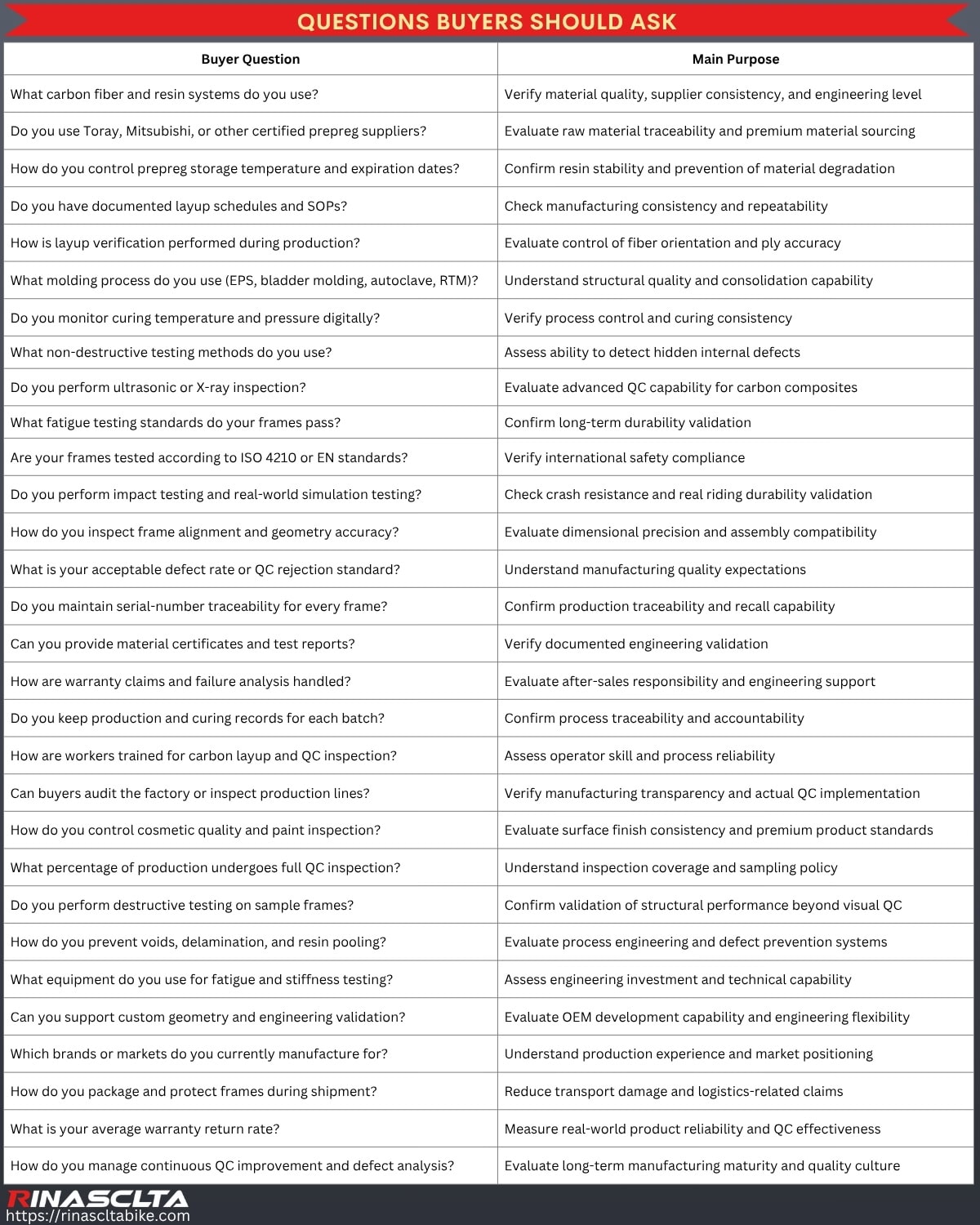
Signs of strong manufacturing quality
Strong manufacturing quality in carbon bike frameset production is indicated by factors such as material traceability, standardized SOPs, advanced testing capability, stable molding control, trained technicians, low defect rates, precise alignment control, documented QC systems, international certification compliance, and full production traceability, because carbon composite manufacturing depends heavily on process consistency, engineering accuracy, laminate integrity, and long-term durability validation rather than simple visual appearance alone. High-quality factories invest heavily in process monitoring, non-destructive testing (NDT), engineering validation, and continuous quality improvement systems to reduce structural defects such as voids, delamination, misalignment, resin pooling, and bonding failures, while ensuring consistent product safety, reliability, and OEM production performance across large manufacturing volumes.
| Sign of Strong Manufacturing Quality | Why It Matters | Related Terms / Value |
| Certified raw material sourcing | Ensures consistent fiber and resin performance across production batches | Toray prepreg, resin systems, material traceability, supplier certification |
| Controlled prepreg storage systems | Prevents resin degradation and unstable curing behavior | Cold storage, humidity control, shelf-life management |
| Standardized SOPs and work instructions | Reduces operator variation and improves manufacturing consistency | SOP, MES systems, process standardization |
| Experienced carbon layup technicians | Improves fiber orientation accuracy and laminate quality | Ply orientation, reinforcement placement, laminate integrity |
| Digital curing and pressure monitoring | Maintains stable molding and consolidation quality | Temperature logging, pressure curves, curing cycle control |
| Advanced molding technology | Improves compaction and reduces internal defects | EPS molding, bladder molding, autoclave systems |
| Non-destructive testing capability | Detects hidden structural defects before shipment | Ultrasonic testing, X-ray inspection, tap testing |
| Internal laboratory testing systems | Validates durability and engineering performance | Fatigue testing, impact testing, stiffness testing |
| ISO / EN testing compliance | Confirms internationally accepted safety validation | ISO 4210, EN standards, certification reports |
| Precise alignment inspection systems | Ensures accurate geometry and assembly compatibility | CMM systems, laser alignment, frame geometry control |
| Low defect and warranty rates | Indicates stable long-term production quality | QC rejection rate, warranty analysis, field failure rate |
| Full serial-number traceability | Allows defect tracking and recall management | Batch tracking, ERP systems, production records |
| Detailed QC documentation | Demonstrates process control and accountability | Inspection records, curing logs, QC reports |
| Dedicated incoming QC inspection | Prevents poor raw materials from entering production | Material inspection, resin verification, prepreg analysis |
| Controlled clean-room production areas | Reduces contamination-related defects | Dust control, bonding cleanliness, laminate protection |
| In-house engineering and testing teams | Improves product development and failure analysis capability | FEA analysis, structural simulation, R&D validation |
| Automated or semi-automated cutting systems | Improves layup consistency and dimensional precision | CNC cutting, ply templates, digital nesting |
| Strong supplier and component management | Ensures assembly compatibility and hardware consistency | Insert tolerances, bonding interfaces, QC auditing |
| Transparent factory audit capability | Shows confidence in manufacturing systems and QC processes | OEM audit, process transparency, customer inspection |
| Continuous improvement and failure analysis systems | Helps reduce recurring defects and improve long-term quality | Root-cause analysis, SPC, CAPA systems |
| Stable cosmetic finishing quality | Reflects good process control and brand-level production standards | Paint consistency, sanding quality, surface inspection |
| Real-world validation and ride testing | Confirms actual riding durability beyond laboratory testing | Road simulation, field testing, telemetry validation |
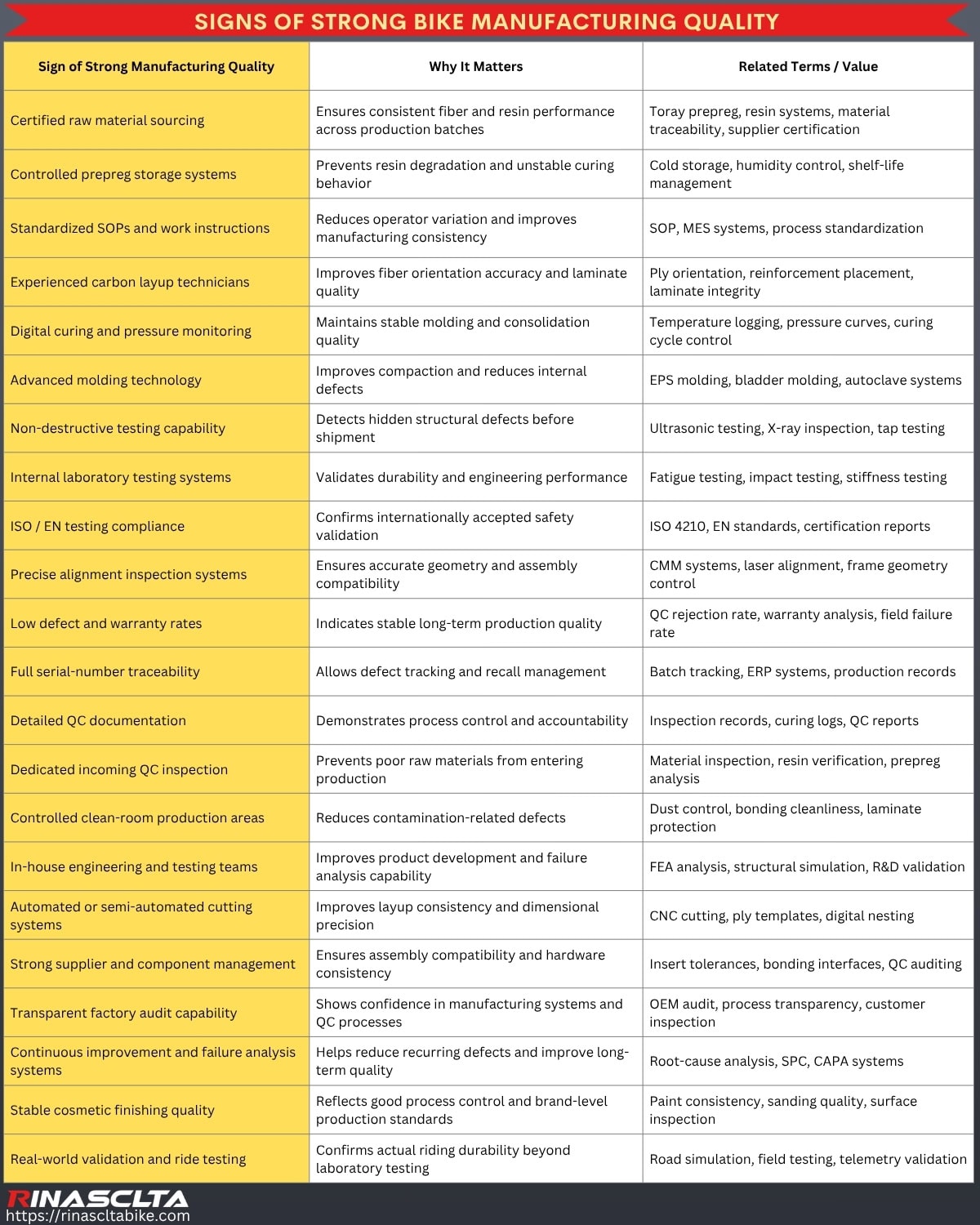
Together, these manufacturing indicators help B2B buyers evaluate whether a factory can consistently produce carbon framesets that meet requirements for structural safety, dimensional accuracy, long-term durability, premium cosmetic quality, international certification, and large-scale OEM reliability, which are critical for reducing warranty risk, protecting brand reputation, and maintaining stable supply-chain performance in the global bicycle industry.
Importance of traceability
Traceability is critically important in carbon bike frameset manufacturing because it allows every frameset to be tracked throughout the entire production lifecycle—from raw material batches, prepreg rolls, resin systems, layup operators, mold numbers, curing cycles, inspection records, testing results, paint batches, and assembly processes to final shipment and warranty history. Since carbon composite defects such as voids, delamination, bonding failure, curing inconsistency, or material contamination may originate from specific production conditions or suppliers, traceability enables manufacturers to quickly identify root causes, isolate affected batches, reduce recall scope, improve failure analysis, and maintain accountability across large-scale OEM production. Modern factories therefore use systems such as serial-number tracking, ERP systems, MES production monitoring, barcode systems, digital curing logs, and QC databases to improve quality consistency, protect brand reputation, reduce warranty costs, support international certification compliance, and provide B2B customers with confidence in long-term manufacturing reliability and product safety.
Future Trends in Carbon Bike Quality Control
Future trends in carbon bike quality control are moving toward increasingly digital, automated, and data-driven manufacturing systems that combine AI-assisted defect detection, robotic layup systems, automated ultrasonic scanning, real-time process monitoring, digital twin simulation, machine learning analysis, and smart factory integration to improve production consistency and reduce human error. As carbon bicycle frames become lighter, more aerodynamic, and structurally optimized, manufacturers are investing in advanced technologies such as automated fiber placement (AFP), robotic trimming, inline NDT inspection, IoT-based curing monitoring, predictive maintenance systems, telemetry-based fatigue simulation, and cloud-connected QC databases to improve traceability, accelerate engineering validation, reduce defect rates, and optimize stiffness-to-weight performance while meeting increasingly strict demands for safety, sustainability, international certification, and premium OEM manufacturing quality in the global bicycle industry.