What is a bike alarm?
A bike alarm is a theft-deterrent security device designed to detect motion, vibration, or unauthorized handling of a bicycle and trigger a loud siren or digital alert, becoming increasingly common in urban cycling as bike values and e-bike adoption rose in the 2000s. It works through motion sensors, accelerometers, tilt detection, remote controls, or smartphone connectivity, and may be integrated into the frame, seatpost, lock, or e-bike electronics; its value lies in providing an audible warning, discouraging opportunistic theft, adding an extra security layer alongside locks, and in some smart systems, enabling GPS tracking and real-time notifications for enhanced bike protection.
What is an anti-theft bike alarm?
An anti-theft bike alarm is a security device specifically designed to prevent or deter bicycle theft by detecting unauthorized movement, vibration, or tampering and activating a loud siren or sending a digital alert, becoming widely used as urban cycling and high-value bikes—especially e-bikes—became more common in the 2000s. It works through built-in motion sensors, accelerometers, tilt detection modules, remote controls, or smartphone-connected systems, and may be integrated into the bike frame, lock, seatpost, or hidden components; its value lies in creating immediate audible deterrence, increasing theft risk for criminals, complementing mechanical locks, and in advanced systems, providing GPS tracking and app notifications for enhanced recovery and protection.
Are bike alarms worth it?
Yes, bike alarms are worth it if you use them as an additional security layer alongside a high-quality lock, because they provide motion detection, vibration sensing, loud siren deterrence, and in some cases GPS tracking and app alerts, which increase the risk and attention faced by a thief. While they do not physically prevent theft like a U-lock or chain lock, their value lies in deterring opportunistic theft, protecting high-value bikes (especially e-bikes), and adding real-time awareness, particularly in urban environments where quick tampering is common.
How does a bike alarm work?
A bike alarm works by using an internal motion sensor or accelerometer to detect vibration, movement, or changes in tilt, and when unauthorized motion is detected, it activates a high-decibel siren or sends a wireless alert to a remote or smartphone app. The system typically includes a sensor module, control circuit, battery (often rechargeable lithium or coin-cell), siren speaker, mounting bracket, and optional GPS or Bluetooth module, and it is installed on parts such as the frame, seatpost, bottle cage mounts, or integrated into a lock or e-bike electronics. When armed, the alarm continuously monitors movement, and if the bike is shaken, lifted, or tampered with, the control unit triggers an audible alarm to deter theft, providing added security value alongside mechanical locks and tracking systems.
How does an anti-theft alarm work on a bike?
An anti-theft alarm on a bike works by continuously monitoring the bicycle’s position and movement using an internal accelerometer, vibration sensor, and tilt sensor, and when unauthorized motion is detected—such as lifting, shaking, or rolling—it activates a high-decibel siren and, in smart systems, sends a Bluetooth, cellular, or GPS-based notification to the owner’s smartphone. The system consists of a sensor module, microcontroller, battery (rechargeable lithium or replaceable cell), speaker, mounting hardware, and sometimes a GPS tracker, and it is typically installed on the frame, seatpost, under the saddle, inside the down tube, or integrated into an e-bike controller or lock. Once armed via a remote key fob or mobile app, the alarm monitors for tampering and triggers an alert when thresholds are exceeded, adding an electronic deterrent layer that complements physical locks and improves theft prevention and recovery value.
Do bike alarms work?
Yes, bike alarms work if they are properly installed and used alongside a strong mechanical lock, because their motion sensors, vibration detection, and high-decibel sirens (often 100–120 dB) can immediately draw attention to tampering and interrupt theft attempts. They are most effective at preventing quick, opportunistic theft rather than defeating determined thieves with tools, so their real value lies in adding an electronic deterrent layer and increasing response time.
Do bike alarms deter thieves?
Yes, bike alarms deter thieves if the alarm is loud, visible (or known to be present), and combined with other security measures, because sudden noise increases risk, attracts attention, and reduces the chance of a thief working undisturbed. While they are not a substitute for a U-lock or chain lock, alarms improve overall security by raising perceived difficulty and lowering the likelihood of low-effort theft.
What is a bike alarm made of?
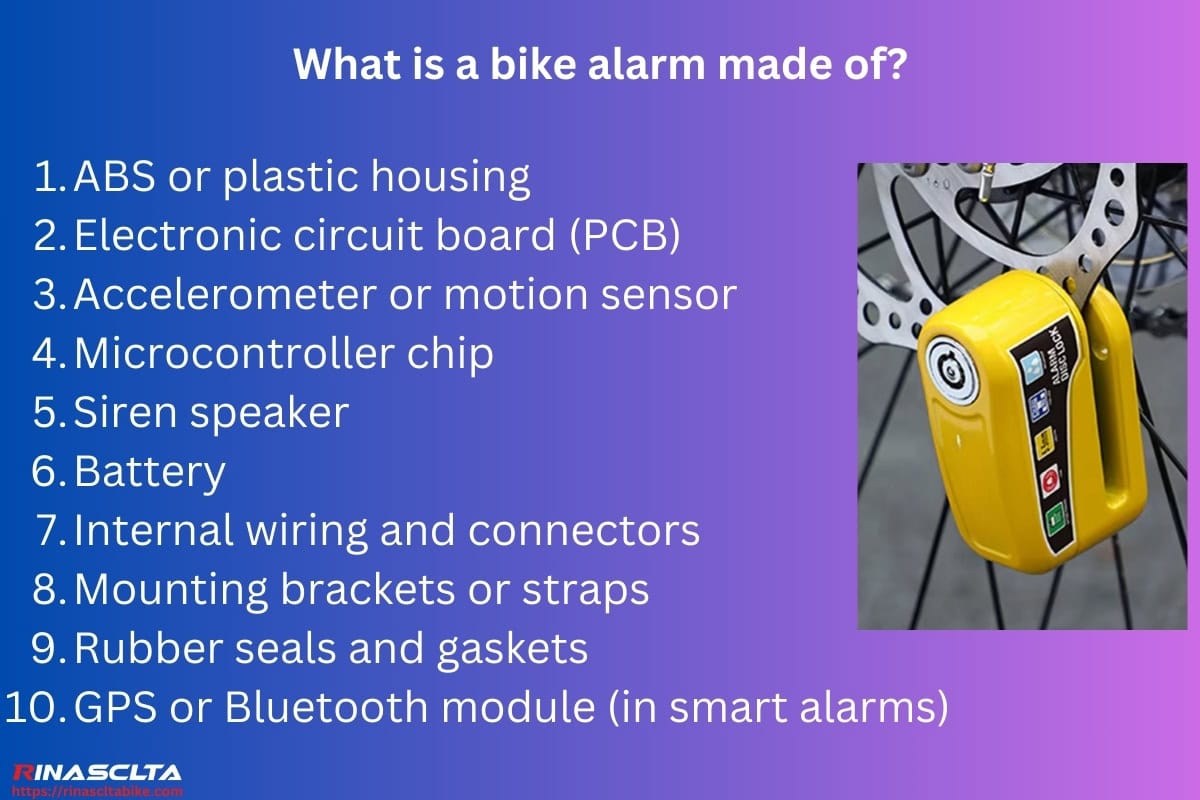
A bike alarm is made of plastic or ABS housing, electronic circuit boards, motion sensors (accelerometers), microcontroller chips, siren speakers, batteries (lithium or coin-cell), wiring, mounting brackets, rubber seals, and sometimes GPS or Bluetooth modules, because these materials ensure durability, vibration detection, sound output, power supply, weather resistance, and wireless communication in outdoor cycling environments.
- ABS or plastic housing: Protects internal electronics from impact, vibration, and weather while keeping the unit lightweight
- Electronic circuit board (PCB): Hosts the control logic and connects all electronic components into a functioning alarm system
- Accelerometer or motion sensor: Detects vibration, tilt, or movement that indicates possible tampering or theft
- Microcontroller chip: Processes sensor data and determines when to trigger the siren or send alerts
- Siren speaker: Produces a high-decibel sound (often 100–120 dB) to deter thieves and attract attention
- Battery (lithium rechargeable or coin-cell): Powers the alarm system for extended standby and active monitoring
- Internal wiring and connectors: Transmit electrical signals between sensors, battery, and speaker
- Mounting brackets or straps: Secure the alarm to the bike frame, seatpost, bottle cage mounts, or under the saddle
- Rubber seals and gaskets: Provide water and dust resistance for outdoor durability
- GPS or Bluetooth module (in smart alarms): Enables tracking, remote arming/disarming, and smartphone notifications

What are the types of bike alarms?
Bike alarms are mainly categorized by function (motion/vibration alarms, tilt-sensitive alarms, lock-integrated alarms, GPS tracking alarms, and immobilizer systems), by connectivity (standalone wireless remote alarms, Bluetooth-connected alarms, LTE-M or NB-IoT cellular smart alarms, Android/iOS app-based systems), and by bike application (road, mountain, fat bike, city/commuter, and e-bike-specific alarms), because different riding environments, theft risks, and technology ecosystems require different levels of detection sensitivity, communication range, power consumption, and integration with the bike’s electronics. These types exist to balance deterrence strength, real-time tracking capability, battery life, installation complexity, and compatibility, which is why choosing the right bike alarm depends not only on loudness but also on how and where the bike is used and how connected the rider wants the security system to be.
Bike alarm types based on function
Bike alarm types based on function include bike lock with alarm, disc lock with alarm, tail light alarm, vibration alarm, audible standalone alarm, and GPS tracking alarm, because different theft scenarios require different combinations of physical locking, motion detection, audible deterrence, and location tracking, balancing security strength, convenience, and recovery potential.
- Bike lock with alarm: Combines a mechanical lock (such as U-lock or chain lock) with a built-in motion sensor and siren to provide both physical restraint and audible deterrence
- Disc lock with alarm: Attaches to the brake disc rotor and triggers a loud alarm if the wheel moves, commonly used for high-value bikes and e-bikes
- Tail light alarm: Integrates a motion-sensitive siren into a rear light unit, adding theft protection without additional visible hardware
- Vibration alarm: Uses an internal accelerometer to detect shaking or tampering and activates a siren when movement exceeds a preset threshold
- Audible standalone alarm: A compact device mounted on the frame or seatpost that emits a high-decibel warning when triggered
- GPS tracking alarm: Combines motion detection with cellular or Bluetooth tracking to send real-time location alerts and enable recovery if theft occurs
How loud can a bike alarm be?
A bike alarm can typically be 100 to 120 decibels (dB) at close range, which is comparable to a motorcycle alarm or car alarm, because high sound pressure levels are needed to create immediate attention and deter theft in noisy urban environments. In many regions there is no specific bicycle-alarm limit, but general noise regulations often restrict prolonged sound above certain levels (commonly around 85–100 dB in residential areas), which is why most bike alarms are designed to trigger for short durations (e.g., 10–30 seconds) to balance deterrence effectiveness, legal compliance, and battery efficiency.
Bike alarm types based on connectivity
Bike alarm types based on connectivity include wireless remote-control alarms, Bluetooth alarms, LTE-M cellular alarms, NB-IoT alarms, Android app-connected systems, and iOS app-connected systems, because different communication technologies determine control range, real-time notification capability, tracking coverage, battery consumption, and subscription requirements.
- Wireless remote-control alarm: Uses a dedicated RF key fob to arm or disarm the alarm locally without smartphone dependency
- Bluetooth alarm: Connects to a nearby smartphone for arming, notifications, and basic tracking within short range
- LTE-M alarm: Uses low-power cellular networks to provide wide-area real-time tracking and theft alerts with lower energy consumption than traditional LTE
- NB-IoT alarm: Operates on narrowband cellular networks for long-range connectivity and very low power usage, ideal for long standby time
- Android app-connected alarm: Integrates with Android smartphones for remote control, notifications, GPS tracking, and sensitivity adjustments
- iOS app-connected alarm: Connects to iPhone devices via Bluetooth or cellular modules, enabling remote alerts, tracking, and configuration through dedicated apps
Bike alarm types based on bike type
Bike alarm types based on bike type include road bike alarms, mountain bike alarms, fat bike alarms, city/commuter bike alarms, and e-bike alarms, because different bike categories face different theft risks, mounting constraints, riding environments, and integration needs, requiring tailored security solutions.
- Road bike alarm: Designed to be lightweight and compact, often hidden under the saddle or inside the frame to protect high-value performance bikes without adding noticeable weight
- Mountain bike alarm: Built with stronger waterproofing and shock resistance to withstand mud, vibration, and rough terrain
- Fat bike alarm: Designed for wider frame spacing and extreme weather conditions such as snow or sand, requiring durable mounting systems
- City/commuter bike alarm: Focused on loud audible deterrence and easy daily activation to address frequent urban parking and higher theft exposure
- E-bike alarm: Often integrated with the e-bike’s battery system or controller, sometimes including GPS tracking and immobilizer functions for higher-value electric bikes
How do you choose a bike alarm?
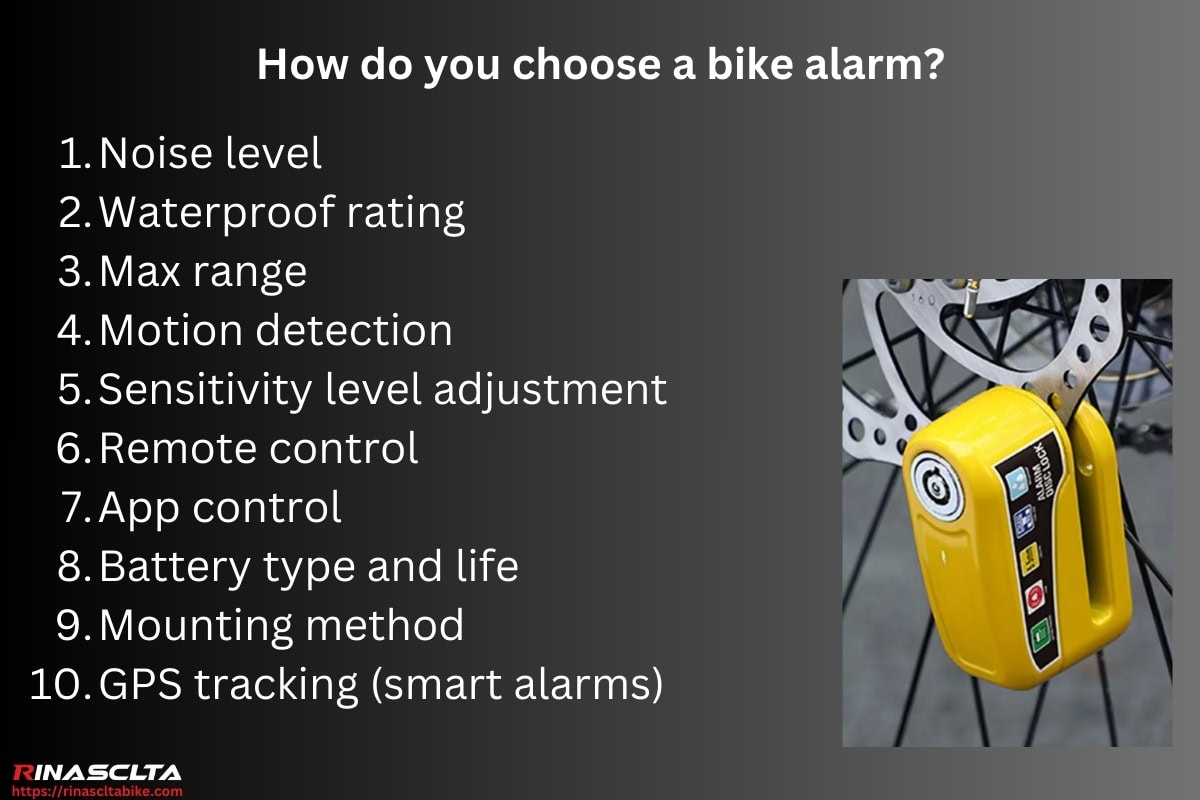
Choosing a bike alarm depends on noise level, waterproof rating, maximum control range, motion detection type, sensitivity adjustment, remote control capability, app connectivity, battery type and life, mounting method, GPS tracking, and integration with locks, because these factors determine how effectively the alarm deters theft, how reliable it is outdoors, and how convenient it is for daily use.
- Noise level: A louder siren (typically 100–120 dB) increases deterrence by drawing attention quickly in urban environments
- Waterproof rating: An IP-rated housing (such as IP65 or higher) ensures reliable operation in rain, mud, and winter conditions
- Max range: The communication distance (RF, Bluetooth, or cellular) determines how far you can arm, monitor, or receive alerts
- Motion detection: Accelerometer- or tilt-based sensors detect vibration and movement to trigger alarms when tampering occurs
- Sensitivity level adjustment: Adjustable thresholds reduce false alarms from minor vibrations while maintaining effective theft detection
- Remote control: A key fob allows quick arming and disarming without opening a smartphone app
- App control: Smartphone connectivity enables real-time notifications, tracking, configuration, and firmware updates
- Battery type and life: Rechargeable lithium batteries or long-lasting coin cells determine standby duration and maintenance frequency
- Mounting method: Secure frame, seatpost, bottle cage, or hidden installation improves tamper resistance and durability
- GPS tracking (smart alarms): Provides location data for recovery if theft occurs, especially useful for high-value bikes and e-bikes
How to install a bike alarm?
You can install a bike alarm by mounting the unit securely to a stable part of the bike such as the frame triangle, seatpost, bottle cage mounts, under the saddle rails, or inside the down tube (for hidden models) using brackets, screws, or heavy-duty straps, ensuring it is tightly fixed to accurately detect vibration. Position it away from moving parts like the chain, crankset, rear derailleur, disc rotor, and spokes, then insert or charge the battery, power it on, and test the motion sensor by gently shaking the frame to confirm proper activation and stable siren output.
How to install anti theft alarm for bikes?
You can install an anti-theft alarm by first choosing whether it is a standalone vibration alarm, lock-integrated alarm, disc lock alarm, or GPS smart alarm, then mounting it on a rigid component such as the seat tube, fork crown area, or rear rack to maximize vibration detection; for disc lock alarms, attach the unit through the brake rotor, and for GPS alarms, ensure unobstructed signal exposure and proper SIM activation if cellular-based. Proper installation increases tamper sensitivity, signal reliability, and theft deterrence value.
How to connect the bike alarm?
You can connect the bike alarm by pairing it with its remote key fob (RF system) or smartphone app (Bluetooth or cellular models), following the manufacturer’s pairing sequence such as holding the arm button or scanning via app, then confirming connection through test alerts. For GPS-enabled alarms, activate the SIM or network subscription, enable Bluetooth permissions, and configure sensitivity, notification alerts, and tracking features to ensure full functionality and real-time theft alerts.
How to fix anti theft alarm in bike?
You can fix an anti-theft alarm by first checking the battery level, wiring (if hardwired to an e-bike system), mounting stability, speaker function, and sensor calibration, then cleaning any corroded connectors and re-securing loose brackets that may cause false alarms. If the siren does not trigger, reset the unit, re-pair the remote or app, inspect for water damage inside the housing, and replace the battery if voltage is low, since most failures are caused by power issues, loose mounting, or pairing errors rather than sensor failure, restoring reliable motion detection and deterrence performance.
Bike alarm brands and manufacturers
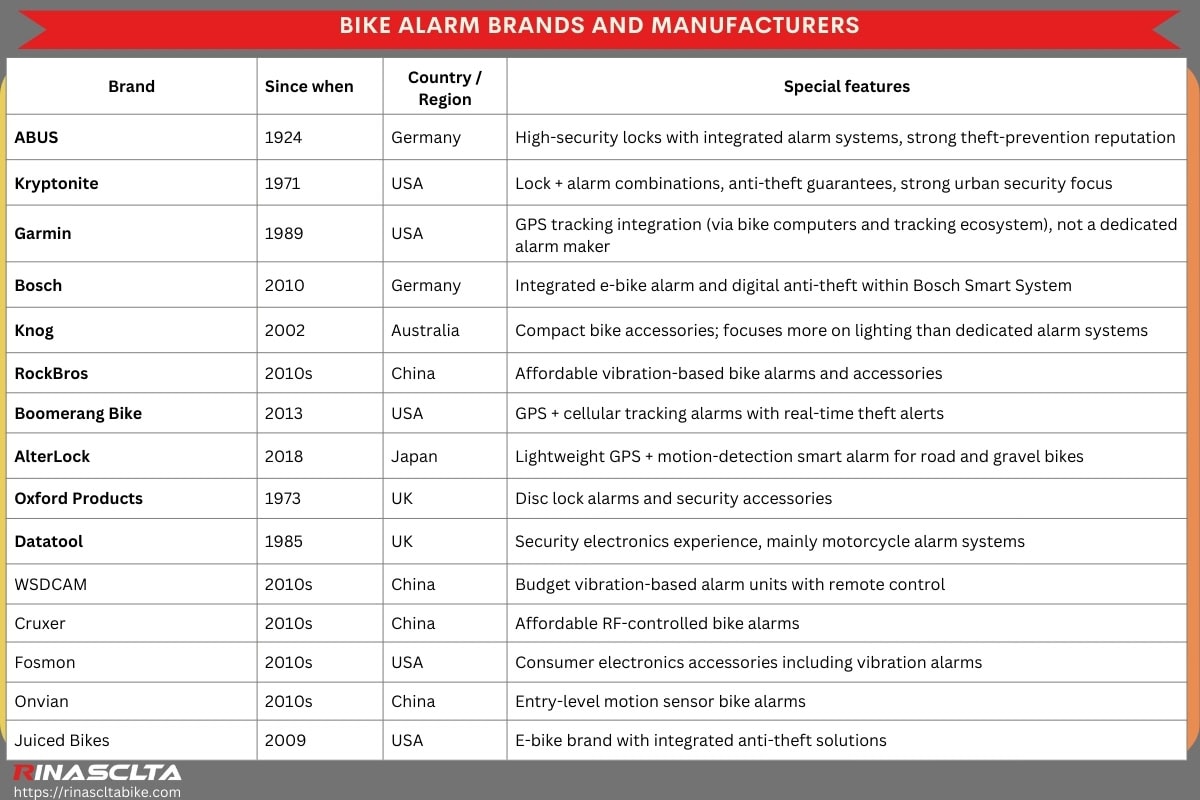
The bike alarm industry is shaped by security brands, cycling accessory manufacturers, and smart tracking technology companies that focus on combining motion detection, audible deterrence, GPS tracking, and app connectivity to reduce bicycle theft. While some brands specialize in lock-integrated alarm systems, others focus on smart Bluetooth or cellular tracking devices, reflecting a market that ranges from affordable vibration alarms to high-end connected anti-theft ecosystems for urban bikes and e-bikes.
| Brand | Since when | Country / Region | Special features |
| ABUS | 1924 | Germany | High-security locks with integrated alarm systems, strong theft-prevention reputation |
| Kryptonite | 1971 | USA | Lock + alarm combinations, anti-theft guarantees, strong urban security focus |
| Garmin | 1989 | USA | GPS tracking integration (via bike computers and tracking ecosystem), not a dedicated alarm maker |
| Bosch | 2010 (e-bike systems) | Germany | Integrated e-bike alarm and digital anti-theft within Bosch Smart System |
| Knog | 2002 | Australia | Compact bike accessories; focuses more on lighting than dedicated alarm systems |
| RockBros | 2010s | China | Affordable vibration-based bike alarms and accessories |
| Boomerang Bike | 2013 | USA | GPS + cellular tracking alarms with real-time theft alerts |
| AlterLock | 2018 | Japan | Lightweight GPS + motion-detection smart alarm for road and gravel bikes |
| Oxford Products | 1973 | UK | Disc lock alarms and security accessories |
| Datatool | 1985 | UK | Security electronics experience, mainly motorcycle alarm systems |
| WSDCAM | 2010s | China | Budget vibration-based alarm units with remote control |
| Cruxer | 2010s | China | Affordable RF-controlled bike alarms |
| Fosmon | 2010s | USA | Consumer electronics accessories including vibration alarms |
| Onvian | 2010s | China | Entry-level motion sensor bike alarms |
| Juiced Bikes | 2009 | USA | E-bike brand with integrated anti-theft solutions |