What is a bicycle light?
A bicycle light is a lighting device mounted on a bicycle to improve visibility during low-light conditions and ensure the rider can see and be seen by others, especially vehicles and pedestrians. The first bicycle lights appeared in the late 1800s, originally fueled by acetylene gas (carbide lamps) and later by oil lanterns, primarily in Europe, where night-time cycling grew due to urban commuting and recreation. In the early 20th century, battery-powered incandescent lights emerged, but it wasn’t until the 1980s and 1990s—with advances in halogen bulbs, alkaline batteries, and eventually LED technology—that bike lights became lighter, brighter, and more efficient. The shift to rechargeable lithium-ion batteries, USB charging, and programmable light modes has made modern lights more environmentally friendly and user-friendly.
In many countries, bike lights are legally required at night or in poor visibility, with laws often mandating a white front light, red rear light, and sometimes reflectors or specific beam patterns (e.g., StVZO-compliant lights in Germany). Beyond safety gear, bike lights have become symbols of sustainable transportation, enabling night commuting, supporting delivery workers, and reducing nighttime cycling accidents. They are part of a broader ecosystem that includes bike reflectors, helmet lights, and visibility gear, all of which play vital roles in road safety and urban mobility. A bicycle light is not only a critical safety component but also a reflection of how cycling has adapted to modern infrastructure, technology, and regulation. As cities evolve toward greener transport, the humble bike light represents a small yet powerful tool in creating safer, more inclusive, and resilient urban environments.
How do bike lights work?
Bike lights work by converting stored electrical energy—usually from rechargeable batteries or dynamos—into visible light through LEDs, making the rider visible (be seen) and helping them navigate in the dark (see). Modern bike lights are compact, efficient, and often include features like multiple light modes, USB charging, and weather resistance. Designed for safety and regulated by laws in many countries, they typically include a white front light and red rear light to reduce accidents and comply with traffic rules. Bike lights function as essential safety devices, using focused illumination and visibility technology to enhance rider protection, meet legal requirements, and support safe cycling in all conditions.
How do bike front lights work?
Bike front lights work by directing a focused beam of white light forward to illuminate the path ahead, allowing the rider to see obstacles, road conditions, and traffic while also helping others see the cyclist. The core mechanism involves an LED (light-emitting diode) powered by a rechargeable lithium-ion battery or hub dynamo, controlled by a driver circuit that regulates brightness and power efficiency. The light is focused using optics—either a lens, reflector, or both—to shape the beam pattern, balancing throw (distance) and spill (side visibility). Higher-quality front lights often feature beam cutoff lines to comply with safety standards like StVZO, which prevent glare to oncoming traffic. Most offer multiple brightness modes and flashing patterns to adapt to different environments such as urban commuting, rural roads, or trails. Laws in many countries mandate a white front light when riding after dark, both for illuminating the cyclist’s path and signaling their presence to others. Bike front lights are precision-designed systems that combine optics, electronics, and safety standards to provide visibility, comply with legal requirements, and enable confident, secure riding in low-light or nighttime conditions.
How do bike rear lights work?
Bike rear lights(tail lights) work by emitting a steady or flashing red light aimed rearward to make the cyclist be seen by vehicles and other road users, especially in low-light or nighttime conditions. These lights typically use LEDs powered by rechargeable lithium-ion batteries, disposable cells, or hub dynamos, with an internal circuit that regulates power flow and lighting modes. Unlike front lights, rear lights prioritize wide-angle visibility over beam distance, often using diffused lenses, reflective housings, or side illumination windows to enhance peripheral visibility. Many feature multiple flash patterns, daytime running modes, and ambient light sensors to increase daytime effectiveness and battery efficiency. Rear lights are required by law in many regions, often specified as a red, non-blinding light visible from at least a certain distance (e.g., 500 feet in the U.S.). Some models integrate brake-sensing technology to brighten automatically when deceleration is detected. Bike rear lights are purpose-built to maximize rider visibility from behind, combining smart lighting technology, wide-angle optics, and legal compliance to reduce collision risk and ensure safe travel on shared roads.
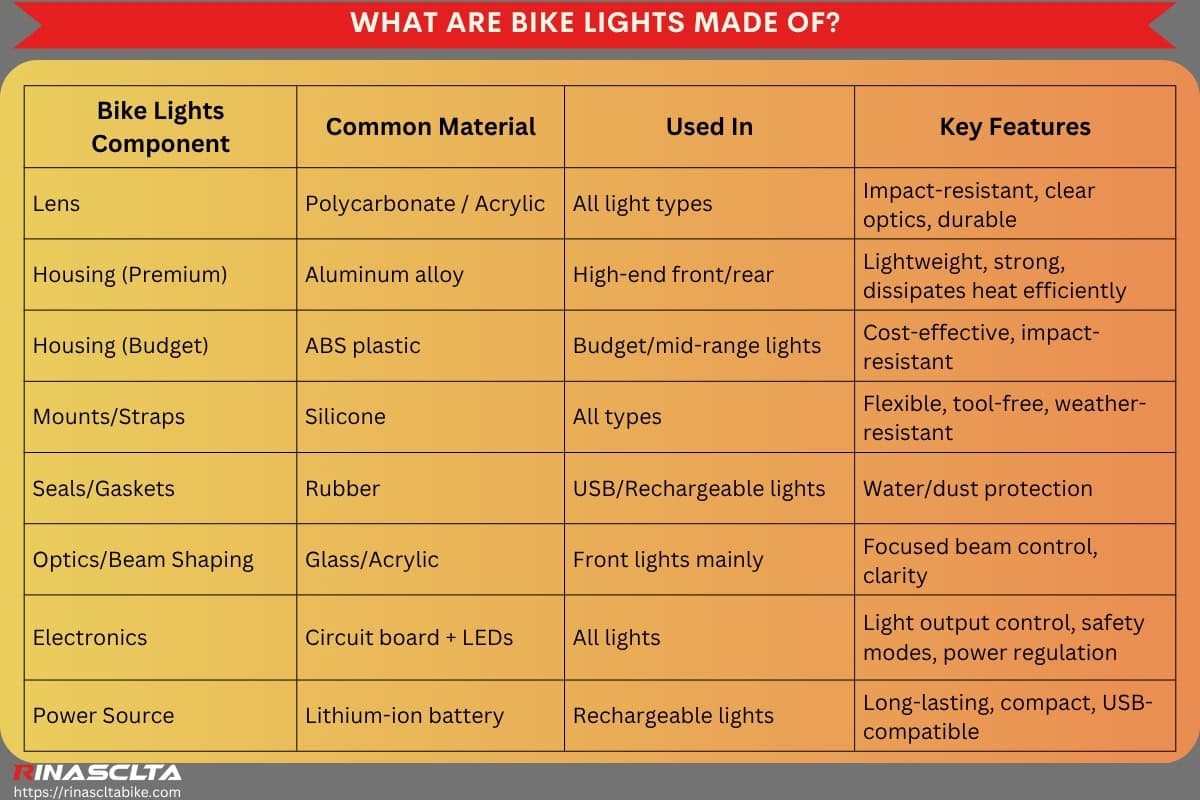
What are bike lights made of?
Bike lights are typically made of materials such as polycarbonate, aluminum alloy, ABS plastic, silicone, glass or acrylic lenses, rubber seals, circuit board components, and lithium-ion batteries—each selected for its durability, weight, weather resistance, and electrical efficiency.
These materials are chosen to ensure the light remains lightweight, impact-resistant, waterproof, and capable of withstanding vibrations and outdoor conditions while maintaining consistent electrical performance.
- Polycarbonate: Used for lenses and housings due to its high impact resistance and optical clarity.
- Aluminum alloy: Common in premium light bodies for its lightweight strength and excellent heat dissipation.
- ABS plastic: Affordable and tough, often used in budget or mid-range models for outer shells.
- Silicone: Flexible material for straps and seals; helps with tool-free mounting and waterproofing.
- Glass or acrylic lenses: Used to focus or diffuse light beams efficiently, offering precise optical control.
- Rubber seals and gaskets: Prevent water and dust ingress, especially in lights with USB charging ports.
- Circuit board and LED components: Control power delivery, light modes, and beam intensity.
- Lithium-ion batteries: Provide high energy density and rechargeability, ideal for compact and long-lasting power.
| Bike Lights Component | Common Material | Used In | Key Features |
| Lens | Polycarbonate / Acrylic | All light types | Impact-resistant, clear optics, durable |
| Housing (Premium) | Aluminum alloy | High-end front/rear | Lightweight, strong, dissipates heat efficiently |
| Housing (Budget) | ABS plastic | Budget/mid-range lights | Cost-effective, impact-resistant |
| Mounts/Straps | Silicone | All types | Flexible, tool-free, weather-resistant |
| Seals/Gaskets | Rubber | USB/Rechargeable lights | Water/dust protection |
| Optics/Beam Shaping | Glass/Acrylic | Front lights mainly | Focused beam control, clarity |
| Electronics | Circuit board + LEDs | All lights | Light output control, safety modes, power regulation |
| Power Source | Lithium-ion battery | Rechargeable lights | Long-lasting, compact, USB-compatible |

How are bike lights made?
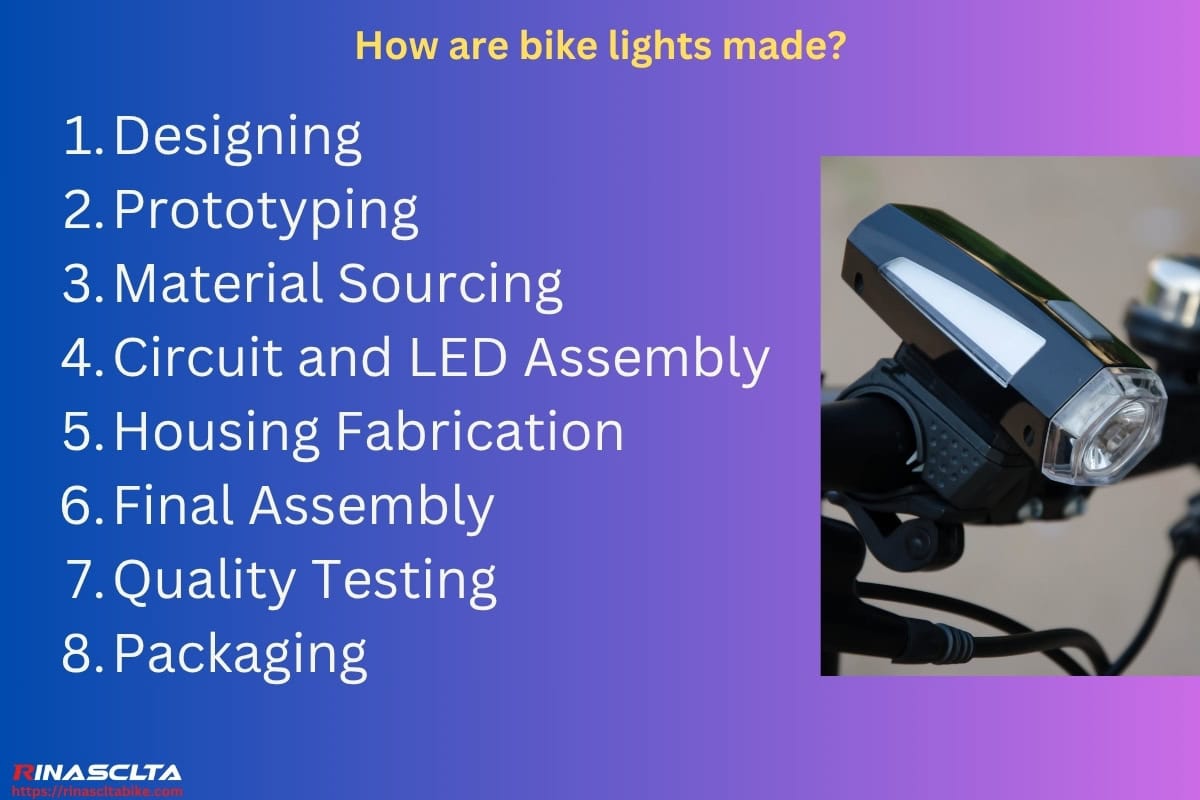
Bike lights are made through a series of steps: designing, prototyping, material sourcing, circuit and LED assembly, housing fabrication, final assembly, quality testing, and packaging—each carefully executed to ensure safety, durability, efficiency, and compliance with industry standards. These steps are essential to create lights that meet legal requirements, withstand outdoor conditions, deliver optimal visibility, and satisfy consumer expectations for function, reliability, and style.
- Designing: Engineers and designers define the light’s purpose, brightness, beam pattern, power source, and form factor using CAD and optical modeling tools.
- Prototyping: Initial samples are 3D printed or CNC machined and tested for ergonomics, optics, and heat management before mass production.
- Material Sourcing: Manufacturers procure polycarbonate lenses, aluminum housings, LEDs, batteries, and circuit components from certified suppliers to meet durability and performance standards.
- Circuit and LED Assembly: Technicians or automated systems mount LEDs and control chips onto printed circuit boards, which are programmed for lighting modes and power regulation.
- Housing Fabrication: Outer shells are injection-molded (plastic) or die-cast (aluminum), then treated for waterproofing and heat dissipation.
- Final Assembly: Internal components, lenses, and housings are assembled by hand or machine, including mounting brackets and rubber seals.
- Quality Testing: Lights are tested for lumen output, beam shape, waterproof rating (IPX), battery performance, and vibration resistance.
- Packaging: Finished products are labeled, boxed, and prepared for retail or online distribution with manuals and accessories included.
Types of bicycle lights
Types of bicycle lights are categorized based on their function, mounting location, power source, beam pattern, and bike compatibility, to meet different safety needs, visibility goals, and riding environments. This classification helps riders choose the most suitable lights for seeing, being seen, or complying with legal regulations, while also matching the light to specific setups, such as road bikes, mountain bikes, or e-bikes. Understanding these types is essential for maximizing safety, legal compliance, and riding efficiency across urban, recreational, and performance cycling.
Bike light types based on light types
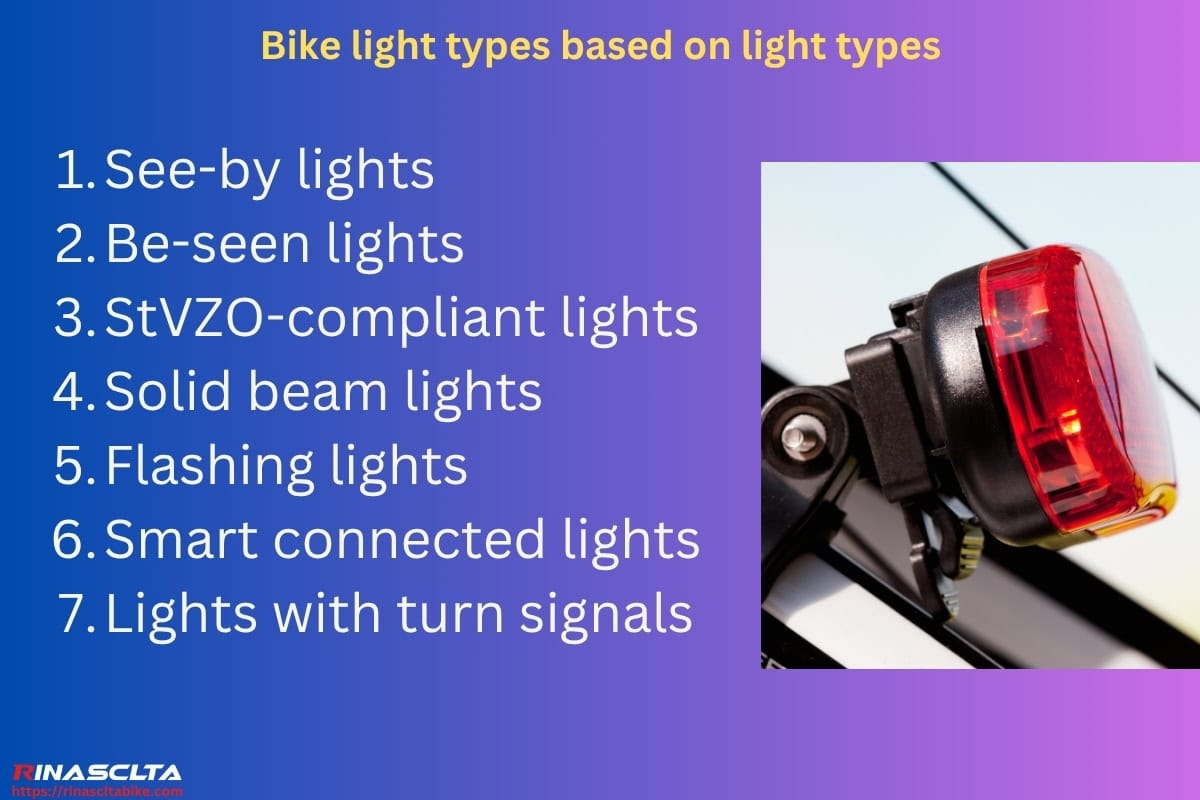
Bike light types based on light function include see-by lights, be-seen lights, StVZO-compliant lights, solid beam lights, flashing lights, smart connected lights, and lights with turn signals—each designed to serve specific safety roles, visibility needs, and regulatory standards for different riding conditions. These types reflect how bike lights are used: to help the rider see the road ahead, to ensure they are seen by others, to comply with traffic laws, and to improve control or communication with added features like smart connectivity and signaling.
- See-by lights: High-lumen front lights that illuminate the rider’s path in dark conditions; essential for night riding and off-road visibility.
- Be-seen lights: Lower-lumen front, rear, or side lights designed to make the cyclist visible to others, especially in urban or daytime traffic.
- StVZO-compliant lights: German-legal lights with beam cutoff technology to prevent glare; often required in the EU for road safety compliance.
- Solid beam lights: Emit a constant stream of light for consistent visibility and are preferred in many countries for predictable road presence.
- Flashing lights: Use intermittent pulses to attract attention and conserve battery life; widely used in cities but restricted in some regions.
- Smart connected lights: Bluetooth-enabled lights that offer app control, automatic on/off, brake detection, GPS syncing, and real-time adjustments.
- Lights with turn signals: Typically rear-mounted or handlebar-integrated, these lights indicate left/right turns to other road users, improving communication and safety in traffic.
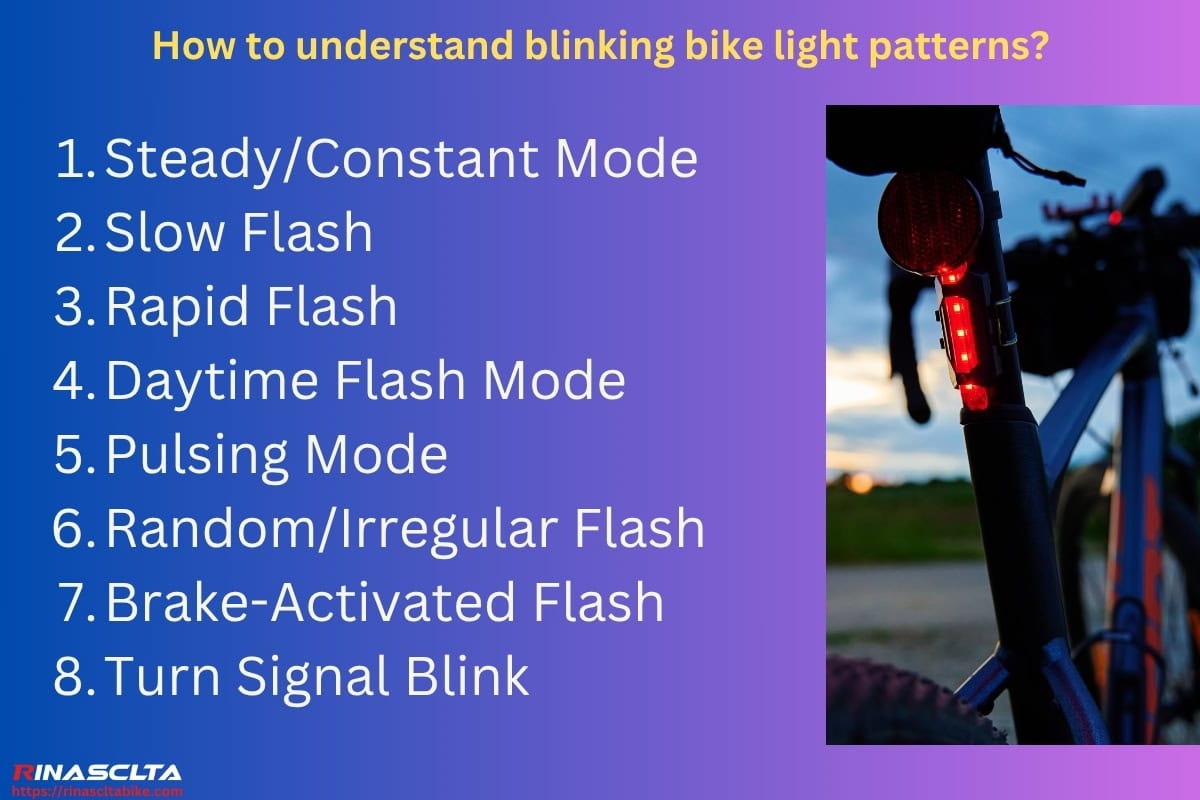
How to understand blinking bike light patterns?
You should understand blinking bike light patterns as intentional variations in flash frequency, intensity, and rhythm—each designed to serve a specific purpose like maximizing visibility, conserving battery, or communicating intent—while also being mindful of local laws and appropriate use based on your riding environment. Understanding when and how to use each pattern helps ensure maximum safety and legal compliance, especially since flashing front lights may be restricted (e.g., under StVZO regulations in Germany) while rear flashing lights are encouraged for visibility in most regions.
Most modern bike lights include several common flash patterns, and understanding them helps you ride more safely and legally from the list below.
- Steady/Constant Mode: Emits a continuous beam; ideal for seeing the road and legally required in some countries (especially for front lights).
- Slow Flash: A gradual pulse that balances visibility and battery life; useful in urban settings with moderate traffic.
- Rapid Flash: High-frequency blinking to maximize attention from drivers; commonly used for rear lights in high-traffic areas.
- Daytime Flash Mode: Ultra-bright flashes designed to be seen even in daylight; effective on busy roads and during commuting hours.
- Pulsing Mode: A steady beam with an overlaid low-frequency pulse; combines the benefits of seeing and being seen without disorienting others.
- Random/Irregular Flash: Unpredictable patterns that draw attention through irregular timing; useful in complex or distracted environments.
- Brake-Activated Flash: Integrated with sensors to trigger a flash or brightness boost when decelerating, similar to car brake lights.
- Turn Signal Blink: Directional blinking lights (usually amber) are activated manually or via remote to indicate left or right turns.
Bike light types based on location
Bike light types based on location include front lights, rear lights, rear radar lights, combo sets, side lights, helmet-mounted lights, wheel lights, and pedal lights—each strategically positioned to enhance visibility, safety, and communication with other road users from multiple angles. These types exist because a cyclist needs 360-degree visibility: to see the road ahead, to be seen from behind and the sides, and to signal presence or intent clearly in diverse environments like city streets, trails, and highways.
- Front lights: Mounted on the handlebar or helmet, they illuminate the path and signal the rider’s approach with a white beam—vital for navigation and legal compliance.
- Rear lights: Attached to the seatpost, rack, or saddle, they emit a red light to alert following traffic, critical for being seen from behind.
- Rear radar lights: Combine a tail light with a radar sensor (e.g., Garmin Varia) to detect approaching vehicles and alert the rider, enhancing situational awareness.
- Combo sets: Packages that include both front and rear lights for balanced visibility—ideal for commuters or first-time buyers seeking full coverage.
- Side lights: Mounted on the frame, fork, or crank area to increase lateral visibility at intersections—useful in urban settings with cross-traffic.
- Helmet-mounted lights: Offer directional control and added height for visibility, especially useful for signaling turns or looking around corners.
- Wheel lights: LEDs mounted on spokes or rims to form patterns while rotating, boosting side visibility, and often used for style and fun in addition to safety.
- Pedal lights: Small lights or reflectors attached to pedals to create motion-based visibility, making it easier for others to notice pedaling movement in the dark.
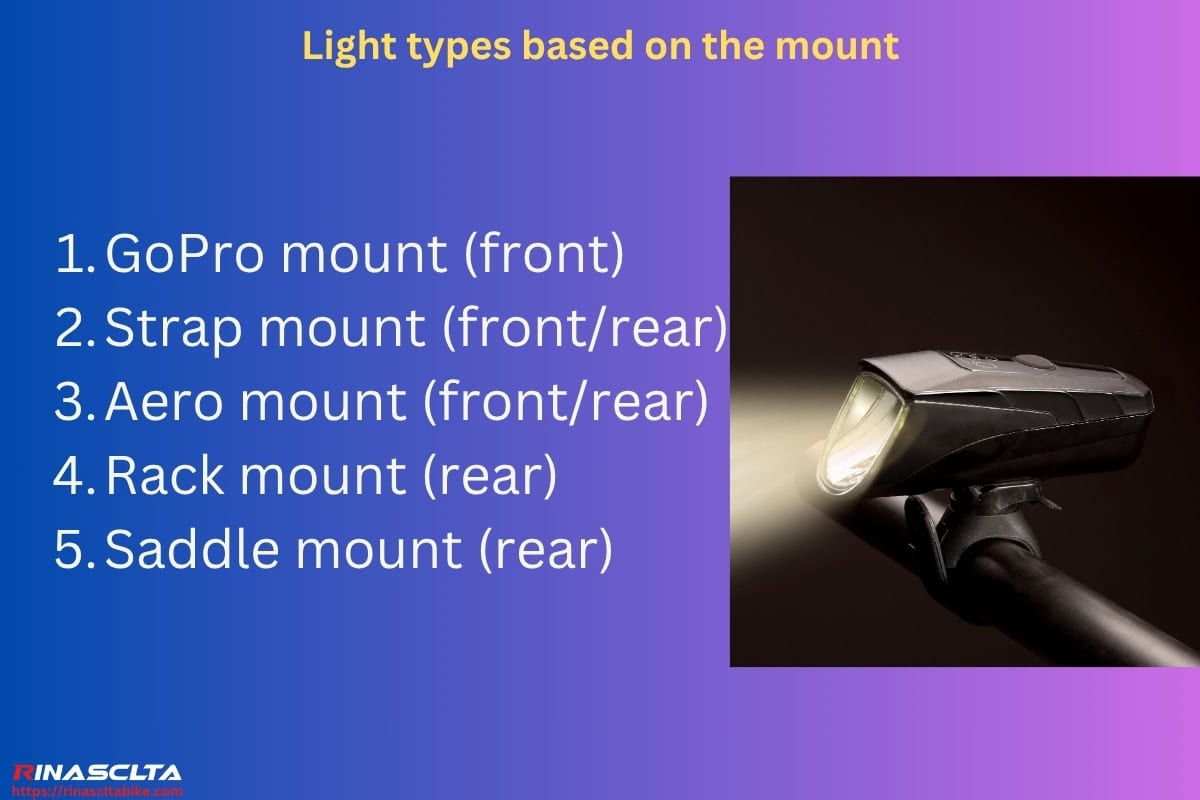
Light types based on the mount
Bike light types based on the mount include GoPro mounts, strap mounts, and aero mounts for front lights, and strap mounts, aero mounts, rack mounts, and saddle mounts for rear lights—each tailored to fit different frame geometries, user preferences, and aerodynamic setups. Mounting type matters because it affects light stability, beam alignment, compatibility with bike components (like aero seatposts or integrated bars), and ease of removal for charging or theft prevention. Choosing the right mount ensures your light stays securely positioned, delivers proper visibility, and maintains aerodynamic efficiency, especially for performance or commuter bikes.
- GoPro mount (front): A standardized interface that attaches lights under computer mounts or action cameras; offers a clean cockpit and solid attachment.
- Strap mount (front/rear): Uses rubber or silicone straps to wrap around handlebars or seatposts; highly versatile and tool-free for quick installation.
- Aero mount (front/rear): Designed to fit aerodynamic handlebars or seatposts with non-round profiles; ensures a flush fit and reduces drag.
- Rack mount (rear): Bolts or clips onto rear cargo racks; common on touring or commuter bikes where seatpost access is limited.
- Saddle mount (rear): Clips beneath the saddle or onto saddle rails; ideal for keeping the seatpost free for other accessories or aero posts.
Light types based on bike types
Bike light types based on bike types include mountain bike lights, road bike lights, gravel bike lights, city/commuter bike lights, and e-bike lights—each designed to meet the specific demands of the terrain, speed, riding style, and visibility needs unique to that bike category. These distinctions exist because different bikes are used in vastly different environments: mountain bikes need rugged, high-output lights for trails; road bikes need lightweight, aerodynamic lights for high-speed travel; city bikes prioritize visibility and legal compliance; and e-bikes often use integrated systems. Selecting the right light type based on your bike ensures optimal safety, battery life, and performance tailored to your ride.
- Mountain bike lights: High-lumen, wide-beam lights built for rough terrain and off-road visibility, often helmet- or bar-mounted for trail flexibility.
- Road bike lights: Slim, lightweight lights with focused beams and daytime flash modes, optimized for speed and aerodynamic setups.
- Gravel bike lights: Durable, long-runtime lights with mixed beam patterns for both on- and off-road use, often with weatherproof features.
- City/commuter bike lights: Practical, easy-to-use lights focused on 360° visibility and legal compliance, often with USB charging and smart modes.
- E-bike lights: Integrated or wired lights powered by the main battery system, offering consistent output and features like automatic on/off or brake light function.
Light types based on battery
Bike light types based on battery include lights that connect to e-bike batteries, human-powered dynamo lights, rechargeable lithium battery lights, and replaceable battery lights—each offering distinct advantages in power source, convenience, runtime, and sustainability. These types reflect the diverse needs of cyclists: e-bikes offer integrated power systems, dynamo hubs are ideal for long-distance or utility riders who want off-grid reliability, while rechargeable and replaceable lights cater to portability, affordability, and easy maintenance. Choosing the right battery type affects charging habits, weight, mounting design, and environmental impact.
- Connects to e-bike battery: Hardwired into the e-bike’s main electrical system for constant power, automatic activation, and minimal maintenance.
- Human-powered (dynamo): Generates electricity from pedaling via a hub or bottle dynamo, offering unlimited runtime and independence from charging.
- Rechargeable lithium batteries: The most common type, offering USB charging, high energy density, and eco-friendliness for everyday riders.
- Replaceable batteries: Use AA, AAA, or coin-cell batteries; convenient for travelers or backup lights where USB charging isn’t always available.
How do you charge a bike light?
You charge a bike light by connecting it to a power source using the appropriate cable—typically a USB-C or micro-USB cable—plugged into a wall charger, power bank, computer USB port, or e-bike charging system, depending on the model.
Most modern rechargeable bike lights have a sealed charging port (often covered by a rubber flap for waterproofing) located on the bottom or rear of the light. Below is the list to show steps of charging a bike light.
- Open the port cover on the bike light.
- Insert the charging cable (usually included with the light).
- Plug the other end into a USB power source.
- Wait for the indicator light to show charging (often red or blinking).
- When the light turns green or steady, the charge is complete.
- Disconnect and close the rubber port cover to keep it sealed.
Some lights use magnetic charging docks or dedicated USB bases, and higher-end models may also support fast charging or smart battery monitoring. Always use the manufacturer-recommended charger and cable to avoid overcharging or damaging the battery.
How do you choose a bicycle light?
You can choose a bicycle light by considering key features such as brightness (lumens), beam pattern, battery type and charging method, mounting style, runtime, durability, water resistance, cost, warranty, lifespan, and local legal requirements—each of which affects your visibility, safety, convenience, and long-term value. These features help match the light to your specific riding conditions, whether you’re commuting in the city, riding trails at night, or staying visible in traffic, while also ensuring compliance with road safety laws in your region.
- Brightness (lumens): Determines how far and wide the light shines; higher lumens are essential for dark roads, while lower lumens work for city visibility.
- Beam pattern: Affects how light is distributed—wide beams increase side visibility, while focused beams offer better distance illumination.
- Battery type and charging: Rechargeable lights (USB or e-bike integrated) offer convenience and cost savings; replaceable batteries are good for backups or travel.
- Mounting style: Should match your bike’s frame, handlebar, seatpost, or helmet setup; good mounts keep lights stable and correctly aligned.
- Runtime: Important for long rides or commutes—ensure the light can last your full trip on a single charge.
- Durability: Rugged materials (like aluminum or polycarbonate) help resist damage from drops, vibration, or weather.
- Water resistance: Look for IPX-rated lights to ensure performance in rain or wet environments.
- Cost: Should reflect the quality and features you need; budget lights are fine for casual use, but frequent riders benefit from investing more.
- Warranty: A solid warranty reflects build quality and offers peace of mind if something goes wrong.
- Lifespan: Longer-lasting lights (especially LEDs and lithium batteries) are more reliable and sustainable in the long run.
- Local legal requirements: Ensure compliance with laws, like mandatory front white and rear red lights, or beam cutoff regulations (e.g., StVZO in Europe).
What is a good bicycle light?
A good bicycle light delivers the right balance of brightness (lumens), beam pattern, battery life, durability, weather resistance, and mounting security—all while meeting legal requirements and matching your specific riding environment. It should provide enough light to see clearly at night (typically 300–1000 lumens for front lights) and ensure you’re seen by others with a highly visible rear light (at least 30–100 lumens), even in daylight. Key features of a good light include USB-rechargeable lithium batteries, multiple lighting modes (steady/flash), an IPX water resistance rating, and a secure mounting system compatible with your bike setup. A good bicycle light also complies with local laws (e.g., StVZO in Europe) and comes with a reliable warranty, ensuring performance, safety, and long-term value on every ride.
How many lumens for a bike light?
For a bike light, the recommended lumen range is 100–300 lumens for city commuting, 400–800 lumens for rural or low-light roads, and 1000+ lumens for off-road or high-speed night riding. This range ensures the rider can see clearly and be seen by others without causing glare or wasting battery life. Lower lumens are suitable where ambient light exists, while higher lumens are essential for navigating dark paths or technical trails. Rear lights typically range from 30 to 100 lumens, providing visibility without blinding drivers or other cyclists. Selecting the proper lumen level helps balance safety, power efficiency, and compliance with visibility standards like StVZO.
How many lumens for a front bike light?
For a front bike light, the ideal lumen range is typically 100–300 lumens for well-lit urban areas, 400–800 lumens for suburban or dimly lit roads, and 1000–1600+ lumens for dark trails, rural roads, or high-speed night riding. This range ensures you can see clearly ahead without blinding others, while preserving battery life and staying within safe, legal limits. Lights under 100 lumens may leave obstacles unseen, while those over 1600 lumens are usually unnecessary for most commuters and can be overkill or even unsafe on shared roads due to glare. Some regions—like Germany under StVZO law—enforce beam cutoff regulations to prevent dazzling oncoming traffic. The right lumen level balances visibility, safety, runtime, and legal compliance, making your ride both efficient and secure.
How many lumens for a rear bike light?
For a rear bike light, the ideal lumen range is typically 30–100 lumens for urban and suburban use, with up to 150–200 lumens recommended for high-traffic roads or daytime visibility. This range is bright enough to make you be seen without overwhelming drivers or other cyclists behind you. Lights under 20 lumens may be too dim in daylight or heavy traffic, while those above 200 lumens can create glare and reduce safety, especially in group rides. Some rear lights also feature daytime flash modes, wide-angle visibility, or brake-sensing functions to enhance presence without needing extreme brightness. Choosing the right lumen level ensures optimal visibility, battery life, and compliance with traffic safety regulations, especially in places where flashing or overly bright lights may be restricted.
What is the best lumens for a bike light?
The best lumens for a bike light depends on your riding environment, but generally, 500–800 lumens is ideal for most riders, offering a perfect balance between seeing the road clearly, being seen by others, battery efficiency, and safety compliance. This range provides enough brightness for unlit paths or rural roads while still being manageable in terms of size, weight, and battery runtime. For city commuting, 100–300 lumens is usually sufficient, while trail or high-speed night riders may benefit from 1000+ lumens. Going much higher can cause glare, drain the battery faster, and may violate legal standards like StVZO, which regulate beam patterns and brightness. Selecting a light in the 500–800 lumen range gives most cyclists the best all-around visibility and value.
What is the brightest bike light?
The brightest bike light currently available for consumer use is the Lupine Alpha, which delivers up to 7200 lumens—a level of brightness comparable to a car’s high beam headlights. Designed primarily for extreme night riding, mountain biking, and off-road racing, this light is not intended for typical road or commuter use due to its intensity, size, and power demands. It features advanced optics, external battery packs, and programmable modes to control beam output and prevent glare. The purpose of such high-output lights is to provide maximum illumination in total darkness, where visibility and quick hazard detection are critical, especially at high speeds on trails or descents.
How bright does a bike light need to be seen?
A bike light needs to be at least 50–100 lumens to ensure a rider can be seen clearly by others, especially in urban traffic or low-light conditions. This brightness level is based on visibility thresholds for the human eye, which generally requires a light source of around 50 lumens to be noticeable from a safe distance. Many traffic safety standards (such as the CPSC in the U.S. or BS6102/3 in the UK) require rear lights to be visible from up to 500 feet (approximately 150 meters). In daytime or high-traffic environments, lights with 100–200 lumens and flashing modes are more effective, as they stand out better against ambient light and background movement. A bike light in the 50–100 lumen range is the minimum needed to be safely seen, balancing biological visibility, road safety expectations, and legal compliance.
Why rear bike light lumens less?
Rear bike light lumens are less because their primary purpose is to make the rider be seen—not to illuminate the path—so they require less brightness to be effective. Unlike front lights, which must project forward to help the rider see the road, rear lights are meant to alert approaching drivers or cyclists from behind. Excessively bright rear lights (over 200 lumens) can cause glare, dazzle, or visual discomfort, especially in group rides or close traffic. Regulations like StVZO in Germany and BS6102/3 in the UK often prohibit flashing or overly intense rear lights, requiring them to be non-blinding and visible from a defined distance, typically up to 500 feet (150 meters). Additionally, human eyes are more sensitive to red light in darkness, so 30–100 lumens is usually sufficient for visibility without causing disruption. Rear bike lights are deliberately lower in lumens to maximize visibility without compromising safety or violating lighting regulations.
What is the difference between lux and lumens?
The difference between lux and lumens lies in what they measure: lumens (lm) indicate the total amount of light emitted by a source, while lux (lx) measures how much of that light actually hits a surface, taking area and distance into account. In other words, lumens quantify brightness output, and lux quantifies light intensity on a given area. For example, 1000 lumens focused into a tight beam will result in a high lux value (e.g., 100 lx on 10 m²), while the same 1000 lumens spread widely will yield a lower lux (e.g., 10 lx on 100 m²). Bike lights often advertise lumens, but lux is more important for seeing the road, especially under regulations like StVZO in Germany, which limit lux and require a cutoff beam pattern to avoid blinding others. Lumens reflect total brightness, while lux reflects usable visibility, making lux critical for front lights intended to illuminate your path safely.
Do I need back-up bike lights or helmet-mounted bike lights for extra brightness?
No, you don’t need back-up bike lights or helmet-mounted bike lights if your primary lights are bright enough, reliable, and legally compliant for your riding conditions—but they are highly recommended for added visibility, redundancy, and directional control in low-light or high-risk environments. Helmet-mounted lights help you direct light where you look, improving reaction time and peripheral awareness, especially on trails or at intersections. Back-up lights offer fail-safe protection if your main light battery dies or malfunctions mid-ride, and dual rear lights (e.g., steady + flash) can improve your visibility profile in traffic. So while not strictly necessary, having extras increases the safety margin, especially for night commuting, winter riding, or long-distance tours.
Is it illegal to have no lights on a bike?
Yes, it is illegal to have no lights on a bike in most countries if you are riding at night or in low-visibility conditions, because bike lights are required for safety and road visibility. Laws typically mandate a white front light and red rear light after dark.
Are bike lights a legal requirement?
Yes, bike lights are a legal requirement in most regions when riding at night or in poor visibility, often specifying brightness, position, and color.
Are flashing bike lights legal?
Yes, flashing bike lights are legal in many countries with some exceptions—for example, Germany (StVZO) requires steady beam front lights and may restrict flashing. In the U.K. and the U.S., flashing lights are typically allowed.
Are flashing bike lights safer?
Yes, flashing bike lights can be safer in certain conditions like daytime riding or urban traffic, because they catch driver attention better, but steady lights may be more effective at night for depth perception and legal clarity.
Can you ride a bike at night without lights?
No, you cannot legally ride a bike at night without lights in most places—it’s dangerous and violates traffic laws designed to prevent collisions.
Can you bike without a taillight?
No, you shouldn’t bike without a tail light, especially at night, as a red rear light is legally required in most jurisdictions and critical for being seen from behind.
Do Citi Bikes have lights?
Yes, Citi Bikes do have lights; they typically come with built-in front and rear LED lights that are dynamo- or battery-powered and activate automatically when riding.
What color of bike lights are required by law?
Bike lights are required by law to be white in the front and red in the rear in most countries, including the U.S., U.K., Canada, Australia, and EU member states. This color standard aligns with global traffic conventions: white lights indicate forward movement, while red signals the rear, just like on motor vehicles. The purpose is to maintain predictable visibility, orientation, and traffic safety. Many laws also require red rear reflectors and sometimes amber or white side reflectors for added passive visibility. Using incorrect colors—like red front lights or blue flashing lights—may violate regulations and confuse other road users. Bike lights must follow color conventions to ensure legal compliance, directional clarity, and overall road safety.
Are bike lights required by law?
Yes, bike lights are required by law in most countries when riding at night or in low-visibility conditions, to ensure cyclists are visible to others and can safely navigate the road. Legal requirements typically mandate a white front light and a red rear light, along with reflectors in some cases, to align with vehicle visibility standards. These rules are enforced under traffic safety regulations such as the U.S. CPSC, U.K. Road Vehicle Lighting Regulations, and Germany’s StVZO, all designed to reduce collisions and improve nighttime road safety. Riding without lights can result in fines, increased accident risk, and legal liability in the event of a crash.
What does UK law say about bike lights?
UK law says that cyclists must have lights and reflectors when riding between sunset and sunrise, as outlined in the Road Vehicles Lighting Regulations 1989 (RVLR). According to these rules:
“Cycles must be fitted with a white front light, a red rear light, a red rear reflector, and amber pedal reflectors (front and rear) on each pedal.”
Key requirements for bike lights in the UK are listed below.
- White front light – can be steady or flashing (must emit at least 4 candela if flashing).
- Red rear light – also steady or flashing (minimum 4 candela if flashing).
- Red rear reflector – fixed.
- Amber pedal reflectors – front and rear on both pedals (mandatory unless the bike was manufactured before October 1, 1985).
- Lights must be clean, working, and properly positioned—front at the bike’s center or off to the right; rear at the center or off to the left.
The law applies from sunset to sunrise, not just “at night,” and cyclists without proper lighting can face fixed penalty notices or be deemed partially liable in accidents.
UK bike light law emphasizes both active visibility (via lights) and passive visibility (via reflectors) for full legal compliance and safety.
What does US law say about bike lights?
US law says that bicycles operated at night must be equipped with specific lighting and reflectors, as outlined in the Consumer Product Safety Commission (CPSC) regulations and further governed by state traffic laws. The federal CPSC requirement is:
“A bicycle must have a white front lamp visible from at least 500 feet and a red rear reflector visible from 100 to 600 feet when directly in front of lawful upper-beam headlights.”
— 16 CFR § 1512.16, CPSC Bicycle Requirements
Most states adopt or expand upon this, commonly requiring are listed below.
- White front light – visible from at least 500 feet (152 meters).
- Red rear light or reflector – required, visibility often between 100–600 feet (30–183 meters).
- Side reflectors – often required on wheels or pedals for lateral visibility.
- Rear red light (flashing or steady) – required in many states (e.g., California, Texas, New York).
- Lights must be used from sunset to sunrise or during limited visibility.
Some states allow or prefer flashing rear lights, but flashing front lights may be restricted or discouraged depending on glare concerns. Penalties for non-compliance vary by state and can include fines, citations, or liability in accidents.
US bike light law focuses on being seen and seeing clearly, combining federal product safety standards with state-level enforcement for night-time and low-visibility cycling.
What is a STVZO-approved light?
A StVZO-approved light is a bicycle light that complies with Germany’s road traffic licensing regulations, specifically the Straßenverkehrs-Zulassungs-Ordnung (StVZO), which sets strict legal standards for bike lighting to ensure safety, non-glare visibility, and road compliance. These lights are required to have a precisely shaped beam with a cut-off line—similar to car headlights—to illuminate the road without blinding oncoming traffic.
Under §67 of the StVZO, key requirements for approved lights include:
- A white front light with a flat, focused beam and clear cut-off.
- A steady red rear light (flashing is not allowed).
- Power from a hub dynamo or permitted battery system.
- Lights must have K-number certification (e.g., “K 1234”) visibly printed on the housing to prove compliance.
These laws apply in Germany and are often adopted in Austria, the Netherlands, and other EU countries. StVZO-approved lights are ideal for commuters and road cyclists in shared traffic environments, where avoiding glare is as important as visibility.
A StVZO-approved light guarantees a legally compliant, road-safe beam pattern in Germany and parts of Europe, ensuring riders are visible without dazzling others, as mandated by national traffic safety regulations.
Are bike lights required in California?
Yes, bike lights are not required in California because California law (Vehicle Code §21201) requires a white front light visible from 300 feet (91 meters) and a red rear reflector or light visible from 500 feet (152 meters) when riding at night, but failure to comply may result in a citation and increased crash risk.
Are blue bike lights legal?
No, blue bike lights are not legal because blue lights are typically reserved for emergency vehicles under California law (Vehicle Code §25268), but you may use blue accent lights only if they are not visible from the front or rear and don’t imitate law enforcement.
Can better lighting help prevent bike accidents?
Yes, better lighting can help prevent bike accidents because higher-quality lighting improves both visibility and conspicuity, reducing collisions with cars, but it must be properly aimed and used in compliance with laws to avoid blinding others.
Can I put red and blue lights on my bike?
No, you can not put red and blue lights on your bike because displaying both red and blue lights may be interpreted as impersonating a police or emergency vehicle in many U.S. states, including California, but red rear lights are legal and required—just avoid blue entirely.
Can I use a phone torch as a bike light?
Yes, you can use a phone torch as a bike light only in an emergency, because any white light is better than none, but phone flashlights are not designed for road use, offer a poor beam pattern, weak mounting, and are not legally compliant as your primary light.
What is the safest bike light?
The safest bike light is one that combines adequate brightness, wide-angle visibility, legal compliance, and reliability, such as the Garmin Varia RTL515 rear radar light or a StVZO-approved front light like the Busch & Müller IQ-X. These lights meet key safety standards by offering:
- Visibility from 220°+ angles
- Appropriate lumen levels (e.g., 400–800 lumens front, 50–100 lumens rear)
- Cut-off beam patterns to prevent glare (front)
- Flashing or radar-enhanced modes for high-traffic awareness (rear)
- USB-rechargeable batteries with long runtime and low-battery indicators
- IPX waterproof ratings for all-weather use
The safest bike light is not just the brightest, but one that maximizes visibility, predictability, and legal use, while functioning reliably under real-world riding conditions—urban, rural, or trail.
How do you attach bike lights?
You can attach bike lights using a variety of mounting systems, such as rubber straps, clamp mounts, GoPro-style brackets, or integrated mounts designed for specific bike components like handlebars, seatposts, racks, or helmets. The key is to position the front light securely on the handlebar or fork crown to project forward, and the rear light on the seatpost, rack, or saddle rails to face directly back, ensuring a stable fit, correct beam angle, and compliance with visibility laws. Proper attachment helps maintain beam alignment, vibration resistance, and safety, especially in variable terrain or weather conditions.
How do you attach bike front lights?
You can attach bike front lights by securing them to the handlebar, helmet, or fork crown using rubber straps, plastic clamps, or GoPro-style mounts, depending on the light’s design and your bike setup. The light should be positioned horizontally, centered, and angled slightly downward to illuminate the road without blinding others, ensuring optimal beam pattern, stability, and legal compliance for visibility and safety during night or low-light rides.
How do you attach bike rear lights?
You can attach bike rear lights by mounting them to the seatpost, rear rack, saddle rails, or back of a bag or fender using rubber straps, clip mounts, rack adapters, or saddle mounts, depending on the light’s compatibility and your bike’s setup. The rear light should face directly backward, positioned at a visible height and angle to ensure maximum visibility, legal compliance, and safety, especially in traffic or low-light conditions.
How much are bike lights?
Bike lights typically range from around USD 10 / €10 / £8 for basic be-seen lights to over USD 300 / €280 / £250 for high-performance, see-by or smart-connected lighting systems. Entry-level USB-rechargeable front or rear lights start at USD 20–$40, while mid-range commuter sets with multiple modes and waterproof ratings fall between USD 50–$100. Premium lights with 1000+ lumens, StVZO beam patterns, radar sensors, or integrated batteries (like the Garmin Varia or Lupine Alpha) can exceed USD 150–$300. These price ranges reflect differences in brightness (lumens), battery capacity, build quality, features, and regulatory compliance.
Where can I buy bike lights?
You can buy bike lights from a variety of sources including online retailers (like Amazon, REI, Wiggle, Chain Reaction Cycles), brand websites (such as Lezyne, Cateye, Garmin, Magicshine), and local bike shops that offer personalized advice and installation help. Many sporting goods stores (like Decathlon, MEC, or Halfords) also carry a wide range of lights for all budgets. Additionally, you can find used or discounted bike lights through cycling forums, Facebook Marketplace, Craigslist, or local bike co-ops and community repair events, which sometimes offer free safety gear. Buying from a trusted source ensures product authenticity, warranty support, and compliance with local safety standards.
How much does a light bike weigh?
A light bike light weighs between 20 to 150 grams for most front or rear units, depending on the battery size, materials, lumens, and mounting system. Minimalist rear lights designed for visibility weigh as little as 20–40 grams, while compact front lights with moderate brightness (200–400 lumens) typically weigh 50–100 grams. High-powered lights with large internal batteries or external packs can weigh 150 grams or more, especially those used for trail or off-road riding. The weight varies due to differences in housing material (plastic vs aluminum), battery capacity, beam optics, and added features like Bluetooth, radar, or brake sensors.
How long do you need to charge bike lights?
You need to charge bike lights for about 2 to 6 hours, depending on the battery capacity, charging method, and light model. Smaller rear lights with basic LEDs and lower battery capacity may charge in 2–3 hours, while high-powered front lights (especially those over 1000 lumens) with larger lithium-ion batteries may take 4–6 hours via USB. Lights with fast charging support (USB-C or dedicated adapters) may reduce this time, while charging through a computer port or low-output charger can extend it. Always refer to the manufacturer’s specs to avoid overcharging and ensure optimal battery health.
How do you change the battery in a bike light?
You can change the battery in a bike light by opening the battery compartment, usually located on the back or underside of the light, using your hands or a small tool like a coin or screwdriver, depending on the model. For lights that use replaceable batteries (like AA, AAA, or CR2032 button cells), simply remove the old battery and insert a new one in the correct orientation (marked +/−), then close the compartment securely to maintain water resistance.
For USB-rechargeable lights with built-in lithium-ion batteries, the battery is not user-replaceable in most models. In these cases, if the battery degrades, your options are to:
- Contact the manufacturer for a professional battery replacement (if supported),
- Or replace the entire light, as many compact models are sealed and not designed to be opened without damage.
Always check the manual or product label for battery type and replacement instructions, and avoid using incompatible batteries that could affect performance or safety.
How long do bike lights last?
Bike lights last anywhere from 1.5 to 100+ hours on a single charge or set of batteries, depending on the brightness level, light mode (steady vs flashing), battery capacity, and LED efficiency. For example, a high-powered front light at full brightness (1000+ lumens) may run for just 1.5 to 3 hours, while the same light on a low or flashing mode can last 10–30 hours. Rear lights, especially flashing ones, often run 20–100+ hours due to lower power demand. Runtime also varies by brand, temperature, and battery health, and many lights include power-saving modes or low-battery indicators to extend performance safely.
How long does the rechargeable bicycle light last?
Bike rechargeable lights last between 2 to 50+ hours per charge, depending on the light’s brightness setting, battery capacity, and usage mode (steady vs flashing). On high mode (e.g., 800–1000 lumens), a front light may run for 2–4 hours, while on low or eco mode, it can last 15–30 hours. Rear rechargeable lights, which use less power, often last 20–50+ hours, especially in flashing mode. Advanced lights with smart sensors, larger lithium-ion batteries, or adaptive brightness can stretch runtime further, but higher brightness always shortens it. Runtime depends heavily on how you use the light, not just its size.
What do the battery life numbers mean?
The battery life numbers indicate how long a bike light can operate on a single charge or set of batteries under specific conditions, typically measured in hours per lighting mode. For example, a light listed as “Runtime: 3h (High), 10h (Low), 25h (Flash)” means it will last 3 hours on high brightness, 10 hours on low, and 25 hours when flashing. These numbers help you plan your rides, ensuring you won’t run out of light mid-trip. Keep in mind that actual performance may vary based on battery health, temperature, and usage patterns, so these figures are often based on lab tests under ideal conditions.
Are the LED lights for bikes waterproof?
Yes, most LED bike lights are waterproof or water-resistant, because they are designed for outdoor use and must function reliably in rain, puddles, or wet road conditions—but the level of protection varies by model and is usually indicated by an IP (Ingress Protection) rating, such as IPX4 (splash-proof) or IPX7 (submersible). Higher-end lights often have sealed housings, rubber port covers, and durable materials to prevent water damage, but not all lights are fully waterproof, so it’s important to check the rating if you ride frequently in harsh weather.
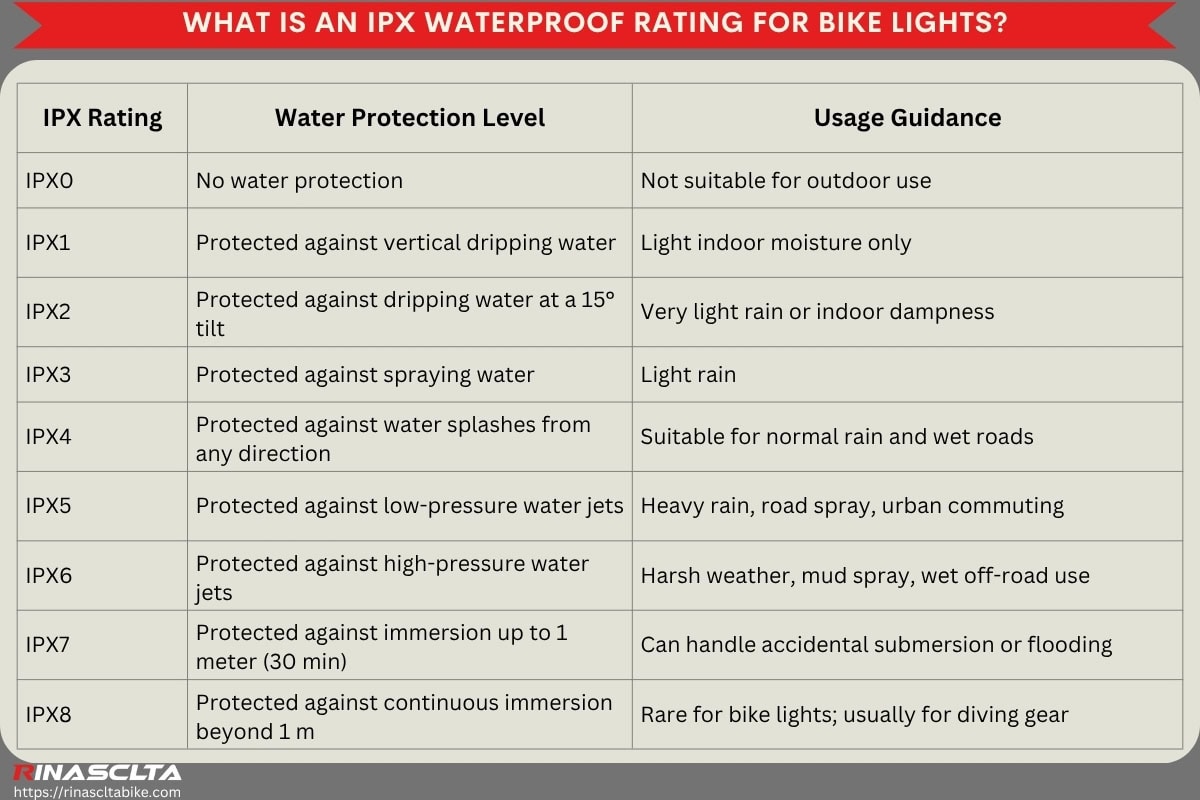
What is an IPX waterproof rating for bike lights?
An IPX waterproof rating for bike lights refers to the level of protection the light has against water ingress, as defined by the Ingress Protection (IP) code. The “X” means the rating does not specify protection against solid objects (like dust), and the number that follows indicates how resistant the light is to water, ranging from light splashes to full submersion. This rating helps riders choose lights suitable for various weather conditions—from occasional rain to heavy storms or river crossings.
| IPX Rating | Water Protection Level | Usage Guidance |
| IPX0 | No water protection | Not suitable for outdoor use |
| IPX1 | Protected against vertical dripping water | Light indoor moisture only |
| IPX2 | Protected against dripping water at a 15° tilt | Very light rain or indoor dampness |
| IPX3 | Protected against spraying water | Light rain |
| IPX4 | Protected against water splashes from any direction | Suitable for normal rain and wet roads |
| IPX5 | Protected against low-pressure water jets | Heavy rain, road spray, urban commuting |
| IPX6 | Protected against high-pressure water jets | Harsh weather, mud spray, wet off-road use |
| IPX7 | Protected against immersion up to 1 meter (30 min) | Can handle accidental submersion or flooding |
| IPX8 | Protected against continuous immersion beyond 1 m | Rare for bike lights; usually for diving gear |
What is the warranty on bike lights?
The warranty on bike lights typically ranges from 1 to 2 years, depending on the brand, product type, and region of purchase. Most reputable manufacturers—such as Lezyne, Cateye, NiteRider, Garmin, and Magicshine—offer a 1-year limited warranty covering defects in materials or workmanship under normal use. Some premium brands or high-end models may include 2-year warranties or extended coverage upon registration. The warranty usually excludes battery degradation, water damage (if misused beyond IP rating), or physical abuse.
This coverage exists to ensure consumer confidence, maintain product quality, and support after-sales service. Always check the official policy on the brand’s website or product manual, and keep proof of purchase for warranty claims.
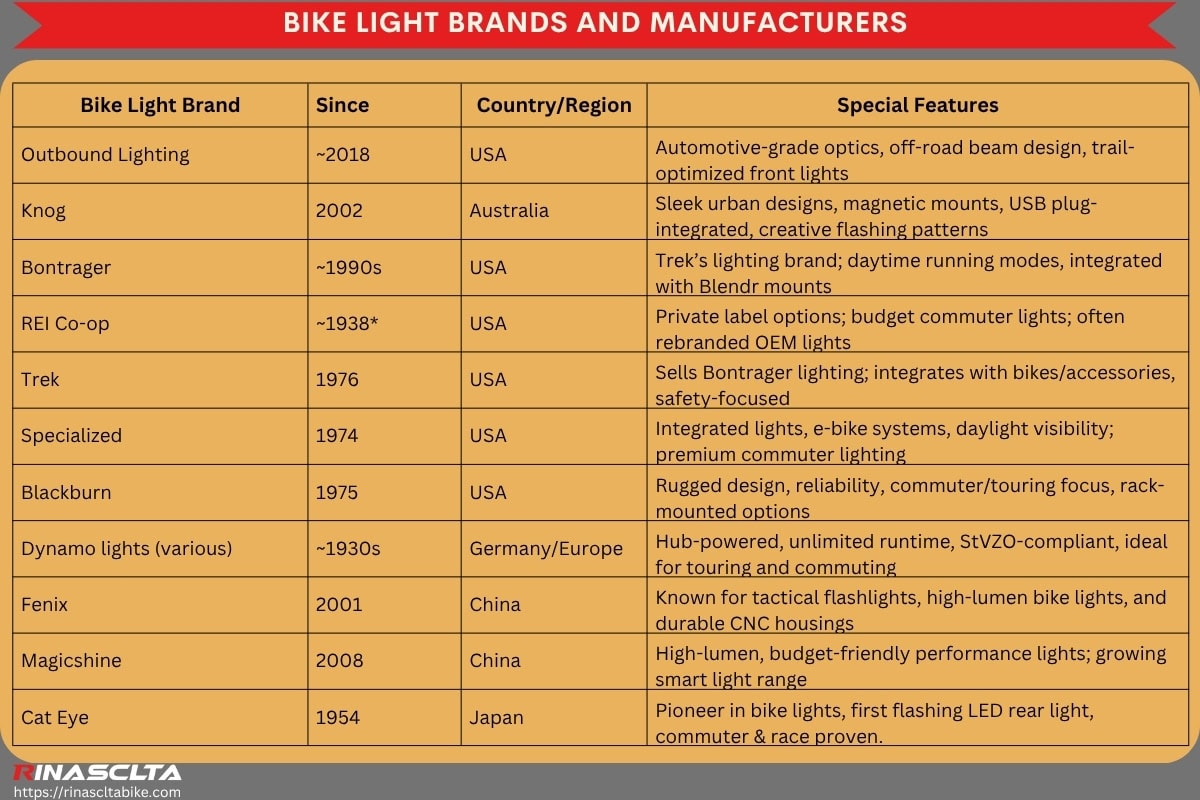
Bike light brands and manufacturers
Bike light brands and manufacturers vary widely in technology, design, origin, and purpose, ranging from rugged trail lighting to sleek urban commuter systems. Some brands specialize in high-performance front lights, while others focus on visibility-focused rear lights, integrated smart systems, or dynamo-powered solutions for off-grid endurance riding. Manufacturers come from all over the world, including the U.S., Germany, Japan, Australia, China, and Taiwan, and many have become known for standout features like StVZO compliance, radar integration, USB-C fast charging, or ultralight form factors. Whether you’re a city commuter, mountain biker, or touring cyclist, knowing the landscape of bike light brands helps you find the right balance between performance, safety, and value.
| Bike Light Brand | Since | Country/Region | Special Features |
| Outbound Lighting | ~2018 | USA | Automotive-grade optics, off-road beam design, trail-optimized front lights |
| Knog | 2002 | Australia | Sleek urban designs, magnetic mounts, USB plug-integrated, creative flashing patterns |
| Bontrager | ~1990s | USA | Trek’s lighting brand; daytime running modes, integrated with Blendr mounts |
| REI Co-op | ~1938* | USA | Private label options; budget commuter lights; often rebranded OEM lights |
| Trek | 1976 | USA | Sells Bontrager lighting; integrates with bikes/accessories, safety-focused |
| Specialized | 1974 | USA | Integrated lights, e-bike systems, daylight visibility; premium commuter lighting |
| Blackburn | 1975 | USA | Rugged design, reliability, commuter/touring focus, rack-mounted options |
| Dynamo lights (various) | ~1930s | Germany/Europe | Hub-powered, unlimited runtime, StVZO-compliant, ideal for touring and commuting |
| Fenix | 2001 | China | Known for tactical flashlights, high-lumen bike lights, and durable CNC housings |
| Magicshine | 2008 | China | High-lumen, budget-friendly performance lights; growing smart light range |
| Cat Eye | 1954 | Japan | Pioneer in bike lights, first flashing LED rear light, commuter & race proven. |