


What Is ANT+ in Cycling?
ANT+ stands for Advanced and Adaptive Network Technology Plus, a standardized extension of the ANT wireless protocol designed for low-power communication between fitness and cycling devices. ANT+ is a wireless communication protocol used in cycling to connect sensors, bike computers, smart trainers, and fitness devices, originally developed by Dynastream Innovations in the early 2000s and standardized as ANT+ in 2004 to enable reliable, low-power data transmission between multiple devices at the same time. It works by broadcasting data such as power, cadence, speed, heart rate, and trainer control signals over the 2.4 GHz band using a one-to-many pairing model, and its value in cycling lies in stable connections, low battery consumption, wide device compatibility, and the ability to link a single sensor to several head units or apps simultaneously—making ANT+ a foundational technology for modern indoor training and performance-focused cycling.
What does ANT+ mean for bikes and cycling devices?
ANT+ means a standardized, low-power wireless communication system that allows bikes and cycling devices—such as power meters, heart rate monitors, speed and cadence sensors, smart trainers, and bike computers—to share data seamlessly and reliably. Its core function is broadcast-based data transmission, enabling one sensor to connect to multiple receivers at the same time with minimal battery drain, and its value for cycling lies in stable indoor training setups, broad cross-brand compatibility, accurate real-time metrics, and smooth integration with head units, training apps, and virtual cycling platforms.
How does ANT+ work in cycling?
ANT+ works in cycling by using a low-power, 2.4 GHz wireless broadcast protocol that continuously transmits sensor data from bike-mounted devices—such as power meters (crank, spider, pedal), speed sensors (hub or wheel), cadence sensors (crank arm), heart rate straps, and smart trainers—to one or more receiving devices at the same time. ANT+ sensors send standardized data profiles (power, cadence, speed, heart rate, trainer control) at fixed intervals, allowing bike computers, watches, and training apps to receive real-time metrics like watts, RPM, speed, heart rate zones, and resistance commands with low latency and minimal battery consumption, which is why ANT+ is widely used for indoor cycling, structured training, ERG mode control, and multi-device setups.
Why do cyclists use ANT+ for indoor training?
Cyclists use ANT+ for indoor training because it provides stable, low-latency, and one-to-many connectivity that allows a smart trainer to communicate simultaneously with training apps, bike computers, and watches without connection conflicts. Its value lies in reliable power data transmission, ERG mode control, cadence and heart rate syncing, and smooth integration with indoor platforms like Zwift, making ANT+ especially effective for structured workouts, virtual riding, and multi-device training setups where consistency and accuracy matter.
Is ANT+ being discontinued in cycling?
No, ANT+ is not being discontinued in cycling because it remains a core wireless standard for smart trainers, power meters, bike computers, and indoor training ecosystems, especially where one-to-many broadcasting, low latency, and low battery consumption are required. Despite Bluetooth gaining popularity on smartphones, ANT+ continues to deliver strong value for multi-device indoor setups, ERG mode control, professional training environments, and cross-brand compatibility, ensuring its ongoing support by major cycling hardware manufacturers.
What are ANT+ cycling accessories made of?
ANT+ cycling accessories are made of plastic or composite housings, electronic circuit boards, radio frequency (RF) chips, antennas, sensors, batteries, seals, and mounting hardware, because these materials balance signal transmission, durability, low power consumption, weather resistance, and lightweight design for use on bikes and the human body.
- Plastic/composite housing: Protects internal electronics while keeping sensors lightweight, impact-resistant, and weatherproof for outdoor and indoor cycling use.
- Electronic circuit boards (PCBs): Host the microcontroller and communication logic that processes sensor data and manages ANT+ transmission.
- RF (radio frequency) chips: Enable low-power wireless communication over the 2.4 GHz band, allowing stable ANT+ data broadcasting.
- Antennas: Transmit ANT+ signals efficiently to bike computers, smart trainers, watches, and training apps with minimal interference.
- Sensors (accelerometers, strain gauges, optical sensors): Measure cycling metrics such as cadence, speed, torque, power, or heart rate with high precision.
- Batteries (coin-cell or rechargeable): Power the device for long periods due to ANT+’s low-energy communication design.
- Seals and gaskets: Prevent moisture, sweat, and dust from entering the device, ensuring reliability in rain, sweat-heavy indoor sessions, and varied temperatures.
- Mounting hardware (rubber straps, brackets, screws): Secure the accessory to bike parts like the crank arm, hub, pedal, chest, or frame without affecting performance.
What Is Bluetooth in Cycling?
Bluetooth in cycling is a wireless communication technology used to connect bikes and cycling devices—such as smart trainers, power meters, heart rate monitors, speed and cadence sensors, and smartphones—for data sharing and device control, originally developed by the Bluetooth Special Interest Group (SIG) in the late 1990s and widely adopted in cycling after the introduction of Bluetooth Low Energy (BLE) around 2010. It works by creating direct, low-power connections between sensors and receiving devices over the 2.4 GHz band, and its value in cycling lies in universal smartphone compatibility, easy pairing, app-based training support, and broad consumer adoption for indoor cycling, fitness apps, and connected training ecosystems.
What is Bluetooth Smart (BLE) for bike sensors?
Bluetooth Smart, also known as Bluetooth Low Energy (BLE), for bike sensors is a low-power wireless communication standard that enables cycling devices such as power meters, heart rate monitors, speed sensors, cadence sensors, and smart trainers to transmit data efficiently to smartphones, tablets, bike computers, and fitness apps. Bluetooth BLE is designed to minimize battery consumption while maintaining reliable data transfer, and its value in cycling lies in easy pairing, universal mobile compatibility, app-based training integration, and support for real-time metrics like watts, cadence, speed, and heart rate without requiring dedicated receiver hardware.
How does Bluetooth work with cycling devices?
Bluetooth works with cycling devices by establishing a direct, low-energy wireless connection between bike-mounted sensors—such as power meters (crank, pedal, spider), speed and cadence sensors (hub, wheel, crank arm), heart rate straps, and smart trainers—and receiving devices like smartphones, tablets, bike computers, and training apps. Using Bluetooth Low Energy (BLE) profiles, these devices exchange real-time data over the 2.4 GHz band in a one-to-one pairing model, transmitting metrics such as power (watts), cadence (RPM), speed, heart rate, resistance commands, and training intervals, which enables app-based indoor training, workout tracking, and virtual cycling experiences.
Bluetooth Low Energy vs classic Bluetooth in cycling
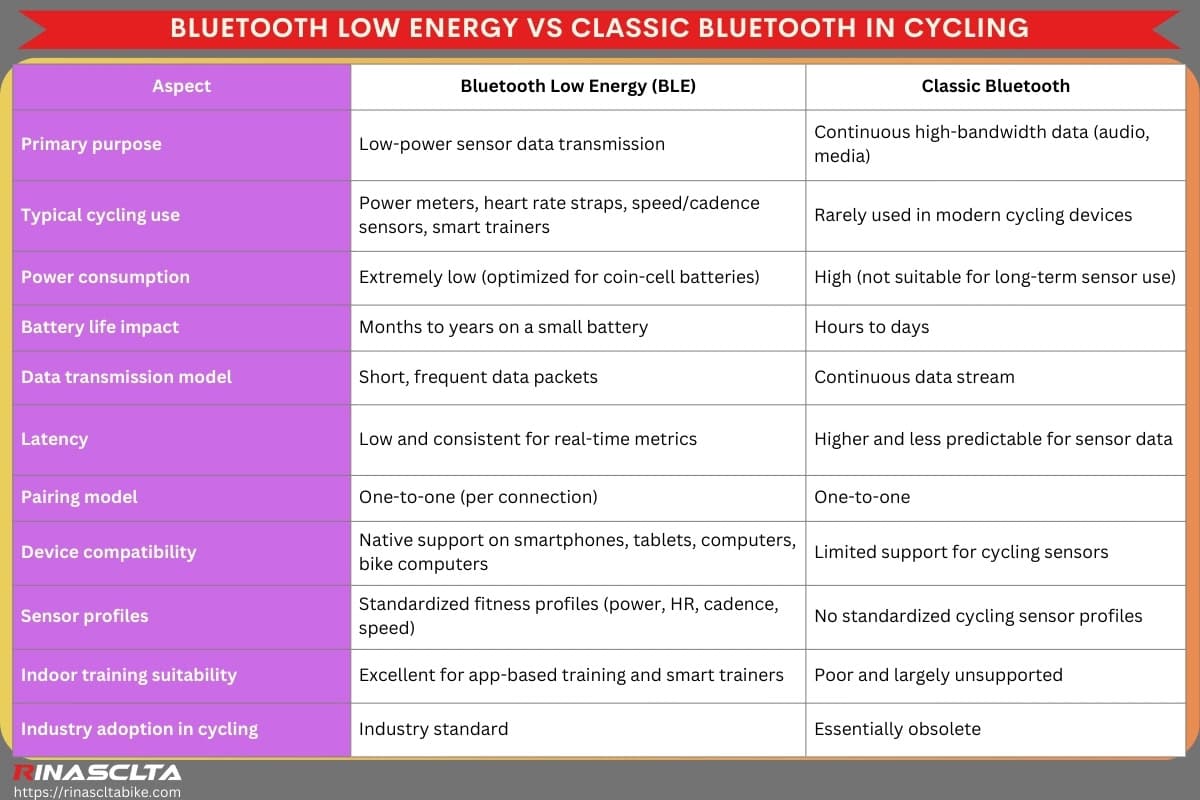
Bluetooth Low Energy (BLE) and classic Bluetooth are both wireless communication standards operating on the 2.4 GHz band and managed by the same Bluetooth ecosystem, but they exist for different use cases, which is why cycling devices overwhelmingly favor BLE. The differences matter because cycling sensors require continuous data transmission, ultra-low power consumption, and long battery life, while classic Bluetooth was designed for audio, file transfer, and high data throughput rather than real-time sports metrics.
| Aspect | Bluetooth Low Energy (BLE) | Classic Bluetooth |
| Primary purpose | Low-power sensor data transmission | Continuous high-bandwidth data (audio, media) |
| Typical cycling use | Power meters, heart rate straps, speed/cadence sensors, smart trainers | Rarely used in modern cycling devices |
| Power consumption | Extremely low (optimized for coin-cell batteries) | High (not suitable for long-term sensor use) |
| Battery life impact | Months to years on a small battery | Hours to days |
| Data transmission model | Short, frequent data packets | Continuous data stream |
| Latency | Low and consistent for real-time metrics | Higher and less predictable for sensor data |
| Pairing model | One-to-one (per connection) | One-to-one |
| Device compatibility | Native support on smartphones, tablets, computers, bike computers | Limited support for cycling sensors |
| Sensor profiles | Standardized fitness profiles (power, HR, cadence, speed) | No standardized cycling sensor profiles |
| Indoor training suitability | Excellent for app-based training and smart trainers | Poor and largely unsupported |
| Industry adoption in cycling | Industry standard | Essentially obsolete |

Why is Bluetooth common on phones and cycling apps?
Bluetooth is common on phones and cycling apps because Bluetooth Low Energy (BLE) is natively built into smartphones, tablets, and operating systems, allowing cycling sensors and smart trainers to connect directly without extra hardware. Its value lies in easy pairing, app-level control, standardized fitness profiles, and low power consumption, which makes Bluetooth ideal for mobile-based indoor training, workout tracking, virtual cycling apps, and fitness ecosystems where convenience and broad device compatibility are critical.
ANT+ vs Bluetooth Key Differences Explained
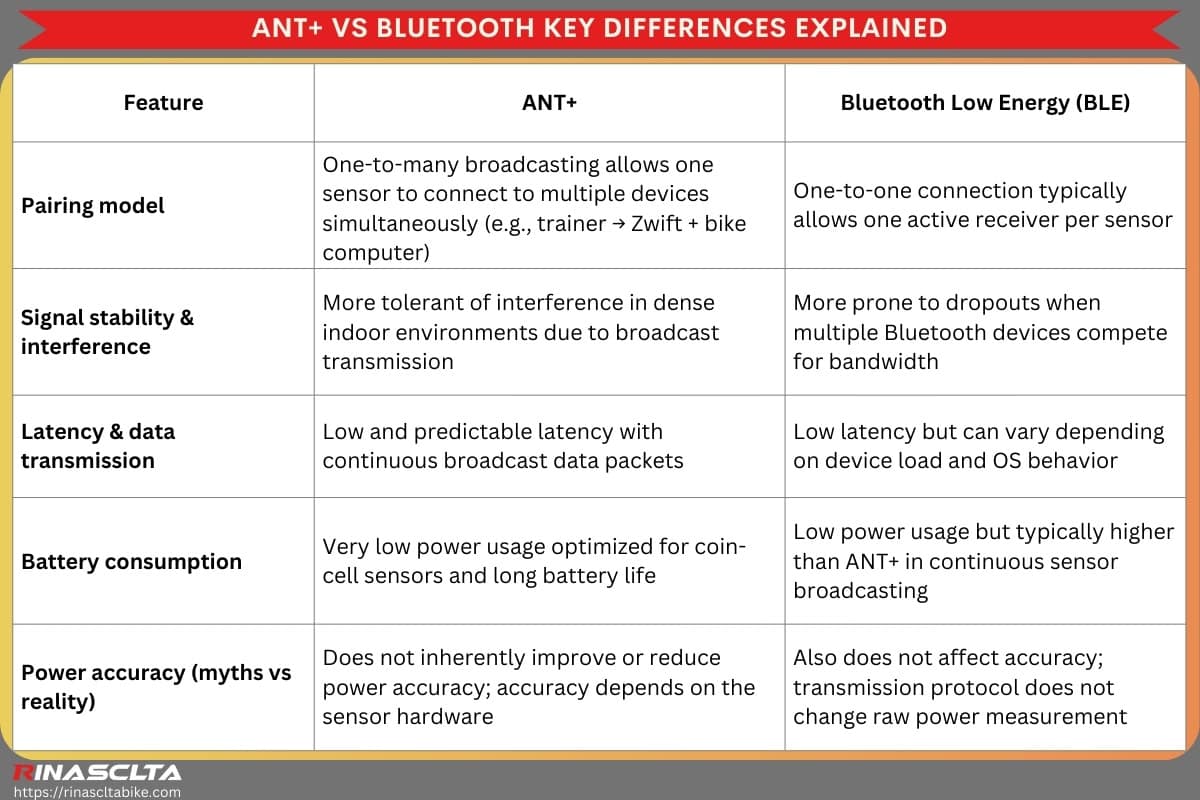
ANT+ and Bluetooth differ mainly in pairing model, signal behavior under interference, data transmission timing, battery efficiency, and how power data is handled, because they were designed for different communication philosophies—broadcast-based sensor networks versus direct device-to-device connections—which directly affects cycling use cases. These differences explain why ANT+ dominates multi-device indoor training setups, while Bluetooth is favored for smartphone-based cycling apps.
| Feature | ANT+ | Bluetooth Low Energy (BLE) |
| Pairing model | One-to-many broadcasting allows one sensor to connect to multiple devices simultaneously (e.g., trainer → Zwift + bike computer) | One-to-one connection typically allows one active receiver per sensor |
| Signal stability & interference | More tolerant of interference in dense indoor environments due to broadcast transmission | More prone to dropouts when multiple Bluetooth devices compete for bandwidth |
| Latency & data transmission | Low and predictable latency with continuous broadcast data packets | Low latency but can vary depending on device load and OS behavior |
| Battery consumption | Very low power usage optimized for coin-cell sensors and long battery life | Low power usage but typically higher than ANT+ in continuous sensor broadcasting |
| Power accuracy (myths vs reality) | Does not inherently improve or reduce power accuracy; accuracy depends on the sensor hardware | Also does not affect accuracy; transmission protocol does not change raw power measurement |
ANT+ vs Bluetooth pairing model
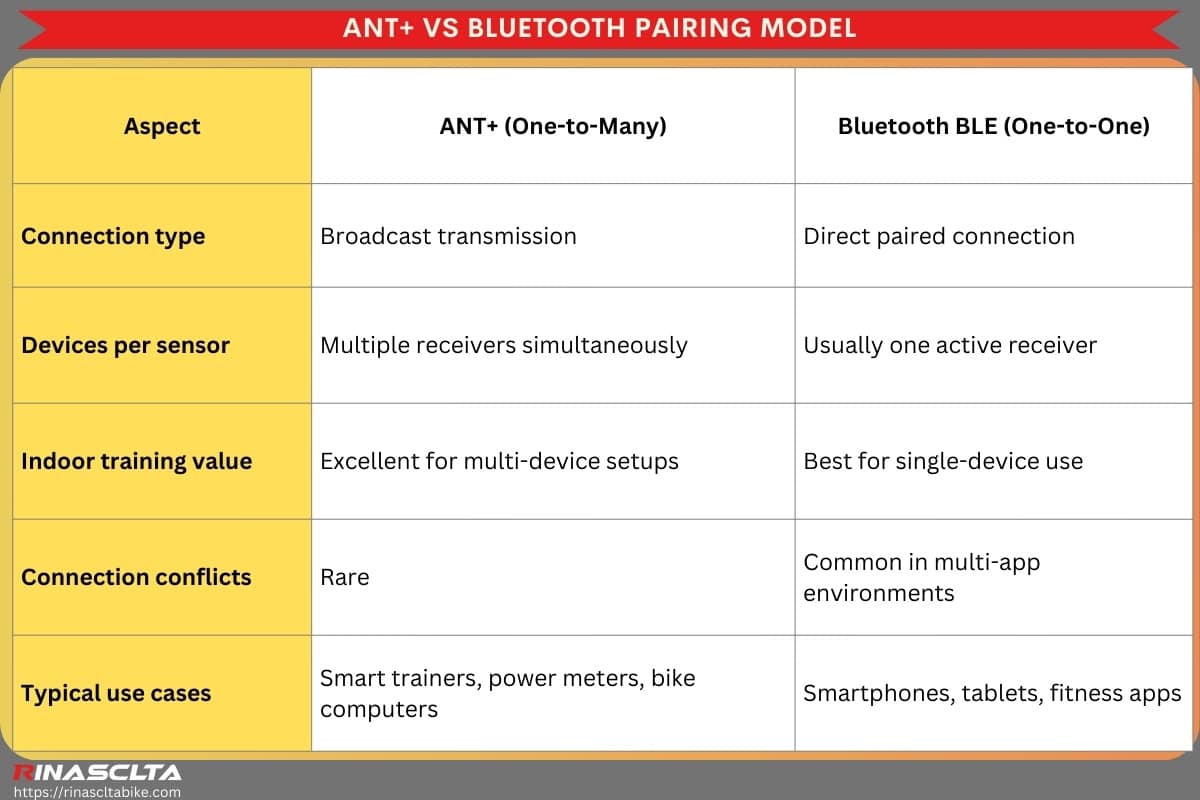
ANT+ and Bluetooth use fundamentally different pairing models, which directly affects how cycling sensors, smart trainers, bike computers, and training apps connect and behave in real-world setups.
ANT+ uses a one-to-many broadcast model, meaning a single sensor (for example a power meter or smart trainer) continuously transmits data that can be received by multiple devices at the same time, such as a bike computer, a watch, and an indoor training app. This provides high value for indoor cycling, Zwift sessions, structured workouts, and dual recording, because it avoids connection conflicts and allows simultaneous data logging without extra configuration.
Bluetooth Low Energy (BLE) typically uses a one-to-one connection model, where a sensor forms an active link with one receiving device at a time, such as a smartphone or tablet. This model simplifies pairing and reduces power overhead, but its value trade-off is limited multi-device support, which can cause dropped connections or force users to choose between an app and a bike computer when both try to connect.
| Aspect | ANT+ (One-to-Many) | Bluetooth BLE (One-to-One) |
| Connection type | Broadcast transmission | Direct paired connection |
| Devices per sensor | Multiple receivers simultaneously | Usually one active receiver |
| Indoor training value | Excellent for multi-device setups | Best for single-device use |
| Connection conflicts | Rare | Common in multi-app environments |
| Typical use cases | Smart trainers, power meters, bike computers | Smartphones, tablets, fitness apps |
ANT+ vs Bluetooth signal stability and interference
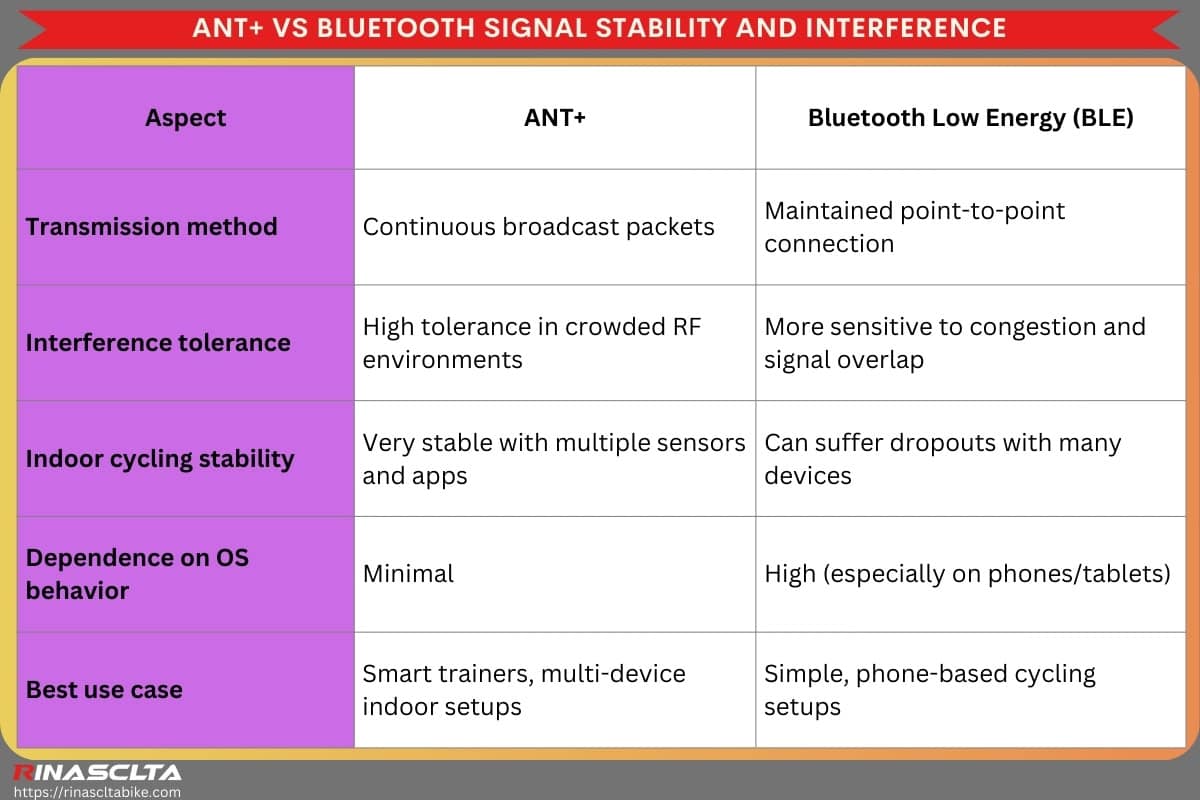
ANT+ and Bluetooth differ noticeably in signal stability and resistance to interference, especially in indoor cycling environments where many wireless devices operate at the same time.
ANT+ is generally more stable under interference because it uses a broadcast transmission model with short, frequent data packets that can be received independently by multiple devices without requiring a persistent connection. This makes ANT+ highly reliable in indoor training rooms, gyms, and multi-sensor setups, where Wi-Fi routers, Bluetooth headphones, smart trainers, and other sensors all compete within the 2.4 GHz band.
Bluetooth Low Energy (BLE) relies on an active, maintained connection, which makes it more sensitive to signal congestion, operating system background management, and device load, especially on smartphones. While Bluetooth can be very stable in simple one-to-one setups, its value decreases in dense indoor environments, where connection drops, delayed reconnections, or data pauses are more common.
| Aspect | ANT+ | Bluetooth Low Energy (BLE) |
| Transmission method | Continuous broadcast packets | Maintained point-to-point connection |
| Interference tolerance | High tolerance in crowded RF environments | More sensitive to congestion and signal overlap |
| Indoor cycling stability | Very stable with multiple sensors and apps | Can suffer dropouts with many devices |
| Dependence on OS behavior | Minimal | High (especially on phones/tablets) |
| Best use case | Smart trainers, multi-device indoor setups | Simple, phone-based cycling setups |
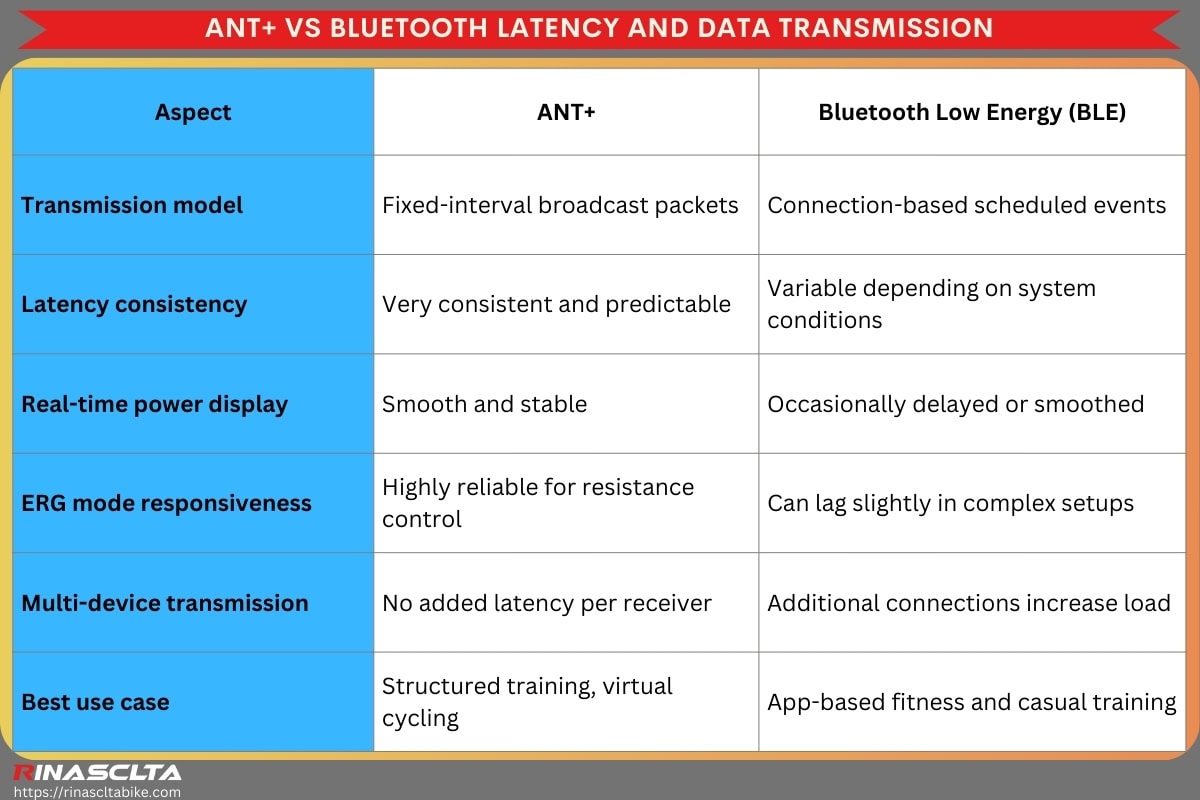
ANT+ vs Bluetooth latency and data transmission
ANT+ and Bluetooth differ in latency characteristics and data transmission behavior, which affects how quickly cycling data—such as power, cadence, speed, heart rate, and trainer control commands—is delivered to apps and devices during a ride.
ANT+ uses fixed-interval broadcast transmissions, sending small data packets at predictable rates (for example, multiple times per second for power data), which results in consistent and low perceived latency across multiple receivers. This makes ANT+ especially valuable for indoor training, ERG mode control, real-time power targets, and simultaneous recording, where stable timing matters more than raw data speed.
Bluetooth Low Energy (BLE) uses event-driven, connection-based transmission, where data is sent during scheduled connection intervals that can vary based on device load, operating system behavior, and power-saving policies. While BLE can achieve low latency in ideal conditions, its transmission timing can fluctuate, which may cause brief delays in power display, resistance changes, or cadence updates in demanding indoor setups.
| Aspect | ANT+ | Bluetooth Low Energy (BLE) |
| Transmission model | Fixed-interval broadcast packets | Connection-based scheduled events |
| Latency consistency | Very consistent and predictable | Variable depending on system conditions |
| Real-time power display | Smooth and stable | Occasionally delayed or smoothed |
| ERG mode responsiveness | Highly reliable for resistance control | Can lag slightly in complex setups |
| Multi-device transmission | No added latency per receiver | Additional connections increase load |
| Best use case | Structured training, virtual cycling | App-based fitness and casual training |
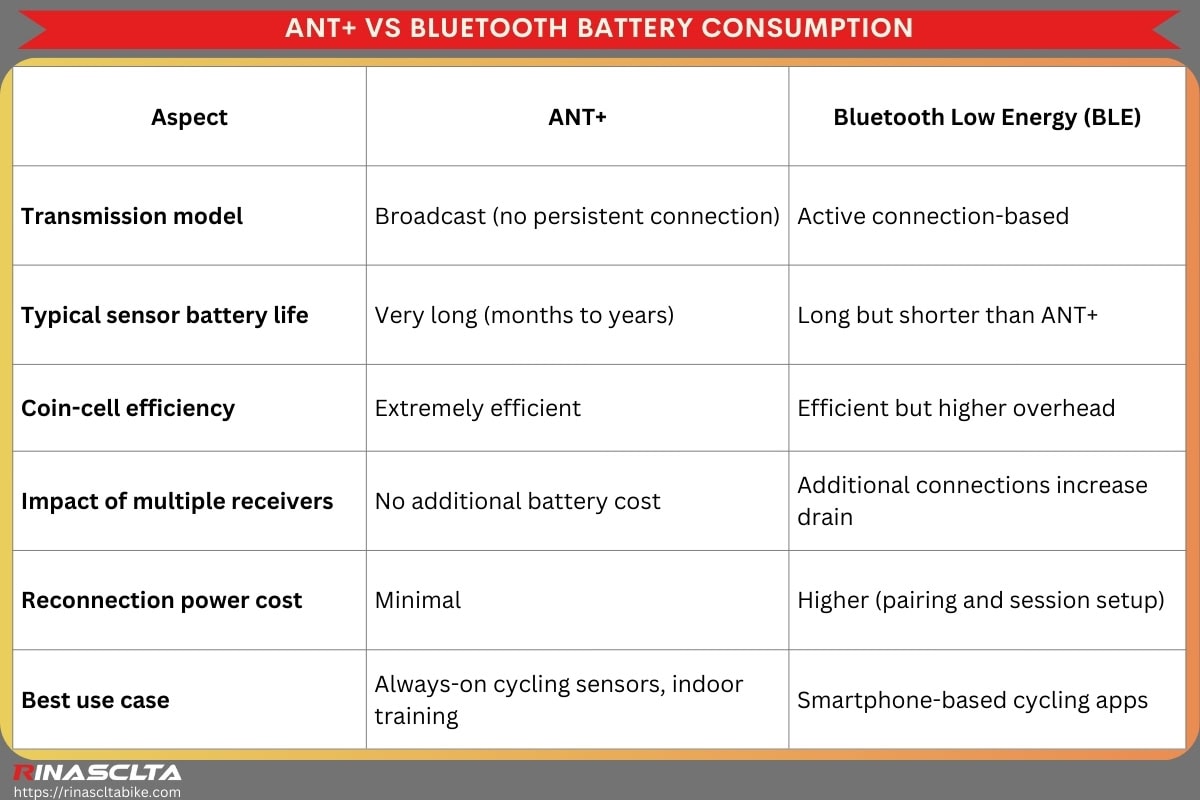
ANT+ vs Bluetooth battery consumption
ANT+ and Bluetooth differ in battery consumption because they use different communication models and connection behaviors, which directly impacts sensor battery life, maintenance frequency, and long-term usability in cycling.
ANT+ is optimized for ultra-low power broadcast transmission, sending small data packets at fixed intervals without maintaining a continuous connection, which allows sensors like power meters, speed/cadence sensors, and heart rate straps to run for months or even years on a single coin-cell battery. This makes ANT+ especially valuable for always-on cycling sensors and multi-device indoor training, where efficiency and longevity matter.
Bluetooth Low Energy (BLE) is also designed for low power use, but its connection-based model requires active session management, handshakes, and OS-level control, which typically consumes slightly more energy—especially when reconnecting, maintaining background connections, or streaming data to smartphones. While still efficient, BLE sensors often have shorter battery life than their ANT+ counterparts under continuous use.
| Aspect | ANT+ | Bluetooth Low Energy (BLE) |
| Transmission model | Broadcast (no persistent connection) | Active connection-based |
| Typical sensor battery life | Very long (months to years) | Long but shorter than ANT+ |
| Coin-cell efficiency | Extremely efficient | Efficient but higher overhead |
| Impact of multiple receivers | No additional battery cost | Additional connections increase drain |
| Reconnection power cost | Minimal | Higher (pairing and session setup) |
| Best use case | Always-on cycling sensors, indoor training | Smartphone-based cycling apps |
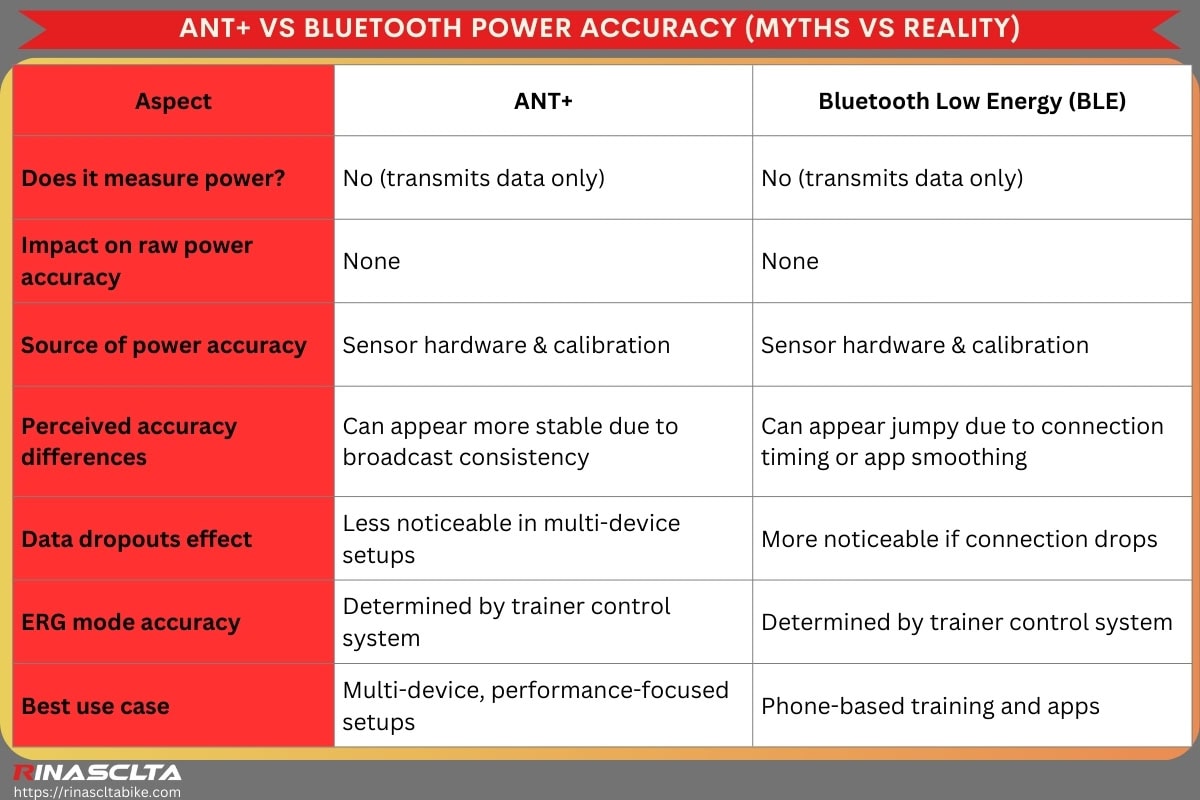
ANT+ vs Bluetooth power accuracy (myths vs reality)
ANT+ vs Bluetooth power accuracy is often misunderstood, because the wireless protocol does not measure power at all—the sensor hardware and algorithms do—while ANT+ and Bluetooth only transmit the already-measured data.
Reality: power accuracy is determined by strain gauges, torque sensors, temperature compensation, sampling rate, and calibration, not by whether data is sent via ANT+ or Bluetooth. Both protocols transmit the same watt values produced by the power meter or smart trainer; differences riders notice are usually caused by signal dropouts, data smoothing, latency, or app behavior, not inaccurate measurement.
| Aspect | ANT+ | Bluetooth Low Energy (BLE) |
| Does it measure power? | No (transmits data only) | No (transmits data only) |
| Impact on raw power accuracy | None | None |
| Source of power accuracy | Sensor hardware & calibration | Sensor hardware & calibration |
| Perceived accuracy differences | Can appear more stable due to broadcast consistency | Can appear jumpy due to connection timing or app smoothing |
| Data dropouts effect | Less noticeable in multi-device setups | More noticeable if connection drops |
| ERG mode accuracy | Determined by trainer control system | Determined by trainer control system |
| Best use case | Multi-device, performance-focused setups | Phone-based training and apps |
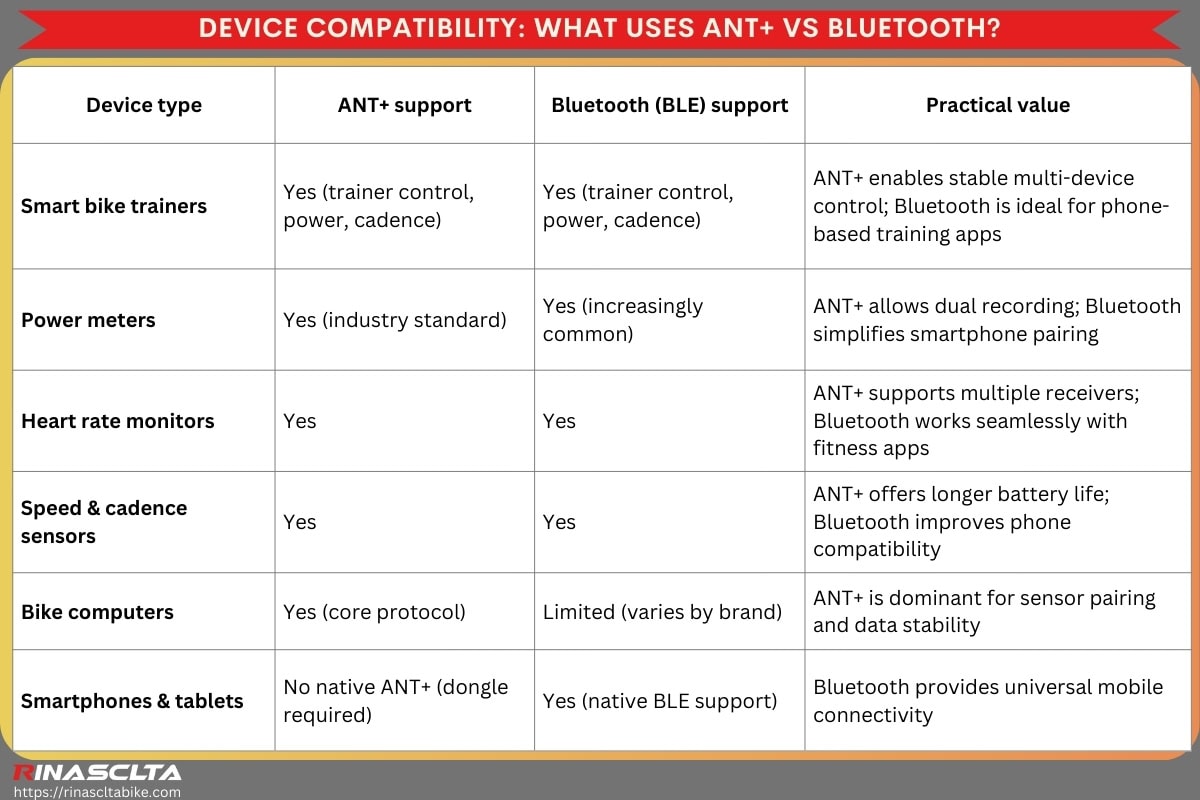
Device Compatibility: What Uses ANT+ vs Bluetooth?
ANT+ and Bluetooth are both widely used across modern cycling devices, but compatibility depends on device type, intended use, and ecosystem design, with ANT+ favoring performance-focused, multi-device setups and Bluetooth favoring mobile-first, app-driven environments. Understanding which devices use which protocol helps cyclists avoid pairing conflicts, maximize data reliability, and choose equipment that fits their training workflow.
| Device type | ANT+ support | Bluetooth (BLE) support | Practical value |
| Smart bike trainers | Yes (trainer control, power, cadence) | Yes (trainer control, power, cadence) | ANT+ enables stable multi-device control; Bluetooth is ideal for phone-based training apps |
| Power meters | Yes (industry standard) | Yes (increasingly common) | ANT+ allows dual recording; Bluetooth simplifies smartphone pairing |
| Heart rate monitors | Yes | Yes | ANT+ supports multiple receivers; Bluetooth works seamlessly with fitness apps |
| Speed & cadence sensors | Yes | Yes | ANT+ offers longer battery life; Bluetooth improves phone compatibility |
| Bike computers | Yes (core protocol) | Limited (varies by brand) | ANT+ is dominant for sensor pairing and data stability |
| Smartphones & tablets | No native ANT+ (dongle required) | Yes (native BLE support) | Bluetooth provides universal mobile connectivity |
ANT+ vs Bluetooth for Indoor Cycling
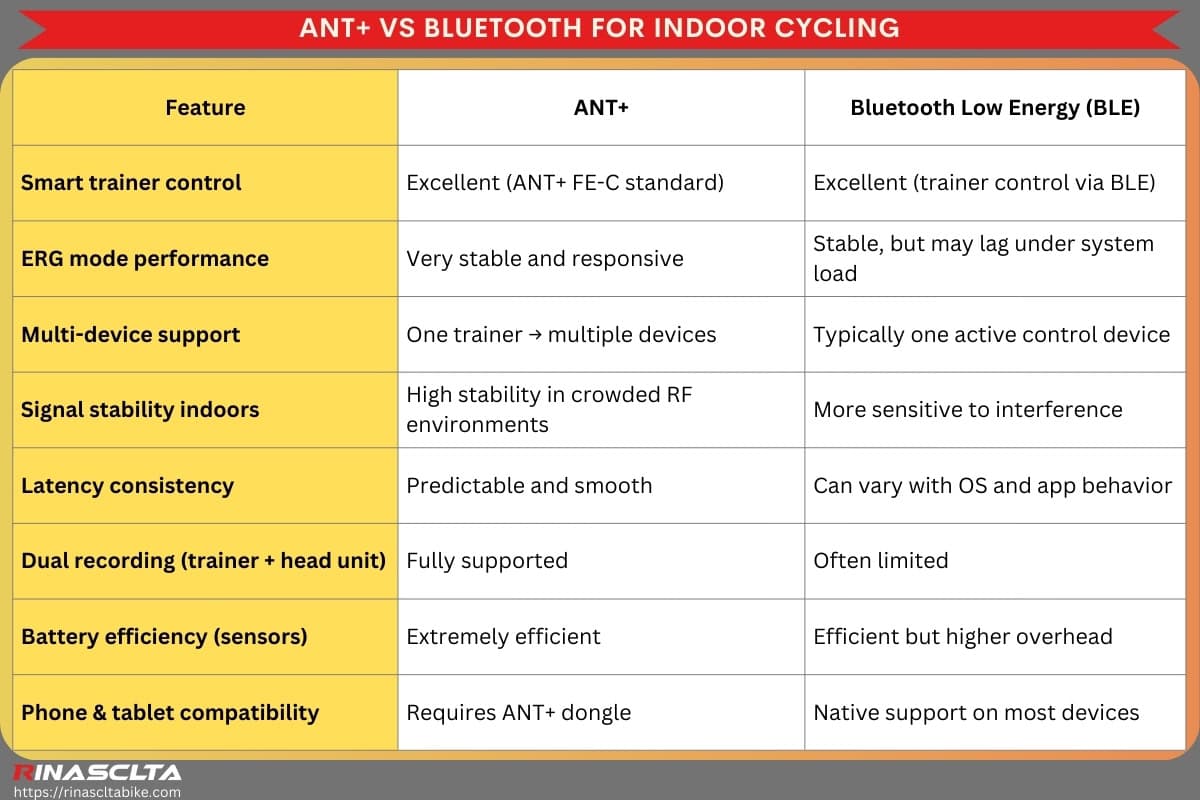
ANT+ and Bluetooth both support indoor cycling, but they differ in how well they handle trainer control, data stability, multi-device setups, and software interaction, which directly affects workout quality and reliability during indoor sessions. These differences matter most when using smart trainers, structured workouts, ERG mode, virtual riding platforms, and simultaneous device recording.
| Feature | ANT+ | Bluetooth Low Energy (BLE) |
| Smart trainer control | Excellent (ANT+ FE-C standard) | Excellent (trainer control via BLE) |
| ERG mode performance | Very stable and responsive | Stable, but may lag under system load |
| Multi-device support | One trainer → multiple devices | Typically one active control device |
| Signal stability indoors | High stability in crowded RF environments | More sensitive to interference |
| Latency consistency | Predictable and smooth | Can vary with OS and app behavior |
| Dual recording (trainer + head unit) | Fully supported | Often limited |
| Battery efficiency (sensors) | Extremely efficient | Efficient but higher overhead |
| Phone & tablet compatibility | Requires ANT+ dongle | Native support on most devices |
Why is ANT+ popular for smart trainers?
ANT+ is popular for smart trainers because it supports stable one-to-many broadcasting, low-latency data transmission, and standardized trainer control, which are critical for reliable indoor cycling. ANT+ allows a smart trainer to simultaneously send power, cadence, and speed data to multiple devices while receiving ERG mode and gradient commands via the ANT+ FE-C (Fitness Equipment Control) protocol, delivering high value for structured workouts, virtual riding, dual recording, and professional training environments where consistency and connection stability matter most.
Bluetooth limitations in indoor training setups
Bluetooth has several limitations in indoor training setups because it relies on one-to-one connections, operating system–managed pairing, and shared wireless bandwidth, which can introduce instability under load. Common limitations include connection conflicts when multiple apps or devices try to pair, increased dropouts in RF-crowded environments, variable latency during ERG mode resistance changes, higher battery drain on sensors due to active connections, background app restrictions on smartphones, and difficulty supporting dual recording, all of which reduce reliability in complex smart trainer, Zwift, and multi-sensor indoor training systems.
Why does Bluetooth drop connections in Zwift?
Bluetooth drops connections in Zwift because Bluetooth Low Energy (BLE) depends on a maintained one-to-one connection that is heavily managed by the operating system, which can be disrupted during high data load indoor training sessions. Bluetooth stability is affected by RF congestion on the 2.4 GHz band, background app management, device CPU load, multiple paired peripherals, power-saving policies, and simultaneous trainer control and data streaming, making dropouts more likely during ERG mode changes, virtual gradient shifts, and high-intensity intervals, which is why ANT+ is often preferred for stable, multi-device Zwift setups.
Trainer + phone + bike computer conflicts explained
Trainer + phone + bike computer conflicts occur because Bluetooth Low Energy (BLE) typically allows only one active control or data connection per device, causing competition when a smart trainer tries to pair simultaneously with a phone-based app (for example Zwift) and a bike computer. When both devices attempt to access trainer control, power, cadence, or speed channels, the Bluetooth connection can be dropped, reassigned, or blocked, resulting in missing data, loss of ERG mode control, or sudden resistance changes, whereas ANT+ avoids these conflicts through one-to-many broadcasting, allowing stable dual recording and smoother indoor training workflows.
ANT+ vs Bluetooth for Zwift
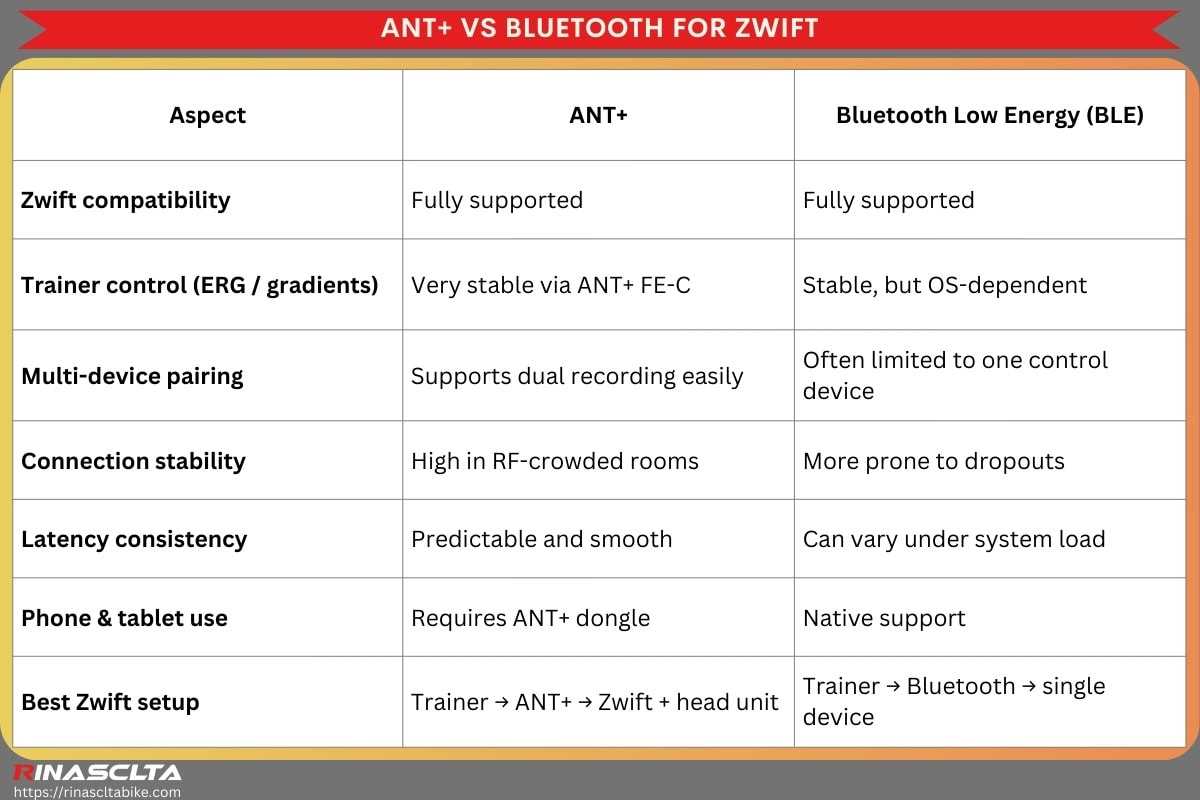
ANT+ and Bluetooth both allow Zwift to receive power, cadence, speed, and trainer control data from smart trainers and sensors, enabling virtual riding, structured workouts, and ERG mode. The key difference lies in connection behavior and stability, which matters because Zwift often runs alongside bike computers, heart rate straps, and other wireless devices in the same indoor environment.
| Aspect | ANT+ | Bluetooth Low Energy (BLE) |
| Zwift compatibility | Fully supported | Fully supported |
| Trainer control (ERG / gradients) | Very stable via ANT+ FE-C | Stable, but OS-dependent |
| Multi-device pairing | Supports dual recording easily | Often limited to one control device |
| Connection stability | High in RF-crowded rooms | More prone to dropouts |
| Latency consistency | Predictable and smooth | Can vary under system load |
| Phone & tablet use | Requires ANT+ dongle | Native support |
| Best Zwift setup | Trainer → ANT+ → Zwift + head unit | Trainer → Bluetooth → single device |
Bike ANT+ Bluetooth apps and platforms
Bike ANT+ and Bluetooth apps and platforms include Zwift, TrainerRoad, Wahoo SYSTM, Rouvy, MyWhoosh, Garmin Connect, Wahoo Fitness, Strava, and manufacturer-specific apps, because these ecosystems rely on wireless sensor data to deliver training control, performance analysis, virtual riding, and workout tracking. ANT+ is favored by platforms that support multi-device setups, smart trainer control, and dual recording, while Bluetooth is essential for smartphone-first apps, making broad protocol support critical for compatibility, user flexibility, and reliable indoor and outdoor cycling experiences.
ANT+ vs Bluetooth for Outdoor Cycling
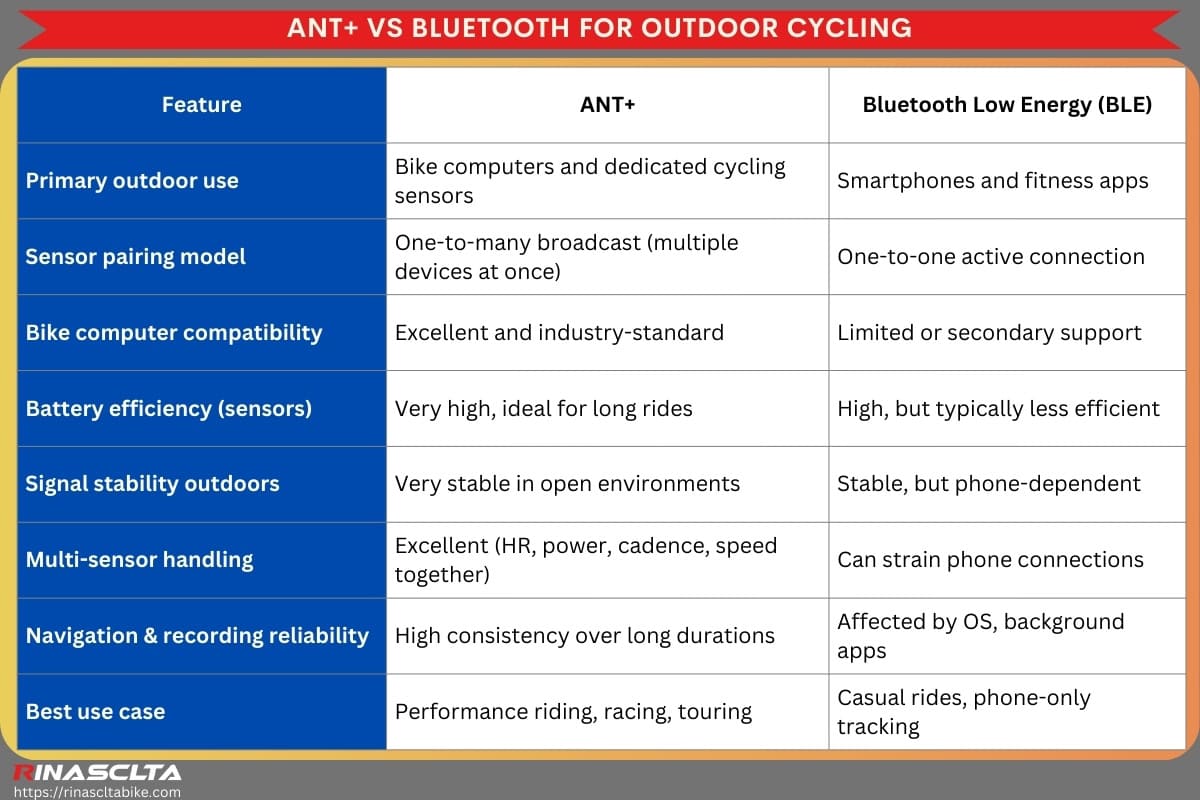
ANT+ and Bluetooth are both used for outdoor cycling, but they differ in sensor pairing behavior, battery efficiency, signal stability, and bike computer integration, which directly affects reliability on long rides and multi-sensor setups. These differences matter because outdoor cycling often involves multiple sensors running for hours, navigation, recording, and uninterrupted data capture.
| Feature | ANT+ | Bluetooth Low Energy (BLE) |
| Primary outdoor use | Bike computers and dedicated cycling sensors | Smartphones and fitness apps |
| Sensor pairing model | One-to-many broadcast (multiple devices at once) | One-to-one active connection |
| Bike computer compatibility | Excellent and industry-standard | Limited or secondary support |
| Battery efficiency (sensors) | Very high, ideal for long rides | High, but typically less efficient |
| Signal stability outdoors | Very stable in open environments | Stable, but phone-dependent |
| Multi-sensor handling | Excellent (HR, power, cadence, speed together) | Can strain phone connections |
| Navigation & recording reliability | High consistency over long durations | Affected by OS, background apps |
| Best use case | Performance riding, racing, touring | Casual rides, phone-only tracking |
ANT+ vs Bluetooth for bike computers and GPS head units
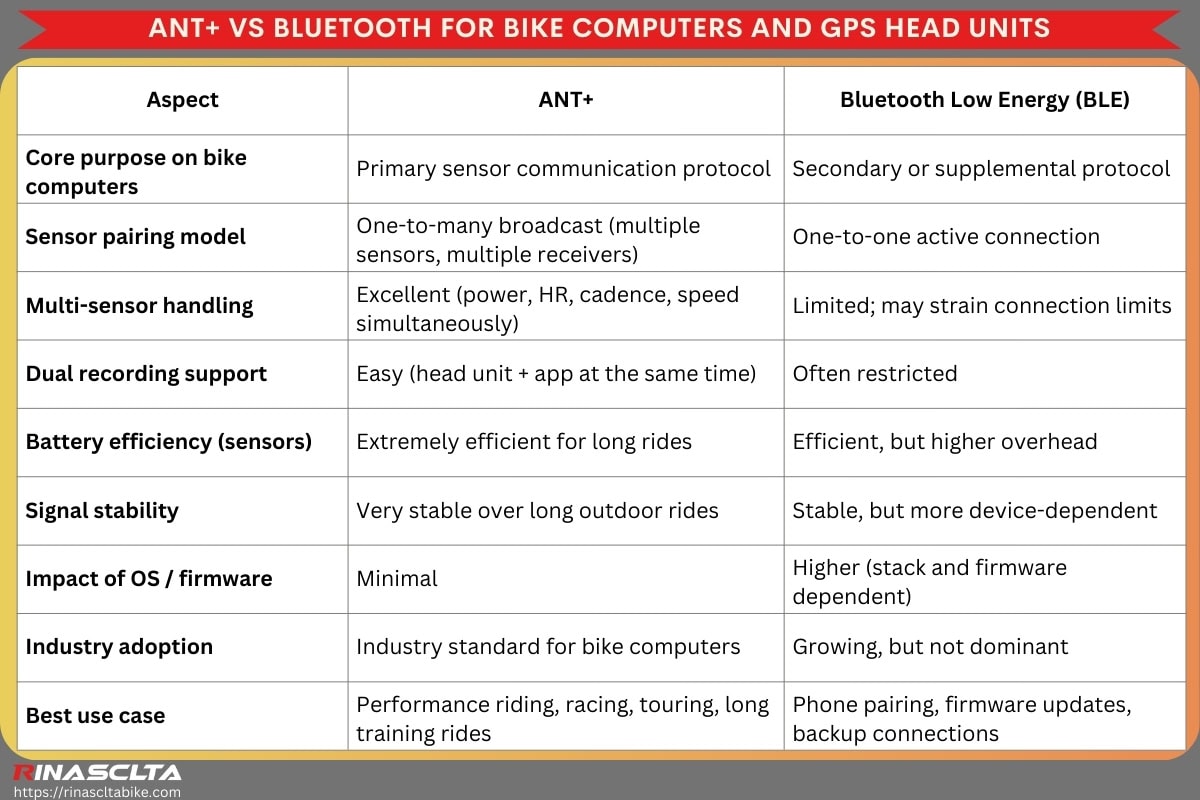
ANT+ and Bluetooth are both used by bike computers and GPS head units to receive sensor data such as power, cadence, speed, and heart rate, and both can deliver accurate ride recording and training metrics. The difference lies in how reliably they handle multiple sensors, long ride durations, and simultaneous connections, which matters because bike computers are designed to be dedicated, always-on cycling hubs rather than general-purpose devices.
| Aspect | ANT+ | Bluetooth Low Energy (BLE) |
| Core purpose on bike computers | Primary sensor communication protocol | Secondary or supplemental protocol |
| Sensor pairing model | One-to-many broadcast (multiple sensors, multiple receivers) | One-to-one active connection |
| Multi-sensor handling | Excellent (power, HR, cadence, speed simultaneously) | Limited; may strain connection limits |
| Dual recording support | Easy (head unit + app at the same time) | Often restricted |
| Battery efficiency (sensors) | Extremely efficient for long rides | Efficient, but higher overhead |
| Signal stability | Very stable over long outdoor rides | Stable, but more device-dependent |
| Impact of OS / firmware | Minimal | Higher (stack and firmware dependent) |
| Industry adoption | Industry standard for bike computers | Growing, but not dominant |
| Best use case | Performance riding, racing, touring, long training rides | Phone pairing, firmware updates, backup connections |
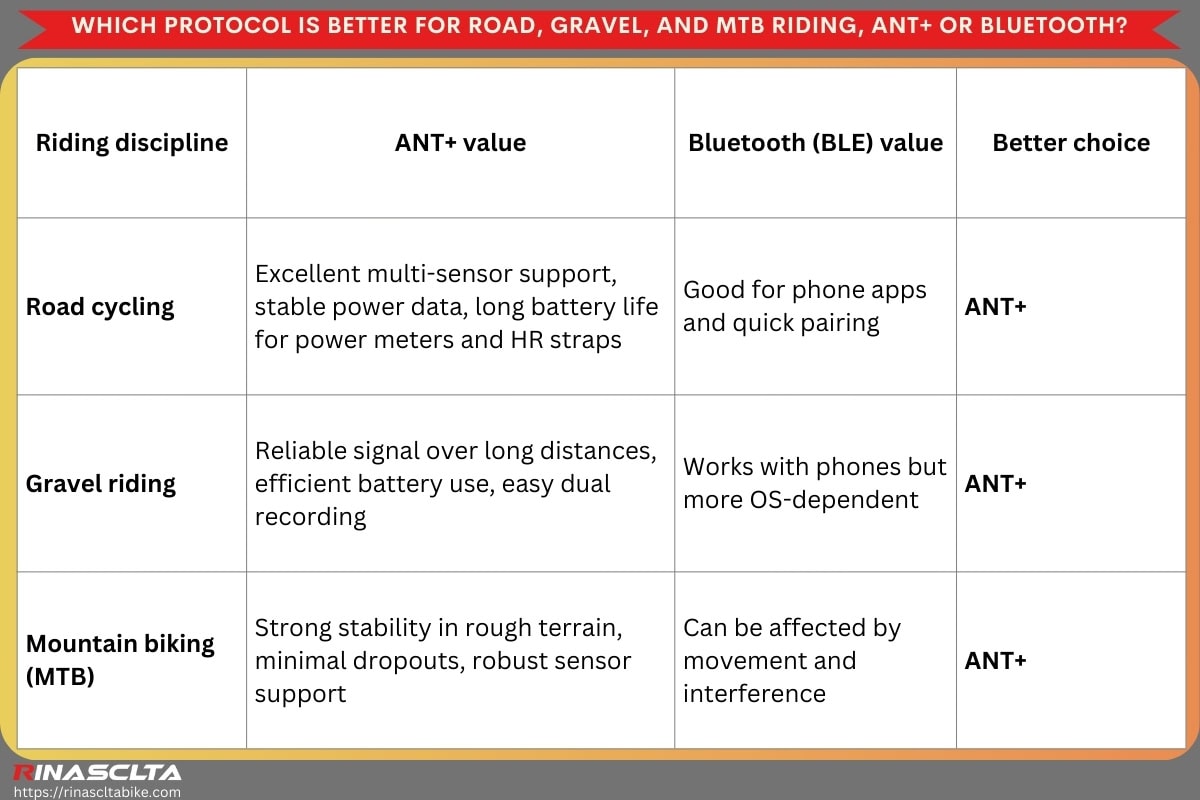
Which protocol is better for road, gravel, and MTB riding, ANT+ or Bluetooth?
ANT+ is generally better than Bluetooth for road, gravel, and mountain bike riding because these disciplines rely on multiple sensors, long ride durations, stable data recording, and dedicated bike computers, where ANT+’s one-to-many broadcast model, superior battery efficiency, and signal stability provide clear advantages. Bluetooth remains useful as a secondary option for smartphone-based tracking or app connectivity, but it is less reliable as the primary protocol for performance-oriented riding.
| Riding discipline | ANT+ value | Bluetooth (BLE) value | Better choice |
| Road cycling | Excellent multi-sensor support, stable power data, long battery life for power meters and HR straps | Good for phone apps and quick pairing | ANT+ |
| Gravel riding | Reliable signal over long distances, efficient battery use, easy dual recording | Works with phones but more OS-dependent | ANT+ |
| Mountain biking (MTB) | Strong stability in rough terrain, minimal dropouts, robust sensor support | Can be affected by movement and interference | ANT+ |
Should You Use ANT+ or Bluetooth?
You should use ANT+ if you rely on a bike computer, smart trainer, power meter, and multiple sensors, want stable one-to-many connections, dual recording, long battery life, and consistent performance for indoor training, racing, and long outdoor rides.
You should use Bluetooth (BLE) if you train primarily with a smartphone or tablet, value simple pairing and app-based control, and run single-device setups for indoor workouts, fitness tracking, or casual cycling.
Should I connect with Bluetooth or ANT+?
You should connect with ANT+ if you are using a bike computer or smart trainer with multiple sensors, want stable one-to-many data broadcasting, dual recording, and reliable ERG mode and power data during indoor training or long outdoor rides.
You should connect with Bluetooth (BLE) if you are pairing directly to a phone or tablet, prefer quick setup and app-based control, and only need a single active connection for workouts, tracking, or virtual cycling.
What to choose when devices support both ANT+ and Bluetooth?
When devices support both ANT+ and Bluetooth, you should choose ANT+ if you are running a multi-device setup—such as a smart trainer connected to a bike computer and an indoor cycling app at the same time—because ANT+ supports one-to-many broadcasting, greater signal stability, and easier dual recording. When simplicity is the priority, you should choose Bluetooth (BLE) if you are connecting to a single phone or tablet, want fast pairing and native app compatibility, and do not need multiple devices receiving data simultaneously.
Best protocol for multi-device setups
The best protocol for multi-device cycling setups is ANT+, because it is designed for one-to-many broadcasting, allowing a single sensor or smart trainer to send data to multiple devices at the same time without connection conflicts.
| Setup element | ANT+ value | Bluetooth (BLE) limitation |
| Smart trainer → app + bike computer | Stable dual control and data sharing | Often limited to one active connection |
| Power meter → head unit + watch | Simultaneous data transmission | Secondary device may be blocked |
| Heart rate monitor → multiple receivers | Works reliably with no pairing conflicts | Typically one receiver at a time |
| Indoor training + recording | Easy dual recording (trainer + head unit) | Dropouts or forced disconnects |
| Battery efficiency | Minimal additional drain with multiple receivers | Increased drain per connection |
Who should choose ANT+?
Cyclists should choose ANT+ if they use a bike computer, smart trainer, power meter (crank, pedal, or spider), heart rate monitor, and speed/cadence sensors together and want stable one-to-many data broadcasting, dual recording, and long sensor battery life. ANT+ delivers the most value for indoor training with ERG mode, Zwift or structured workouts, racing, and long outdoor rides, where reliability, low latency, and multi-device compatibility matter more than simple phone pairing.
Who should choose Bluetooth?
Cyclists should choose Bluetooth Low Energy (BLE) if they primarily ride or train using a smartphone or tablet, rely on cycling apps for workouts or tracking, and prefer quick pairing and minimal setup with a single device. Bluetooth provides the greatest value for casual riding, fitness-focused training, mobile-first indoor setups, and situations where convenience and universal device compatibility outweigh the need for multi-sensor robustness.
How to Convert ANT+ to Bluetooth Smart?
You can convert ANT+ to Bluetooth Smart (BLE) by using an ANT+-to-BLE bridge or gateway device that receives ANT+ sensor data and rebroadcasts it as Bluetooth so phones and apps can recognize it. These adapters are used when ANT+ sensors (power meters, heart rate straps, speed/cadence sensors, or smart trainers) need to connect to Bluetooth-only smartphones, tablets, or apps, adding value by extending device compatibility without replacing existing bike accessories.
Common ANT+ to Bluetooth conversion solutions include hardware bridges (small USB or inline devices placed near the trainer or bike) and software bridges (apps that read ANT+ via a USB dongle and rebroadcast via BLE), though limitations may include added latency, single-device output, battery drain, and reduced support for trainer control protocols like ERG mode.
ANT+ to Bluetooth bridges and adapters
ANT+ to Bluetooth bridges and adapters are small hardware or app-based tools that receive ANT+ signals from cycling sensors or smart trainers and rebroadcast them as Bluetooth Low Energy (BLE) so phones, tablets, or apps can recognize the data. Their value is enabling ANT+-only power meters, heart rate monitors, speed/cadence sensors, or trainers to work with Bluetooth-only devices, though they may add slight latency and usually support sensor data better than full trainer control.
Limitations of protocol conversion
Protocol conversion has clear limitations because ANT+ and Bluetooth are fundamentally different communication systems, and converting between them adds an extra translation layer that can affect performance. In practice, ANT+→Bluetooth conversion may introduce slight latency, limit one-to-many broadcasting, reduce dual-recording capability, increase battery consumption, and sometimes restrict full smart trainer control features such as ERG mode or fast resistance changes, meaning conversion tools are best used for compatibility and convenience rather than as a perfect replacement for native protocol support.
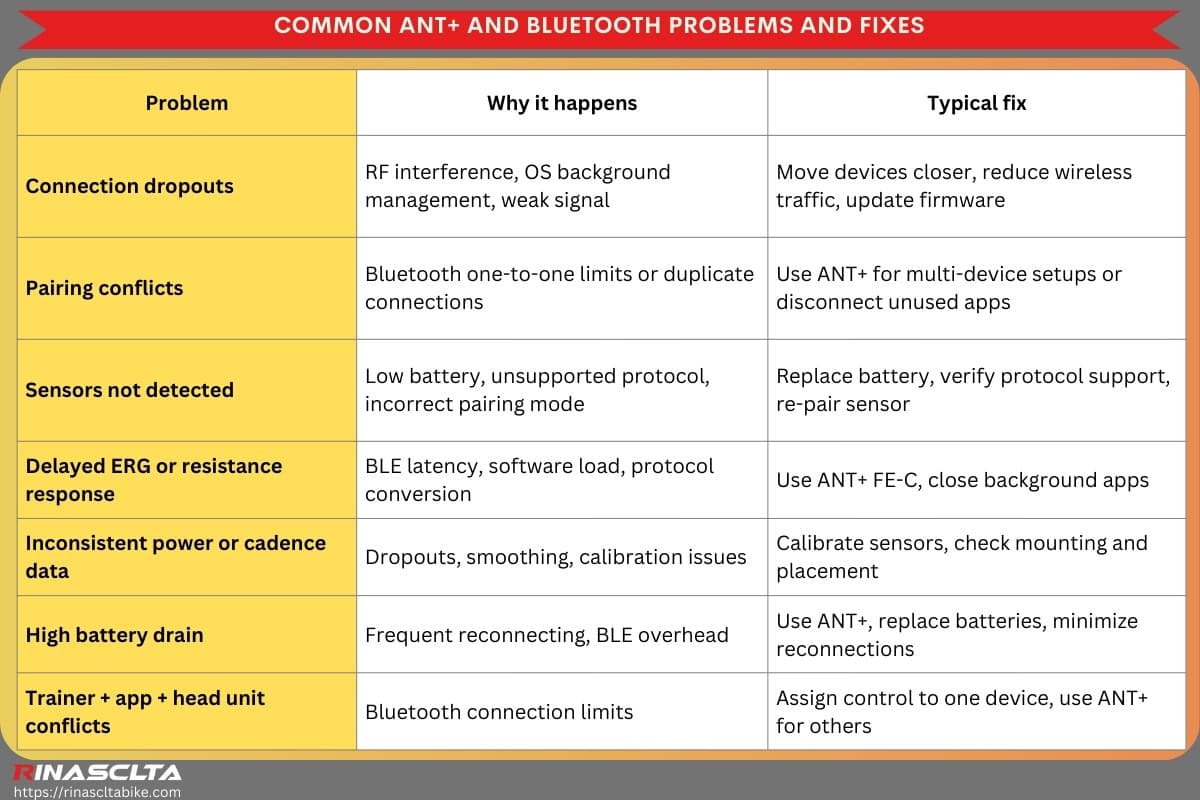
Common ANT+ and Bluetooth Problems and Fixes
ANT+ and Bluetooth commonly face issues such as connection dropouts, pairing conflicts, signal interference, delayed data or resistance response, missing sensors, inconsistent power or cadence readings, and rapid battery drain, because both protocols operate on the crowded 2.4 GHz band, depend on device firmware and software behavior, and are sensitive to indoor environments with many wireless signals. These problems usually stem from protocol limitations, operating system control, RF congestion, poor sensor placement, low battery levels, or incompatible device combinations, rather than faulty hardware.
| Problem | Why it happens | Typical fix |
| Connection dropouts | RF interference, OS background management, weak signal | Move devices closer, reduce wireless traffic, update firmware |
| Pairing conflicts | Bluetooth one-to-one limits or duplicate connections | Use ANT+ for multi-device setups or disconnect unused apps |
| Sensors not detected | Low battery, unsupported protocol, incorrect pairing mode | Replace battery, verify protocol support, re-pair sensor |
| Delayed ERG or resistance response | BLE latency, software load, protocol conversion | Use ANT+ FE-C, close background apps |
| Inconsistent power or cadence data | Dropouts, smoothing, calibration issues | Calibrate sensors, check mounting and placement |
| High battery drain | Frequent reconnecting, BLE overhead | Use ANT+, replace batteries, minimize reconnections |
| Trainer + app + head unit conflicts | Bluetooth connection limits | Assign control to one device, use ANT+ for others |
ANT+ not connecting, what are the causes and solutions
ANT+ connection problems are usually caused by low sensor battery, signal interference, excessive distance, incorrect pairing mode, firmware issues, USB dongle problems, and device compatibility conflicts, because ANT+ relies on continuous low-power broadcasting that is sensitive to environment and setup quality.
| Cause | Why it happens | Solution |
| Low or dead battery | ANT+ sensors reduce transmission strength as battery drops | Replace coin-cell battery |
| Signal interference | Wi-Fi routers, Bluetooth devices, and electronics share 2.4 GHz | Move dongle closer, reduce nearby wireless devices |
| Distance between devices | ANT+ has limited effective range indoors | Use USB extension cable to place dongle near trainer |
| Incorrect pairing mode | Sensor paired to another device or wrong channel | Unpair from other devices and re-pair correctly |
| Firmware or software issues | Outdated firmware or app bugs | Update device firmware and training app |
| USB ANT+ dongle issues | Poor-quality or incompatible dongle | Use a known ANT+ compatible dongle |
| Device incompatibility | Unsupported ANT+ profile | Verify sensor and receiver compatibility |
Bluetooth sensor keeps disconnecting why and how to fix it
Bluetooth sensors disconnect because Bluetooth Low Energy (BLE) relies on a one-to-one, OS-managed connection that is sensitive to RF congestion, background app restrictions, low battery voltage, and device prioritization, especially on smartphones and tablets. You can fix this by replacing the sensor battery, keeping the sensor within 1–2 meters of the receiving device, closing other apps that may auto-connect, disabling aggressive battery-saving modes, updating firmware, and ensuring only one app or device controls the connection at a time, which restores stability and preserves training data integrity.
Signal dropouts, interference, and pairing errors
Signal dropouts and pairing errors occur because ANT+ and Bluetooth both operate on the crowded 2.4 GHz band, where Wi-Fi routers, wireless headphones, keyboards, and smart home devices compete for bandwidth. The value fix is environmental control and clean pairing: reduce nearby wireless traffic, place ANT+ dongles close to the trainer using a USB extension, avoid metal obstructions, re-pair sensors cleanly, and keep firmware updated, which dramatically improves data continuity for power, cadence, and heart rate.
Future of ANT+ and Bluetooth in Cycling
The future of ANT+ and Bluetooth in cycling is coexistence rather than replacement, because each protocol serves a different role in the ecosystem. ANT+ will continue to dominate performance cycling, smart trainers, and multi-device setups, while Bluetooth will remain essential for smartphone-based training, consumer fitness apps, and simplified user experiences, ensuring both protocols stay relevant.
Will Bluetooth replace ANT+ in cycling?
No, Bluetooth is unlikely to replace ANT+ in cycling because one-to-many broadcasting, superior battery efficiency, and multi-device reliability remain critical for bike computers, smart trainers, and professional training environments. Bluetooth will grow in consumer and mobile use, but ANT+ retains clear value where stability, dual recording, and sensor longevity matter most.
Future trends in smart trainers and cycling sensors
Future trends include dual-protocol sensors (ANT+ + BLE as standard), tighter software–hardware integration, improved trainer control responsiveness, smarter auto-pairing logic, and increased focus on data reliability rather than raw accuracy, since measurement precision is already high. The long-term value shift is toward simpler setup for casual riders while preserving robust multi-device support for serious cyclists, with ANT+ and Bluetooth evolving together rather than competing directly.
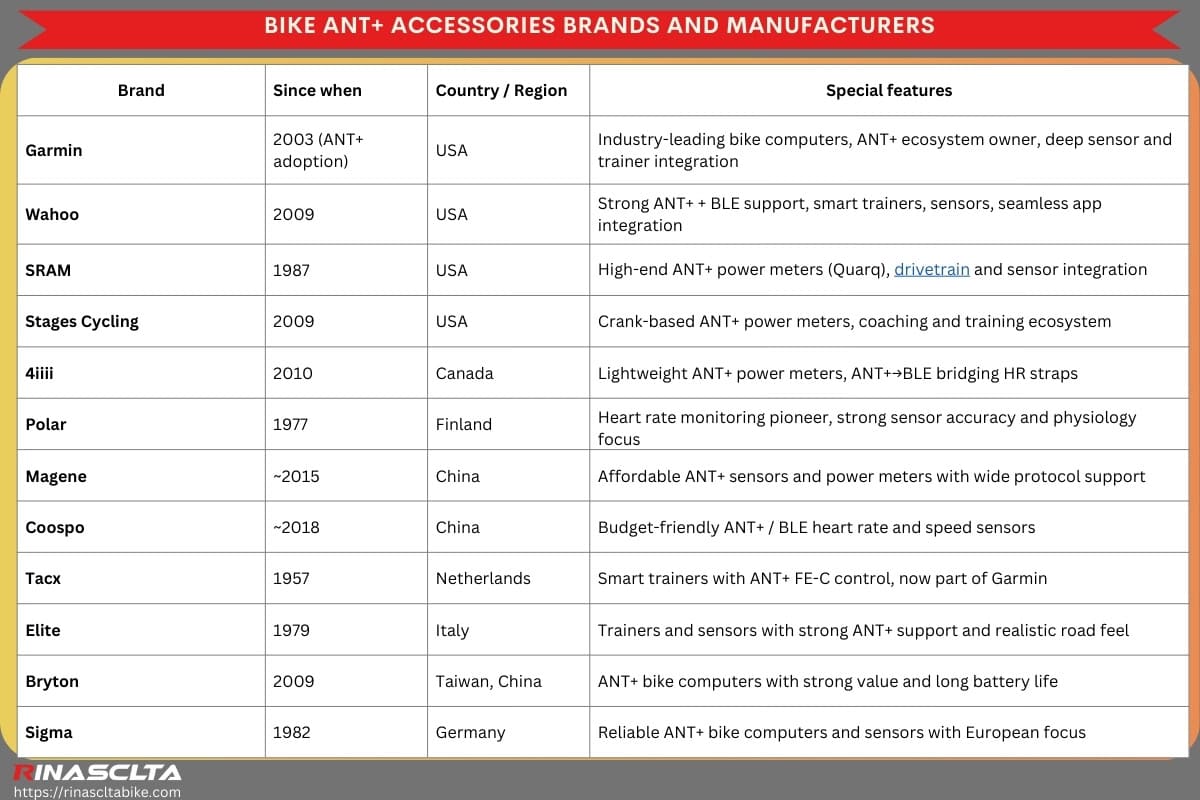
Bike ANT+ Accessories Brands and Manufacturers
The bike ANT+ accessories industry is built around sensor manufacturers, cycling electronics brands, and training technology companies that develop power meters, heart rate monitors, speed/cadence sensors, smart trainers, and bike computers designed for low-latency, low-power, multi-device data transmission. These brands differentiate themselves through measurement accuracy, battery efficiency, protocol support (ANT+ / BLE), ecosystem integration, and long-term reliability, serving everyone from casual riders to professional cyclists and indoor training platforms.
| Brand | Since when | Country / Region | Special features |
| Garmin | 2003 (ANT+ adoption) | USA | Industry-leading bike computers, ANT+ ecosystem owner, deep sensor and trainer integration |
| Wahoo | 2009 | USA | Strong ANT+ + BLE support, smart trainers, sensors, seamless app integration |
| SRAM | 1987 | USA | High-end ANT+ power meters (Quarq), drivetrain and sensor integration |
| Stages Cycling | 2009 | USA | Crank-based ANT+ power meters, coaching and training ecosystem |
| 4iiii | 2010 | Canada | Lightweight ANT+ power meters, ANT+→BLE bridging HR straps |
| Polar | 1977 | Finland | Heart rate monitoring pioneer, strong sensor accuracy and physiology focus |
| Magene | ~2015 | China | Affordable ANT+ sensors and power meters with wide protocol support |
| Coospo | ~2018 | China | Budget-friendly ANT+ / BLE heart rate and speed sensors |
| Tacx | 1957 | Netherlands | Smart trainers with ANT+ FE-C control, now part of Garmin |
| Elite | 1979 | Italy | Trainers and sensors with strong ANT+ support and realistic road feel |
| Bryton | 2009 | Taiwan, China | ANT+ bike computers with strong value and long battery life |
| Sigma | 1982 | Germany | Reliable ANT+ bike computers and sensors with European focus |
ANT+ vs Bluetooth: Which Is Better for Cycling?
ANT+ is generally better for cycling when you use a bike computer, smart trainer, power meter, heart rate monitor, and multiple sensors together, because its one-to-many broadcast model, low and predictable latency, excellent battery efficiency, and high signal stability make it ideal for indoor training, ERG mode control, dual recording, racing, and long outdoor rides. Bluetooth Low Energy (BLE), by contrast, excels in smartphone- and app-based cycling thanks to native phone support, simple pairing, and wide consumer adoption, but its one-to-one connection model, OS dependency, and higher susceptibility to dropouts reduce reliability in complex setups, meaning the best choice depends on whether you prioritize multi-device performance and stability (ANT+) or mobile convenience and simplicity (Bluetooth).
Best choice for indoor cycling
ANT+ is the best choice for indoor cycling because it delivers stable connections, low and predictable latency, and one-to-many broadcasting, allowing a smart trainer to communicate simultaneously with training apps, bike computers, and sensors without conflicts, which is critical for ERG mode, structured workouts, and virtual cycling.
Best choice for outdoor cycling
ANT+ is the best choice for outdoor cycling because bike computers and GPS head units are designed around ANT+ for long battery life, multi-sensor pairing (power, cadence, heart rate, speed), and uninterrupted recording during long rides, races, and endurance sessions.
Best choice for smart trainers
ANT+ is the best choice for smart trainers because the ANT+ FE-C (Fitness Equipment Control) protocol enables reliable resistance control, gradient simulation, and dual recording while maintaining stable data transmission even in RF-crowded indoor environments.
Best choice for multi-device training setups
ANT+ is the best choice for multi-device training setups because its one-to-many broadcast design allows a single sensor or trainer to send data to multiple devices at the same time—such as a trainer connected to Zwift, a bike computer, and a watch—without pairing conflicts or added battery drain.