What is a bike cadence sensor?
A bike cadence sensor is a small electronic device that measures pedaling rate in revolutions per minute (RPM) by detecting crank rotation using accelerometers or magnetic sensors, first adopted in late-1990s cycling sports science in Europe and North America to help riders optimize pedaling technique and training efficiency. Over time it evolved into a wireless, lightweight accessory integrated with ANT+ and Bluetooth ecosystems from brands like Garmin and Wahoo, and today it adds clear value across road bikes, mountain bikes, gravel bikes, indoor trainers, and e-bikes by supporting smoother cadence, reduced joint strain, better pacing, and data-driven cycling technique in modern riding.
What is a pedal cadence sensor?
A pedal cadence sensor is simply a bike cadence sensor mounted on the crank arm or pedal spindle to measure pedaling rate in revolutions per minute (RPM), using an internal accelerometer rather than directly sensing the pedal mechanism itself. The term became common in the 2000s–2010s as wireless sensors from brands like Garmin and Wahoo moved away from magnet-based systems, and in modern cycling it adds value across road, mountain, gravel, indoor, and e-bike riding by helping riders maintain efficient cadence ranges and improve pedaling technique without changing pedals or drivetrain parts.
Are speed sensor and cadence sensor the same thing?
No, speed sensors and cadence sensors are not the same thing because they measure completely different aspects of cycling performance and are mounted on different parts of the bike for different purposes. A speed sensor measures wheel rotation to calculate riding speed and distance with high accuracy, while a cadence sensor measures crank rotation (RPM) to evaluate pedaling rhythm and efficiency—together they provide complementary data that improves training precision, pacing, and technique analysis.
How does a cadence sensor work?
A cadence sensor works by detecting the rotational movement of the bike’s crank arm using an internal accelerometer or, in older designs, a magnet-and-reed-switch system, then converting that motion into pedaling rate measured in revolutions per minute (RPM). The data is transmitted wirelessly via ANT+ or Bluetooth to a bike computer or training app, allowing cyclists to maintain efficient cadence ranges, reduce joint stress, improve pedaling technique, and ride more safely and consistently across road, mountain, gravel, indoor, and e-bike cycling.
What does the cadence sensor measure?
The cadence sensor measures the rider’s pedaling rate, expressed as revolutions per minute (RPM), by tracking how many times the crank completes a full rotation within a given time period. This value helps cyclists evaluate pedaling efficiency, smoothness, and workload distribution, adding training and injury-prevention value by encouraging optimal cadence rather than excessive force at low RPM.
Are cadence sensors worth it?
Yes, cadence sensors are worth it when you want to improve pedaling efficiency, pacing control, and joint health, because cadence data helps riders avoid grinding at low RPM or spinning inefficiently at very high RPM. They add clear value for training-focused cyclists, beginners learning proper technique, indoor riders, and anyone using structured workouts, while remaining inexpensive, easy to install, and compatible with most bike computers and training apps.
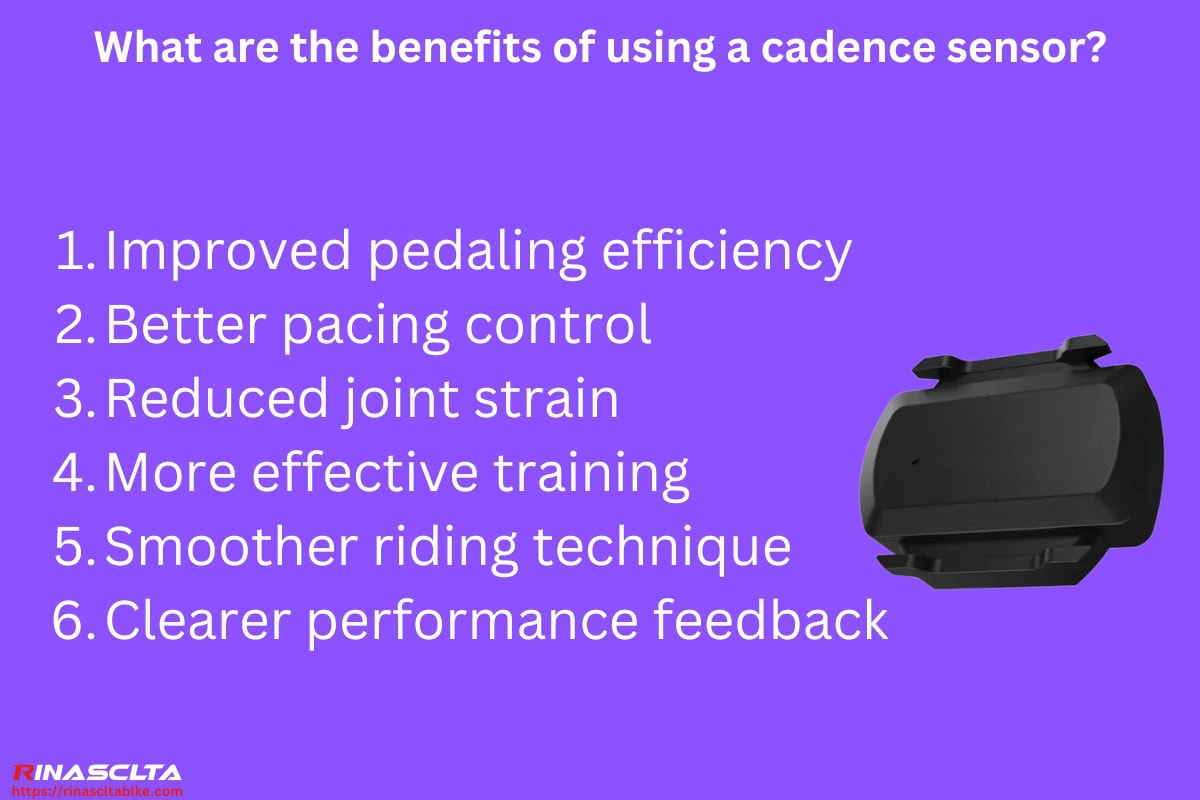
What are the benefits of using a cadence sensor?
The benefits of using a cadence sensor include improved pedaling efficiency, better pacing, reduced joint strain, more effective training, smoother riding technique, and clearer performance feedback, because cadence directly reflects how efficiently you turn effort into motion rather than how fast you are going.
- Improved pedaling efficiency: Cadence data helps riders stay within optimal RPM ranges so muscles work more economically instead of grinding heavy gears.
- Better pacing control: Monitoring cadence allows consistent effort across flats, climbs, and headwinds without relying only on speed.
- Reduced joint strain: Maintaining a healthy cadence lowers excessive force on knees and hips, reducing overuse injury risk.
- More effective training: Cadence targets are widely used in structured workouts to improve endurance, neuromuscular coordination, and power delivery.
- Smoother riding technique: Real-time feedback encourages even, circular pedaling rather than jerky or uneven strokes.
- Clearer performance feedback: Cadence adds an extra performance layer alongside heart rate and power, making training data more complete and actionable.

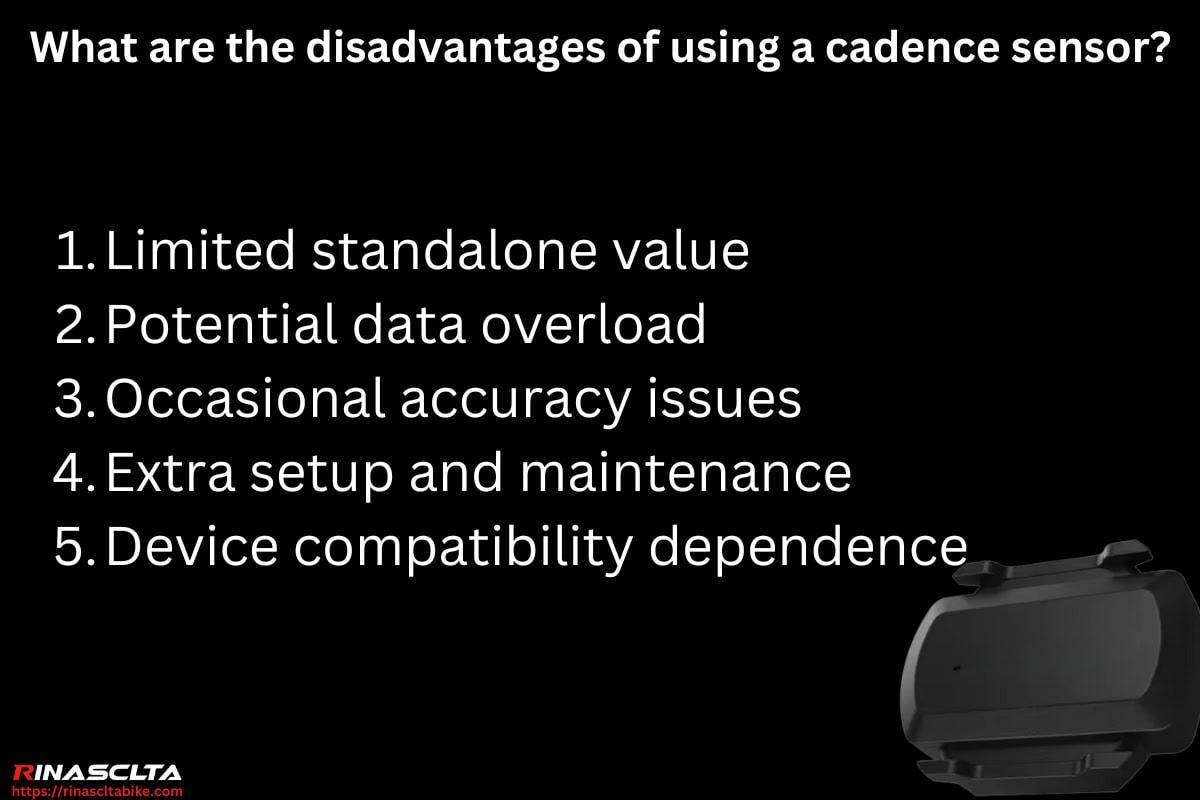
What are the disadvantages of using a cadence sensor?
The disadvantages of using a cadence sensor include limited standalone value, potential data overload, occasional accuracy issues, extra setup complexity, and dependence on compatible devices, because cadence alone does not measure effort, speed, or fitness without supporting metrics.
- Limited standalone value: Cadence data is most useful when combined with power or heart rate, and offers little insight on its own.
- Potential data overload: Additional metrics can overwhelm beginners and distract from basic riding enjoyment.
- Occasional accuracy issues: Poor sensor placement, low battery, or signal dropouts can cause cadence spikes or dropouts.
- Extra setup and maintenance: Installing, pairing, and maintaining another sensor adds small but real complexity.
- Device compatibility dependence: Cadence sensors require compatible bike computers or apps, limiting usefulness if ecosystems don’t align.
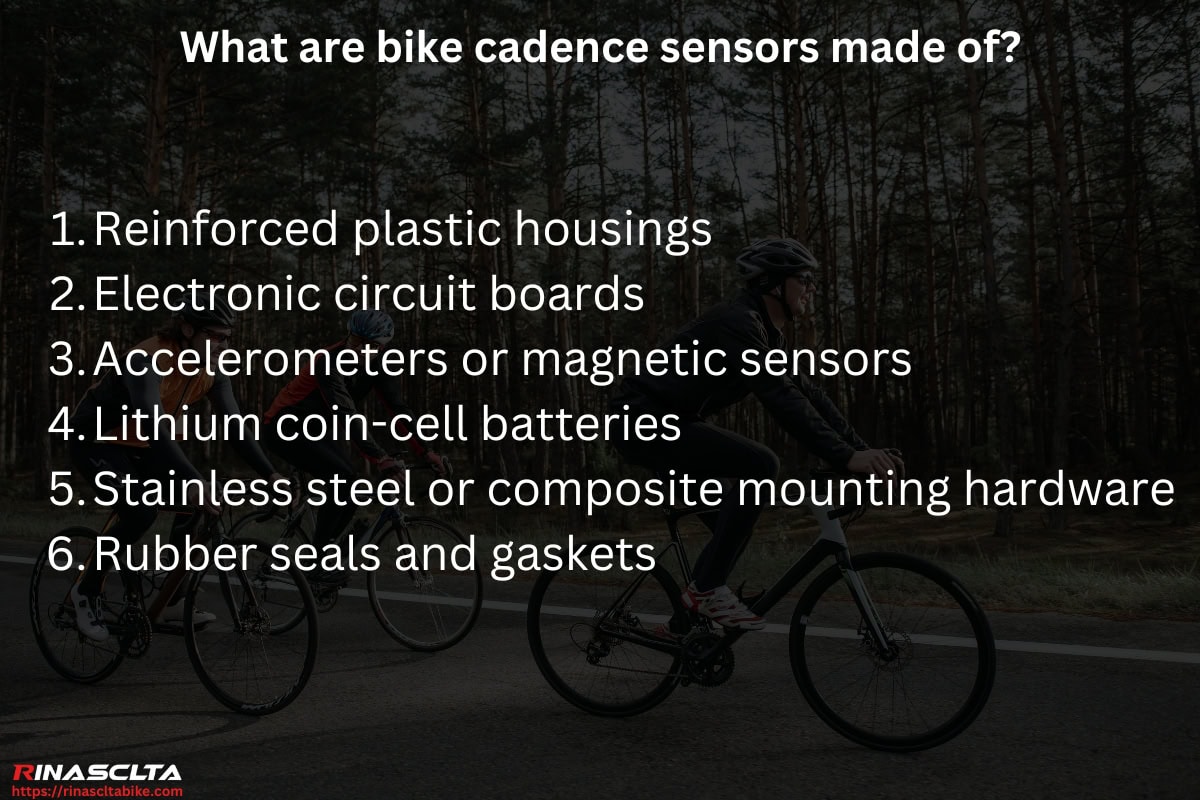
What are bike cadence sensors made of?
Bike cadence sensors are made of reinforced plastic housings, electronic circuit boards, accelerometers or magnetic sensors, lithium coin-cell batteries, stainless steel or composite mounting hardware, and rubber sealing components, because these materials must keep the sensor lightweight, durable, accurate, and weather-resistant while operating continuously on a moving bicycle.
- Reinforced plastic housings: Protect internal electronics while keeping the sensor small, light, and impact-resistant.
- Electronic circuit boards: Process motion data, calculate cadence, and manage wireless signal transmission.
- Accelerometers or magnetic sensors: Detect crank rotation precisely to measure pedaling rate in RPM.
- Lithium coin-cell batteries: Provide long-lasting power in a compact form with minimal weight.
- Stainless steel or composite mounting hardware: Secure the sensor firmly to the crank arm without corrosion or fatigue.
- Rubber seals and gaskets: Prevent water, dust, and sweat from damaging sensitive electronic components.
What are the types of bike cadence sensors?
The types of bike cadence sensors include Bluetooth cadence sensors, ANT+ cadence sensors, dual wireless (ANT+ + Bluetooth) sensors, smart trainer–integrated cadence sensors, and Peloton-style cadence systems, because cadence data can be captured either by standalone sensors or built directly into connected indoor cycling platforms.
- Bluetooth cadence sensors: Transmit cadence data via Bluetooth Low Energy for easy pairing with smartphones, fitness apps, and indoor platforms.
- ANT+ cadence sensors: Use the ANT+ protocol to connect reliably with bike computers and training systems, especially in multi-sensor setups.
- Dual wireless cadence sensors: Support both ANT+ and Bluetooth, offering maximum compatibility across head units, apps, and indoor trainers.
- Smart trainer cadence sensor: Built into indoor trainers and estimates cadence based on drivetrain rotation or resistance systems, simplifying indoor setups.
- Peloton cadence systems: Use bike-integrated sensors or software estimation to display cadence within the Peloton ecosystem rather than as a standalone bike sensor.
How do you choose bike cadence sensors?
You choose bike cadence sensors by considering accuracy, connectivity, compatibility, mounting method, battery life, brand reliability, ease of setup, indoor/outdoor use, and budget, because these factors determine how reliably cadence data is captured and how easily it integrates into your cycling setup.
- Accuracy: Reliable sensors with stable motion detection ensure cadence readings reflect real pedaling rhythm without spikes or dropouts.
- Connectivity (ANT+, Bluetooth, or both): Choose based on whether you use a bike computer, smartphone app, or indoor training platform.
- Device compatibility: Ensure the sensor pairs seamlessly with your bike computer, watch, trainer, or fitness apps.
- Mounting method: Crank-arm or spindle-mounted designs affect stability, ease of installation, and bike compatibility.
- Battery life: Long-lasting coin-cell batteries reduce maintenance and ensure uninterrupted training data.
- Brand reliability: Established brands offer better firmware support, consistent performance, and durable hardware.
- Ease of setup: Tool-free installation and quick pairing save time and reduce user error.
- Indoor vs outdoor use: Some sensors are optimized for outdoor riding, while others integrate better with smart trainers or indoor platforms.
- Budget and value: Most cadence sensors are affordable, so choose one that meets your connectivity and accuracy needs without unnecessary extras.
Do I need a cadence sensor?
Yes, you need a cadence sensor if you want feedback on pedaling rhythm (RPM) to improve efficiency, pacing, and joint health, but it’s optional for casual riding where speed or distance is enough.
Do I need a cadence sensor for Zwift?
Yes, you need a cadence sensor if you want accurate RPM data in Zwift, but it’s not mandatory if your smart trainer already reports cadence.
Does Tacx Neo need a speed and cadence sensor?
No, you do not need speed and cadence sensors if you use a Tacx Neo, because it has built-in power, speed, and cadence measurement.
Can a cadence sensor measure power?
No, a cadence sensor cannot measure power because power requires force (torque) measurement, which cadence sensors do not capture; power meters or smart trainers are required for watts.
Does a cadence sensor measure distance?
No, a cadence sensor does not measure distance because distance is derived from wheel rotation or GPS, which requires a speed sensor or GPS device.
Can you use Zwift with just a cadence sensor?
Yes, you can use Zwift with just a cadence sensor if you enable estimated power (zPower) with a supported trainer setup, but accuracy is limited and the experience is inferior to using a real power source.
How to install the cadence sensor?
To install a bike cadence sensor, you choose the mounting location, attach the sensor securely, pair it with your device, calibrate or wake the sensor, and verify data, because correct placement and setup are essential for accurate and stable cadence readings.
- Choose the mounting location: Install the sensor on the crank arm or pedal spindle where it can detect smooth rotational movement.
- Attach the sensor securely: Use rubber bands, zip ties, or a dedicated mount to prevent movement that could cause inaccurate readings.
- Pair the sensor with a device: Connect via ANT+ or Bluetooth to your bike computer, smartwatch, or training app.
- Wake and calibrate the sensor: Rotate the crank to activate the sensor and complete any app-based setup steps.
- Verify cadence data: Spin the cranks and confirm RPM is displayed correctly before riding to ensure reliable performance.
How to attach the Garmin cadence sensor?
You can attach a Garmin cadence sensor by fastening it to the inside of the crank arm using the supplied rubber bands or sleeve, because this position allows the internal accelerometer to detect smooth crank rotation accurately without magnets. Proper attachment ensures stable RPM data, minimal signal dropouts, and long-term durability during road, gravel, or indoor cycling.
Where to mount the cadence sensor?
You can mount a cadence sensor on the crank arm (non-drive side preferred) because this location provides consistent rotational motion and avoids interference from the chain or drivetrain. Correct placement improves accuracy, reduces vibration errors, and works across road bikes, mountain bikes, and smart trainer setups.
How to connect the cadence sensor to apple watch?
You can connect a cadence sensor to an Apple Watch if the sensor supports Bluetooth Low Energy (BLE) by pairing it through the Watch’s workout app or a compatible third-party cycling app. This adds cadence visibility and training value beyond the Watch’s built-in motion estimates, especially for indoor or structured rides.
How to connect the Cadence sensor to Garmin?
You can connect a cadence sensor to a Garmin bike computer by opening Sensors → Add Sensor → Cadence, then rotating the crank to wake the sensor and complete pairing via ANT+ or Bluetooth. This enables real-time RPM display, cadence-based training fields, and more accurate ride analysis.
How to connect the Cadence sensor to Strava?
You can connect a cadence sensor to Strava indirectly by pairing the sensor with your bike computer, smartwatch, or supported app, because Strava records cadence data from uploaded activity files rather than pairing with sensors directly. This workflow preserves cadence metrics in ride analysis and improves training insight without extra setup complexity.
Does the Wahoo cadence sensor work with apple watch?
Yes, it works with Apple Watch if the Wahoo cadence sensor uses Bluetooth Low Energy (BLE) and you pair it through a compatible cycling app on Apple Watch, because Apple Watch does not support ANT+ but accepts BLE sensors for workouts—adding accurate RPM data beyond wrist motion estimates.
How to activate the Wahoo cadence sensor?
You can activate the Wahoo cadence sensor by spinning the crank arm to wake the internal accelerometer, then pairing it with a compatible device via Bluetooth or ANT+. Once motion is detected, the sensor automatically powers on and begins transmitting cadence data, providing accurate RPM readings for bike computers, smartwatches, and training apps without manual buttons or switches.
Are cadence sensor transferable?
Yes, cadence sensors are transferable if they use a strap-on or banded mount (common for most modern sensors), because you can quickly remove and reinstall them on another bike without tools, preserving training consistency across multiple bikes.
Are Garmin speed and cadence sensors transferable?
Yes, Garmin speed and cadence sensors are transferable if you’re using the strap-based models from Garmin, because they are designed for tool-free mounting and re-pairing—making them ideal for riders who switch between bikes or indoor and outdoor setups.
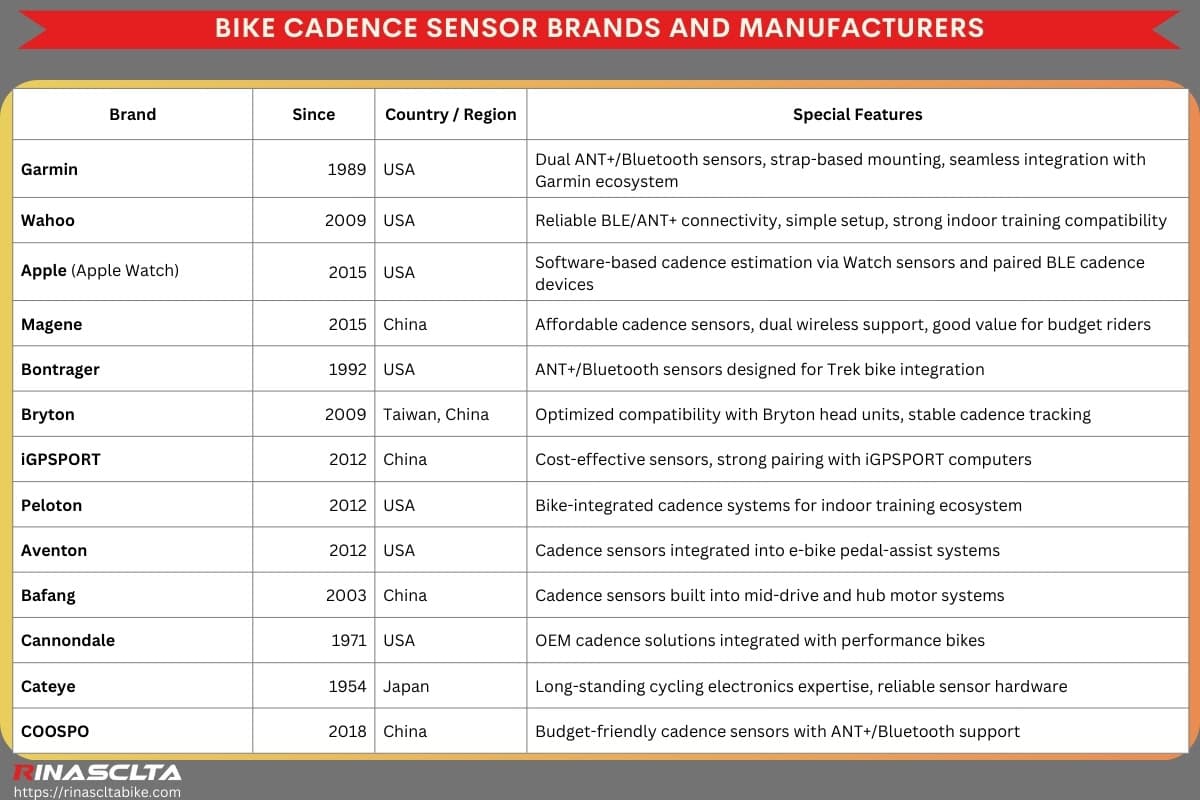
Bike cadence sensor brands and manufacturers
The bike cadence sensor industry developed alongside wireless cycling electronics in the late 1990s–2000s, evolving from magnet-based systems into today’s compact, accelerometer-driven, Bluetooth and ANT+ sensors. Modern brands and manufacturers focus on accuracy, cross-platform compatibility, battery efficiency, and ecosystem integration, serving road cyclists, mountain bikers, indoor riders, commuters, and e-bike users who rely on cadence data for training efficiency, comfort, and injury prevention.
| Brand | Since | Country / Region | Special Features |
| Garmin | 1989 | USA | Dual ANT+/Bluetooth sensors, strap-based mounting, seamless integration with Garmin ecosystem |
| Wahoo | 2009 | USA | Reliable BLE/ANT+ connectivity, simple setup, strong indoor training compatibility |
| Apple (Apple Watch) | 2015 | USA | Software-based cadence estimation via Watch sensors and paired BLE cadence devices |
| Magene | 2015 | China | Affordable cadence sensors, dual wireless support, good value for budget riders |
| Bontrager | 1992 | USA | ANT+/Bluetooth sensors designed for Trek bike integration |
| Bryton | 2009 | Taiwan, China | Optimized compatibility with Bryton head units, stable cadence tracking |
| iGPSPORT | 2012 | China | Cost-effective sensors, strong pairing with iGPSPORT computers |
| Peloton | 2012 | USA | Bike-integrated cadence systems for indoor training ecosystem |
| Aventon | 2012 | USA | Cadence sensors integrated into e-bike pedal-assist systems |
| Bafang | 2003 | China | Cadence sensors built into mid-drive and hub motor systems |
| Cannondale | 1971 | USA | OEM cadence solutions integrated with performance bikes |
| Cateye | 1954 | Japan | Long-standing cycling electronics expertise, reliable sensor hardware |
| COOSPO | 2018 | China | Budget-friendly cadence sensors with ANT+/Bluetooth support |