What are indoor cycling controllers?
Indoor cycling controllers are devices or software interfaces used to control the behavior of a smart trainer or indoor cycling system by adjusting resistance, training modes, and virtual riding conditions during indoor workouts. They became widely used with the growth of smart trainers and virtual cycling platforms in the 2010s, particularly with applications such as Zwift, TrainerRoad, Wahoo SYSTM, and Rouvy, and they operate by sending control commands to the trainer through wireless communication protocols such as Bluetooth, ANT+, or FTMS. The controller may be a smartphone app, bike computer, desktop software, or dedicated physical device, and it communicates with the trainer’s electronic resistance unit and internal control system to simulate terrain changes, maintain target power in ERG mode, or follow structured workouts, providing value by enabling precise training control, interactive virtual riding, and automated resistance adjustments during indoor cycling sessions.
Why are indoor cycling controllers important?
Indoor cycling controllers are important because they allow riders to control and automate the resistance behavior of a smart trainer during indoor workouts, enabling structured training, realistic terrain simulation, and interactive riding experiences. By communicating with the trainer’s electronic resistance unit, motor brake, and control firmware through protocols such as Bluetooth, ANT+, or FTMS, these controllers adjust resistance based on power targets, gradient changes, or workout intervals, which helps riders maintain precise training zones, follow ERG mode workouts, and replicate outdoor riding conditions. This improves the overall indoor cycling experience by providing accurate performance feedback, smoother resistance transitions, better training efficiency, and deeper integration with virtual cycling platforms, bike computers, and training software.
How does the indoor cycling controller system work?
An indoor cycling controller system works by sending control commands from the controller to the smart trainer, which then adjusts its internal resistance system to simulate riding conditions or follow training targets. The controller—such as a smartphone app, bike computer, or physical control device—communicates with the trainer through wireless protocols like Bluetooth, ANT+, or FTMS, transmitting instructions related to target power, resistance level, or virtual gradient. Once the trainer receives the command, its electronic resistance unit, electromagnetic brake, or motor brake changes the load applied to the bike’s rear wheel or cassette interface, allowing the rider’s pedaling force through the crankset, chain, and drivetrain to experience the programmed resistance, which enables features such as ERG mode training, interval workouts, and simulated climbs or descents during indoor cycling sessions.
How do indoor cycling controllers connect to trainers?
Indoor cycling controllers connect to trainers mainly through ANT+, Bluetooth, and the FTMS (Fitness Machine Service) protocol, because these wireless communication standards allow the controller to send resistance commands and receive performance data such as power, cadence, and speed from the smart trainer during indoor workouts.
- ANT+: A low-power wireless communication protocol widely used in cycling electronics that allows controllers such as bike computers, training apps, and sensors to transmit resistance commands and receive performance metrics from compatible smart trainers.
- Bluetooth: A common wireless communication technology used by smartphones, tablets, and training apps to connect with smart trainers, enabling real-time control of resistance, workout programs, and data transmission during indoor cycling sessions.
- FTMS protocol: The Bluetooth Fitness Machine Service protocol designed specifically for fitness equipment, allowing training apps to standardize communication with smart trainers and treadmills, including sending resistance or gradient commands and receiving workout data.
What devices can control smart trainers?
A smart trainer can be controlled by indoor cycling controllers, which may take the form of a mobile app, bike computer, desktop training platform, or dedicated physical control device, because these controllers send commands to the trainer’s electronic resistance system through ANT+, Bluetooth, or FTMS to change resistance, simulate gradients, or hold target power in ERG mode. In other words, the actual controller is the control interface the rider uses, while the phone, tablet, or bike computer is only the hardware platform that runs or hosts that controller; this distinction matters because the value of an indoor cycling controller lies in how it manages trainer resistance, workout automation, virtual riding interaction, and compatibility with training ecosystems such as Zwift, Wahoo, Rouvy, and TrainerRoad.
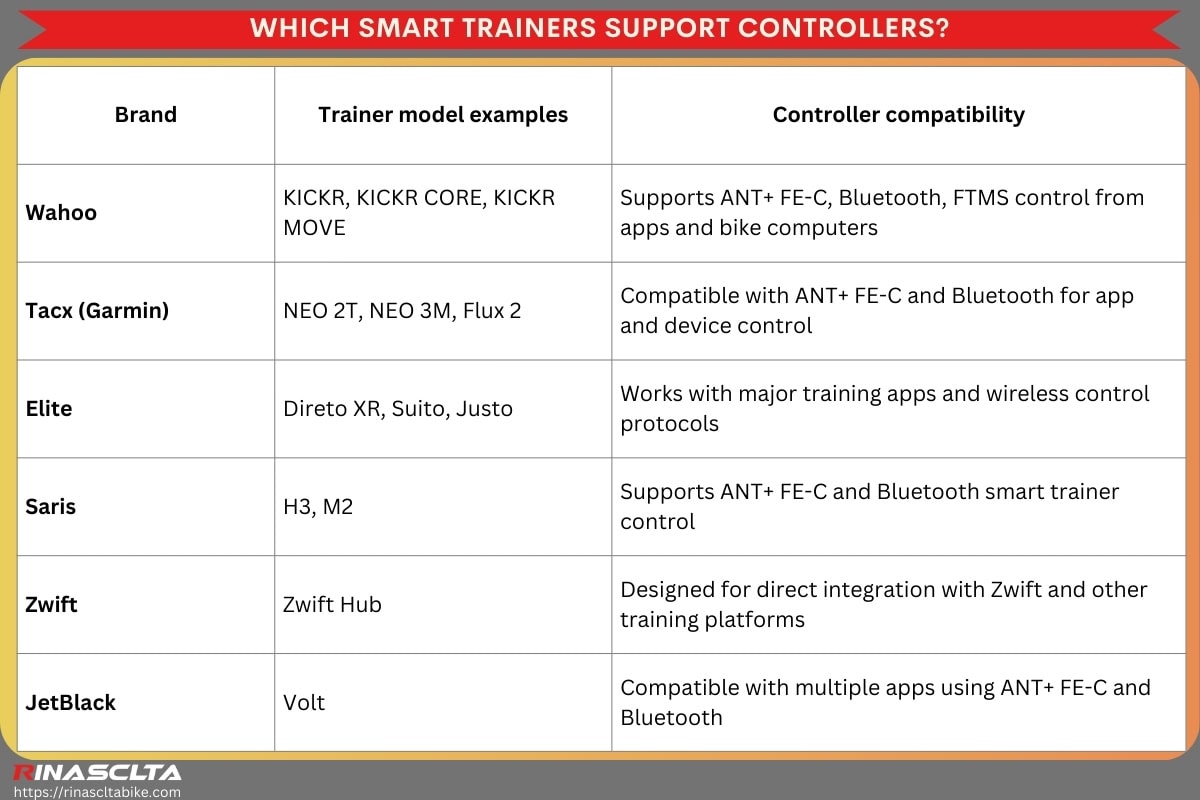
Which smart trainers support controllers?
Most modern smart trainers support indoor cycling controllers because they include an electronic resistance unit and wireless communication modules that accept control commands through protocols such as ANT+ FE-C, Bluetooth, or FTMS. These trainers can receive instructions from indoor cycling controllers—such as training apps, bike computers, or dedicated control devices—to automatically adjust resistance for ERG mode workouts, gradient simulation, and structured training programs. In practice, most smart trainers released in the last decade support indoor cycling controllers because virtual cycling platforms rely on the ability to send resistance commands and receive performance data such as power, cadence, and speed during indoor training sessions.
| Brand | Trainer model examples | Controller compatibility |
| Wahoo | KICKR, KICKR CORE, KICKR MOVE | Supports ANT+ FE-C, Bluetooth, FTMS control from apps and bike computers |
| Tacx (Garmin) | NEO 2T, NEO 3M, Flux 2 | Compatible with ANT+ FE-C and Bluetooth for app and device control |
| Elite | Direto XR, Suito, Justo | Works with major training apps and wireless control protocols |
| Saris | H3, M2 | Supports ANT+ FE-C and Bluetooth smart trainer control |
| Zwift | Zwift Hub | Designed for direct integration with Zwift and other training platforms |
| JetBlack | Volt | Compatible with multiple apps using ANT+ FE-C and Bluetooth |

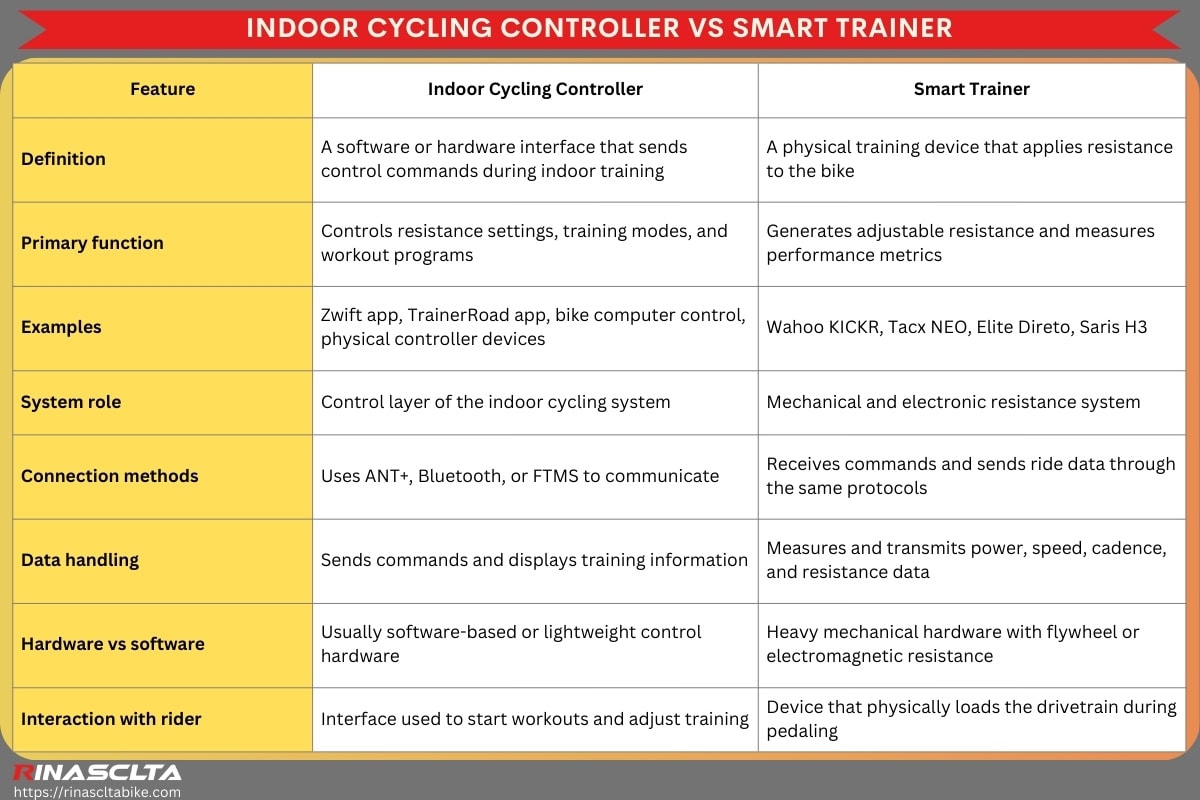
Indoor cycling controller vs smart trainer
Indoor cycling controllers and smart trainers are closely related components in an indoor training setup, but they serve different roles in the system. Both are used in indoor cycling to create a controlled training environment and interact through wireless communication protocols such as ANT+, Bluetooth, or FTMS, yet they perform different functions: the controller manages commands and training logic, while the smart trainer physically generates resistance and measures performance data. Comparing them helps riders understand how the indoor cycling ecosystem works and how each component contributes to structured workouts, resistance simulation, and performance tracking.
| Feature | Indoor Cycling Controller | Smart Trainer |
| Definition | A software or hardware interface that sends control commands during indoor training | A physical training device that applies resistance to the bike |
| Primary function | Controls resistance settings, training modes, and workout programs | Generates adjustable resistance and measures performance metrics |
| Examples | Zwift app, TrainerRoad app, bike computer control, physical controller devices | Wahoo KICKR, Tacx NEO, Elite Direto, Saris H3 |
| System role | Control layer of the indoor cycling system | Mechanical and electronic resistance system |
| Connection methods | Uses ANT+, Bluetooth, or FTMS to communicate | Receives commands and sends ride data through the same protocols |
| Data handling | Sends commands and displays training information | Measures and transmits power, speed, cadence, and resistance data |
| Hardware vs software | Usually software-based or lightweight control hardware | Heavy mechanical hardware with flywheel or electromagnetic resistance |
| Interaction with rider | Interface used to start workouts and adjust training | Device that physically loads the drivetrain during pedaling |
What are the types of indoor cycling controllers?
Indoor cycling controllers can be categorized based on product form (Zwift Companion app, bike control apps, and physical control devices), training platforms (Zwift, Wahoo SYSTM, Elite MyETraining, Rouvy, and Peloton), and control mode (ERG mode controllers, resistance controllers, and simulation controllers), because different controllers are designed to match the hardware interface used by riders, the virtual training ecosystem they operate in, and the specific resistance-control logic used during indoor workouts. These classifications help riders understand how controllers interact with smart trainers, training software, and wireless communication protocols such as ANT+, Bluetooth, and FTMS, allowing them to choose the right solution for structured workouts, virtual racing, and realistic terrain simulation.
Indoor cycling controller types based on product form
Indoor cycling controller types based on product form include mobile companion apps, dedicated bike control apps, desktop training software, and physical control devices, because indoor cycling controllers can exist either as software interfaces running on digital devices or as hardware units that directly control trainer resistance and training modes.
- Mobile companion app: A smartphone companion application like Zwift Companion that works alongside indoor cycling platforms to control features such as workout selection, trainer resistance, navigation, and in-ride communication during indoor sessions.
- Bike control app: A dedicated mobile application that directly controls the smart trainer’s resistance system, allowing riders to adjust power targets, resistance levels, or training modes through Bluetooth or ANT+.
- Desktop training software: A computer-based controller running on PC or Mac platforms, used to manage smart trainer resistance, structured workouts, and virtual cycling environments on larger displays.
- Physical control device: A hardware controller mounted on the handlebars or used as a remote, allowing riders to adjust trainer resistance, change workout modes, or navigate training platforms without using a touchscreen device.
Indoor cycling controllers based on training platforms
Indoor cycling controllers based on training platforms include Zwift, Wahoo SYSTM, Elite MyETraining, Rouvy, Peloton, and TrainerRoad, because different indoor cycling ecosystems provide their own software controllers that manage smart trainer resistance, structured workouts, and virtual riding environments through communication protocols such as Bluetooth, ANT+, or FTMS.
- Zwift controller: A virtual cycling platform controller that adjusts smart trainer resistance to simulate terrain gradients, races, and structured workouts in a 3D virtual environment.
- Wahoo SYSTM controller: A training platform controller designed to manage structured training plans, ERG mode workouts, and performance analytics while controlling Wahoo and compatible smart trainers.
- Elite MyETraining controller: Elite’s proprietary training software used to control smart trainers, offering resistance adjustment, workout programming, and virtual route simulation.
- Rouvy controller: A virtual riding platform that controls trainer resistance based on real-world video routes and augmented reality cycling experiences.
- Peloton controller: A training platform used primarily with Peloton bikes that manages class-based workouts, resistance adjustments, and instructor-guided training sessions.
- TrainerRoad controller: A performance-focused indoor training platform that controls trainer resistance through precise ERG mode workouts and structured power-based training programs.
Indoor cycling controllers based on the control mode
Indoor cycling controllers based on control mode include ERG mode controllers, resistance controllers, simulation controllers, and workout program controllers, because different control modes determine how the smart trainer adjusts resistance in response to training targets, rider input, or virtual terrain conditions during indoor cycling sessions.
- ERG mode controller: Automatically adjusts the smart trainer’s resistance to keep the rider at a target power output, regardless of cadence or gear selection, making it ideal for structured power-based workouts.
- Resistance controller: Allows the rider or app to manually set a fixed resistance level, similar to adjusting the load on a traditional indoor trainer for steady effort training.
- Simulation controller: Changes trainer resistance dynamically to simulate real-world terrain gradients, drafting effects, and speed changes within virtual cycling environments.
- Workout program controller: Controls the trainer according to predefined training intervals or structured workout plans, automatically switching resistance levels based on the workout schedule.
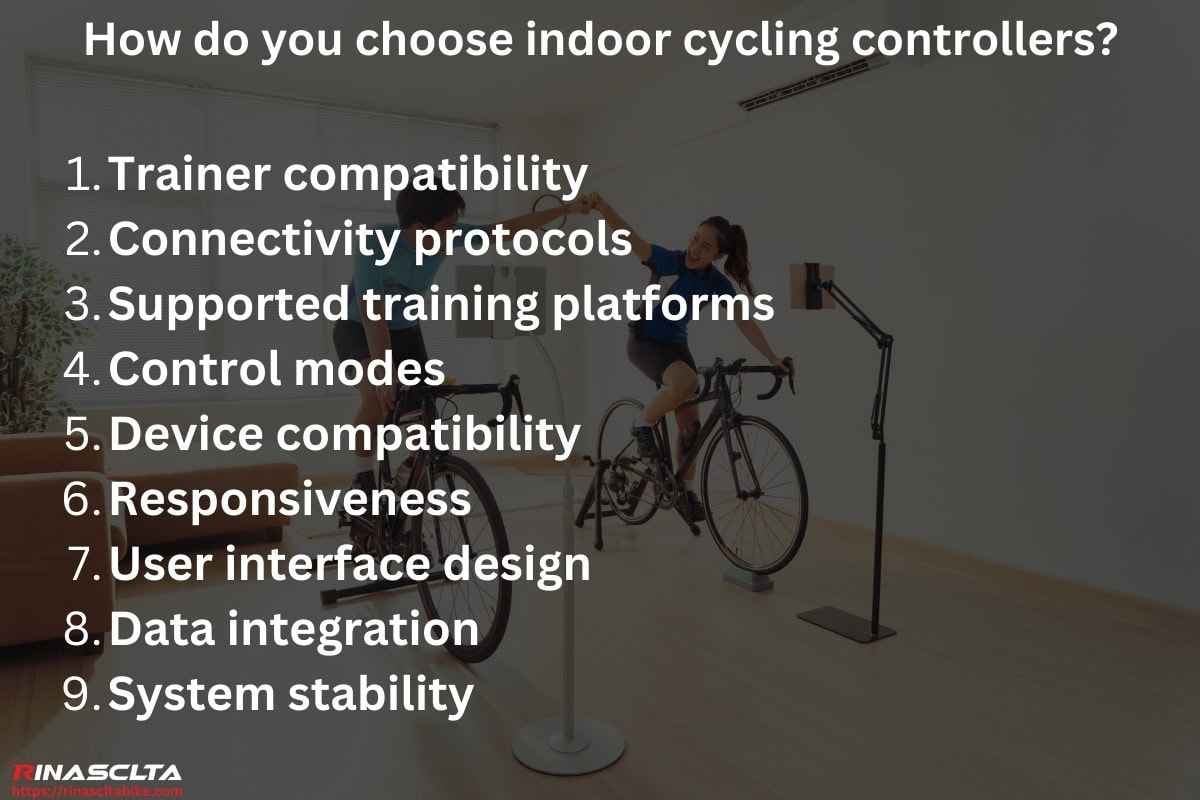
How do you choose indoor cycling controllers?
Choosing indoor cycling controllers depends on trainer compatibility, connectivity protocols, supported training platforms, control modes, device compatibility, responsiveness, user interface design, data integration, and system stability, because these factors determine how effectively the controller communicates with the smart trainer’s resistance system, training software, and performance sensors during indoor workouts.
- Trainer compatibility: The controller must support the specific smart trainer model and communication standards used in the indoor cycling setup to ensure proper resistance control.
- Connectivity protocols: Compatibility with ANT+, Bluetooth, or FTMS protocols ensures reliable communication between the controller and the trainer.
- Supported training platforms: Controllers should work with the rider’s preferred platforms such as Zwift, TrainerRoad, Wahoo SYSTM, Rouvy, or Peloton for seamless workout control.
- Control modes: The controller should support training modes such as ERG mode, resistance mode, or simulation mode depending on the rider’s training style.
- Device compatibility: Controllers may run on smartphones, tablets, computers, or bike computers, so device support affects usability and flexibility.
- Responsiveness: Fast communication between the controller and trainer ensures smooth resistance adjustments during workouts or virtual terrain changes.
- User interface design: A clear interface allows riders to quickly adjust settings, start workouts, or change resistance while riding.
- Data integration: Good controllers integrate with power meters, cadence sensors, heart rate monitors, and training platforms to provide comprehensive workout data.
- System stability: Reliable software and wireless communication reduce connection dropouts, resistance delays, or control interruptions during training sessions.
How do you use indoor cycling controllers?
You can use indoor cycling controllers by connecting a control device or training app to a smart trainer through wireless communication protocols such as ANT+, Bluetooth, or FTMS, allowing the controller to send commands that adjust the trainer’s electronic resistance system during indoor workouts. After pairing the controller with the trainer—typically through a smartphone, tablet, computer, or bike computer running an indoor cycling platform such as Zwift, TrainerRoad, or Wahoo SYSTM—the system communicates with the trainer’s flywheel resistance unit, motor brake, and internal control firmware to change resistance based on ERG mode power targets, manual resistance settings, or simulated terrain gradients. While the rider pedals through the bike’s crankset, chain, cassette, and drivetrain, the controller manages resistance and displays performance metrics such as power output, cadence, speed, and heart rate, enabling structured workouts, interval training, and realistic virtual riding experiences.
How to control a smart trainer with apps?
You can control a smart trainer with apps by connecting the trainer to a smartphone, tablet, or computer through Bluetooth, ANT+, or the FTMS protocol, allowing the app to send commands that adjust the trainer’s electronic resistance unit during structured workouts, virtual riding, or interval training.
- Zwift: Controls the trainer by automatically adjusting resistance based on virtual terrain gradients, races, and structured training sessions in a simulated 3D cycling environment.
- Wahoo: Uses the Wahoo Fitness or Wahoo SYSTM app to control trainer resistance for ERG mode workouts, manual resistance adjustments, and structured training programs.
- Elite MyETraining: Connects to compatible Elite trainers and controls resistance for workout programs, power training, and virtual route simulations.
- Rouvy: Adjusts trainer resistance according to real-world video routes and gradient changes, creating an immersive indoor riding experience.
- TrainerRoad: Controls the trainer primarily through power-based ERG mode workouts, automatically adjusting resistance to maintain target training zones.
How to control the smart trainer with the Garmin 520?
You can control the smart trainer with the Garmin 520 by pairing the trainer to the Garmin Edge 520 bike computer using the ANT+ FE-C (Fitness Equipment Control) protocol, which allows the device to send resistance commands to the trainer during indoor workouts. After connecting the trainer through the sensor pairing menu, the Garmin 520 can run structured workouts, adjust resistance levels, and maintain target power in ERG mode, while displaying ride data such as power output, cadence, and speed generated by the trainer and the bike’s drivetrain.
How to control the smart trainer with TrainingPeaks?
You can control the smart trainer with TrainingPeaks by first creating or scheduling structured workouts in the TrainingPeaks training platform, then syncing those workouts to a compatible training app or device such as TrainerRoad, Zwift, Wahoo SYSTM, or a Garmin bike computer that can control the trainer. When the workout is started, the controller communicates with the trainer through Bluetooth, ANT+, or FTMS, automatically adjusting resistance to match the power targets and intervals defined in the TrainingPeaks workout plan.
Can TrainingPeaks control a smart trainer?
Yes, TrainingPeaks can control a smart trainer if the workouts created in TrainingPeaks are synced to a compatible controller such as TrainerRoad, Zwift, Wahoo SYSTM, or a Garmin bike computer, because TrainingPeaks itself mainly functions as a training plan and workout platform, while the controlling device sends resistance commands to the trainer through ANT+, Bluetooth, or the FTMS protocol to follow the scheduled power intervals.
Can the Peloton app control a smart trainer?
Yes, the Peloton app can control a smart trainer if the trainer supports Bluetooth FTMS compatibility or a third-party integration, but many Peloton classes require the rider to manually adjust resistance because the Peloton ecosystem is primarily designed for Peloton bikes with proprietary control systems rather than universal smart trainer control.
Can the Wahoo fitness app control a smart trainer?
Yes, the Wahoo Fitness app can control a smart trainer if the trainer supports Bluetooth or ANT+ FE-C communication, because the app can send commands to the trainer’s electronic resistance system to adjust resistance levels, run ERG mode workouts, and simulate gradients, while displaying performance metrics such as power, cadence, and speed during indoor training sessions.
Why is the controller not connecting to the smart trainer?
The controller may not connect to the smart trainer because the wireless communication link using Bluetooth, ANT+, or the FTMS protocol is not properly established, which can happen if the trainer is already paired with another device, the wireless signal is weak, or the trainer is not in pairing mode. You can fix this by turning the trainer off and on, enabling pairing mode, disabling other connected devices, checking the Bluetooth or ANT+ settings on the controller device, and ensuring the trainer and controller are within close range.
Why is the smart trainer not responding to the controllers?
The smart trainer may not respond to the controller because the trainer is not receiving resistance commands or the control protocol is incompatible with the controller device, which may occur when the trainer is connected only as a power meter or sensor rather than a controllable trainer, or when the selected protocol (such as ANT+ FE-C or Bluetooth FTMS) is not enabled. You can solve this by selecting the trainer as a controllable device in the training app, reconnecting the controller, updating firmware, and ensuring the trainer supports the control mode used by the app or bike computer.
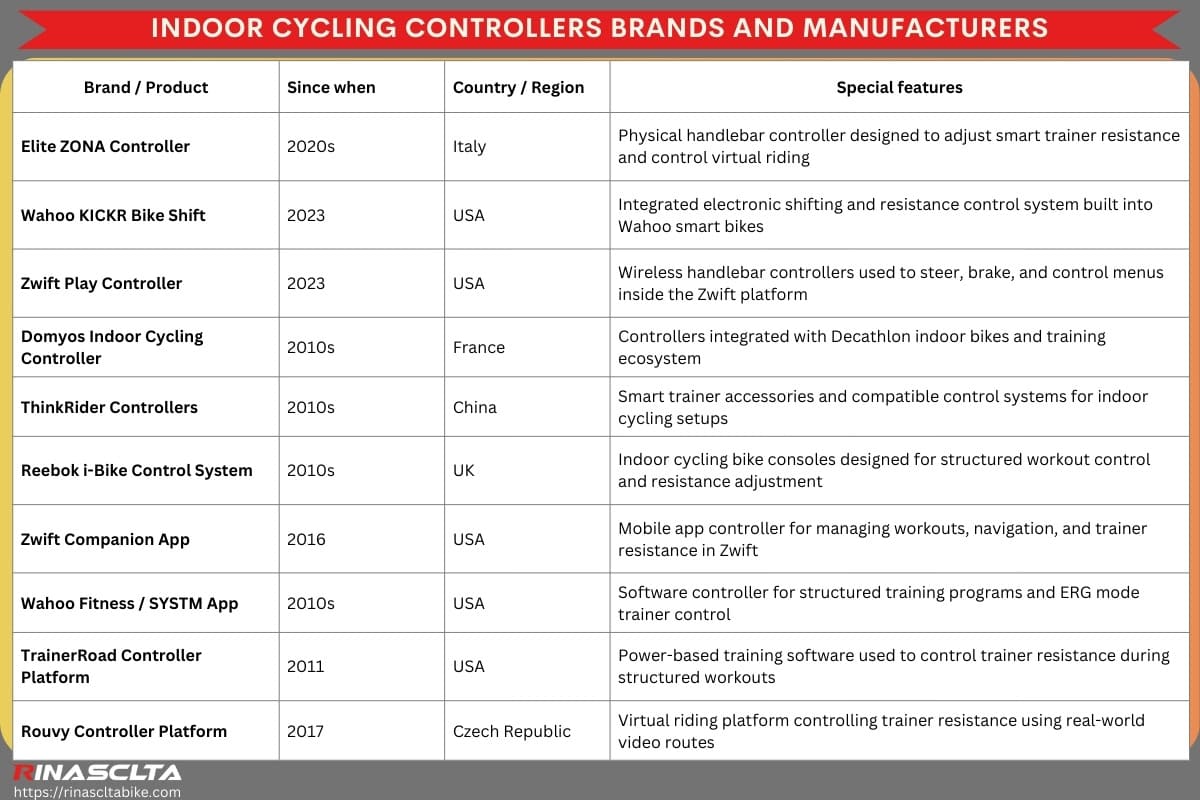
Indoor cycling controllers brands and manufacturers
The indoor cycling controller market has grown alongside the expansion of smart trainers, virtual cycling platforms, and connected training ecosystems, where manufacturers develop both hardware control devices and software-based controller systems that allow riders to adjust trainer resistance, change gears virtually, and interact with training platforms. These controllers typically communicate with smart trainers through Bluetooth, ANT+, or the FTMS protocol, and the industry includes training platform developers, smart trainer brands, and fitness equipment manufacturers, reflecting the increasing demand for interactive and structured indoor cycling experiences.
| Brand / Product | Since when | Country / Region | Special features |
| Elite ZONA Controller | 2020s | Italy | Physical handlebar controller designed to adjust smart trainer resistance and control virtual riding |
| Wahoo KICKR Bike Shift | 2023 | USA | Integrated electronic shifting and resistance control system built into Wahoo smart bikes |
| Zwift Play Controller | 2023 | USA | Wireless handlebar controllers used to steer, brake, and control menus inside the Zwift platform |
| Domyos Indoor Cycling Controller | 2010s | France | Controllers integrated with Decathlon indoor bikes and training ecosystem |
| ThinkRider Controllers | 2010s | China | Smart trainer accessories and compatible control systems for indoor cycling setups |
| Reebok i-Bike Control System | 2010s | UK | Indoor cycling bike consoles designed for structured workout control and resistance adjustment |
| Zwift Companion App | 2016 | USA | Mobile app controller for managing workouts, navigation, and trainer resistance in Zwift |
| Wahoo Fitness / SYSTM App | 2010s | USA | Software controller for structured training programs and ERG mode trainer control |
| TrainerRoad Controller Platform | 2011 | USA | Power-based training software used to control trainer resistance during structured workouts |
| Rouvy Controller Platform | 2017 | Czech Republic | Virtual riding platform controlling trainer resistance using real-world video routes |