What is a bike speed sensor?
A bike speed sensor is a small electronic device that measures wheel rotation to calculate a bicycle’s real-time speed and total distance, first appearing in early cycling computers in Europe and North America in the 1990s to provide more accurate data than time-and-distance estimates alone. As technology evolved into wireless ANT+ and Bluetooth systems used by brands like Garmin and Wahoo, bike speed sensors now play a key role in modern cycling across road bikes, mountain bikes, gravel bikes, indoor trainers, and e-bikes by delivering precise speed data unaffected by GPS dropouts, improving training accuracy, pacing technique, and ride analysis.
Why do you need a speed sensor on a bike?
You need a speed sensor on a bike if you want accurate, consistent speed and distance data that is not affected by GPS signal loss, terrain, tunnels, trees, or indoor riding conditions, because a speed sensor measures actual wheel rotation rather than estimated movement. It adds clear value for training precision, pacing, indoor cycling, structured workouts, and detailed ride analysis, improves data accuracy on mountain bikes, gravel bikes, smart trainers, and e-bikes, and ensures reliable speed tracking when GPS-based devices alone cannot deliver consistent results.
How does a bike speed sensor work?
A bike speed sensor works by detecting each rotation of the bicycle wheel using an internal accelerometer or a magnet-based trigger, then multiplying that rotation count by the wheel circumference to calculate real-time speed and total distance. The sensor transmits this data via ANT+ or Bluetooth to a bike computer or training app, providing highly accurate speed readings that support safe pacing, reliable indoor training, and consistent performance analysis across road, mountain, gravel, and e-bike riding—especially where GPS accuracy is limited.
What is a bike speed sensor made of?
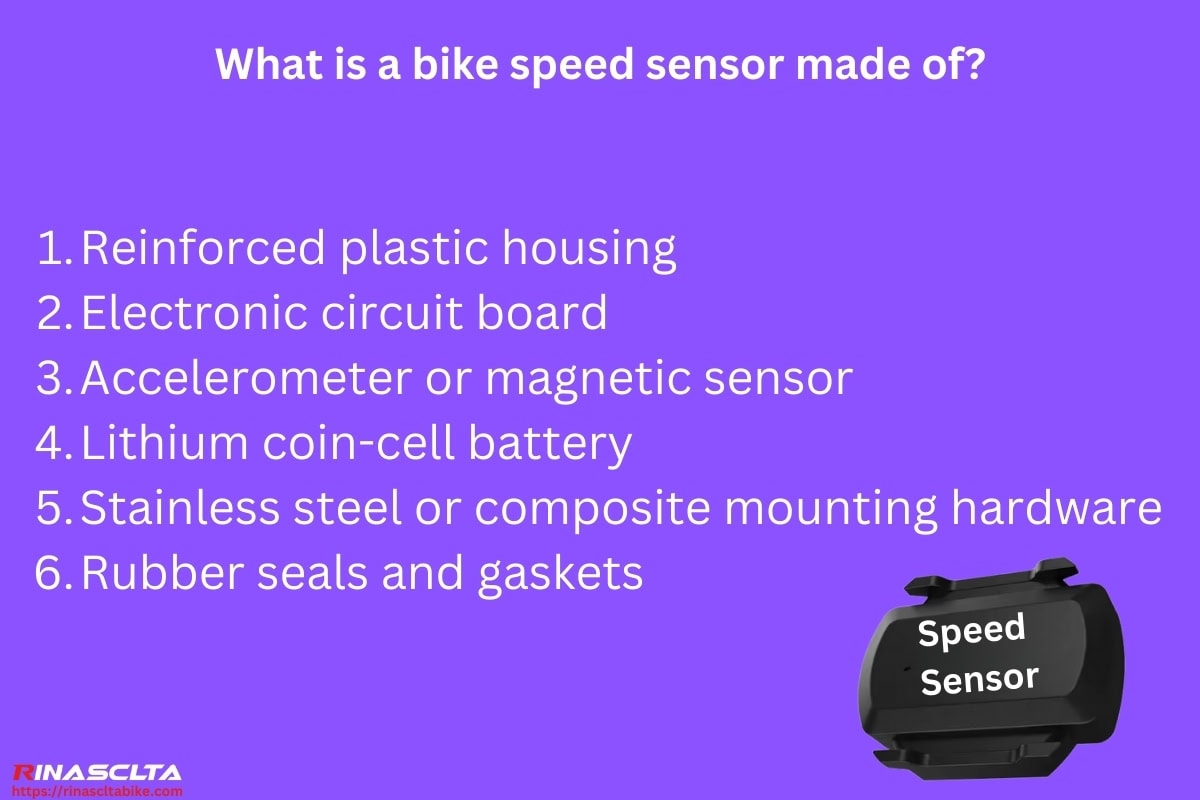
A bike speed sensor is made of a reinforced plastic housing, electronic circuit board, accelerometer or magnetic sensor, lithium coin-cell battery, stainless steel or composite mounting hardware, and rubber sealing components, because these materials must balance light weight, durability, accuracy, low power consumption, and weather resistance in outdoor cycling conditions.
- Reinforced plastic housing: Protects internal electronics while keeping the sensor lightweight and impact-resistant.
- Electronic circuit board: Processes wheel-rotation signals and manages wireless data transmission.
- Accelerometer or magnetic sensor: Detects each wheel rotation precisely to calculate speed and distance.
- Lithium coin-cell battery: Provides long battery life in a compact form suitable for continuous riding.
- Stainless steel or composite mounting hardware: Secures the sensor firmly to the hub or fork without corrosion or fatigue.
- Rubber seals and gaskets: Prevent water, dust, and mud from entering the sensor and damaging components.

What are the types of bike speed sensors?
Bike speed sensors can be classified by connectivity (ANT+, Bluetooth, or dual wireless), by installation location (wheel hub, fork-mounted, or crank-based systems), and by bike type compatibility (road bikes, mountain bikes, e-bikes, exercise bikes, stationary bikes, and bike trainers), because speed data can be captured and transmitted in different ways depending on hardware design and riding context. These categories exist to balance data accuracy, device compatibility, installation practicality, and riding environment, helping cyclists choose a speed sensor that delivers reliable speed and distance measurements for both outdoor and indoor cycling.
Bike speed sensor types based on connectivity
Bike speed sensors based on connectivity include ANT+ speed sensors, Bluetooth speed sensors, and dual wireless (ANT+ + Bluetooth) speed sensors, because different communication protocols determine how the sensor pairs with bike computers, smartphones, watches, and indoor training platforms.
- ANT+ speed sensors: Provide stable, low-latency connections to bike computers and allow simultaneous pairing with multiple devices.
- Bluetooth speed sensors: Pair easily with smartphones, smartwatches, and fitness apps using Bluetooth Low Energy for convenience.
- Dual wireless speed sensors: Support both ANT+ and Bluetooth, offering maximum compatibility across head units, apps, and indoor trainers.
Bike speed sensor types based on installation
Bike speed sensors based on installation include wheel-mounted sensors, fork-mounted sensors, and crank-based speed sensing systems, because speed can be derived from wheel rotation or drivetrain movement depending on sensor design and bike setup.
- Wheel-mounted speed sensors: Attach directly to the hub or wheel and provide the most accurate speed and distance by measuring true wheel rotation.
- Fork-mounted speed sensors: Mount on the fork leg and work with a spoke magnet or hub sensor to detect wheel passes reliably.
- Crank-based speed sensing systems: Estimate speed from drivetrain rotation and gearing, commonly used on indoor or stationary bikes rather than outdoor riding.
What rpm speed sensors are compatible with the spin bike?
RPM speed sensors compatible with spin bikes are Bluetooth cadence/speed sensors designed to detect flywheel or crank rotation, because most spin bikes lack free-spinning wheels, hubs, or GPS and instead rely on RPM (revolutions per minute) to estimate speed and distance.
- Bluetooth cadence sensors (crank-mounted): These are the most compatible option, attaching to the crank arm and transmitting RPM via Bluetooth Low Energy (BLE) to spin apps and displays.
- Dual speed & cadence sensors (Bluetooth preferred): Sensors that support cadence-only mode work well, even if marketed as speed sensors, as long as they transmit RPM rather than wheel speed.
- App-compatible RPM sensors: Sensors explicitly supported by spin platforms (e.g., Peloton-style or studio bikes) ensure correct RPM interpretation inside the app ecosystem.
Bike speed sensor types based on bike types
Bike speed sensors by bike type include road bike speed sensors, mountain bike speed sensors, e-bike speed sensors, exercise bike speed sensors, stationary bike speed sensors, and bike trainer speed sensors, because different riding environments and drivetrain designs require different measurement accuracy, mounting methods, and data integration.
- Road bike speed sensors: Prioritize high accuracy and smooth wheel-rotation tracking for training, racing, and long-distance riding.
- Mountain bike speed sensors: Emphasize rugged construction and stable readings under vibration, mud, and variable terrain.
- E-bike speed sensors: Integrate with motor systems to manage assist levels, legal speed limits, and riding efficiency.
- Exercise bike speed sensors: Measure RPM or flywheel rotation to estimate speed and distance in indoor fitness setups.
- Stationary bike speed sensors: Use cadence-based or resistance-based calculations rather than true wheel speed.
- Bike trainer speed sensors: Provide speed and distance data for indoor training platforms when power or smart resistance is not available.
How do you choose bike speed sensors?
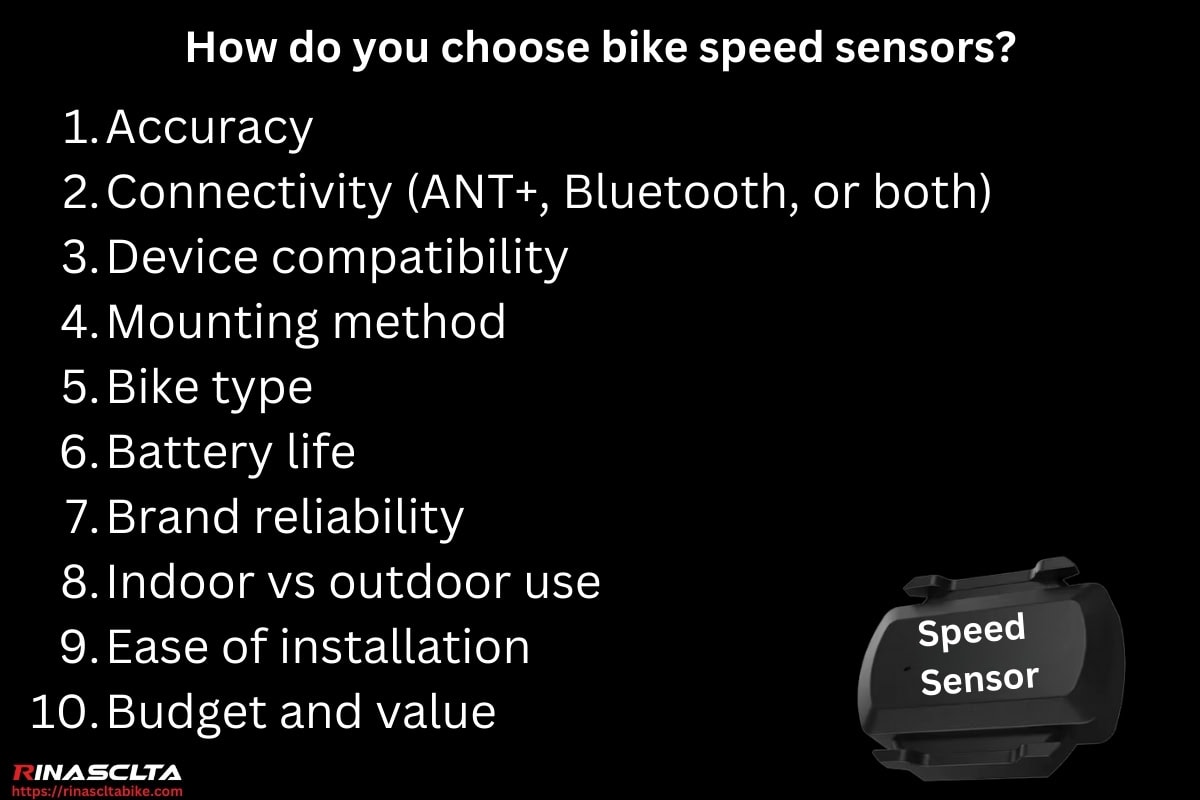
You choose bike speed sensors by evaluating accuracy, connectivity, compatibility, mounting method, bike type, battery life, brand reliability, indoor/outdoor use, ease of setup, and budget, because these factors determine how precise the speed data is and how well the sensor integrates with your cycling setup.
- Accuracy: Sensors that measure true wheel rotation provide the most reliable speed and distance data.
- Connectivity (ANT+, Bluetooth, or both): Choose based on whether you use a bike computer, smartphone, smartwatch, or indoor training app.
- Device compatibility: Ensure the sensor pairs smoothly with your head unit, watch, trainer, or fitness platform.
- Mounting method: Hub, fork, or crank mounting affects installation ease, stability, and data precision.
- Bike type: Road, mountain, e-bike, and indoor bikes require different sensor designs and integration levels.
- Battery life: Long-lasting coin-cell batteries reduce maintenance and missed data during rides.
- Brand reliability: Established brands offer better firmware support, durability, and long-term accuracy.
- Indoor vs outdoor use: Some sensors excel indoors where GPS is unavailable, while others complement outdoor GPS data.
- Ease of installation: Tool-free mounting saves time and reduces setup errors.
- Budget and value: Most speed sensors are affordable, so prioritize compatibility and accuracy over unnecessary extras.
How to install speed sensor on bike?
You can install a speed sensor on a bike by mounting it on the wheel hub or fork, pairing it via ANT+ or Bluetooth to your bike computer or app, and setting the correct wheel circumference, because speed sensors calculate speed from wheel rotation and require accurate wheel size for precise distance and pacing data.
How to attach speed sensor to spin bike?
You can attach a speed sensor to a spin bike by mounting a cadence-style speed sensor on the crank arm or flywheel area, because spin bikes do not have free-rolling wheels and rely on RPM (revolutions per minute) to estimate speed, distance, and workout intensity for indoor training apps.
How to install Wahoo speed sensor on spin bike?
You can install a Wahoo speed sensor on a spin bike by strapping it to the crank arm in cadence mode and pairing it via Bluetooth to your indoor cycling app, since Wahoo sensors automatically detect motion and can function without wheel magnets—making them ideal for spin setups.
How to use Garmin speed cadence bike sensor?
You can use a Garmin Speed and Cadence Sensor by mounting the speed sensor on the wheel hub and the cadence sensor on the crank arm, then pairing both to a Garmin device via ANT+ or Bluetooth to receive accurate speed, distance, and RPM data indoors or outdoors.
How to add speed sensor to stationary bike?
You can add a speed sensor to a stationary bike by installing a Bluetooth cadence/speed sensor on the crank arm or flywheel and pairing it with a compatible app or console, because stationary bikes estimate speed from pedaling rate and resistance, enabling consistent tracking of workouts, calories, and training zones without GPS.
Where to put speed sensor on bike?
You should put a bike speed sensor on the wheel hub (most common and accurate), because this position measures true wheel rotation and provides precise speed and distance data regardless of GPS quality.
- Wheel hub (recommended): Mounting the sensor on the front or rear hub delivers the most accurate readings by directly tracking wheel revolutions.
- Fork-mounted (with magnet): Older systems place a sensor on the fork leg with a spoke magnet, reliably detecting each wheel pass.
- Crank arm (spin / stationary bikes): Used when no free-rolling wheel exists, estimating speed from RPM (cadence) rather than actual distance.
Can you put a speed sensor on a spin bike?
Yes, you can put a speed sensor on a spin bike if you use a Bluetooth cadence-style speed sensor mounted on the crank arm or flywheel, because spin bikes lack free-rolling wheels and calculate speed from RPM rather than true wheel distance.
Do all myx bikes have a speed sensor?
No, not all MYX bikes have a traditional speed sensor, because MYX bikes typically estimate speed and output using resistance and cadence data integrated into the bike’s console, rather than a standalone wheel-based speed sensor.
Do bike speed sensors need to be calibrated?
Yes, bike speed sensors need to be calibrated if they rely on wheel circumference settings, because incorrect wheel size will cause inaccurate speed and distance readings—but most modern sensors self-calibrate when paired with GPS-enabled bike computers.
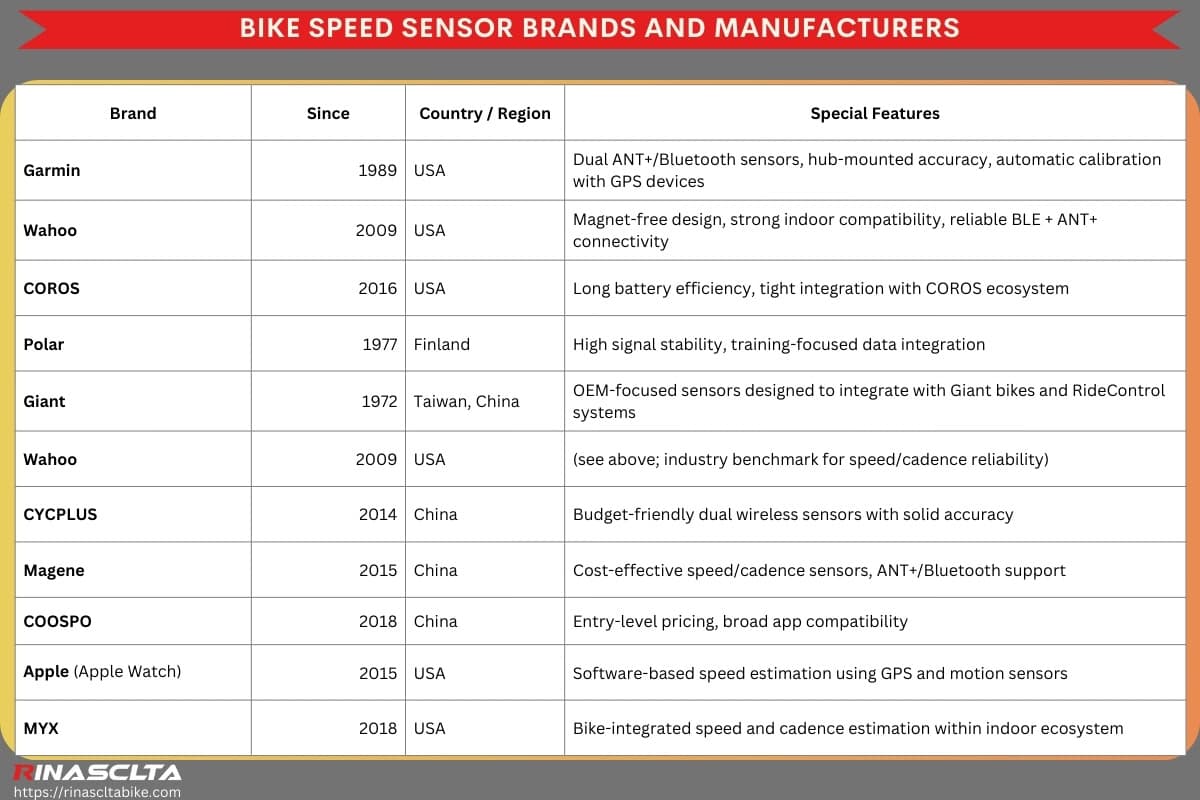
Bike speed sensor brands and manufacturers
The bike speed sensor industry has evolved from wired, magnet-based systems in early cycling computers to today’s compact, wireless, accelerometer-driven sensors that integrate seamlessly with bike computers, smart trainers, and fitness apps. Modern brands and manufacturers compete on accuracy, dual-protocol connectivity (ANT+/Bluetooth), ecosystem compatibility, battery life, and ease of installation, serving road cyclists, mountain bikers, indoor riders, spin-bike users, and e-bike owners in an increasingly data-driven cycling landscape.
| Brand | Since | Country / Region | Special Features |
| Garmin | 1989 | USA | Dual ANT+/Bluetooth sensors, hub-mounted accuracy, automatic calibration with GPS devices |
| Wahoo | 2009 | USA | Magnet-free design, strong indoor compatibility, reliable BLE + ANT+ connectivity |
| COROS | 2016 | USA | Long battery efficiency, tight integration with COROS ecosystem |
| Polar | 1977 | Finland | High signal stability, training-focused data integration |
| Giant | 1972 | Taiwan, China | OEM-focused sensors designed to integrate with Giant bikes and RideControl systems |
| Wahoo | 2009 | USA | (see above; industry benchmark for speed/cadence reliability) |
| CYCPLUS | 2014 | China | Budget-friendly dual wireless sensors with solid accuracy |
| Magene | 2015 | China | Cost-effective speed/cadence sensors, ANT+/Bluetooth support |
| COOSPO | 2018 | China | Entry-level pricing, broad app compatibility |
| Apple (Apple Watch) | 2015 | USA | Software-based speed estimation using GPS and motion sensors |
| MYX | 2018 | USA | Bike-integrated speed and cadence estimation within indoor ecosystem |