


Why Carbon Fiber Is Used in Modern Bicycle Manufacturing?
Carbon fiber is widely used in modern bicycle manufacturing because it allows engineers to achieve an extremely efficient balance between low structural weight, high stiffness, controlled compliance, aerodynamic freedom, and application-specific ride tuning. Unlike traditional metal materials such as aluminum or steel, carbon composites allow material to be placed precisely according to load direction and structural demand, meaning reinforcement can be concentrated only in high-stress areas such as the bottom bracket shell, head tube junction, chainstay interface, and disc brake mounts while reducing unnecessary material in lower-load zones. This selective material placement improves the stiffness-to-weight ratio significantly, allowing modern carbon frames to deliver faster acceleration response, improved climbing efficiency, sharper steering precision, and lower rider energy loss without excessive frame mass. In professional OEM and ODM manufacturing, lightweight optimization is not simply about achieving the lowest gram number, but about balancing laminate efficiency, impact resistance, fatigue durability, resin content, overlap control, and long-term structural reliability under ISO and EN testing requirements.
The most important engineering advantage of carbon fiber, however, is its tuning capability. Because carbon is an anisotropic composite material, manufacturers can precisely control how the frame behaves under pedaling load, cornering force, braking stress, and road vibration by adjusting fiber orientation, ply sequencing, carbon modulus, wall thickness, and localized reinforcement architecture. This allows engineers to create high torsional stiffness in the front triangle for sprinting and steering accuracy while simultaneously introducing controlled vertical compliance in the rear triangle and fork structure to improve comfort, traction, and vibration damping. Modern OEM and ODM factories therefore use technologies such as FEA simulation, ply mapping software, EPS molding systems, pressure-controlled curing, vibration analysis, and real-world ride testing to tune ride characteristics for different bicycle categories including aero road, endurance, gravel, XC, and all-road platforms. In current high-end carbon manufacturing, ride quality is no longer defined simply by stiffness or low weight alone, but by how efficiently the frame manages directional loads, rider fatigue, power transfer, and real-world terrain behavior as a complete integrated riding system.
Carbon vs aluminum frame manufacturing differences
Carbon and aluminum bicycle frame manufacturing differ significantly in terms of material behavior, structural engineering, production methods, tooling systems, labor intensity, ride tuning capability, quality-control requirements, scalability, repairability, and target market positioning because the two materials operate under completely different mechanical and manufacturing principles. Aluminum frames are manufactured mainly through tube forming, welding, heat treatment, alignment correction, and machining, while carbon frames rely on composite layup engineering, mold-based shaping, thermal curing, pressure compaction, and laminate optimization. As a result, carbon manufacturing allows much greater control over stiffness tuning, aerodynamics, and ride feel customization, but also requires more complex tooling, stricter QC systems, and higher labor specialization compared to aluminum production.
| Manufacturing Area | Carbon Frame Manufacturing | Aluminum Frame Manufacturing |
| Base material | Carbon fiber composite with resin matrix | Aluminum alloy tubing |
| Material behavior | Anisotropic, directionally tunable | Isotropic, uniform behavior |
| Main production method | Carbon layup and molding | Tube welding and forming |
| Structural tuning method | Fiber orientation and layup engineering | Tube shape and wall thickness |
| Mold requirement | High-precision steel or alloy molds | Welding fixtures and tube dies |
| Tooling investment | Very high initial mold cost | Lower tooling investment |
| Labor intensity | High manual layup involvement | Skilled welding and alignment labor |
| Automation potential | Limited in layup stages | Higher in welding and tube forming |
| Main shaping process | EPS molding, latex bladder, compression molding | Hydroforming, butting, CNC machining |
| Joining method | One-piece molded composite structure | Welded tube assemblies |
| Heat treatment | Thermal curing in molds | Post-weld heat treatment |
| Ride tuning capability | Extremely high | Moderate |
| Stiffness tuning | Directional carbon layup control | Tube dimension optimization |
| Compliance engineering | Precise flex-zone tuning | Limited material tuning capability |
| Aerodynamic shaping freedom | Very high | Moderate due to tube limitations |
| Weight optimization | Excellent stiffness-to-weight ratio | Good but more material-dependent |
| Impact resistance behavior | Sensitive to sharp impacts and delamination | Denting and deformation behavior |
| QC requirements | Ultrasonic, X-ray, layup inspection | Weld QC, alignment, heat-treatment QC |
| Cosmetic process | Extensive paint and clear-coat systems | Simpler paint finishing possible |
| Production scalability | Slower and labor-dependent | Faster mass-production potential |
| Repairability | Composite repair required | Easier welding-based repair |
| Manufacturing consistency | Highly process-sensitive | More stable material consistency |
| Common OEM market | High-end road, gravel, MTB, triathlon | Mid-range, entry-level, urban, MTB |
| Typical product positioning | Premium performance segment | Cost-efficient performance segment |
| Engineering complexity | Very high | Moderate |
| Development flexibility | Layup-based customization | Tube-set-based customization |
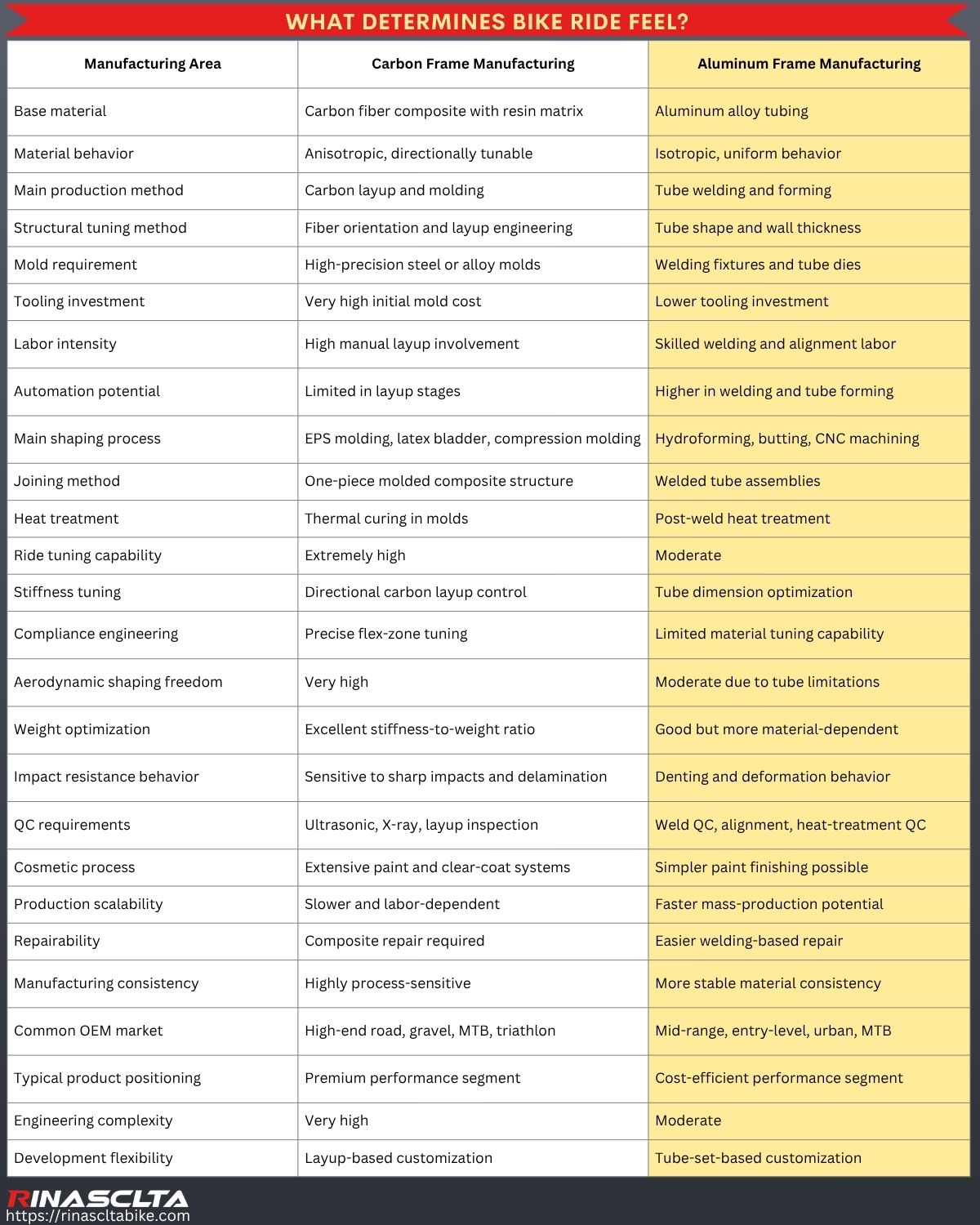

Modern OEM and ODM bicycle manufacturing increasingly uses carbon for premium performance categories because it allows advanced tuning of stiffness, compliance, vibration damping, aerodynamics, and rider-specific ride feel, while aluminum remains highly valuable for cost-efficient production, durability, and scalable manufacturing in mid-range and high-volume markets. Both materials continue evolving, but carbon manufacturing now dominates high-end performance bicycle development due to its engineering flexibility and ability to optimize ride characteristics at a much more detailed structural level.
Carbon vs titanium frame manufacturing differences
Carbon and titanium bicycle frame manufacturing differ greatly in terms of material structure, fabrication method, engineering flexibility, ride tuning capability, labor requirements, tooling systems, production scale, durability behavior, finishing process, and market positioning because carbon fiber is a composite material engineered through mold-based laminate construction, while titanium is a metallic material manufactured through precision tube fabrication and inert-gas welding. Carbon manufacturing focuses heavily on fiber orientation, resin systems, mold pressure, curing cycles, and laminate architecture, allowing highly tunable stiffness and aerodynamic shaping, while titanium manufacturing relies on tube selection, butting, machining precision, weld quality, and alignment control to achieve durability, corrosion resistance, and ride smoothness. As a result, carbon dominates high-performance race categories due to its lightweight and aerodynamic potential, while titanium remains highly valued in premium endurance, custom, adventure, and lifetime-use markets for its durability and distinctive ride quality.
| Manufacturing Area | Carbon Frame Manufacturing | Titanium Frame Manufacturing |
| Base material | Carbon fiber composite with resin matrix | Titanium alloy tubing |
| Material behavior | Anisotropic, directionally tunable | Isotropic metallic behavior |
| Main production method | Carbon layup and molding | Tube cutting, machining, and welding |
| Structural tuning method | Fiber orientation and ply sequencing | Tube diameter, wall thickness, shaping |
| Tooling requirement | High-cost precision molds | Welding fixtures and tube tooling |
| Initial tooling investment | Very high | Moderate |
| Main shaping process | EPS molding, bladder molding, compression molding | Tube butting, bending, CNC machining |
| Joining method | Molded composite structure | TIG welding under inert gas |
| Welding requirement | None for main structure | Extremely high welding precision required |
| Oxygen contamination sensitivity | Resin and curing control sensitive | Very sensitive during welding |
| Ride tuning capability | Extremely high | Moderate |
| Compliance tuning | Precise layup-based tuning | Natural material flex behavior |
| Aerodynamic shaping freedom | Very high | Limited compared to carbon |
| Weight optimization | Excellent stiffness-to-weight ratio | Moderate lightweight potential |
| Surface finishing | Paint, raw carbon, clear coat | Brushed, blasted, polished titanium |
| Corrosion resistance | Excellent with proper coating | Naturally excellent |
| Fatigue durability | High with correct layup engineering | Very high long-term fatigue resistance |
| Impact behavior | Risk of delamination under sharp impacts | Denting and deformation behavior |
| QC requirements | Layup QC, ultrasonic, X-ray inspection | Weld QC, alignment, purge quality |
| Production scalability | Higher OEM mass-production capability | Lower due to labor intensity |
| Labor specialization | Composite layup expertise | High-level titanium welding expertise |
| Repairability | Composite repair processes required | Weld repair possible but specialized |
| Manufacturing speed | Slower due to curing cycles | Slower due to precision welding |
| Common OEM market | High-performance road, gravel, MTB, triathlon | Premium endurance, custom, adventure |
| Typical ride character | Tunable, category-specific performance | Smooth, stable, natural ride feel |
| Product positioning | High-performance and race-focused | Premium lifetime-use and boutique market |
| OEM customization flexibility | Layup and geometry customization | Tube-set and custom geometry flexibility |
| Manufacturing complexity | Very high composite engineering complexity | Very high welding and fabrication precision |
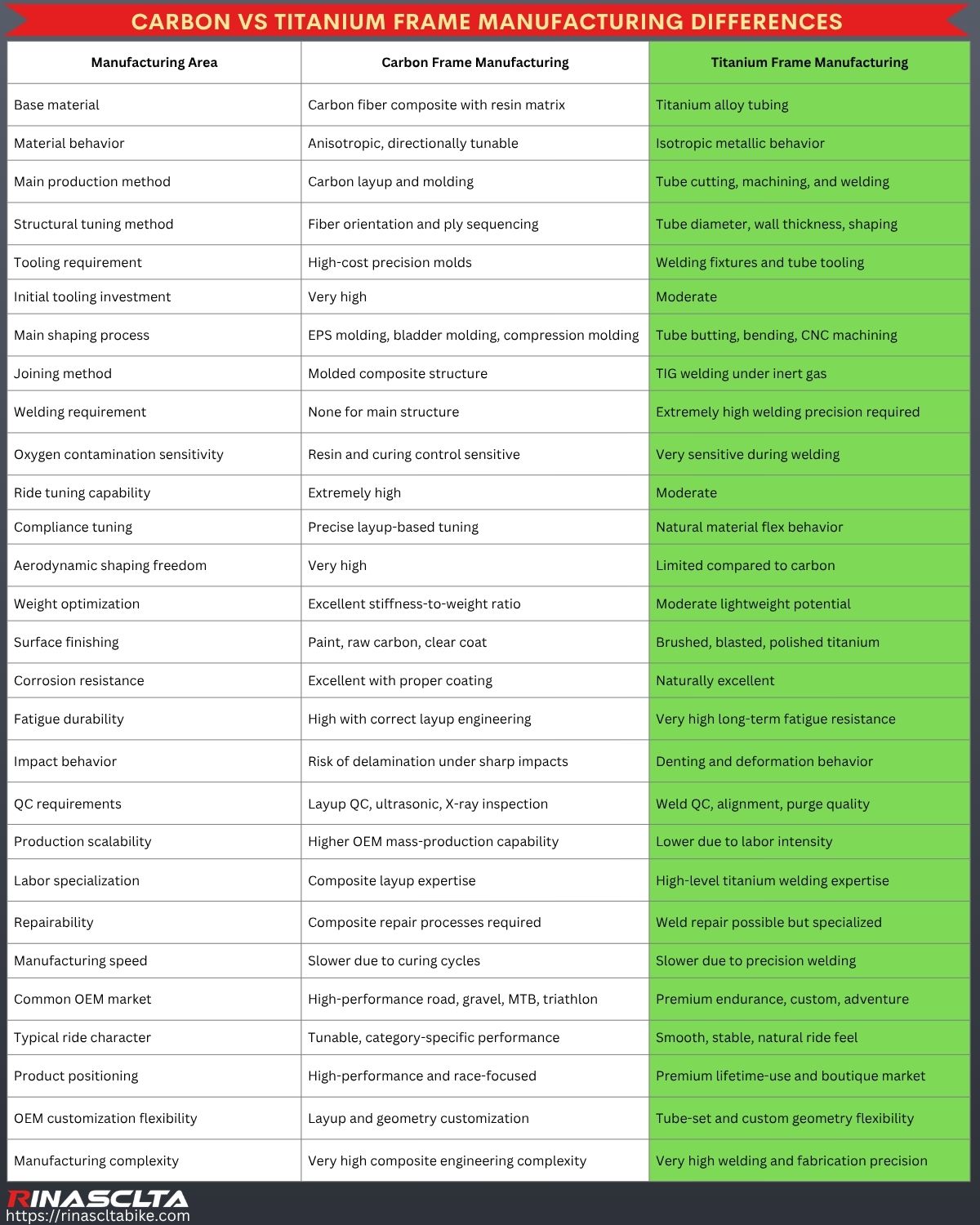
Modern OEM and ODM bicycle manufacturing uses carbon primarily when brands prioritize aerodynamics, lightweight race performance, stiffness tuning, and category-specific ride optimization, while titanium is often chosen for projects focused on durability, corrosion resistance, smooth ride quality, long-term ownership, and handcrafted premium positioning. Carbon manufacturing is more scalable for high-volume global OEM production, whereas titanium manufacturing remains more specialized and labor-intensive, often associated with boutique builders, custom geometry programs, and premium endurance-oriented bicycle markets.
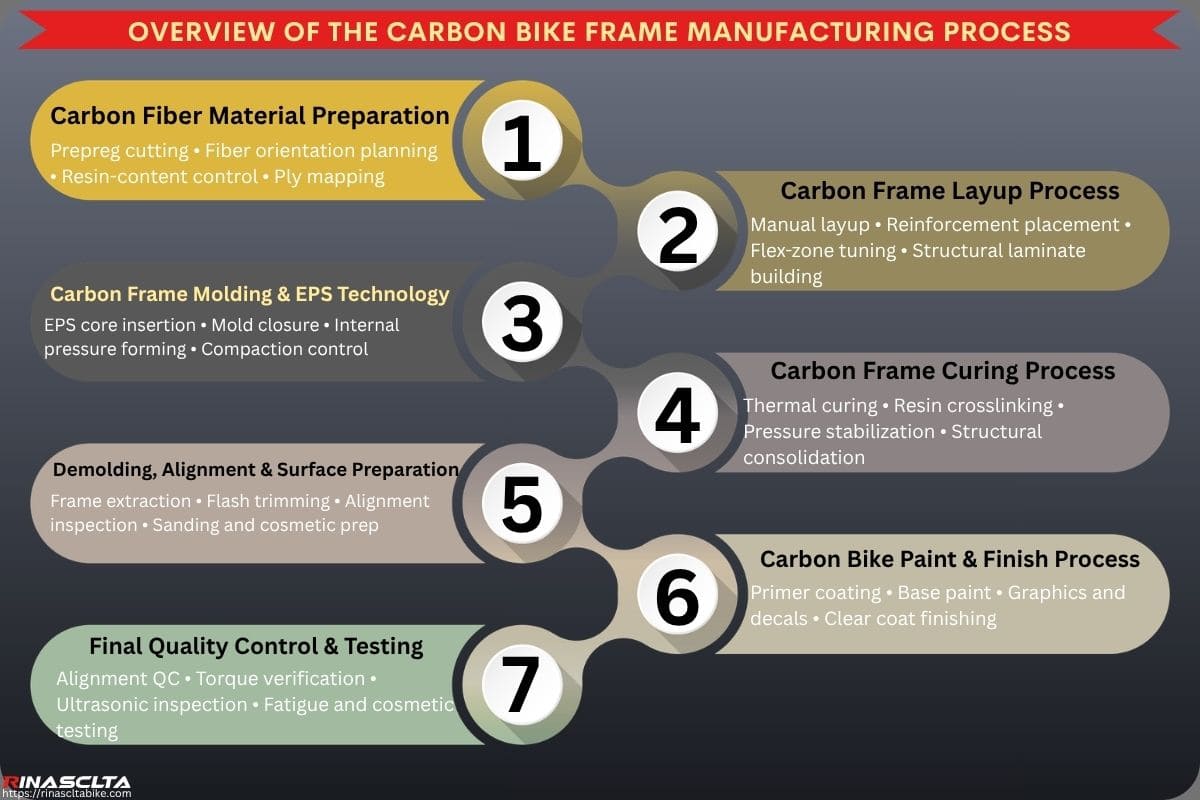
Overview of the Carbon Bike Frame Manufacturing Process
The carbon bike frame manufacturing process involves multiple highly controlled engineering and production stages including carbon fiber material preparation, carbon frame layup, molding and EPS internal forming, thermal curing, demolding and alignment correction, surface preparation, paint finishing, and final QC testing because modern carbon bicycle frames require precise control over fiber orientation, resin content, laminate compaction, structural stiffness, aerodynamic accuracy, cosmetic quality, durability, and production consistency. Unlike metal frame production, carbon manufacturing is a composite engineering process where every stage directly affects the frame’s final ride feel, weight, stiffness balance, fatigue resistance, vibration damping, dimensional accuracy, and long-term reliability. Modern OEM and ODM factories therefore combine technologies such as laser-cut prepreg systems, CNC-machined molds, EPS molding technology, pressure-controlled curing cycles, ultrasonic inspection, FEA-guided layup schedules, and ISO fatigue testing to ensure each production stage meets both structural and cosmetic performance standards.
| Manufacturing Stage | Main Purpose | Related Terms / Industrial Value |
| Carbon Fiber Material Preparation | Prepare engineered composite material system | Prepreg carbon, ply kits, fiber orientation |
| Carbon Frame Layup Process | Build structural stiffness and ride characteristics | Layup schedule, modulus tuning, reinforcement zones |
| Carbon Frame Molding & EPS Technology | Shape and compact frame structure accurately | EPS molding, bladder molding, compaction control |
| Carbon Frame Curing Process | Harden and stabilize composite structure | Resin crosslinking, thermal curing cycle |
| Demolding, Alignment & Surface Preparation | Ensure dimensional accuracy and cosmetic readiness | Alignment QC, trimming, sanding |
| Carbon Bike Paint & Finish Process | Protect frame and create visual branding | Paint adhesion, Pantone matching, clear coat |
| Final Quality Control & Testing | Verify structural and cosmetic consistency | ISO testing, ultrasonic inspection, fatigue QC |

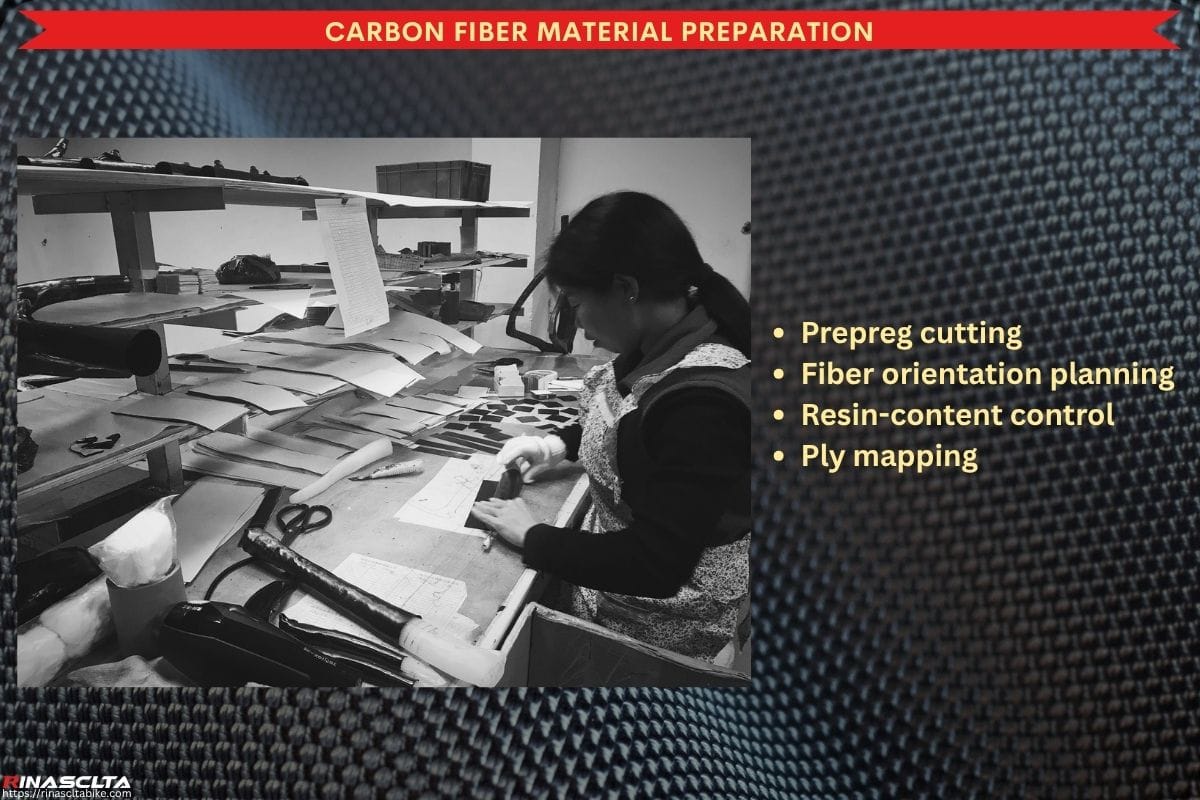
Carbon Fiber Material Preparation
Carbon fiber material preparation is the first controlled stage in carbon bike frame manufacturing, covering carbon prepreg material selection, freezer storage and temperature control, carbon sheet cutting, and fiber orientation planning before any layup work begins. In professional OEM/ODM production, this stage determines the foundation of the frame’s strength, stiffness-to-weight ratio, fatigue resistance, impact durability, ride feel, and production consistency, because carbon prepreg is not a generic sheet material but a pre-impregnated composite system made from carbon fiber reinforcement and a partially cured resin matrix.
The factory must control the prepreg’s fiber grade, modulus, resin content, tack level, shelf life, thawing time, humidity exposure, and batch traceability before cutting and layup, because poor material handling can cause resin degradation, weak bonding, voids, delamination, curing instability, or inconsistent laminate performance. After storage verification, carbon sheets are cut into precise ply shapes according to the ply book, CAD nesting file, layup schedule, and structural reinforcement map, then organized by part, orientation, and sequence for areas such as the head tube, bottom bracket, downtube, chainstays, seatstays, fork crown, and dropout zones.
Fiber orientation planning is especially important because the direction of each ply controls how the frame reacts to pedaling load, torsional force, braking stress, impact, vibration, and rider weight transfer. By arranging fibers at directions such as 0°, 45°, -45°, and 90°, engineers can tune different parts of the frame for power transfer, steering precision, vertical compliance, vibration damping, and long-term durability, making material preparation not only a production step but the starting point of the entire carbon frame performance design.
Carbon prepreg materials
Carbon prepreg materials are the primary structural raw materials used in modern carbon bike frame manufacturing, consisting of carbon fiber reinforcement pre-impregnated with a controlled resin matrix before layup and molding. For OEM/ODM carbon frameset production, prepreg quality directly affects the frame’s stiffness-to-weight ratio, fatigue resistance, impact strength, wall-thickness consistency, ride tuning, curing stability, and long-term structural reliability, so professional factories must evaluate not only the carbon fiber grade, but also the resin system, fiber areal weight, resin content, tack level, shelf life, storage condition, batch traceability, and supplier certification.
In real manufacturing, carbon prepreg is selected according to the frame’s engineering target, such as high-modulus fiber for stiffness-critical zones, intermediate-modulus fiber for balanced strength and durability, and toughened resin systems for impact resistance and fatigue performance. Buyers should care about this because a good carbon frame is not made simply by using “Toray carbon” or “T800 carbon”; it depends on how the factory controls the full prepreg system, including fiber orientation, ply thickness, resin flow, compaction behavior, curing temperature, void control, and laminate consistency.
For B2B clients, important prepreg-related indicators include material certificate availability, COA documentation, freezer storage records, FIFO inventory control, roll batch tracking, expiration-date management, thawing procedures, humidity protection, and layup traceability. These controls help prevent defects such as dry spots, resin-rich areas, voids, delamination, weak bonding, fiber wrinkles, curing instability, and inconsistent ride feel across production batches, which is why serious OEM factories treat carbon prepreg management as the first critical checkpoint in the entire carbon frame manufacturing process.
Prepreg storage and temperature control
Prepreg storage and temperature control are critical because carbon prepreg contains a partially cured resin system that can continue aging if exposed to improper temperature, humidity, or handling conditions before layup. Professional carbon frame factories normally store prepreg rolls in controlled freezer storage, manage shelf life, out-time, thawing time, humidity exposure, and FIFO inventory, and record each material batch through COA documentation, roll number tracking, barcode systems, and material traceability logs to keep the resin stable and predictable during molding and curing.
If prepreg is stored too warm, thawed too often, or exposed to moisture, the resin can lose tack, change viscosity, cure unevenly, or create defects such as voids, dry spots, delamination, weak bonding, fiber wrinkles, resin-rich areas, and inconsistent laminate compaction. Good storage control helps maintain resin flow behavior, fiber wet-out quality, curing stability, laminate strength, fatigue resistance, impact performance, and ride-feel consistency, which is why serious manufacturers monitor freezer temperature, humidity, material expiration date, defrost cycles, operator handling time, and production release records before any carbon sheet is cut or laid into the mold.
Carbon sheet cutting process
Carbon sheet cutting is the process of converting frozen or thawed carbon prepreg rolls into accurately shaped ply pieces according to the frame’s CAD nesting file, ply book, layup schedule, and reinforcement map. Professional factories use CNC cutting tables, laser-guided cutting, digital ply templates, barcode labeling, and nesting optimization software to control ply shape, fiber direction, edge quality, material waste, and production consistency before layup begins.
The most important requirement is to keep every cut ply consistent in dimension, fiber orientation, ply sequence, and batch traceability, because small cutting errors can affect wall thickness, overlap accuracy, local stiffness, impact strength, fatigue resistance, and final ride feel. Good cutting control reduces problems such as fiber fraying, wrong-angle plies, missing reinforcement patches, excessive overlap, resin contamination, and inconsistent laminate thickness, while improving repeatability in key structural zones such as the head tube, bottom bracket, downtube, chainstays, fork crown, and dropout interfaces.
Fiber orientation planning
Fiber orientation planning is the engineering process of deciding the direction, position, sequence, and overlap of each carbon ply before layup, because carbon fiber delivers its highest strength and stiffness along the direction of the fibers. In professional carbon frame manufacturing, engineers use 0°, 90°, +45°, -45°, and multi-directional layup patterns to control how each frame section reacts to pedaling force, torsional load, braking stress, impact, vibration, and rider weight transfer.
A well-planned fiber orientation system allows the frame to be stiff where needed and compliant where useful: 0° fibers improve longitudinal stiffness and power transfer, ±45° fibers improve torsional stiffness and steering control, and 90° fibers support lateral stability, tube shape retention, and local reinforcement. This planning is based on the ply book, CAD layup map, FEA stress analysis, modulus selection, load-path design, and reinforcement schedule, helping control critical areas such as the bottom bracket shell, head tube junction, downtube, chainstays, seatstays, fork crown, and dropout zones.
For buyers, strong fiber orientation planning shows real engineering capability because it affects stiffness-to-weight ratio, fatigue resistance, vibration damping, impact durability, ride feel consistency, and production repeatability. Poor orientation control can cause soft power transfer, unstable handling, weak junctions, fiber wrinkles, delamination, uneven wall thickness, and inconsistent ride characteristics, which is why advanced factories use digital ply templates, laser positioning, operator checklists, layup verification, and traceability records to ensure every frame follows the approved structural design.
Carbon Frame Layup Process
The carbon frame layup process is the core structural stage where pre-cut carbon prepreg plies are placed into the mold according to the approved ply book, layup schedule, fiber orientation map, and reinforcement design, turning raw composite material into a controlled frame structure with defined stiffness, strength, weight, compliance, and ride feel. In most high-performance bicycle production, layup is still highly dependent on skilled manual work because complex areas such as the bottom bracket shell, head tube junction, chainstays, seatstays, fork crown, dropout interfaces, and internal cable-routing zones require accurate ply placement, overlap control, wrinkle prevention, and reinforcement positioning that directly affect final laminate quality.
Manual carbon layup is not simply placing sheets into a mold; it is a controlled engineering process where each ply must follow the correct orientation angle, sequence, overlap length, compaction pressure, tack condition, and position tolerance. Reinforcement zones are added in high-stress areas to handle concentrated loads from pedaling torque, steering force, braking stress, axle loads, seatpost clamping, impact events, and fatigue cycles, especially around the bottom bracket and head tube, where poor layup control can cause weak power transfer, steering instability, delamination, cracking, or premature fatigue failure.
Layup also determines how the frame feels on the road because different fiber directions and laminate thicknesses change how the frame responds to rider input and surface vibration. More 0° and high-modulus plies can improve longitudinal stiffness and power transfer, more ±45° plies can improve torsional rigidity and steering precision, while carefully controlled thinner zones or flex-oriented layups in the seatstays, seat tube, fork blades, and top tube can improve vertical compliance and vibration damping. This is why professional factories focus heavily on layup verification, operator training, digital ply templates, laser positioning, debulking, curing consistency, and traceability records, because small layup errors can change not only frame strength, but also ride consistency, comfort, handling, and long-term durability across production batches.
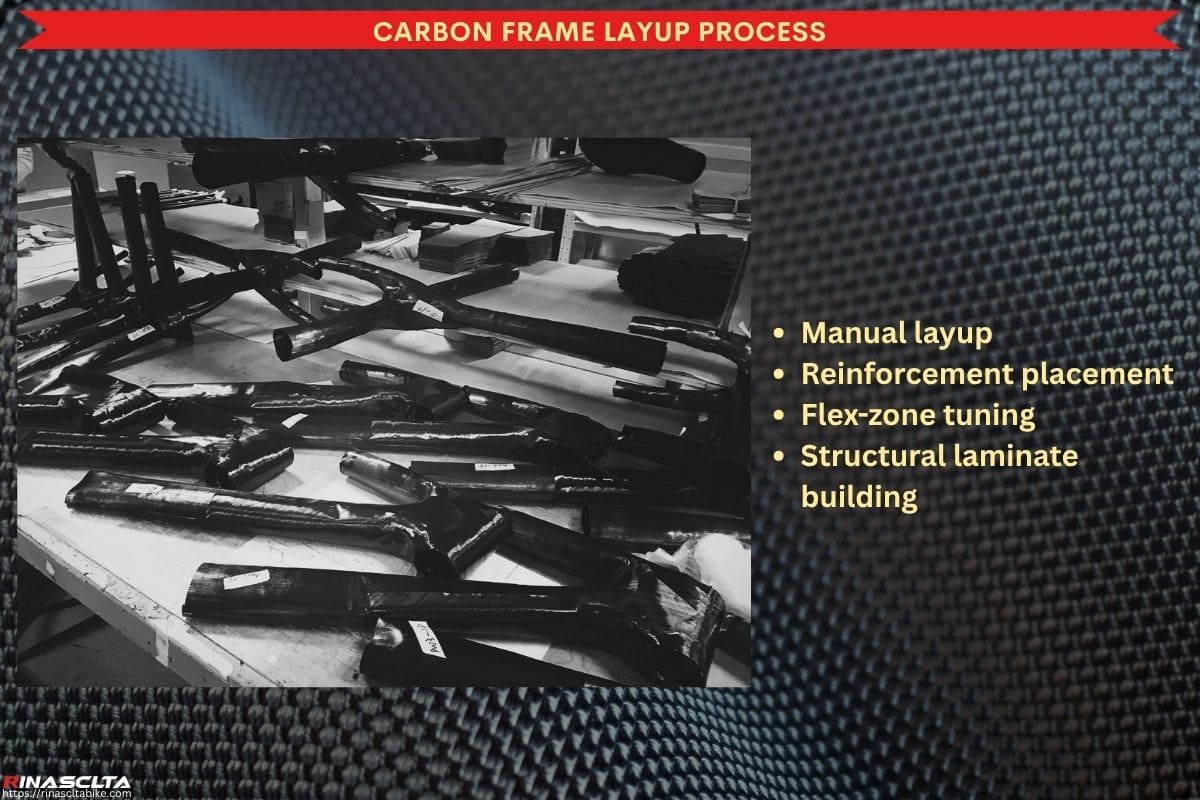
Manual carbon layup
Manual carbon layup is the controlled process of placing pre-cut carbon prepreg plies into the frame mold by hand according to the approved ply book, layup schedule, fiber orientation map, ply sequence, overlap specification, and reinforcement plan. It remains one of the most important stages in carbon bike frame manufacturing because the accuracy of each ply directly affects the frame’s stiffness-to-weight ratio, torsional rigidity, impact resistance, fatigue life, vibration damping, and ride feel consistency.
In professional production, operators do not simply stack carbon sheets randomly; each ply must be positioned with the correct 0°, 90°, +45°, or -45° fiber direction, correct surface side, correct overlap length, and correct location inside the mold. Critical areas such as the bottom bracket shell, head tube junction, downtube, chainstays, seatstays, fork crown, dropout interfaces, disc brake mounts, and cable-routing ports require extra attention because they carry concentrated loads from pedaling torque, steering force, braking stress, axle loads, and road impacts.
Good manual layup requires strict control of prepreg tack, thawing condition, ply handling time, wrinkle prevention, air entrapment, contamination control, ply compaction, and operator traceability. Professional factories use digital ply templates, laser positioning systems, layup checklists, debulking procedures, clean workstations, barcode tracking, and in-process QC inspection to make sure every frame follows the approved structural design.
The value of high-quality manual layup is that it allows the manufacturer to tune different parts of the frame for different ride characteristics: stronger BB and head tube zones for power transfer and steering precision, controlled seatstay and fork flex for comfort and vibration damping, and optimized reinforcement zones for durability without unnecessary weight. Poor layup control can cause fiber wrinkles, bridging, voids, delamination, resin-rich zones, weak bonding, uneven wall thickness, inconsistent stiffness, and premature fatigue failure, which is why manual layup skill is one of the clearest indicators of a factory’s real carbon frame manufacturing capability.
Reinforcement zones in high-stress areas
Reinforcement zones in high-stress areas are localized carbon layup structures added to parts of the frame that experience concentrated loads during real riding, such as the bottom bracket shell, head tube junction, downtube, chainstays, seatstays, fork crown, dropouts, thru-axle interfaces, disc brake mounts, seatpost clamp area, bottle bosses, and internal cable-routing ports. These zones are engineered with extra carbon prepreg plies, multi-directional fiber orientation, woven carbon patches, high-modulus reinforcement, impact-resistant layers, and controlled overlap design to improve strength exactly where the frame needs it, without adding unnecessary weight across the whole structure.
In production, reinforcement is based on the frame’s FEA stress analysis, load-path design, ply book, fatigue testing requirements, impact testing targets, ISO 4210 validation, and real-world riding conditions. For example, the bottom bracket requires reinforcement for pedaling torque and drivetrain stiffness, the head tube needs support for steering and braking loads, the disc brake area must resist localized braking force, and the dropout zone must maintain axle alignment and wheel retention under repeated loading.
Good reinforcement design improves power transfer, torsional rigidity, steering precision, impact resistance, fatigue life, bearing stability, brake mount durability, and long-term structural reliability. Poor reinforcement control can cause cracking, delamination, insert loosening, brake mount deformation, BB flex, headset instability, dropout misalignment, and premature fatigue failure, which is why professional factories control reinforcement zones through ply templates, laser positioning, layup verification, overlap inspection, curing control, ultrasonic testing, and traceability records.
The key is not simply adding more carbon, but placing the right material in the right direction and thickness. Excessive reinforcement increases weight and can make the frame feel harsh, while insufficient reinforcement creates weak points; high-quality carbon frame manufacturing balances structural safety, lightweight performance, stiffness tuning, compliance, and production repeatability through precise reinforcement engineering.
Bottom bracket and head tube reinforcement
Bottom bracket and head tube reinforcement are two of the most critical structural areas in carbon bike frame manufacturing because they carry the highest repeated loads from pedaling torque, drivetrain force, steering input, braking stress, rider weight transfer, sprinting, climbing, and road impact. The bottom bracket area is reinforced to improve power transfer, lateral stiffness, torsional rigidity, bearing support, chainstay load distribution, and fatigue resistance, while the head tube area is reinforced to maintain steering precision, fork interface stability, braking control, front-end stiffness, and impact safety.
In professional carbon production, these areas are engineered with additional carbon prepreg plies, 0° / ±45° / 90° fiber orientation, high-modulus carbon layers, woven reinforcement patches, overlap control, localized wall-thickness increases, insert bonding control, and FEA-based load-path design. Around the bottom bracket, reinforcement usually connects the downtube, seat tube, chainstays, and BB shell into a strong structural node so the rider’s pedaling force is transferred efficiently through the crankset and drivetrain. Around the head tube, reinforcement connects the top tube, downtube, fork steerer interface, bearing seats, and headset area to resist twisting, braking loads, and front-end impacts.
Good reinforcement in these zones creates a frame that feels stiff under acceleration, stable during sprinting, precise when cornering, confident under braking, and durable over long-term fatigue cycles. Poor reinforcement can lead to BB flex, creaking, bearing movement, headset looseness, steering instability, delamination, cracking, fork-interface weakness, brake-shudder feel, and premature fatigue failure, which is why advanced factories control these areas through ply book verification, laser ply positioning, mold-pressure control, curing-cycle monitoring, ultrasonic inspection, alignment checks, and ISO 4210 fatigue and impact testing.
How does layup affect stiffness and comfort?
Carbon layup directly controls frame stiffness and comfort because the frame’s mechanical behavior depends on the fiber orientation, ply sequence, laminate thickness, carbon modulus, overlap strategy, and reinforcement distribution inside the structure rather than only the external tube shape. By changing how carbon plies are arranged in different sections of the frame, engineers can control how the bicycle reacts to pedaling torque, steering force, braking load, vibration, impact, and rider weight transfer. This is why two frames using similar carbon materials and molds can still feel completely different on the road.
In professional manufacturing, stiffness tuning is usually concentrated around areas such as the bottom bracket, downtube, head tube, and chainstays to improve power transfer, torsional rigidity, sprint response, and steering precision, while comfort tuning is normally focused around the seatstays, seat tube, top tube, and fork blades to increase vertical compliance, vibration damping, traction, and fatigue reduction. More high-modulus and longitudinal fibers generally create a stiffer and more direct ride feel, while more controlled flex-oriented layups improve smoothness and long-distance comfort.
| Layup Strategy | Fiber / Structure Characteristics | Effect on Stiffness | Effect on Comfort | Related Terms / Value |
| High 0° fiber content | More longitudinal fiber orientation | Very high power-transfer stiffness | Lower vibration absorption | Sprint efficiency, BB rigidity |
| Increased ±45° plies | More torsional reinforcement | Improved steering precision | Moderate compliance retention | Torsional rigidity |
| Thick laminate structure | More ply layers and overlap | Higher structural rigidity | Harsher ride feel | Wall thickness control |
| High-modulus carbon layup | Stiffer fiber material | Faster acceleration response | Reduced flex and damping | Stiffness-to-weight ratio |
| Thin flex-tuned seatstay layup | Reduced wall thickness in rear triangle | Moderate rear stiffness | Increased vertical compliance | Endurance tuning |
| Fork compliance layup | Controlled directional flex in fork blades | Stable steering support | Reduced front-end vibration | Road buzz damping |
| Multi-directional layup | Balanced fiber orientation | Balanced stiffness behavior | Balanced comfort behavior | Ride-feel optimization |
| Gravel-oriented layup | Reinforced impact zones with compliance tuning | Stable under rough loads | High vibration damping | Mixed-terrain control |
| Aero race layup | Maximum torsional stiffness focus | Extremely direct handling | Lower comfort priority | Aerodynamic race tuning |
| Endurance layup | Compliance-focused reinforcement balance | Moderate stiffness | High long-distance comfort | Fatigue reduction |
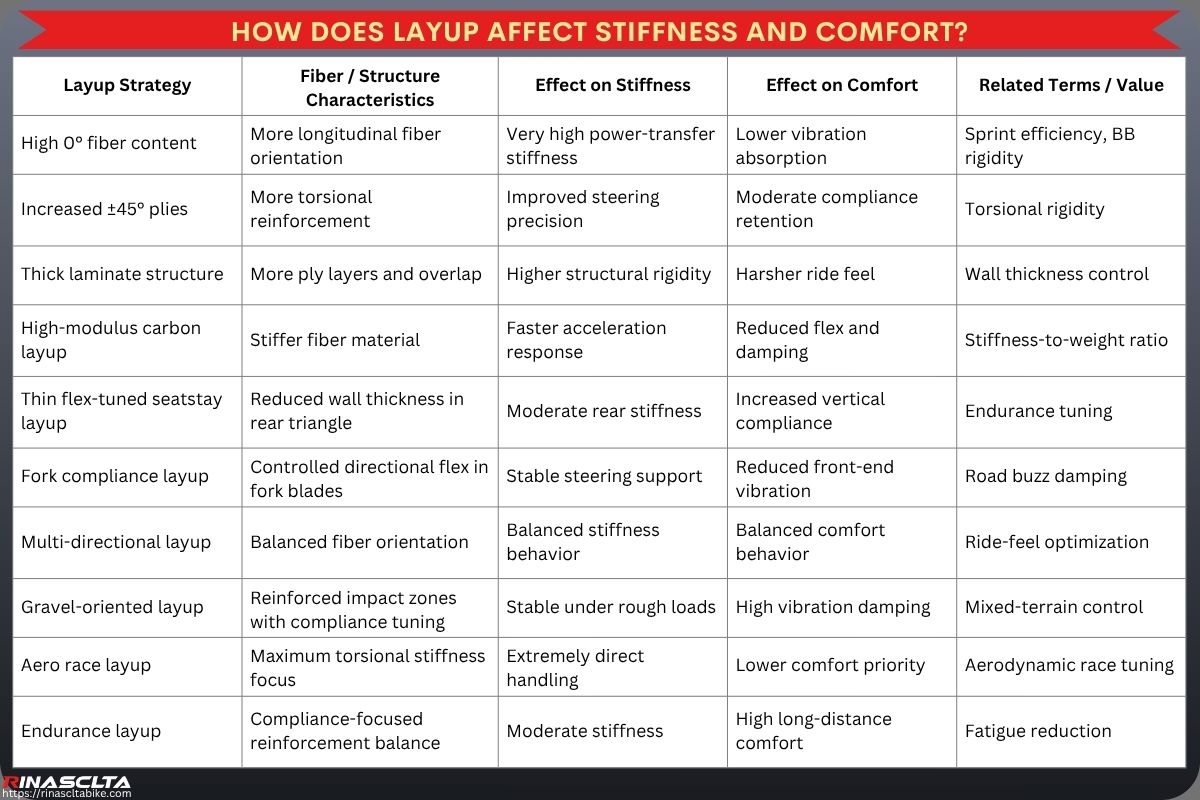
The key in high-end carbon manufacturing is not simply making the frame stiffer, but controlling exactly where the frame flexes and where it resists deformation under load. Professional factories therefore use FEA simulation, ply mapping software, stiffness testing rigs, vibration-frequency analysis, fatigue-cycle testing, and prototype ride evaluation to optimize the balance between efficiency, comfort, handling precision, and durability for different riding categories such as aero road, endurance, gravel, XC, and all-road platforms.
Carbon Frame Molding and EPS Technology
Carbon frame molding and EPS technology are the stages where the laid-up carbon structure is shaped, compacted, and consolidated inside a precision mold to form the final frame geometry, tube profile, wall thickness, and internal laminate quality. This process includes mold preparation, EPS or internal core positioning, mold closure, pressure control, thermal curing preparation, and defect prevention, and it is critical because even a well-designed layup can fail if the molding system does not provide stable compaction, accurate alignment, clean mold surfaces, and controlled resin flow.
In professional carbon frame manufacturing, EPS internal molding systems help support the carbon laminate from inside the frame during curing, creating smoother internal walls, more consistent tube thickness, better compaction around complex junctions, and lower risk of wrinkles, bridging, resin pooling, trapped air, delamination, and internal voids. The mold must be properly cleaned, released, aligned, preheated if required, and checked for wear before production, while pressure and temperature must be controlled through validated process parameters such as bladder pressure, mold-clamping force, curing curve, dwell time, resin flow behavior, and compaction uniformity. High-quality molding improves structural consistency, fatigue resistance, impact durability, stiffness accuracy, surface quality, frame alignment, and ride-feel repeatability, making EPS molding and pressure control key indicators of advanced carbon frame manufacturing capability.
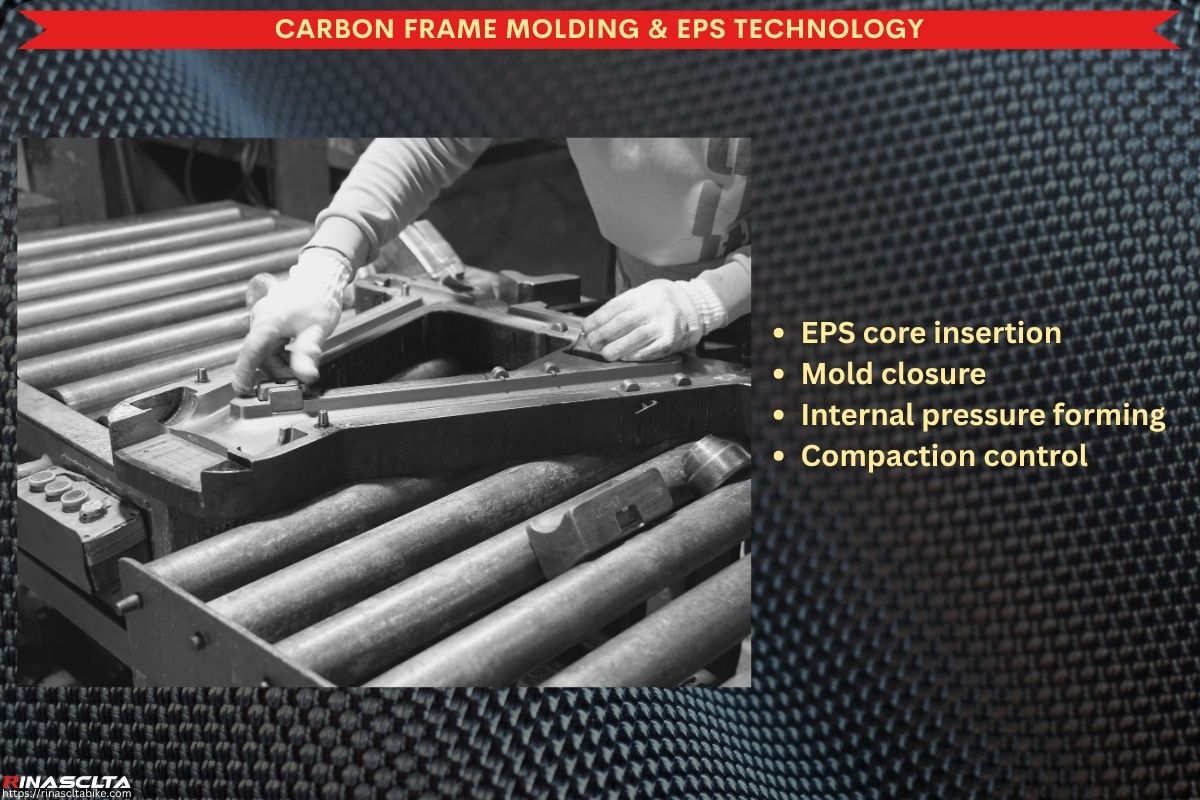
Mold preparation
Mold preparation is the controlled setup stage before carbon frame molding, where the factory verifies that the frame mold, fork mold, insert fixtures, alignment pins, clamping surfaces, cavity surfaces, release system, and heating channels are clean, accurate, and ready for production. In professional carbon frame manufacturing, the mold is not just a shaping tool; it controls the final frame geometry, tube profile accuracy, surface quality, wall-thickness consistency, compaction behavior, and dimensional tolerance, so any contamination, mold wear, misalignment, poor release-agent application, or incorrect fixture setup can cause defects such as surface marks, resin sticking, frame distortion, flashing, uneven compaction, internal wrinkles, voids, and poor alignment.
Before layup is loaded into the mold, technicians usually perform mold cleaning, cavity inspection, release-agent application, insert positioning, alignment-pin verification, mold-temperature check, and clamping-system inspection based on the approved production SOP and mold maintenance record. Key details include checking for scratches, dents, resin residue, dust, worn edges, blocked vents, damaged sealing surfaces, loose inserts, and uneven mold closure, because these issues can directly affect curing pressure, resin flow, laminate consolidation, and final frame accuracy.
Good mold preparation improves molding repeatability, surface finish quality, frame alignment, curing consistency, EPS/bladder compaction performance, and production yield, while reducing rework and rejection rates. For serious carbon frame factories, mold preparation is a critical quality-control checkpoint supported by CNC-machined mold precision, mold maintenance logs, release-agent control, temperature monitoring, trial-fit checks, and first-article inspection, ensuring every molded frame starts from a stable and repeatable tooling condition.
EPS and internal molding systems
EPS and internal molding systems are used to support the carbon laminate from inside the frame during molding and curing, helping the frame achieve cleaner internal surfaces, more consistent wall thickness, better compaction, and fewer hidden defects. In carbon bike frame production, the external mold controls the outside shape of the frame, while the internal system—such as EPS core, latex bladder, silicone bladder, PU mandrel, airbag system, or removable internal mandrel—presses the carbon plies outward against the mold cavity so the laminate consolidates properly under heat and pressure.
EPS molding is valued because it gives more stable internal support than a simple bladder-only process, especially around complex areas such as the head tube junction, bottom bracket shell, chainstay bridge, seat cluster, fork crown, and internal cable-routing zones. A well-designed EPS system helps reduce fiber wrinkles, bridging, resin pooling, dry spots, trapped air, delamination, and internal voids, while improving fiber compaction, resin flow control, wall-thickness accuracy, fatigue resistance, impact durability, and ride-feel consistency. For performance frames, this matters because the internal laminate quality directly affects stiffness, strength, weight control, and long-term reliability, even when the outside surface looks perfect.
Professional factories control EPS and internal molding through core design, core positioning, bladder pressure, mold-closing accuracy, venting channels, curing temperature, dwell time, compaction uniformity, and post-curing core removal. Strong internal molding capability is a clear sign of advanced carbon manufacturing because it improves structural repeatability and reduces hidden defects that may not be visible without ultrasonic inspection, X-ray inspection, borescope checking, or destructive section analysis.
Compaction and pressure control
Compaction and pressure control are critical in carbon frame molding because they determine how tightly the carbon prepreg layers consolidate against the mold surface and internal core during curing. In professional production, the goal is to create stable fiber volume fraction, resin distribution, wall-thickness consistency, and laminate density while avoiding defects such as voids, dry spots, resin pooling, fiber wrinkles, bridging, delamination, and weak bonding. This is controlled through validated parameters such as bladder pressure, EPS core support, mold-clamping force, vacuum assistance, venting design, curing temperature, heat ramp rate, dwell time, and cooling control, all of which must match the resin system and layup schedule.
Good pressure control allows excess air and resin to move out of the laminate while keeping enough resin inside the structure for proper fiber wet-out and interlaminar bonding. If pressure is too low, the laminate may not consolidate properly, causing internal voids, loose plies, poor surface definition, and reduced fatigue strength; if pressure is too high or uneven, it can squeeze out too much resin, distort fiber orientation, create local dry areas, or cause wall-thickness variation. High-quality factories monitor this stage with pressure gauges, digital curing logs, thermocouples, mold-temperature sensors, vacuum leak checks, trial-section analysis, ultrasonic inspection, and process traceability records, because consistent compaction directly affects stiffness accuracy, impact resistance, fatigue durability, weight control, ride-feel repeatability, and final structural reliability.
Reducing wrinkles and internal voids
Reducing wrinkles and internal voids is one of the most important controls in carbon bike frame molding because both defects directly weaken the laminate even when the outside of the frame looks perfect. Wrinkles happen when carbon plies fold, bridge, shift, or fail to sit smoothly around complex shapes such as the bottom bracket shell, head tube junction, chainstay bridge, seat cluster, fork crown, and dropout zones, while internal voids form when air, moisture, or volatile gases remain trapped between layers during compaction and curing.
Professional factories reduce these defects through accurate ply cutting, fiber orientation control, staged layup, overlap management, debulking, EPS core support, bladder pressure control, mold venting, vacuum assistance, resin-flow control, curing temperature stability, and operator layup verification. The key is to maintain consistent laminate consolidation, fiber volume fraction, resin wet-out, wall-thickness uniformity, and interlaminar bonding without over-compressing the structure or disturbing fiber alignment.
Wrinkles can cause local stiffness imbalance, stress concentration, premature cracking, and delamination because the fibers are no longer aligned with the intended load path. Voids reduce bonding between plies, lower fatigue strength, and increase the risk of hidden structural failure under repeated pedaling torque, braking stress, impact load, road vibration, and torsional force. This is why advanced manufacturers check these risks through visual layup inspection, laser ply positioning, pressure and temperature logs, ultrasonic testing, X-ray inspection, borescope inspection, tap testing, and destructive section analysis during process validation.
A high-quality molding system should produce clean internal surfaces, smooth laminate transitions, consistent wall thickness, and minimal porosity across the full frame structure. For carbon frameset buyers, strong wrinkle and void control shows real manufacturing capability because it improves fatigue durability, impact resistance, stiffness consistency, weight control, ride-feel repeatability, and long-term structural reliability.
Carbon Frame Curing Process
The carbon frame curing process is the stage where the laid-up carbon prepreg is transformed from a soft, tacky laminate into a rigid structural composite through controlled heat, pressure, time, and resin cross-linking. During curing, the mold, EPS core or bladder system, and laminate stack work together to maintain stable compaction pressure, fiber volume fraction, resin flow, wall-thickness consistency, and laminate consolidation, while the resin system bonds the carbon plies into one continuous structure.
Heat and pressure curing must follow a validated curing cycle, including controlled temperature ramp-up, target curing temperature, dwell time, pressure stability, and cooling rate. If the curing cycle is stable, the resin flows correctly, wets the fibers, removes trapped air, and hardens into a strong matrix that supports fatigue resistance, impact durability, torsional stiffness, and long-term structural reliability; if curing is unstable, the frame may develop voids, dry spots, resin pooling, weak bonding, delamination, fiber distortion, wall-thickness variation, or inconsistent stiffness.
Resin bonding and hardening are especially important because the resin matrix is what transfers load between carbon fibers and keeps the laminate layers working as a unified structure. A properly cured frame should achieve stable glass transition temperature (Tg), interlaminar shear strength, dimensional accuracy, and surface quality, while maintaining the intended balance between power transfer, compliance, vibration damping, and frame weight.
Curing consistency is one of the strongest indicators of professional carbon frame manufacturing capability because two frames with the same mold and layup can perform differently if temperature, pressure, dwell time, or cooling conditions vary between batches. Advanced factories control this stage through thermocouples, mold-temperature sensors, pressure gauges, digital curing logs, autoclave or oven monitoring, vacuum leak checks, process traceability records, and post-curing inspection, ensuring every frame meets the approved structural specification, fatigue-performance target, and production repeatability standard.
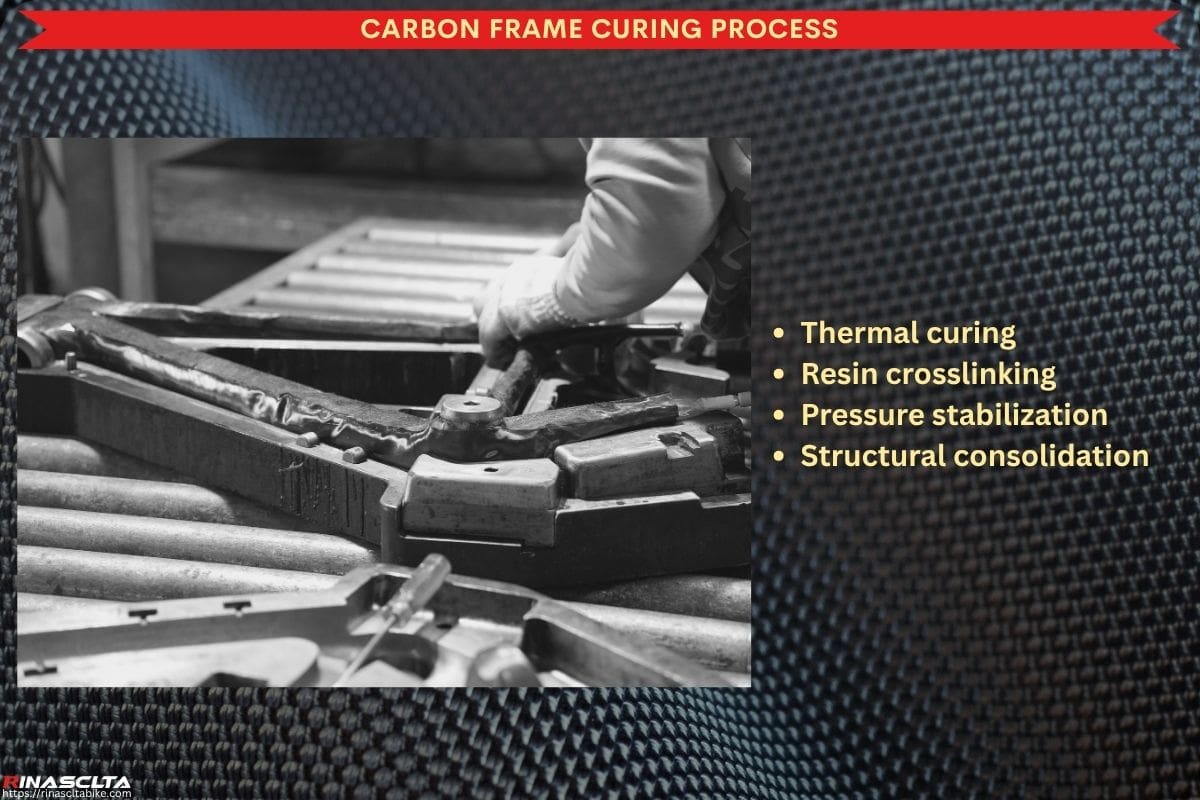
Heat and pressure curing
Heat and pressure curing is the controlled process that converts laid-up carbon prepreg into a rigid carbon composite frame by applying a validated combination of temperature, pressure, dwell time, and cooling rate inside the mold. During this stage, the resin system softens, flows, wets the carbon fibers, removes trapped air, and then cross-links into a hardened matrix that bonds the laminate into one structural unit. In professional carbon frame production, the curing cycle must match the prepreg resin specification and frame layup design, with close control of heat ramp rate, target cure temperature, bladder pressure, EPS core support, mold-clamping force, vacuum stability, venting, and cooling profile.
Good heat and pressure curing improves laminate consolidation, fiber volume fraction, wall-thickness consistency, interlaminar bonding, fatigue resistance, impact strength, stiffness accuracy, and ride-feel repeatability. Poor curing control can cause voids, resin pooling, dry spots, under-cured resin, over-cured brittle areas, delamination, fiber distortion, frame warping, and inconsistent mechanical performance. Advanced factories monitor this stage with thermocouples, mold-temperature sensors, pressure gauges, digital curing logs, oven or autoclave control systems, vacuum leak checks, and post-cure inspection, because stable curing is what ensures the finished carbon frame meets its designed strength, stiffness, durability, and production consistency targets.
Resin bonding and hardening
Resin bonding and hardening is the chemical and structural process where the resin matrix in the carbon prepreg flows, wets the carbon fibers, fills micro-gaps between plies, and then cures into a solid cross-linked network that locks the laminate into one unified composite structure. In carbon bike frame manufacturing, this stage directly affects interlaminar shear strength, fiber-to-resin bonding, load transfer efficiency, impact resistance, fatigue durability, void control, and long-term structural reliability, because the carbon fibers provide stiffness and strength while the resin system holds the fibers in position and transfers stress between layers. A properly hardened resin matrix gives the frame stable torsional rigidity, bottom bracket stiffness, head tube strength, vibration damping, and dimensional accuracy, while poor resin bonding can lead to delamination, dry spots, weak joints, resin-rich zones, brittle laminate behavior, surface cracking, or inconsistent ride feel. Professional factories control resin hardening through validated curing temperature, dwell time, heat ramp rate, pressure control, resin flow behavior, Tg performance, post-cure inspection, and batch traceability records, ensuring the frame reaches the required mechanical properties before demolding, finishing, and final QC testing.
The importance of curing consistency
Curing consistency is critical because even if two carbon frames use the same mold, prepreg, layup schedule, and fiber orientation, they can perform differently if the temperature curve, pressure level, dwell time, resin flow, heat ramp rate, cooling rate, or mold-clamping condition is not controlled consistently. A stable curing process ensures the resin reaches the correct glass transition temperature (Tg), bonds properly between plies, consolidates the laminate, and produces predictable fiber volume fraction, wall-thickness consistency, interlaminar shear strength, fatigue resistance, impact durability, stiffness accuracy, and ride-feel repeatability.
Poor curing consistency can create hidden structural problems such as under-cured resin, over-cured brittle laminate, voids, resin pooling, dry spots, delamination, fiber distortion, frame warping, and inconsistent stiffness between production batches. Professional factories control curing consistency through digital curing logs, thermocouples, mold-temperature sensors, pressure gauges, autoclave or oven calibration, vacuum leak checks, process traceability, and post-cure inspection, because stable curing directly affects long-term safety, production repeatability, warranty risk, and the finished frame’s real-world performance.
Common manufacturing defects during curing
Common manufacturing defects during carbon frame curing include voids, resin pooling, dry spots, delamination, fiber wrinkles, bridging, under-cured resin, over-cured laminate, wall-thickness inconsistency, frame warping, print-through marks, trapped air pockets, weak bonding zones, and dimensional distortion. These defects usually occur because of unstable temperature control, pressure inconsistency, poor laminate compaction, incorrect resin flow, bad venting design, inaccurate layup positioning, improper bladder or EPS support, vacuum leakage, or incorrect curing-cycle parameters. In professional carbon frame manufacturing, curing defects are especially critical because many of them are internal and may not be visible externally, yet they directly affect fatigue durability, impact resistance, stiffness consistency, ride feel, bearing alignment, structural reliability, and long-term product lifespan.
| Manufacturing Defect | Main Cause During Curing | Structural / Ride Impact | Related Terms / Industrial Value |
| Voids | Trapped air, poor compaction, vacuum leakage | Reduced fatigue strength and bonding quality | Porosity control, laminate consolidation |
| Resin pooling | Excess resin flow or uneven pressure | Increased weight and stiffness inconsistency | Resin distribution control |
| Dry spots | Insufficient resin wet-out | Weak bonding and local structural weakness | Fiber wet-out quality |
| Delamination | Poor interlaminar bonding or curing instability | Layer separation under load | Interlaminar shear strength |
| Fiber wrinkles | Ply shifting or poor compaction | Stress concentration and crack initiation | Fiber alignment accuracy |
| Bridging | Carbon plies not conforming to mold corners | Internal gaps and weak structural zones | Complex-junction molding quality |
| Under-cured resin | Low temperature or insufficient dwell time | Soft laminate and poor durability | Tg stability, curing completeness |
| Over-cured laminate | Excessive heat or curing duration | Brittle structure and reduced impact resistance | Resin degradation control |
| Wall-thickness inconsistency | Uneven pressure or layup overlap | Unstable stiffness and weight variation | Laminate uniformity |
| Frame warping | Uneven cooling or mold distortion | Geometry and alignment problems | Dimensional stability |
| Trapped air pockets | Poor venting or vacuum instability | Hidden internal weakness | Air evacuation efficiency |
| Weak bonding zones | Poor resin flow or contamination | Localized fatigue failure risk | Adhesion integrity |
| Print-through marks | Fiber texture imprint from curing imbalance | Cosmetic inconsistency | Surface-finish quality |
| Dimensional distortion | Mold misalignment or thermal instability | Poor assembly fit and alignment | Tolerance control |
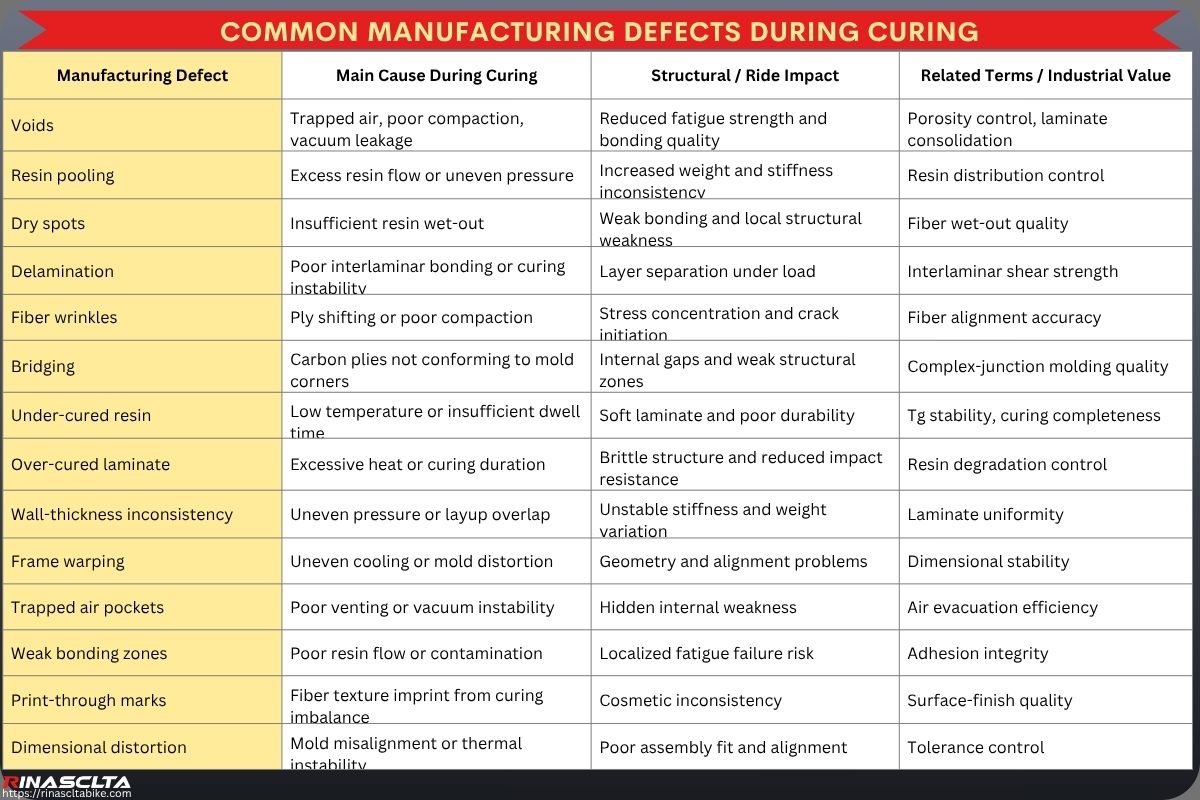
Professional factories reduce these risks through validated curing cycles, EPS-supported molding systems, pressure monitoring, vacuum control, thermocouple tracking, ultrasonic inspection, X-ray inspection, destructive section analysis, mold-maintenance programs, and full process traceability, because curing quality is one of the most important factors determining whether a carbon frame performs consistently across real-world riding conditions and long-term fatigue use.
Demolding, Alignment, and Surface Preparation
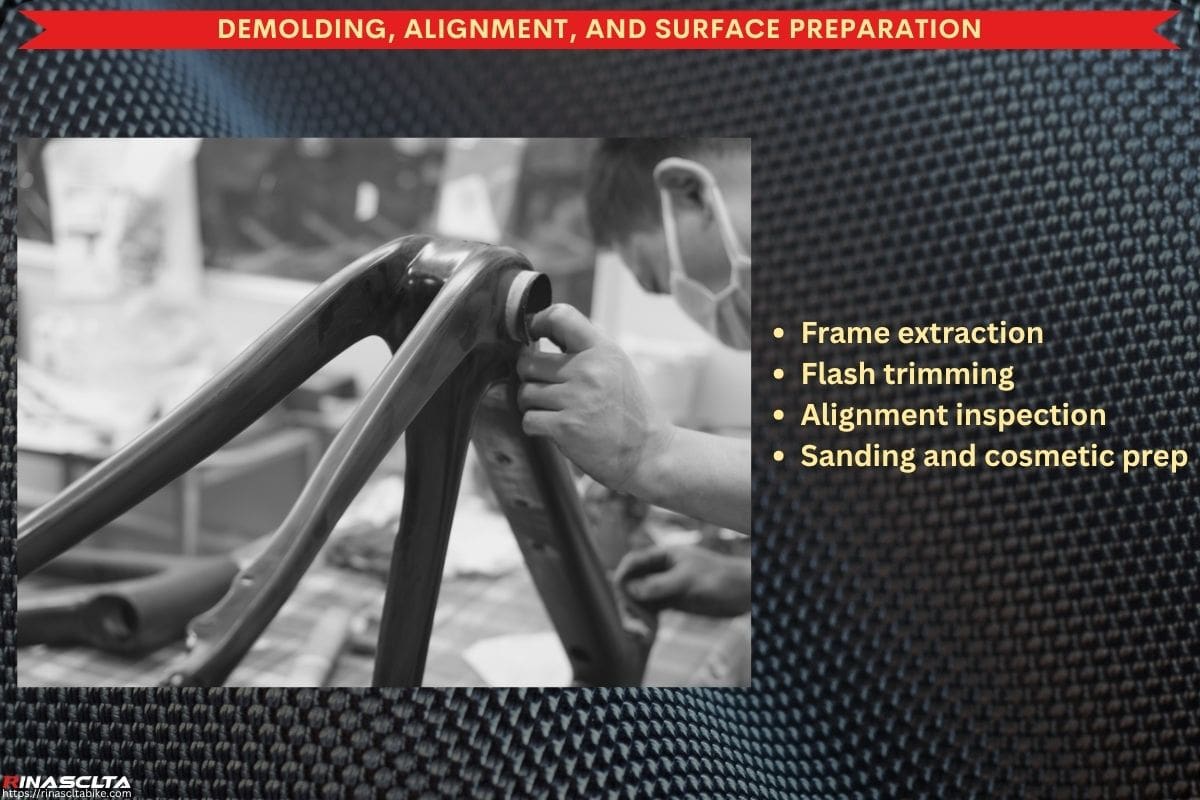
Demolding, alignment, and surface preparation are the post-curing stages where the cured carbon frame is safely removed from the mold, checked for dimensional accuracy, trimmed, sanded, inspected, and prepared for the paint system. After curing, the frame may still have flash lines, mold-release residue, excess resin, rough edges, insert areas, bonding transitions, and minor surface imperfections, so the factory must control demolding force, fixture support, dropout alignment, bottom bracket tolerance, head tube concentricity, surface sanding depth, dust removal, and contamination control before the frame moves to finishing.
Removing the frame from the mold must be done carefully to avoid surface cracks, edge damage, delamination, insert movement, or frame distortion, especially around high-stress areas such as the head tube, bottom bracket, chainstay bridge, fork crown, and dropout zones. After demolding, frame alignment inspection verifies geometry accuracy, rear triangle symmetry, dropout spacing, BB shell position, brake mount alignment, headset interface, thru-axle fit, and wheel tracking, usually with alignment jigs, CMM systems, laser gauges, calipers, bore gauges, and go/no-go fixtures. Sanding and surface finishing then remove flash, smooth tube transitions, repair pinholes or resin marks, and create the correct surface profile for primer adhesion, while final paint preparation uses degreasing, anti-static cleaning, masking, tack cloth wiping, and surface QC lighting to prevent defects such as paint peeling, orange peel, dust contamination, bubbling, fisheyes, visible sanding marks, and poor clear-coat adhesion.
For a professional carbon frame factory, this stage is important because it connects structural manufacturing with cosmetic finishing and final assembly compatibility. Good control improves frame geometry consistency, paint adhesion, surface quality, component fit, bearing stability, brake alignment, cosmetic value, and production yield, while poor control can lead to misalignment, creaking interfaces, brake rub, poor headset fit, uneven paint finish, exposed fibers, weak coating adhesion, and higher warranty risk.
Removing the frame from the mold
Removing the frame from the mold is the first post-curing step where the cured carbon frame is released from the precision mold after the resin has fully hardened and the laminate has reached its designed structural state. This process must be controlled carefully because the frame is already structurally formed, but surface areas such as mold parting lines, tube junctions, dropouts, bottom bracket shell, head tube, fork crown, and thin seatstay sections can still be damaged by excessive removal force, poor mold-release control, incorrect cooling, or rough handling.
A professional factory checks that the curing cycle, cooling temperature, mold pressure release, and resin hardening condition are complete before opening the mold. Technicians then release the mold using controlled separation methods, avoiding twisting or prying forces that could create surface cracks, edge chipping, delamination, insert movement, fiber lifting, or frame distortion. Good demolding control depends on mold-release agent quality, cavity surface condition, mold alignment, EPS/core removal process, operator handling procedure, and post-demolding inspection, because any damage at this stage can affect both structural reliability and paint preparation.
After removal, the frame is inspected for flash, resin residue, mold marks, surface pinholes, exposed fibers, internal wrinkles, void indicators, bonding irregularities, and dimensional stability before trimming, sanding, alignment checking, and paint preparation begin. High-quality demolding improves surface finish consistency, frame geometry accuracy, laminate integrity, production yield, cosmetic quality, and downstream QC efficiency, while poor demolding can increase rework, rejection rate, paint defects, and long-term warranty risk.
Frame alignment inspection
Frame alignment inspection is the post-molding quality-control process used to verify that the carbon frame matches the approved CAD geometry, drawing tolerance, frame centerline, rear triangle symmetry, dropout spacing, bottom bracket position, head tube axis, brake mount location, and wheel-tracking path before paint and final assembly. After curing, trimming, bonding, and machining, even small dimensional errors can affect handling stability, drivetrain alignment, brake performance, tire clearance, headset fit, bearing life, and complete-bike assembly quality, so professional factories inspect the frame with alignment jigs, CMM systems, laser gauges, dropout gauges, BB bore gauges, head tube gauges, thru-axle fit tools, brake mount fixtures, and go/no-go gauges.
A strong alignment inspection checks key areas such as head tube concentricity, BB shell roundness and centering, rear dropout parallelism, rear axle spacing, chainstay and seatstay symmetry, disc brake mount flatness, derailleur hanger position, fork fit, headset bearing seat accuracy, and front-to-rear wheel centerline. Good alignment control improves straight tracking, predictable cornering, smooth shifting, reduced brake rub, stable wheel installation, correct bearing preload, and lower warranty risk, while poor alignment can cause bike pulling to one side, unstable descending, uneven tire clearance, drivetrain noise, brake rotor rubbing, premature bearing wear, assembly difficulty, and inconsistent ride feel.
Sanding and surface finishing
Sanding and surface finishing are controlled post-molding processes used to remove flash lines, resin residue, mold marks, parting-line edges, excess adhesive, rough transitions, pinholes, and minor cosmetic imperfections before the frame enters primer and paint preparation. In professional carbon frame manufacturing, sanding is not just cosmetic work; it must be carefully controlled because aggressive sanding can cut into structural carbon plies, expose fibers, reduce local wall thickness, weaken laminate integrity, and create future paint adhesion problems.
A good factory controls sanding through defined grit sequences, sanding depth limits, surface-profile standards, operator SOPs, dust extraction, lighting inspection, and in-process QC checks. Critical areas such as the head tube junction, bottom bracket shell, seat cluster, chainstay bridge, dropout zones, disc brake mounts, and fork crown require special attention because these sections contain reinforcement layers, bonding transitions, and tight geometry features where over-sanding or uneven finishing can affect both structural quality and cosmetic appearance.
High-quality sanding and finishing create a clean, smooth, stable surface for primer adhesion, base coating, decal application, and clear coat durability, reducing defects such as visible sanding scratches, orange peel, pinholes, bubbling, fisheyes, paint peeling, uneven gloss, and clear-coat delamination. Poor sanding control can lead to exposed carbon fibers, surface waviness, thin laminate zones, rough paint transitions, weak coating adhesion, cosmetic rejection, and higher warranty risk, which is why premium factories combine manual finishing skill with LED inspection lighting, surface defect marking, tack cloth cleaning, anti-static treatment, and final pre-paint QC before releasing the frame to the paint line.
Preparing the frame for paint
Preparing the frame for paint is the final pre-coating stage where the sanded carbon frame is cleaned, inspected, masked, and stabilized so the primer, base coat, graphics, and clear coat can bond correctly to the composite surface. A professional factory controls surface cleanliness, sanding profile, dust removal, oil contamination, static charge, moisture exposure, masking accuracy, insert protection, thread protection, and pre-paint inspection, because paint defects often start before spraying begins. Key procedures include degreasing, tack-cloth wiping, filtered compressed-air cleaning, anti-static treatment, humidity control, masking of BB threads, headset seats, brake mounts, cable ports, bottle bosses, and thru-axle interfaces, followed by inspection under LED or D65 lighting to check for pinholes, exposed fibers, sanding scratches, resin marks, dust particles, poor transitions, and surface waviness. Good paint preparation improves paint adhesion, coating durability, gloss consistency, decal bonding, UV protection, cosmetic value, and long-term weather resistance, while poor preparation can cause peeling, bubbling, fisheyes, orange peel, dust contamination, uneven color, clear-coat delamination, and higher cosmetic warranty risk.
Carbon Bike Paint and Finish Process
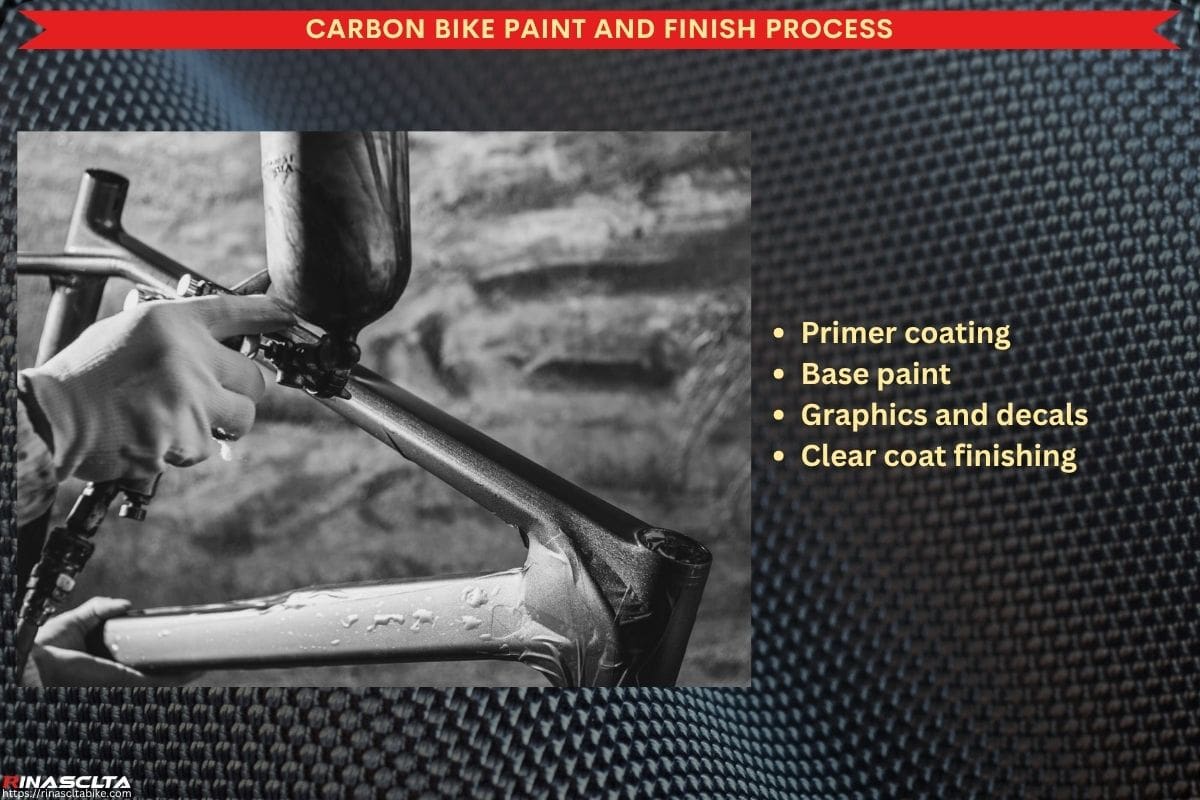
The carbon bike paint and finish process is the controlled coating stage that gives the frame its surface protection, OEM visual identity, color consistency, gloss or matte appearance, decal integration, UV resistance, scratch resistance, and premium cosmetic value after structural manufacturing is complete. It normally includes primer and base coating, custom graphics and decals, matte or gloss finish selection, clear coating, and final curing, because each layer has a different function: primer improves adhesion and surface leveling, base coat creates the main color, decals and graphics define brand identity, and clear coat seals the full finish system against weather, sweat, cleaning chemicals, road debris, cable rub, transport abrasion, and long-term UV exposure.
In professional production, primer and base coating must be controlled through surface preparation, paint viscosity, spray pressure, coating thickness, flash-off time, booth temperature, humidity control, and curing parameters to prevent defects such as orange peel, fisheyes, pinholes, color mismatch, poor adhesion, and uneven gloss. Custom graphics and decals require accurate logo positioning, Pantone color matching, water-transfer decals, masking lines, under-clear-coat sealing, and OEM artwork verification, because poor decal work immediately reduces perceived product quality. Matte and gloss finishes are selected according to brand positioning and product category: matte creates a stealth, technical, modern appearance, while gloss gives deeper color, sharper reflection, and stronger showroom impact. The final clear coat and curing process then stabilizes the full paint system, improving clear-coat hardness, adhesion strength, UV durability, chemical resistance, scratch resistance, and long-term cosmetic consistency, making paint and finish quality a direct indicator of factory discipline, brand value, and premium carbon bike manufacturing capability.
Primer and base coating
Primer and base coating are the foundation layers of a carbon bike paint system, used to create strong paint adhesion, surface leveling, color stability, UV resistance, and long-term coating durability before graphics and clear coat are applied. In professional carbon frame production, the primer seals the prepared composite surface, fills minor sanding marks or pinholes, improves bonding between the carbon substrate and paint layer, and helps prevent defects such as peeling, bubbling, fisheyes, orange peel, and clear-coat delamination.
The base coat provides the frame’s main visual color and finish effect, including solid color, metallic, pearl, gradient, tinted carbon, or OEM Pantone-matched color systems. A high-quality factory controls paint viscosity, spray pressure, atomization quality, coating thickness, flash-off time, booth temperature, humidity, dust control, and curing conditions to keep color and surface quality consistent across the frame, fork, and production batch.
Good primer and base coating improve cosmetic consistency, decal bonding, gloss depth, matte uniformity, weather resistance, scratch resistance, and perceived product value, while poor coating control can cause color mismatch, uneven surface texture, weak adhesion, excessive paint weight, visible sanding marks, patchy metallic effect, and higher warranty risk. For premium carbon frames, this stage is one of the clearest signs of paint-process capability because it determines whether the final finish looks clean, stable, lightweight, and brand-ready after clear coating and curing.
Custom graphics and decals
Custom graphics and decals are the branding layer of the carbon bike finish system, used to create logo identity, model recognition, team edition styling, private-label branding, serial graphics, and visual differentiation after the base coat is applied and before the final clear coat. In professional production, factories control CAD graphic layout, Pantone color matching, water-transfer decals, vinyl masks, laser-cut stencils, logo positioning, symmetry, decal adhesion, edge sealing, and under-clear-coat integration so the graphics become part of the finish rather than looking like simple stickers. Good decal and graphic work improves brand consistency, premium appearance, showroom value, social-media visibility, UV durability, and long-term cosmetic reliability, while poor control can cause misaligned logos, bubbling, wrinkling, lifting edges, color mismatch, visible decal thickness, trapped dust, weak adhesion, and clear-coat defects, which immediately reduces perceived manufacturing quality even if the carbon structure itself is strong.
Matte and gloss finishes
Matte and gloss finishes are the final visual style choices in a carbon bike paint system, but they also affect surface texture, maintenance behavior, perceived quality, brand positioning, and cosmetic QC requirements. A matte finish uses low-gloss clear coat, flattening agents, and controlled surface texture to create a stealth, modern, technical appearance, often used for gravel, MTB, endurance, and minimalist OEM designs; a gloss finish uses a smooth high-reflection clear coat to create deeper color, sharper graphics, stronger showroom impact, and easier cleaning, often used for road race, aero, flagship, and premium display models. Professional factories must control clear-coat chemistry, spray thickness, booth humidity, curing temperature, gloss-level consistency, surface leveling, dust control, and final LED inspection, because matte finishes can show shiny rub marks, fingerprints, and uneven sheen, while gloss finishes can reveal orange peel, swirl marks, dust nibs, and reflection waviness. High-quality matte or gloss finishing improves UV resistance, scratch resistance, decal protection, coating durability, resale value, and brand recognition, while poor finish control can cause patchy gloss, cloudy clear coat, peeling, bubbling, uneven texture, visible sanding marks, and higher cosmetic warranty risk.
Clear coating and final curing
Clear coating and final curing are the last protective stages of the carbon bike finish system, where the frame’s base paint, custom graphics, decals, matte/gloss appearance, and exposed carbon areas are sealed under a durable outer layer. A professional clear coat must provide UV resistance, scratch resistance, chemical resistance, moisture protection, gloss or matte stability, decal edge sealing, and long-term cosmetic durability, while final curing controls the coating’s hardness, adhesion strength, surface smoothness, solvent release, and cross-linking stability.
In production, factories must control clear-coat viscosity, spray pressure, coating thickness, flash-off time, booth temperature, humidity, dust filtration, curing temperature, dwell time, and cooling conditions to avoid defects such as orange peel, runs, bubbling, fisheyes, cloudiness, yellowing, peeling, soft coating, uneven gloss, and clear-coat delamination. High-quality clear coating and curing improve the frame’s premium finish, weather resistance, transport durability, cleaning resistance, UV stability, resale value, and warranty performance, making this stage a key indicator of a factory’s paint-process discipline and final cosmetic quality.
Final Quality Control and Testing
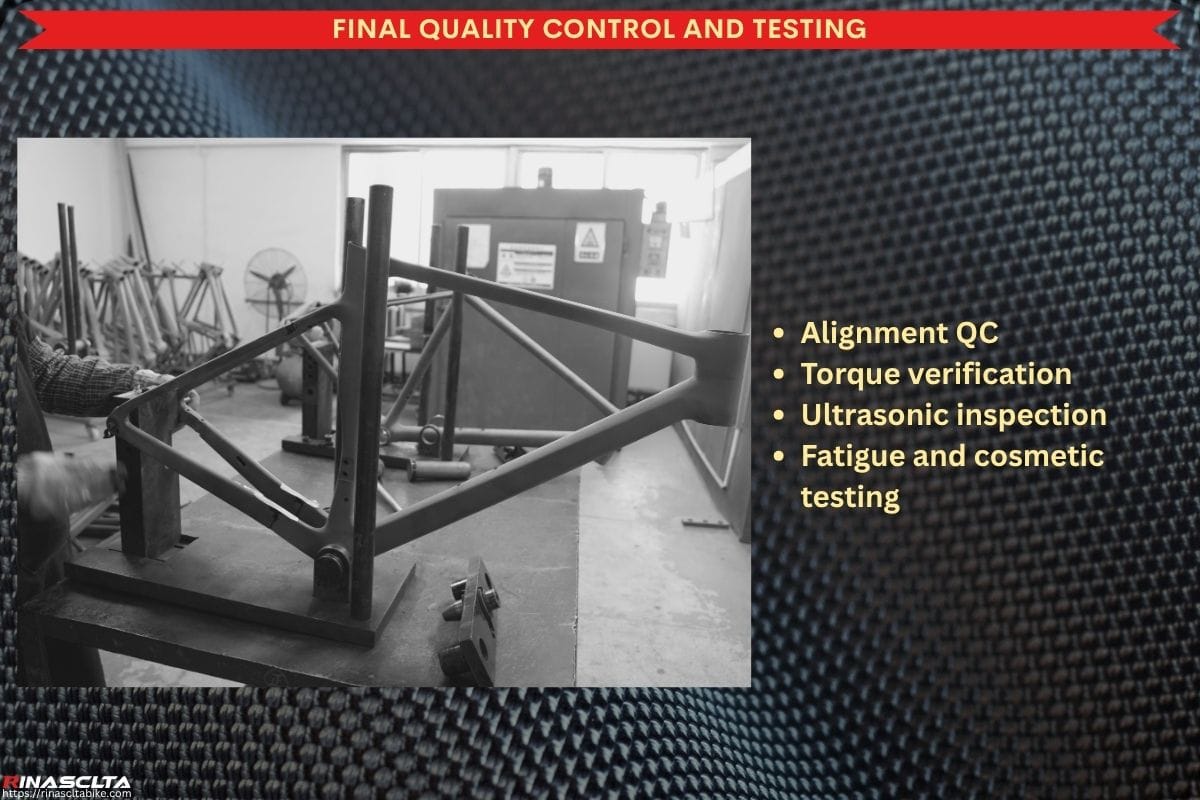
Final quality control and testing are the last verification stages before a carbon bike frameset is approved for packaging, shipment, or complete-bike assembly, covering visual inspection, alignment and dimensional checks, fatigue and impact testing, and final assembly compatibility inspection. This stage confirms that the frame meets the approved engineering drawing, CAD geometry, cosmetic standard, ISO 4210 safety requirements, OEM tolerance specification, and component interface requirements, while detecting issues such as surface defects, paint problems, frame misalignment, BB tolerance errors, headset fit problems, brake mount deviation, dropout spacing error, hidden laminate damage, or assembly interference.
Visual inspection verifies the final cosmetic and surface condition, including paint finish, clear coat, decal alignment, exposed carbon quality, sanding marks, pinholes, dust contamination, orange peel, scratches, and transport protection readiness. Alignment and dimensional checks confirm head tube axis, bottom bracket position, rear triangle symmetry, dropout spacing, thru-axle fit, brake mount flatness, tire clearance, fork fit, and wheel centerline tracking using tools such as CMM systems, laser gauges, alignment jigs, go/no-go gauges, calipers, BB gauges, and headset gauges.
Fatigue and impact testing validate the structural safety of the frameset under repeated riding loads and sudden impact events, checking key areas such as the bottom bracket shell, head tube junction, fork crown, chainstays, seat cluster, and dropout zones for cracking, delamination, stiffness loss, or permanent deformation. Final assembly compatibility inspection confirms that real components such as headsets, bottom brackets, thru-axles, seatposts, derailleur hangers, disc brake calipers, internal cable systems, bottle bosses, and fork assemblies fit correctly, reducing assembly problems, warranty risk, brake rub, drivetrain noise, bearing wear, and customer complaints.
Visual inspection
Visual inspection is the final surface-level QC process used to confirm that the carbon frameset meets the approved cosmetic standard, paint specification, exposed-carbon quality, decal accuracy, and shipment-ready appearance before packaging or assembly. Inspectors check the full frame and fork under controlled lighting for pinholes, scratches, dust contamination, orange peel, paint runs, fisheyes, bubbles, clear-coat defects, color inconsistency, decal misalignment, sanding marks, exposed fibers, resin marks, mold lines, rough transitions, and handling damage, because these issues directly affect perceived quality, brand value, resale value, and warranty risk.
A professional visual inspection is performed in a dedicated QC area using LED inspection lights, D65 lighting booths, gloss meters, color reference samples, magnification lamps, paint-thickness gauges, defect marking labels, and cosmetic grading standards. Critical areas such as the head tube junction, bottom bracket shell, fork crown, chainstay bridge, seat cluster, dropouts, brake mounts, cable ports, logo zones, and tube transitions receive closer inspection because defects often appear around complex shapes, bonded interfaces, or high-handling areas. Good visual inspection helps ensure stable surface finish, clear-coat quality, graphic alignment, paint adhesion, customer-ready appearance, and batch consistency, while poor inspection allows cosmetic defects to reach the market and can create unnecessary claims even when the frame structure is mechanically sound.
Alignment and dimensional checks
Alignment and dimensional checks verify that the finished carbon frameset matches the approved CAD geometry, engineering drawing, tolerance specification, frame centerline, and component interface standards before final assembly or shipment. Inspectors check critical points such as head tube axis, headset bearing seats, bottom bracket shell position, BB roundness, rear triangle symmetry, dropout spacing, thru-axle fit, derailleur hanger alignment, disc brake mount flatness, fork fit, tire clearance, seatpost insertion, bottle boss position, and wheel tracking line, because even small dimensional errors can cause unstable handling, brake rub, poor shifting, headset play, bearing wear, creaking, assembly difficulty, and inconsistent ride feel. Professional factories use CMM measurement, laser alignment systems, frame alignment jigs, go/no-go gauges, calipers, bore gauges, BB gauges, dropout gauges, axle gauges, brake mount fixtures, and torque-fit testing to confirm that every frame meets the required dimensional accuracy. Good alignment control improves assembly compatibility, wheel tracking, drivetrain efficiency, braking stability, customer satisfaction, and warranty reliability, making it one of the most important final QC checkpoints in carbon frameset production.
Fatigue and impact testing
Fatigue and impact testing are structural validation processes used to confirm that a carbon bike frameset can survive both long-term repeated riding loads and sudden high-force events before approval for production, shipment, or certification. Fatigue testing simulates repeated stress from pedaling torque, rider weight, road vibration, braking force, cornering load, and sprinting, while impact testing simulates sudden events such as pothole strikes, curb hits, crash loads, stone impacts, and front-end collision forces; together, they verify the frame’s laminate integrity, interlaminar bonding, reinforcement design, fatigue life, impact resistance, and safety margin.
In professional manufacturing, these tests are normally based on ISO 4210, EN safety standards, internal engineering specifications, and category-specific load cases for road, gravel, MTB, e-bike, or endurance frames. Fatigue testing uses servo-hydraulic test rigs, cyclic loading machines, BB fatigue fixtures, head tube loading rigs, fork fatigue rigs, strain gauges, displacement sensors, and digital data logging to apply thousands or hundreds of thousands of repeated load cycles to critical areas such as the bottom bracket shell, head tube junction, seat tube, chainstays, dropouts, and fork crown. Impact testing uses drop-weight machines, pendulum impact systems, frontal impact rigs, high-speed cameras, load cells, and post-test ultrasonic or tap inspection to evaluate whether the frame cracks, delaminates, deforms, or loses stiffness after controlled impact energy.
Good fatigue and impact performance confirms that the frame has proper carbon layup design, reinforcement placement, curing quality, compaction control, void reduction, wall-thickness consistency, and structural safety factor. Poor results may indicate weak bonding, insufficient reinforcement, dry spots, delamination, resin pooling, fiber wrinkles, under-cured laminate, or poor load-path design, which must be corrected before mass production. For a serious carbon frame factory, fatigue and impact testing are not only certification steps, but also engineering feedback tools that help refine ply schedule, modulus selection, BB stiffness, head tube strength, fork safety, dropout durability, and real-world ride reliability.
Final assembly compatibility inspection
Final assembly compatibility inspection verifies that the finished carbon frameset works correctly with real bicycle components before packaging, shipment, or complete-bike assembly. This inspection focuses on all functional interfaces, including the bottom bracket shell, headset bearing seats, fork and steerer fit, thru-axle interfaces, rear dropout spacing, derailleur hanger alignment, disc brake mounts, seatpost insertion, seat clamp area, bottle bosses, internal cable routing, Di2 or electronic-wire ports, brake hose channels, headset cable integration, and cockpit compatibility.
A professional factory uses go/no-go gauges, BB gauges, headset gauges, bore gauges, torque tools, axle gauges, brake mount fixtures, derailleur hanger alignment tools, dummy components, routing cables, and assembly jigs to confirm that each interface meets the approved CAD drawing, tolerance specification, assembly SOP, and component standard. Good compatibility inspection reduces problems such as creaking, headset play, brake rub, poor shifting, bearing misfit, seatpost slipping, cable friction, thru-axle binding, tire clearance issues, and assembly delays, improving production efficiency, warranty reliability, rider safety, and final complete-bike quality.
How OEM/ODM Manufacturers Customize Carbon Bike Frames?
OEM and ODM manufacturers customize carbon bike frames by adjusting geometry design, paint and branding systems, carbon layup structure, and application-specific engineering targets to create different ride characteristics, visual identities, market positioning, and riding applications from a shared manufacturing platform. These customization stages are important because modern bicycle brands require more than just a standard frame mold; they need unique combinations of handling behavior, stiffness balance, comfort tuning, aerodynamic performance, tire compatibility, brand identity, and category-specific ride feel for road, gravel, MTB, endurance, aero, or all-road markets. Professional factories therefore combine CAD geometry development, FEA simulation, carbon ply mapping, paint-process engineering, prototype testing, and production validation to turn brand requirements into repeatable production-ready framesets.
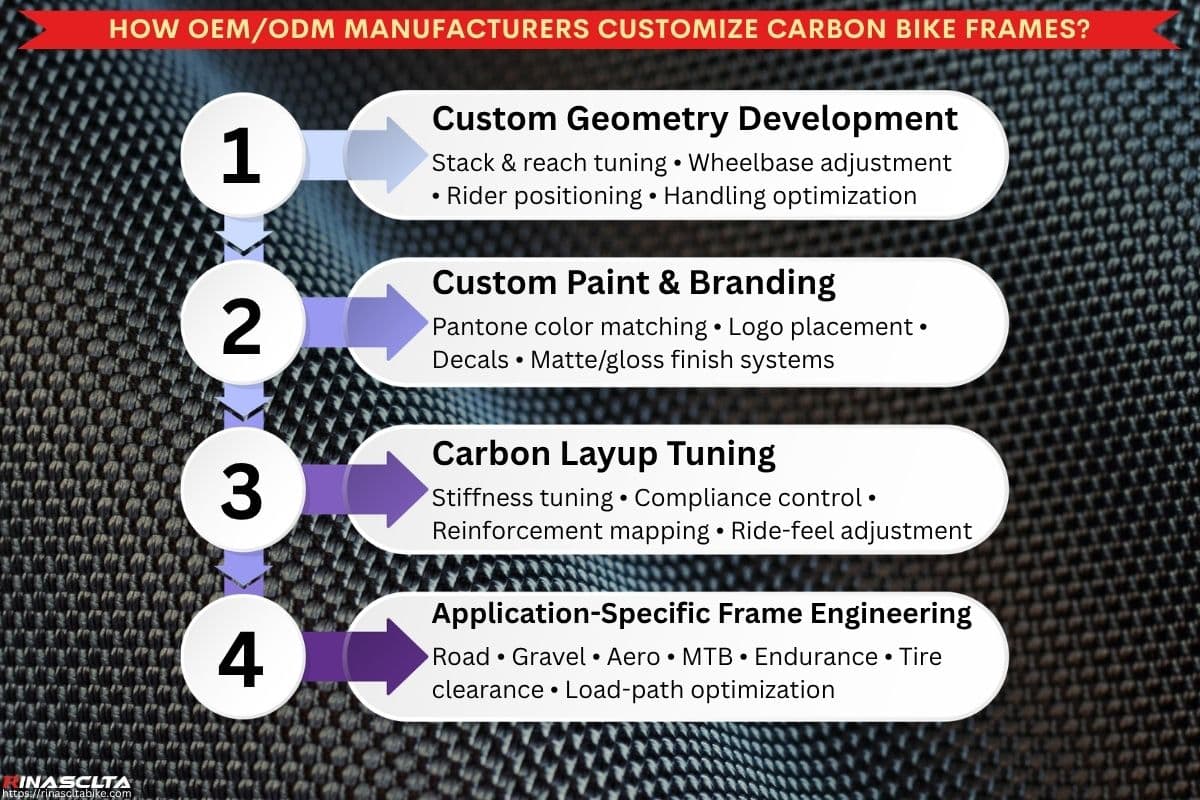
Custom geometry development
Custom geometry development is the process of designing or adjusting a carbon bike frame’s stack, reach, wheelbase, head tube angle, seat tube angle, chainstay length, bottom bracket drop, fork rake, trail, front-center length, tire clearance, and frame size grading to match a specific riding purpose, rider fit profile, and market positioning. In professional carbon frame manufacturing, geometry is not only a drawing dimension; it defines how the bike handles, climbs, descends, corners, accelerates, and distributes rider weight between the front and rear wheels.
A well-developed geometry platform helps create the intended ride character: lower stack and longer reach for aggressive race positioning, higher stack and shorter reach for endurance comfort, longer wheelbase and slacker head angle for gravel stability, shorter chainstays for responsive acceleration, and larger tire clearance for all-road versatility. Professional manufacturers develop geometry through CAD design, bike-fit data, rider-position analysis, wheel and tire compatibility, component standards, frame-size scaling, prototype validation, and ride testing, ensuring that the final frame delivers stable handling, correct assembly fit, consistent sizing, and the desired ride feel across all production sizes.
Custom paint and branding
Custom paint and branding are the finishing customization stages that turn a carbon frame platform into a recognizable market-ready product through Pantone color matching, OEM logo placement, water-transfer decals, private-label graphics, team-edition designs, matte or gloss finishes, raw carbon sections, metallic effects, clear-coat systems, and serialized branding details. In professional carbon frame manufacturing, this process is controlled through CAD graphic layout, masking templates, decal alignment standards, color reference samples, paint-thickness control, UV-resistant clear coat, adhesion testing, gloss inspection, and final cosmetic QC, because paint quality directly affects brand identity, perceived product value, showroom presentation, resale value, and long-term durability. A strong customization system ensures consistent color accuracy, logo sharpness, decal bonding, surface smoothness, weather resistance, scratch resistance, and batch-to-batch repeatability, while poor control can cause color mismatch, bubbling, decal lifting, orange peel, dust contamination, weak clear-coat adhesion, and higher cosmetic warranty risk.
Carbon layup tuning
Carbon layup tuning is the process of adjusting the fiber orientation, ply sequence, carbon modulus, laminate thickness, overlap design, resin system, and reinforcement placement inside a carbon frame to create the required balance of stiffness, comfort, strength, weight, vibration damping, and ride feel. In professional frame manufacturing, the layup schedule determines how the frame reacts to pedaling torque, steering load, braking force, rider weight, cornering stress, and road vibration, so it is one of the most important engineering tools for turning a standard frame platform into a race, endurance, gravel, aero, or lightweight-specific product.
A well-tuned layup can increase bottom bracket stiffness for better power transfer, improve head tube torsional rigidity for sharper steering, add controlled flex in the seatstays and fork blades for comfort, and reinforce high-load areas such as the disc brake mounts, dropouts, chainstays, fork crown, and seatpost clamp zone for durability. Professional factories control this through FEA stress analysis, ply book development, 0° / ±45° / 90° fiber orientation planning, high-modulus and intermediate-modulus carbon selection, laser-cut prepreg plies, layup verification, curing-cycle control, ultrasonic inspection, fatigue testing, and ride testing, ensuring the final frame achieves consistent stiffness-to-weight ratio, fatigue life, impact resistance, compliance tuning, and production repeatability across all sizes and batches.
Application-specific frame engineering
Application-specific frame engineering means designing a carbon frameset around its real riding use case instead of treating every frame as the same structure with a different label. A road race frame, gravel frame, aero frame, endurance frame, XC frame, and e-bike frame all need different targets for geometry, carbon layup, tube shaping, tire clearance, stiffness profile, compliance behavior, reinforcement zones, braking loads, drivetrain forces, rider position, and durability standards.
For example, an aero road frame prioritizes CFD-shaped tubes, integrated cockpit routing, high torsional stiffness, and sprint efficiency; a gravel frame needs wider tire clearance, impact-resistant reinforcement, stable wheelbase geometry, vibration damping, and mud/debris clearance; an endurance frame focuses on higher stack, controlled rear-triangle compliance, fork comfort, and long-distance fatigue reduction. Professional manufacturers use CAD design, FEA stress analysis, ply book development, fatigue testing, impact testing, prototype ride testing, ISO 4210 validation, and final assembly compatibility checks to make sure each frame category delivers the intended ride feel, safety margin, and production repeatability.
Future Trends in Carbon Bike Manufacturing
Future trends in carbon bike manufacturing are moving toward higher-performance composite systems, more automated production control, cleaner internal molding, and more sustainable factory processes. Advanced composite materials will focus on improved high-modulus and intermediate-modulus fiber combinations, toughened resin systems, nano-enhanced resins, recycled carbon fiber applications, hybrid fiber structures, and better impact-resistant laminates, allowing frames to achieve stronger stiffness-to-weight ratio, fatigue durability, vibration damping, and crash resistance without unnecessary material buildup.
Automation in carbon production will continue to improve consistency through CNC prepreg cutting, digital ply books, laser ply positioning, robotic trimming, automated inspection, MES production tracking, barcode traceability, digital curing logs, and AI-assisted defect detection. While full automation of complex manual layup is still difficult, factories are increasingly using automation to reduce human error, stabilize ply accuracy, fiber orientation, overlap control, curing parameters, and QC repeatability, which directly improves production consistency across frame sizes and batches.
Improved internal molding technology will become a major quality differentiator, especially through more precise EPS molding systems, silicone bladders, PU mandrels, optimized airbag structures, better venting design, pressure-controlled compaction, and smoother internal wall formation. These technologies help reduce hidden defects such as wrinkles, voids, resin pooling, dry spots, bridging, and delamination, while improving wall-thickness consistency, laminate consolidation, fatigue life, impact resistance, and ride-feel repeatability.
Sustainable manufacturing trends will also become increasingly important as brands and factories face pressure to reduce material waste, VOC emissions, energy consumption, scrap prepreg, paint waste, and packaging waste. Future factories will focus more on low-VOC coatings, water-based paint systems, recyclable packaging, prepreg nesting optimization, carbon scrap recovery, renewable energy use, wastewater treatment, and lifecycle-based product development, making carbon bike manufacturing not only lighter and stronger, but also cleaner, more traceable, and more responsible for global OEM production.
Conclusion
Modern carbon bike frame manufacturing is a highly engineered process that combines advanced composite materials, precision mold technology, carbon layup tuning, EPS internal molding systems, controlled curing cycles, structural reinforcement design, paint-process engineering, and strict QC validation to produce frames with optimized stiffness-to-weight ratio, fatigue durability, vibration damping, aerodynamic performance, and ride-feel consistency. From prepreg material preparation and fiber orientation planning to final alignment inspection, paint finishing, and ISO-standard fatigue testing, every production stage directly affects the frame’s structural reliability, cosmetic quality, assembly compatibility, and real-world riding performance. As the industry continues evolving toward more advanced composites, automated process control, cleaner internal molding, wider tire integration, and sustainable manufacturing systems, high-end carbon frame production increasingly depends on engineering precision, production repeatability, and long-term quality control rather than simply material branding or weight reduction alone.