


What Determines Bike Ride Feel?
Bike ride feel is determined by a combination of factors such as frame geometry, carbon layup design, frame stiffness, compliance tuning, wheelbase, head tube angle, fork design, bottom bracket stiffness, wheel and tire setup, rider position, frame weight distribution, vibration damping, and component integration, because every part of the bicycle influences how forces from the rider, road surface, braking, cornering, and acceleration are transferred through the bike during riding. Modern carbon bike engineering carefully balances these factors to create specific ride characteristics such as aggressive handling, climbing efficiency, sprint responsiveness, long-distance comfort, high-speed stability, gravel compliance, or aerodynamic performance, making ride feel one of the most important differentiators in premium OEM and ODM bicycle manufacturing.
| Ride Feel Factor | How It Affects Ride Feel | Why It Matters / Related Terms |
| Frame geometry | Changes handling, stability, and rider posture | Reach, stack, wheelbase, trail, head angle |
| Carbon layup design | Controls stiffness and compliance in specific areas | Fiber orientation, modulus, flex tuning |
| Frame stiffness | Affects power transfer and acceleration response | BB stiffness, torsional rigidity, sprint efficiency |
| Compliance tuning | Influences comfort and vibration absorption | Vertical compliance, flex zones, fatigue reduction |
| Head tube angle | Changes steering speed and stability | Aggressive vs stable handling characteristics |
| Fork design | Affects front-end comfort and steering precision | Fork rake, trail, vibration damping |
| Wheelbase length | Influences stability and cornering behavior | High-speed control vs agility |
| Chainstay length | Changes acceleration feel and traction | Rear-end stiffness and wheel response |
| Bottom bracket stiffness | Impacts pedaling efficiency | Power transfer and drivetrain rigidity |
| Seatstay design | Influences comfort and rear-end flex | Dropped stays, vibration absorption |
| Tire width and pressure | Strongly affects comfort and grip | Rolling resistance, traction, damping |
| Wheel stiffness | Changes acceleration and road feedback | Lateral stiffness, responsiveness |
| Frame weight distribution | Influences balance and handling feel | Front/rear weight bias |
| Aerodynamic tube shaping | Affects speed and wind behavior | Aero efficiency and crosswind stability |
| Vibration damping | Reduces rider fatigue on rough roads | Carbon damping characteristics |
| Rider position | Changes comfort, control, and efficiency | Bike fit, endurance vs race posture |
| Integrated cockpit systems | Affects front-end stiffness and steering feel | One-piece bars, cable integration |
| Material modulus | Influences frame responsiveness and harshness | High-modulus vs intermediate-modulus carbon |
| Manufacturing precision | Impacts consistency of ride characteristics | QC control, alignment, layup accuracy |
| Component integration | Alters overall handling and compliance | Seatpost, stem, handlebars, wheels |
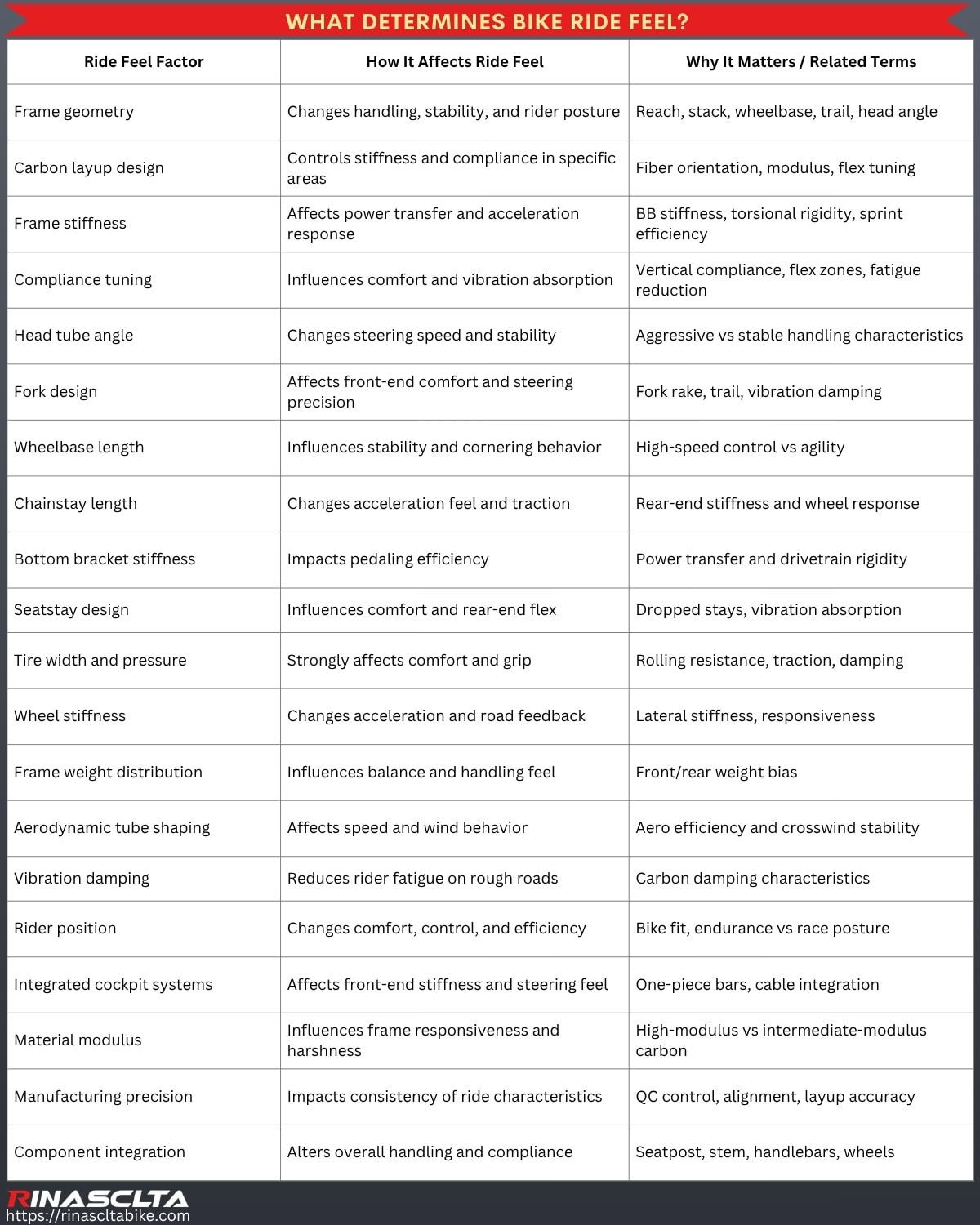

Together, these engineering factors determine whether a bicycle feels responsive, stable, smooth, aggressive, comfortable, efficient, forgiving, or race-oriented, which is why modern bicycle brands invest heavily in frame engineering, rider testing, simulation software, and category-specific geometry development to create distinct ride personalities for different markets and riding disciplines.
Frame stiffness and compliance
Frame stiffness and compliance affect bike ride feel because they control how the frame resists flex under pedaling, steering, braking, and cornering loads, while also determining how much vibration and road shock the frame can absorb before reaching the rider. In carbon bike engineering, stiffness usually refers to areas such as bottom bracket stiffness, torsional stiffness, head tube stiffness, and lateral stiffness, which influence power transfer, sprint response, climbing efficiency, steering precision, and high-speed stability; compliance refers mainly to controlled vertical flex in areas such as the seat tube, seatpost, top tube, seatstays, fork blades, and rear triangle, which improves comfort, traction, vibration damping, and fatigue reduction on long rides or rough surfaces.
A very stiff frame often feels fast, direct, and responsive because less energy is lost through unwanted frame movement when the rider accelerates, sprints, climbs, or corners hard, but excessive stiffness can make the bike feel harsh, nervous, or tiring, especially on rough roads or gravel. A more compliant frame feels smoother, more forgiving, and easier to ride for long distances because it reduces road buzz and helps the tires maintain contact with uneven surfaces, but too much compliance can make the bike feel soft, delayed, or less efficient under hard pedaling. The best carbon frames balance both by using fiber orientation, carbon modulus selection, tube shape, wall thickness, layup zones, dropped seatstays, slim seatposts, and asymmetric chainstay design to make the frame stiff where power and control are needed, and compliant where comfort and vibration absorption matter.
Geometry and rider position
Geometry and rider position strongly affect bike ride feel because they determine how the rider’s body is positioned relative to the wheels, bottom bracket, handlebars, and steering axis, directly influencing handling speed, stability, comfort, power transfer, cornering behavior, climbing efficiency, aerodynamics, weight distribution, and rider confidence. Modern bike geometry is built around measurements such as reach, stack, wheelbase, head tube angle, seat tube angle, chainstay length, bottom bracket drop, fork rake, and trail, while rider position depends on factors such as stem length, handlebar reach, saddle setback, saddle height, crank length, and cockpit integration. Together, these dimensions define whether a bicycle feels aggressive and race-oriented, stable and endurance-focused, or playful and responsive for gravel and MTB riding.
A longer and lower geometry with increased reach and reduced stack usually creates a more aerodynamic and performance-focused riding position, improving high-speed stability, sprint efficiency, and aerodynamic drag reduction, but it may also place more stress on the rider’s back, shoulders, neck, and wrists during long rides. A shorter and taller geometry creates a more upright position that improves comfort, visibility, control, and long-distance endurance, especially on rough roads and gravel terrain. Head tube angle and trail heavily influence steering feel: steeper head angles create faster, more responsive steering, while slacker angles improve stability and confidence at high speed or on rough surfaces. Wheelbase and chainstay length also affect ride character, with shorter wheelbases generally feeling quicker and more agile, while longer wheelbases improve stability and smoothness.
Modern carbon bike brands use geometry engineering to create very different ride personalities for different categories:
| Bike Category | Typical Geometry Effect on Ride Feel |
| Aero road bikes | Aggressive, low, fast-handling, race-focused |
| Endurance road bikes | Stable, comfortable, less fatiguing |
| Gravel bikes | Balanced stability, control, tire clearance |
| XC MTB bikes | Efficient climbing with quick steering |
| Trail / Enduro MTB bikes | Slacker geometry for downhill stability |
| Triathlon bikes | Extreme aerodynamic positioning |
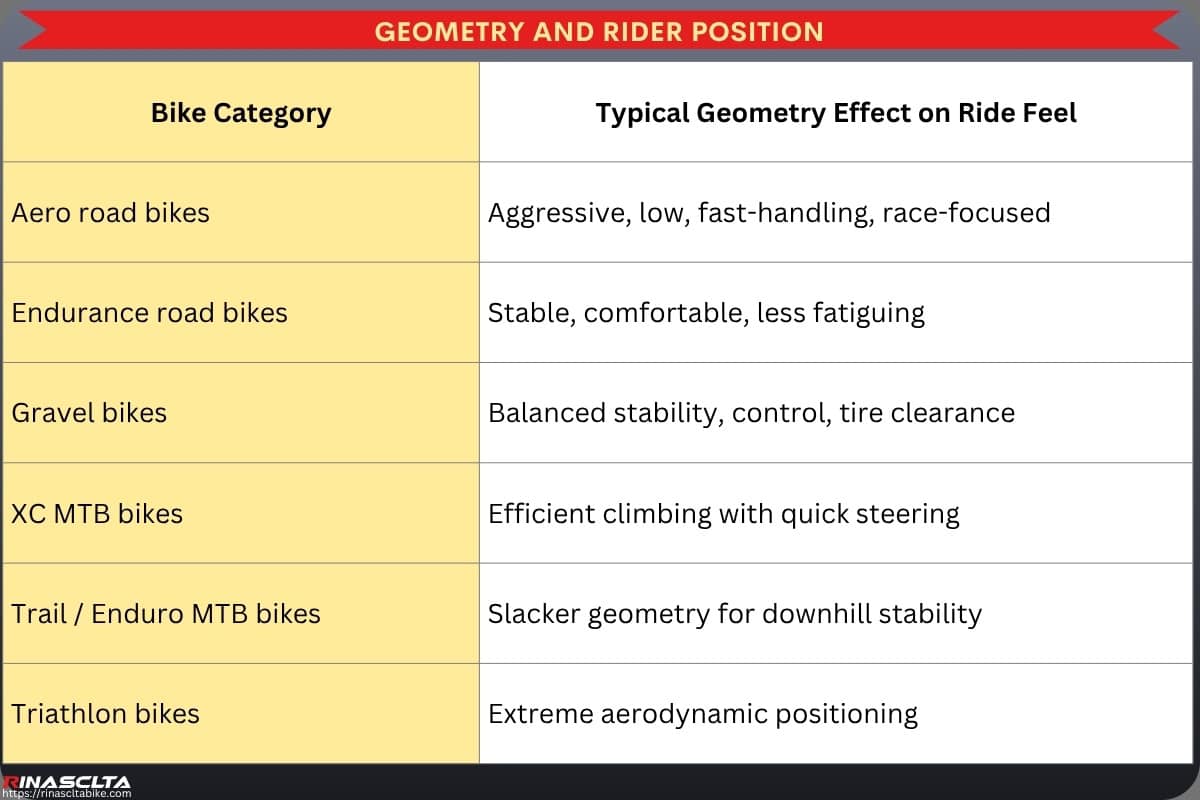

Rider position also changes how weight is distributed between the front and rear wheels, which affects:
- Front-wheel grip
- Rear-wheel traction
- Cornering confidence
- Braking stability
- Climbing posture
- Descending control
- Fatigue management
OEM and ODM manufacturers now use advanced technologies such as bike-fit simulation, motion capture analysis, FEA engineering, CFD aerodynamic testing, rider-category-specific geometry platforms, and integrated cockpit systems to optimize geometry for different rider groups, body proportions, riding styles, and market trends. Modern trends such as longer reach, shorter stems, dropped seatstays, larger tire clearance, and endurance-focused stack heights show how geometry has evolved to balance performance with comfort and control, especially as gravel and all-road categories continue influencing the wider bicycle industry.
In modern bike engineering, geometry and rider position are often considered even more important than frame material alone because they define how the rider interacts with the bicycle during every aspect of riding, shaping whether the bike feels responsive, stable, efficient, comfortable, aggressive, forgiving, or confidence-inspiring across different terrain and riding conditions.
Carbon layup and vibration damping
Carbon layup and vibration damping affect bike ride feel because the direction, sequence, thickness, and modulus of carbon fiber layers determine how the frame reacts to road vibration, pedaling force, cornering load, and rider weight. Unlike metal tubes, carbon frames can be tuned zone by zone, so engineers can use 0°, 45°, 90° fiber orientation, high-modulus carbon, intermediate-modulus carbon, wall-thickness control, resin systems, and local reinforcement zones to make one area stiff for power transfer while allowing another area to absorb road buzz.
A well-designed carbon layup can make a bike feel smooth, quiet, efficient, and controlled because the frame filters high-frequency vibration from rough roads, gravel, chipseal, and small impacts before it reaches the rider’s hands, feet, and saddle. This is especially important in areas such as the fork blades, seatstays, top tube, seat tube, seatpost junction, and rear triangle, where controlled flex can improve comfort, traction, and fatigue resistance without making the bike feel slow or soft.
Poor layup design can make the frame feel either too harsh or too dead. If the layup is overly stiff, the bike may feel fast on smooth roads but uncomfortable on long rides because more vibration passes through the handlebar, saddle, pedals, and frame contact points. If the layup is too compliant or poorly balanced, the bike may feel vague during sprinting, cornering, or climbing because the frame loses torsional stiffness, bottom bracket support, and steering precision.
For OEM and ODM carbon bike manufacturing, carbon layup is one of the most valuable engineering tools because it allows brands to create different ride personalities from similar frame platforms, such as aero race stiffness, endurance comfort, gravel vibration damping, MTB impact compliance, or lightweight climbing responsiveness. A good factory must control layup accuracy through ply books, fiber orientation checks, mold pressure control, curing consistency, and QC inspection, because even small errors in layup placement can change stiffness, comfort, durability, and ride feel across production batches.
Wheels and tire interaction
Wheels and tire interaction strongly affects bike ride feel because the wheel–tire system is the first contact point between the bicycle and the road, controlling rolling resistance, vibration damping, grip, comfort, acceleration, cornering stability, braking traction, and road feedback before loads even reach the frame. Wider tires, lower tire pressure, tubeless setups, and compliant wheel systems can make a bike feel smoother, more stable, and more forgiving, while narrower tires, higher pressure, and very stiff wheels can make the bike feel faster, sharper, and more responsive, but sometimes harsher on rough roads.
For carbon frame engineering, wheels and tires are important because they work together with frame clearance, fork design, chainstay length, seatstay shape, rim width, tire volume, tire casing, and air pressure to define the final ride character. A frame designed for 28 mm road tires will feel different from one designed for 35–45 mm gravel tires, even if the carbon layup is similar, because larger tire volume absorbs more road shock and increases traction. Rim width also matters: a wider internal rim supports the tire better, improves cornering stability, and allows lower pressure without excessive tire squirm. Tubeless tires can further improve ride comfort and puncture resistance by allowing lower pressure, while stiff deep-section carbon wheels may improve speed and aerodynamics but can increase road harshness if not matched with the right tire size and pressure.
In OEM and ODM bike development, wheel and tire compatibility is now a major design factor because modern road, gravel, and all-road bikes are trending toward larger tire clearance, wider rims, lower pressure, tubeless systems, and mixed-surface versatility. Brands must decide whether the bike should feel race-fast, endurance-comfortable, gravel-stable, or all-road balanced, then match the frame geometry and clearance to the intended tire range. This is why frame design, fork clearance, brake mount position, chainstay shaping, and seat tube profile must be engineered around the target wheel and tire system, not treated as separate components.
How Carbon Frame Engineering Works?
Carbon frame engineering works by combining material science, structural mechanics, rider biomechanics, aerodynamics, manufacturing engineering, and ride-performance tuning to design a bicycle frame that achieves specific targets for stiffness, weight, comfort, durability, handling, vibration damping, aerodynamics, and ride feel. Unlike metal frames that rely mainly on tube diameter and wall thickness, carbon frames can be engineered at the fiber level by controlling carbon modulus, fiber orientation, ply sequence, resin systems, tube shaping, reinforcement zones, and laminate thickness, allowing engineers to tune different areas of the frame independently for specific riding characteristics.
Modern carbon frame engineering is usually based on factors such as:
- Rider category and intended use
- Geometry and rider position targets
- Power-transfer requirements
- Compliance and comfort goals
- Aerodynamic efficiency
- Weight optimization
- Tire clearance requirements
- Safety and fatigue standards
- Manufacturing capability and cost targets
- OEM/ODM production scalability
The engineering process typically involves multiple stages:
| Engineering Stage | Main Purpose | How It Works / Related Terms |
| Market and rider analysis | Define target rider and bike category | Road, gravel, aero, endurance, MTB, triathlon |
| Geometry development | Create handling and rider-position characteristics | Reach, stack, trail, wheelbase, head angle |
| Structural concept design | Define load paths and tube behavior | Torsional stiffness, flex zones, BB rigidity |
| Carbon layup engineering | Tune stiffness and compliance | Fiber orientation, modulus selection, ply schedule |
| Tube shape and aerodynamic design | Improve airflow and structural efficiency | CFD simulation, Kammtail profiles, aero integration |
| Finite element analysis (FEA) | Simulate structural loads and stress | Stress mapping, fatigue prediction, impact analysis |
| Prototype production | Build early physical samples | Prototype molds, sample layup testing |
| Laboratory testing | Verify safety and stiffness targets | Fatigue testing, impact testing, ISO standards |
| Ride testing and tuning | Evaluate real-world ride feel | Handling, vibration damping, sprint response |
| Manufacturing optimization | Adapt design for mass production | Mold design, curing cycles, QC repeatability |
| OEM/ODM production validation | Ensure scalable production consistency | Layup SOPs, tooling precision, traceability |
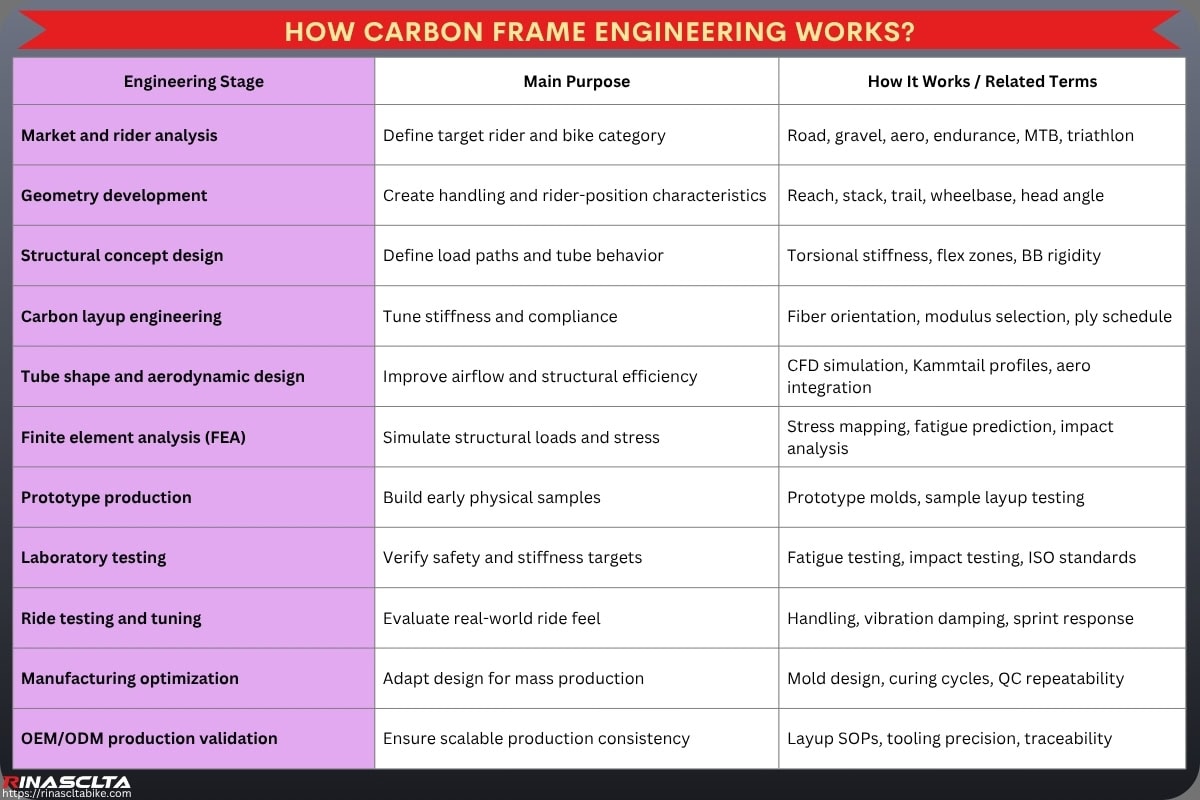
The theoretical foundation behind carbon frame engineering comes from:
- Composite material theory
- Structural load distribution
- Beam and torsion mechanics
- Fatigue and impact engineering
- Aerodynamics and fluid dynamics
- Human biomechanics
- Vibration damping theory
- Manufacturing process engineering
For example, engineers may intentionally design:
- A stiff bottom bracket area for efficient sprinting
- Flexible seatstays for comfort
- A tapered head tube for steering precision
- Asymmetric chainstays for drivetrain load balancing
- Deep aero tube profiles for drag reduction
- Wider tire clearance for lower-pressure comfort tuning
Modern OEM and ODM factories now combine advanced technologies such as:
- FEA structural simulation
- CFD aerodynamic testing
- Motion-capture rider analysis
- Carbon ply-mapping software
- CNC mold machining
- Robotic cutting systems
- Digital layup instructions
- Real-world telemetry testing
to create highly optimized carbon bicycles for different markets and riding disciplines.
In modern bicycle manufacturing, carbon frame engineering is not simply about making a frame lighter or stiffer, but about controlling how the bike behaves dynamically under real riding conditions. The final ride feel depends on how successfully the engineering team balances stiffness, compliance, aerodynamics, handling, vibration damping, geometry, and manufacturing consistency into one complete system that matches the intended rider and bike category.
Fiber orientation and stiffness tuning
Fiber orientation and stiffness tuning are core principles of carbon bike frame engineering because carbon fiber is an anisotropic material, meaning it behaves differently depending on the direction of the fibers. Unlike metal frames where stiffness mainly depends on tube shape and wall thickness, carbon frames can be precisely tuned by changing the fiber angle, ply sequence, modulus, layer thickness, resin content, and reinforcement location inside different parts of the frame. Engineers use this control to decide where the bicycle should feel stiff for power transfer, sprinting, steering precision, and cornering, and where it should flex slightly for comfort, traction, vibration damping, and fatigue reduction.
The most common fiber orientations include:
- 0° fibers: Maximize longitudinal stiffness and power transfer along the tube length
- 45° fibers: Improve torsional stiffness and resistance to twisting forces
- 90° fibers: Increase lateral stability and shape retention
- Multi-directional layups: Balance stiffness, compliance, impact resistance, and durability
For example, engineers may place more 0° and high-modulus fibers around the bottom bracket, downtube, head tube, and chainstays to improve acceleration and steering response, while using thinner or differently oriented plies around the seatstays, top tube, seat tube, and fork blades to increase compliance and vibration damping. This is why two carbon frames with similar external shapes can feel completely different on the road depending on how the layup is engineered internally.
| Engineering Area | Fiber Orientation Goal | Effect on Ride Feel | Related Terms |
| Bottom bracket area | High longitudinal and torsional stiffness | Faster power transfer and sprint response | BB stiffness, drivetrain rigidity |
| Head tube and front triangle | Steering precision and torsional control | Sharper handling and cornering stability | Torsional rigidity, steering accuracy |
| Seatstays and rear triangle | Controlled vertical flex | Improved comfort and traction | Compliance tuning, vibration damping |
| Fork blades | Vibration absorption with steering stability | Smoother front-end ride feel | Road buzz reduction, fork compliance |
| Top tube and seat tube | Balance frame rigidity and comfort | Reduced rider fatigue | Flex zones, vertical compliance |
| Chainstays | Transfer pedaling force efficiently | Responsive acceleration | Lateral stiffness, drivetrain efficiency |
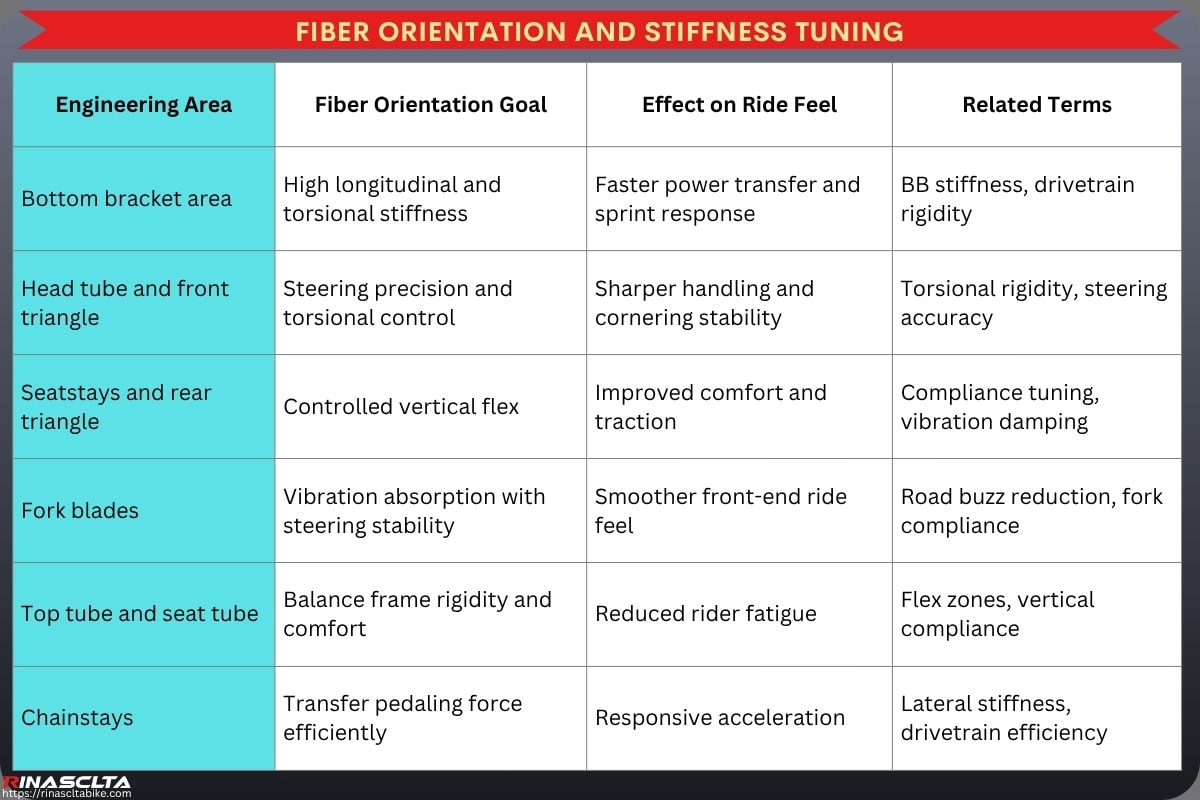
Modern OEM and ODM carbon manufacturers use advanced tools such as FEA simulation, ply-mapping software, stiffness testing rigs, vibration analysis, and prototype ride testing to optimize fiber orientation for different bike categories like aero road, endurance, gravel, XC MTB, or triathlon. High-end brands may even develop category-specific layup schedules where the same frame mold receives different carbon tuning depending on whether the final bike is intended for racing, climbing, endurance riding, or gravel comfort.
The quality of stiffness tuning depends heavily on manufacturing precision because even small layup errors such as incorrect ply angle, poor overlap control, resin pooling, or fiber wrinkling can change the bike’s stiffness balance, ride feel, durability, and fatigue resistance. This is why advanced carbon factories invest heavily in digital layup instructions, ply templates, operator training, curing control, and QC inspection systems to maintain consistent ride characteristics across mass OEM production.
Reinforcement zones in high-stress areas
Reinforcement zones in high-stress areas are critical parts of carbon bike frame engineering because certain sections of a bicycle experience much higher mechanical loads during pedaling, sprinting, braking, cornering, climbing, impacts, and repeated fatigue cycles. Unlike metal frames that distribute strength more uniformly through the tube material, carbon frames rely on strategically placed reinforcement layers made from additional high-modulus carbon plies, localized layup patches, thicker laminate sections, woven carbon reinforcements, impact-resistant fibers, or hybrid composite structures to strengthen areas exposed to concentrated stress. These reinforcement zones help improve power transfer, torsional stiffness, durability, impact resistance, fatigue life, bearing support, and structural safety while allowing lower-stress areas of the frame to remain lighter and more compliant for comfort and ride tuning.
Common high-stress reinforcement areas include:
- Bottom bracket shell
- Head tube junction
- Seat tube and seatpost clamp area
- Chainstay junctions
- Dropouts and thru-axle interfaces
- Disc brake mounts
- Fork crown and steerer tube area
- Suspension pivot zones on MTB frames
- Bottle cage and mounting inserts
- Internal cable-routing entry points
| High-Stress Area | Why Reinforcement Is Needed | Common Engineering Solutions | Effect on Ride Feel / Performance |
| Bottom bracket area | High pedaling and torsional loads | Extra 0° and 45° carbon plies, thicker laminate | Improves sprint response and power transfer |
| Head tube junction | Steering and braking stress concentration | Multi-directional reinforcement and tapered structures | Increases steering precision and stability |
| Chainstay junctions | Drivetrain force and rear-wheel load transfer | Asymmetric layup and impact-resistant plies | Improves acceleration and rear-end stiffness |
| Seatpost clamp area | Clamping pressure and rider weight concentration | Local reinforcement patches and thicker wall sections | Prevents cracking while maintaining compliance |
| Disc brake mounts | Localized braking force concentration | Reinforced inserts and heat-resistant layup zones | Improves braking stability and durability |
| Fork crown and steerer | Front impact and steering loads | High-strength woven carbon and compression reinforcement | Enhances front-end safety and steering accuracy |
| Dropouts and axle interfaces | Repeated wheel-loading stress | Metal inserts and reinforced carbon structure | Improves wheel alignment and load durability |
| Suspension pivot zones | Repeated dynamic MTB loading | Bearing reinforcement and hybrid layup structures | Increases long-term fatigue resistance |
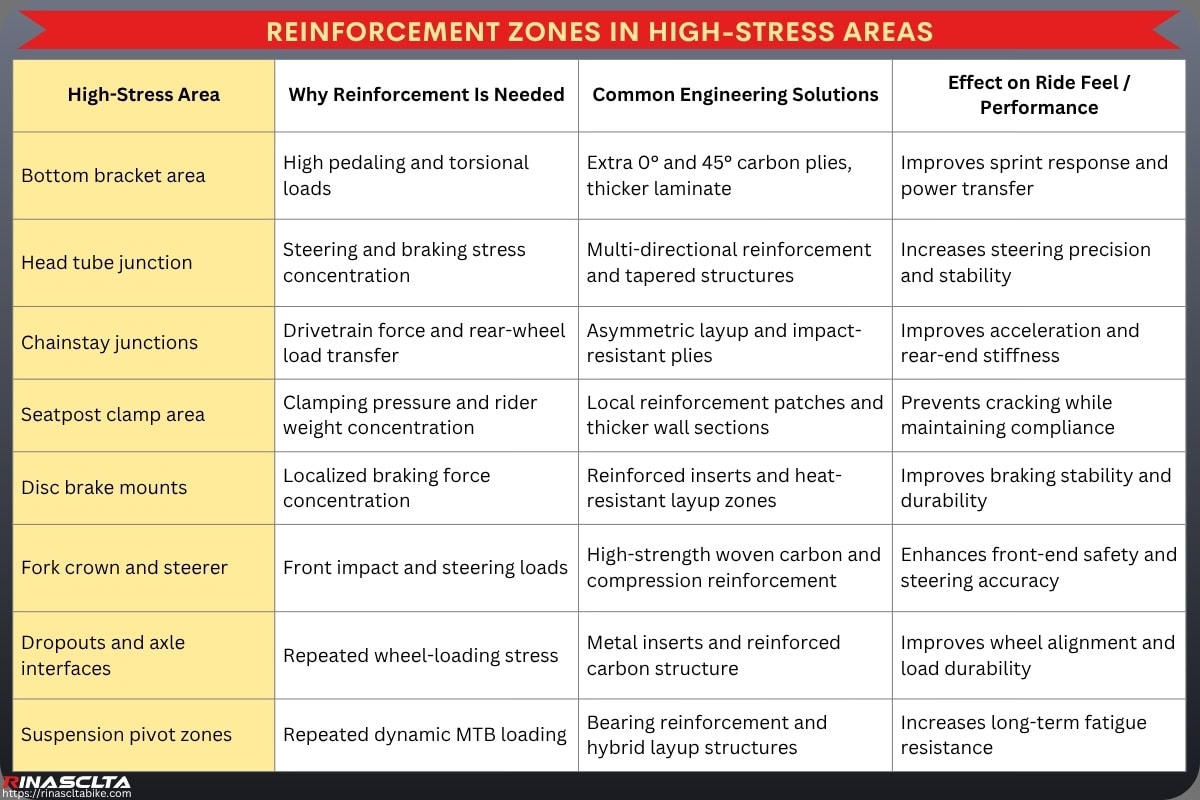
Modern OEM and ODM carbon manufacturers use technologies such as FEA stress simulation, fatigue-cycle analysis, impact testing, carbon ply mapping, localized laminate optimization, and ISO/EN structural testing to determine where reinforcement is required and how much material should be added. The challenge is balancing reinforcement strength with weight control because excessive reinforcement can make the frame heavy and harsh, while insufficient reinforcement increases the risk of cracking, delamination, bearing deformation, brake-mount failure, or long-term fatigue damage. High-end carbon engineering therefore focuses on placing reinforcement only where the load paths require it, allowing the bike to remain light, efficient, responsive, and durable while maintaining the intended ride feel and long-term structural reliability.
Balancing power transfer and comfort
Balancing power transfer and comfort is one of the most important goals in carbon bike frame engineering because riders want a bicycle that feels fast, efficient, responsive, and stable under hard pedaling, while still remaining comfortable enough for long rides, rough roads, gravel terrain, and fatigue reduction. Power transfer refers to how efficiently rider energy moves through the drivetrain into forward motion, which depends heavily on bottom bracket stiffness, torsional rigidity, chainstay stiffness, head tube stability, and frame lateral rigidity. Comfort, on the other hand, comes from controlled compliance and vibration damping in areas such as the seatstays, fork blades, seat tube, top tube, seatpost, tires, and cockpit, helping reduce road shock, muscle fatigue, hand numbness, and long-term rider stress.
If a frame is engineered with too much stiffness, the bike may feel extremely direct and efficient during sprinting or climbing, but also harsh, nervous, and physically tiring on rough roads because more vibration reaches the rider through the saddle, pedals, and handlebars. If the frame is too compliant, the bike may feel comfortable but less responsive under acceleration, cornering, or high-power efforts because energy is partially absorbed by excessive frame flex. Modern carbon engineering therefore focuses on selective stiffness tuning, where different parts of the frame are designed for different mechanical behaviors using fiber orientation, modulus selection, tube shaping, dropped seatstays, asymmetric chainstays, flex zones, and localized reinforcement structures.
| Engineering Area | Power Transfer Goal | Comfort Goal | Common Engineering Solutions |
| Bottom bracket area | Maximize pedaling efficiency | Limit unwanted flex | High-modulus carbon and torsional reinforcement |
| Chainstays | Improve acceleration response | Maintain traction on rough surfaces | Asymmetric stiffness tuning |
| Head tube and front triangle | Increase steering precision | Reduce harsh steering vibration | Balanced torsional stiffness |
| Seatstays | Maintain rear-wheel control | Increase vertical compliance | Dropped seatstays and thinner layup zones |
| Fork blades | Improve braking stability | Absorb road buzz and impacts | Controlled fork flex engineering |
| Seat tube and seatpost | Support rider load efficiently | Reduce saddle vibration | Slim seatposts and compliance tuning |
| Tire clearance design | Maintain speed and handling | Allow larger tires and lower pressure | Endurance and gravel geometry optimization |
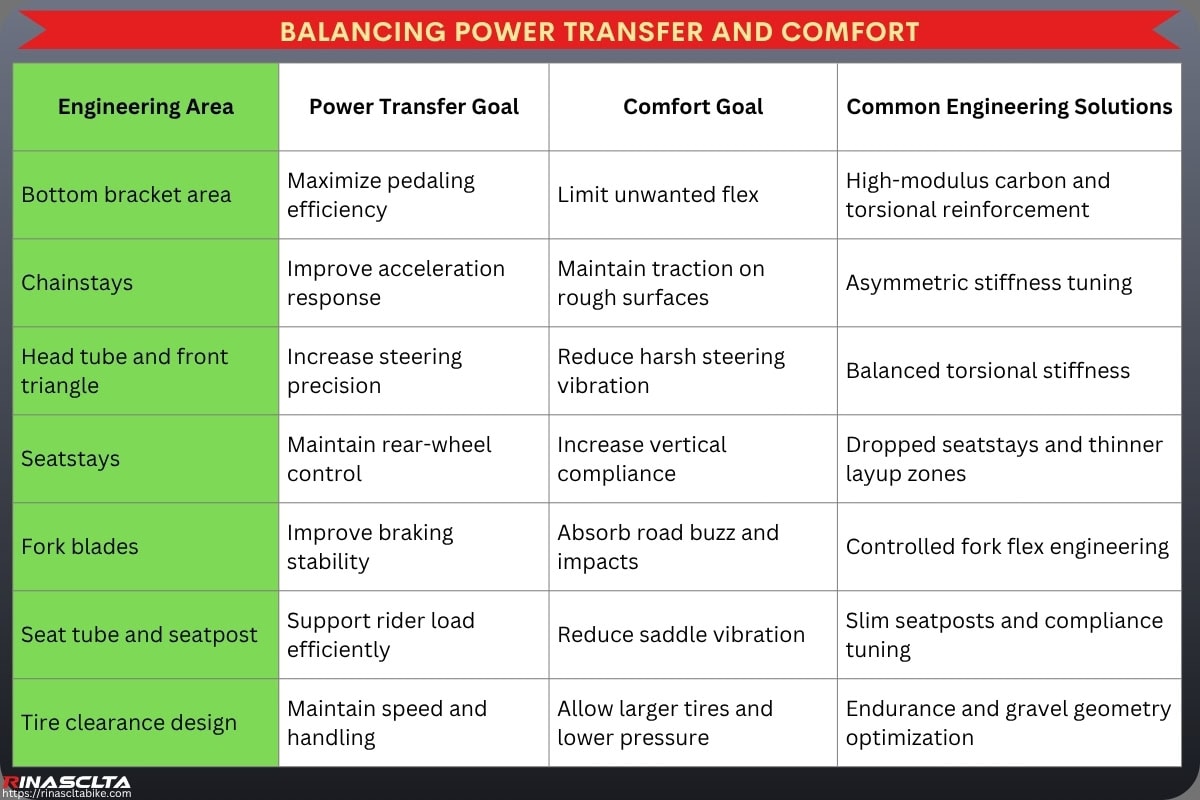
Modern OEM and ODM manufacturers now use advanced technologies such as FEA stiffness simulation, vibration analysis, rider telemetry, fatigue testing, and real-world ride evaluation to optimize this balance for different bike categories. Aero race bikes may prioritize stiffness and acceleration, endurance road bikes focus more on vibration damping and long-distance comfort, while gravel bikes require a balanced mix of compliance, traction, stability, and efficiency across mixed terrain.
In modern bicycle design, the best ride feel usually comes not from making a frame simply stiffer or softer, but from controlling exactly where and how the frame flexes under load. High-end carbon engineering therefore aims to create bikes that feel efficient during hard efforts while still remaining smooth, stable, and comfortable enough for long-term riding performance and reduced rider fatigue.
Why does engineering matter more than raw carbon grade?
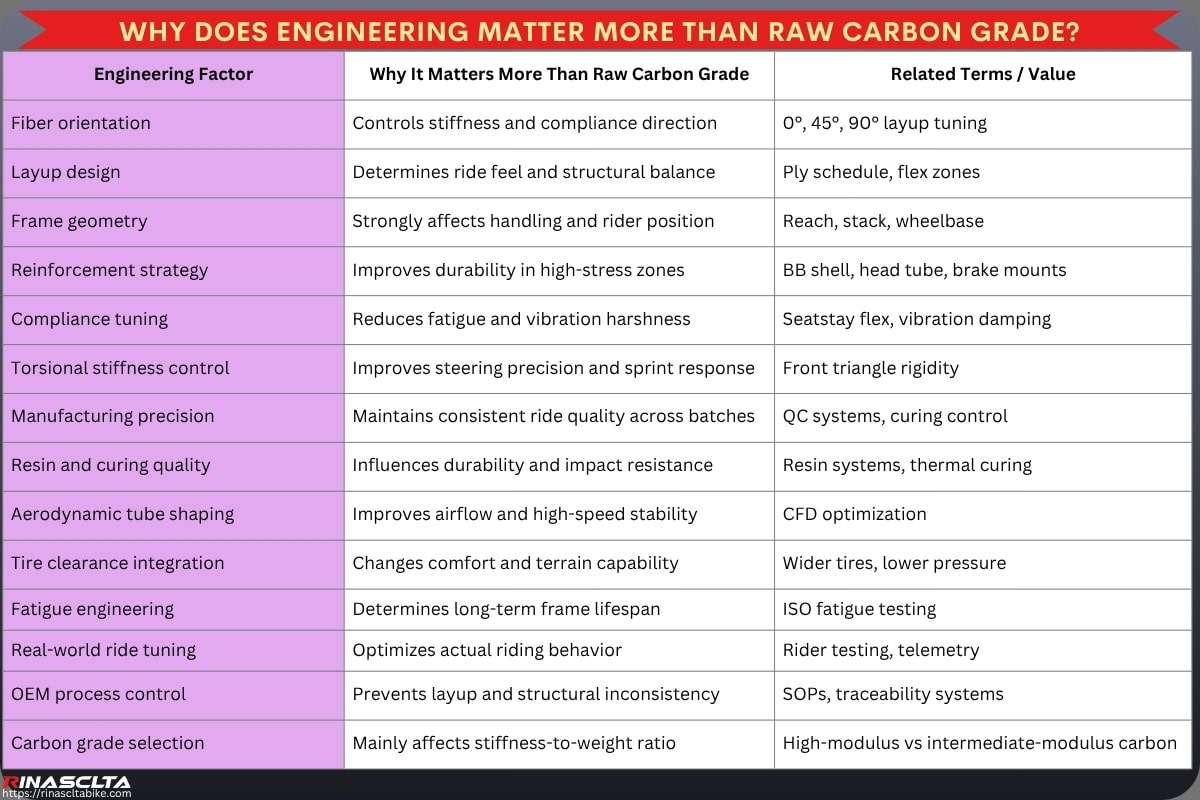
Engineering matters more than raw carbon grade because the overall ride quality, durability, handling, stiffness balance, comfort, safety, and long-term performance of a bicycle depend far more on frame design, fiber orientation, layup strategy, reinforcement placement, geometry, manufacturing precision, curing control, and stiffness tuning than simply using higher-modulus carbon fiber. While premium carbon grades such as high-modulus fibers can reduce weight and increase stiffness, poorly engineered frames made with expensive carbon may still ride harshly, crack prematurely, feel unstable, or perform inefficiently if the load paths, laminate structure, compliance tuning, and structural balance are not designed correctly. Modern OEM and ODM carbon engineering therefore focuses on how the material is used rather than only which material is used, because factors such as FEA simulation, aerodynamic tube shaping, ply sequencing, vibration damping, torsional rigidity, fatigue resistance, impact reinforcement, and QC consistency have a much larger influence on real-world ride feel and durability than carbon grade alone.
| Engineering Factor | Why It Matters More Than Raw Carbon Grade | Related Terms / Value |
| Fiber orientation | Controls stiffness and compliance direction | 0°, 45°, 90° layup tuning |
| Layup design | Determines ride feel and structural balance | Ply schedule, flex zones |
| Frame geometry | Strongly affects handling and rider position | Reach, stack, wheelbase |
| Reinforcement strategy | Improves durability in high-stress zones | BB shell, head tube, brake mounts |
| Compliance tuning | Reduces fatigue and vibration harshness | Seatstay flex, vibration damping |
| Torsional stiffness control | Improves steering precision and sprint response | Front triangle rigidity |
| Manufacturing precision | Maintains consistent ride quality across batches | QC systems, curing control |
| Resin and curing quality | Influences durability and impact resistance | Resin systems, thermal curing |
| Aerodynamic tube shaping | Improves airflow and high-speed stability | CFD optimization |
| Tire clearance integration | Changes comfort and terrain capability | Wider tires, lower pressure |
| Fatigue engineering | Determines long-term frame lifespan | ISO fatigue testing |
| Real-world ride tuning | Optimizes actual riding behavior | Rider testing, telemetry |
| OEM process control | Prevents layup and structural inconsistency | SOPs, traceability systems |
| Carbon grade selection | Mainly affects stiffness-to-weight ratio | High-modulus vs intermediate-modulus carbon |
How Geometry Changes Ride Characteristics?
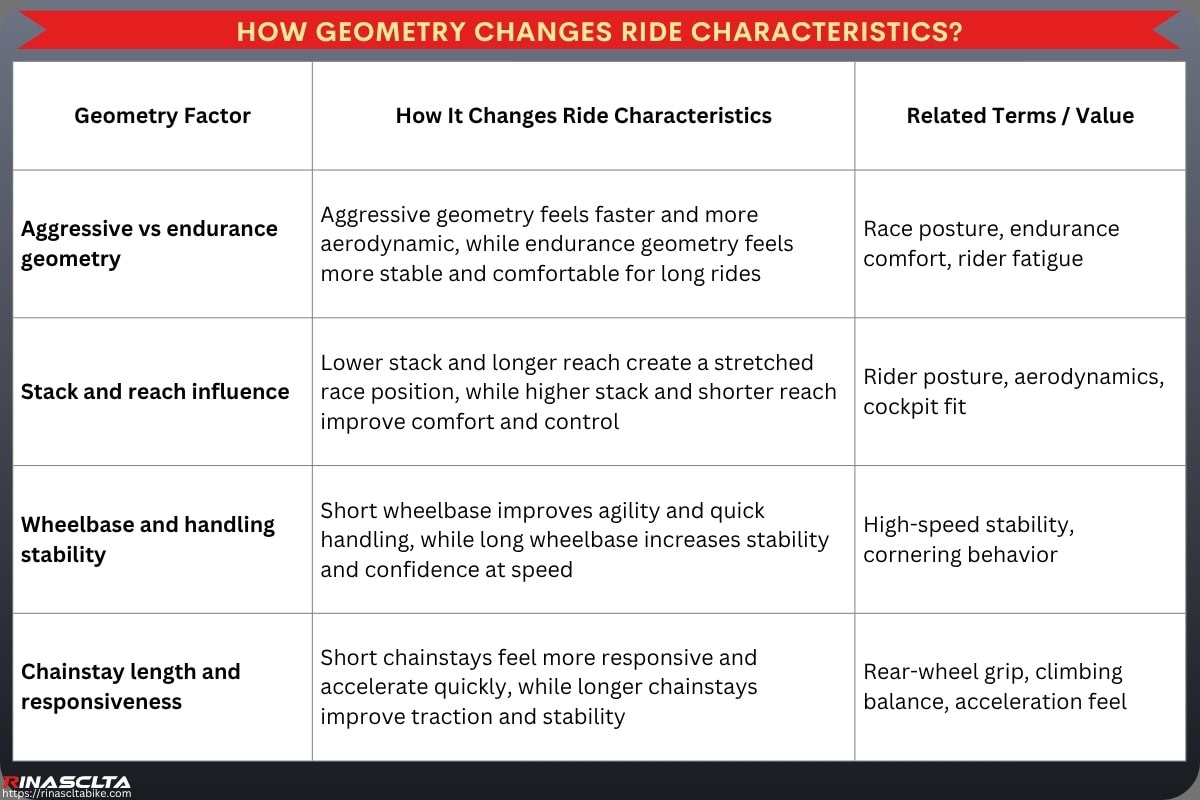
Bike geometry changes ride characteristics because the relative position of the wheels, bottom bracket, head tube, and rider contact points determines how the bicycle distributes weight, reacts to steering input, transfers power, absorbs road forces, and maintains stability at different speeds and terrain conditions. Small geometry changes can significantly alter whether a bike feels fast and aggressive, stable and comfortable, responsive and playful, or smooth and confidence-inspiring, which is why modern OEM and ODM bicycle brands carefully tune geometry for specific categories such as aero road, endurance, gravel, XC MTB, or long-distance adventure riding. Geometry directly affects important ride-feel factors such as handling speed, rider posture, climbing behavior, descending confidence, cornering stability, traction, aerodynamics, fatigue management, and overall bike balance, making it one of the most influential aspects of frame engineering.
| Geometry Factor | How It Changes Ride Characteristics | Related Terms / Value |
| Aggressive vs endurance geometry | Aggressive geometry feels faster and more aerodynamic, while endurance geometry feels more stable and comfortable for long rides | Race posture, endurance comfort, rider fatigue |
| Stack and reach influence | Lower stack and longer reach create a stretched race position, while higher stack and shorter reach improve comfort and control | Rider posture, aerodynamics, cockpit fit |
| Wheelbase and handling stability | Short wheelbase improves agility and quick handling, while long wheelbase increases stability and confidence at speed | High-speed stability, cornering behavior |
| Chainstay length and responsiveness | Short chainstays feel more responsive and accelerate quickly, while longer chainstays improve traction and stability | Rear-wheel grip, climbing balance, acceleration feel |
Aggressive vs endurance geometry
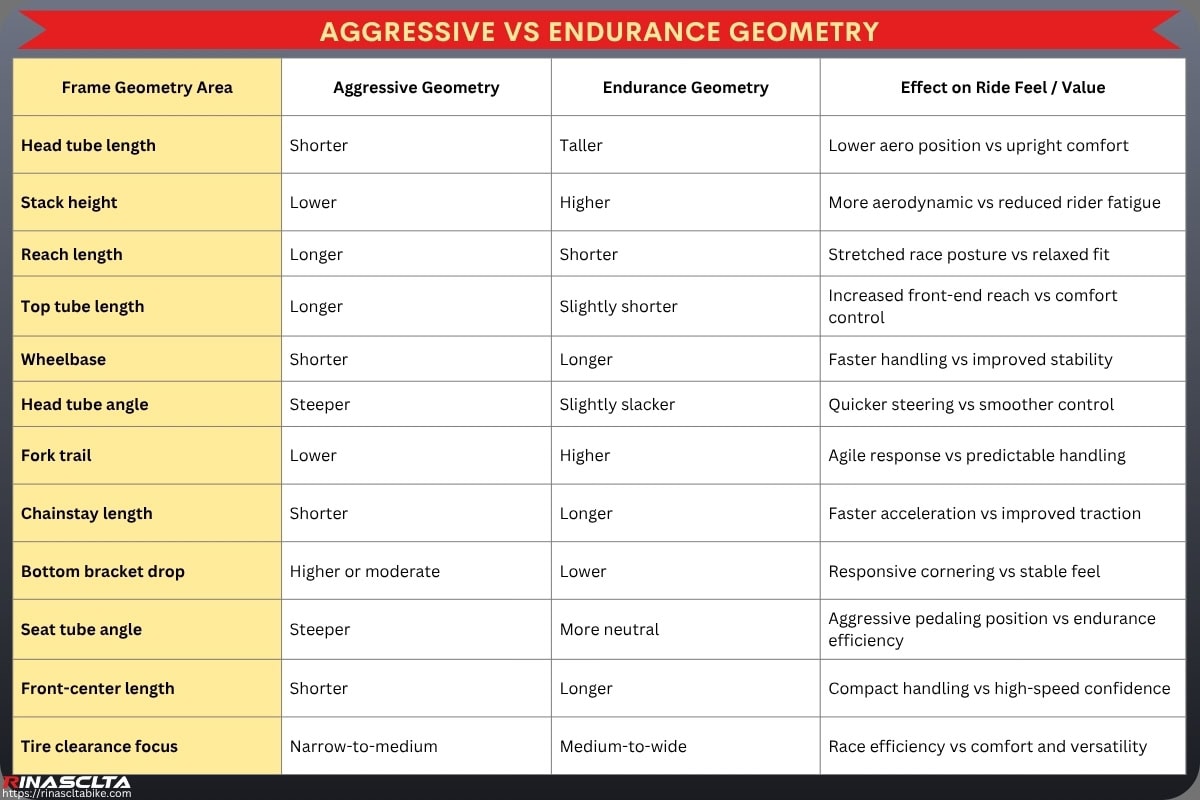
Aggressive versus endurance geometry refers to two different approaches in bike frame design that change how the bicycle feels, handles, and positions the rider during riding through adjustments to the head tube length, stack height, reach length, wheelbase length, head tube angle, chainstay length, bottom bracket drop, fork rake and trail, top tube length, seat tube angle, and front-center length. Aggressive geometry is designed for speed, aerodynamics, rapid handling, sprint efficiency, and race performance, creating a lower and more stretched rider position that improves power transfer and aerodynamic efficiency at high speed, while endurance geometry focuses more on comfort, stability, vibration reduction, long-distance efficiency, and fatigue management, using a more upright and balanced rider position to improve comfort and confidence during long rides or rough road conditions.
| Frame Geometry Area | Aggressive Geometry | Endurance Geometry | Effect on Ride Feel / Value |
| Head tube length | Shorter | Taller | Lower aero position vs upright comfort |
| Stack height | Lower | Higher | More aerodynamic vs reduced rider fatigue |
| Reach length | Longer | Shorter | Stretched race posture vs relaxed fit |
| Top tube length | Longer | Slightly shorter | Increased front-end reach vs comfort control |
| Wheelbase | Shorter | Longer | Faster handling vs improved stability |
| Head tube angle | Steeper | Slightly slacker | Quicker steering vs smoother control |
| Fork trail | Lower | Higher | Agile response vs predictable handling |
| Chainstay length | Shorter | Longer | Faster acceleration vs improved traction |
| Bottom bracket drop | Higher or moderate | Lower | Responsive cornering vs stable feel |
| Seat tube angle | Steeper | More neutral | Aggressive pedaling position vs endurance efficiency |
| Front-center length | Shorter | Longer | Compact handling vs high-speed confidence |
| Tire clearance focus | Narrow-to-medium | Medium-to-wide | Race efficiency vs comfort and versatility |
Stack and reach influence
Stack and reach influence bike ride feel because they determine the rider’s overall body position relative to the handlebars, bottom bracket, and front wheel, directly affecting comfort, aerodynamics, steering control, weight distribution, climbing posture, fatigue management, handling stability, and riding efficiency. Stack and reach are influenced by factors such as the head tube length, top tube length, seat tube angle, fork length, headset height, bottom bracket position, stem length, handlebar reach, spacer height, and frame front-center design, all of which combine to shape whether the rider sits in a more aggressive race posture or a more upright endurance-oriented position.
Stack is the vertical distance between the bottom bracket and the top of the head tube, while reach is the horizontal distance between those same points. A higher stack generally creates a more upright and comfortable riding position, while a lower stack produces a lower aerodynamic posture. A longer reach stretches the rider forward for improved high-speed stability and aerodynamic efficiency, while a shorter reach creates a more compact, relaxed, and easier-to-control riding position.
| Geometry / Frame Area | Effect on Stack & Reach | Ride Feel Influence | Related Terms / Value |
| Head tube length | Longer head tube increases stack | More upright posture and comfort | Endurance geometry, fatigue reduction |
| Top tube length | Longer top tube increases effective reach | More stretched and aerodynamic position | Race posture, stability |
| Seat tube angle | Steeper angle can shorten effective reach | More forward pedaling position | Climbing efficiency, rider balance |
| Fork length | Taller fork slightly increases stack | Softer front-end feel and comfort | Gravel geometry, tire clearance |
| Headset spacers | More spacers increase effective stack | Reduced back and neck strain | Bike fit adjustment |
| Stem length | Longer stem increases rider reach | Slower, more stable steering feel | Cockpit tuning |
| Handlebar reach | Longer handlebar reach extends position | More aggressive front-end posture | Aero positioning |
| Bottom bracket position | BB height influences rider center of gravity | Stability and handling balance | Cornering behavior |
| Front-center length | Longer front-center increases cockpit space | High-speed stability and confidence | Weight distribution |
| Frame size scaling | Larger frames naturally increase stack and reach | Rider fit consistency | OEM geometry sizing |
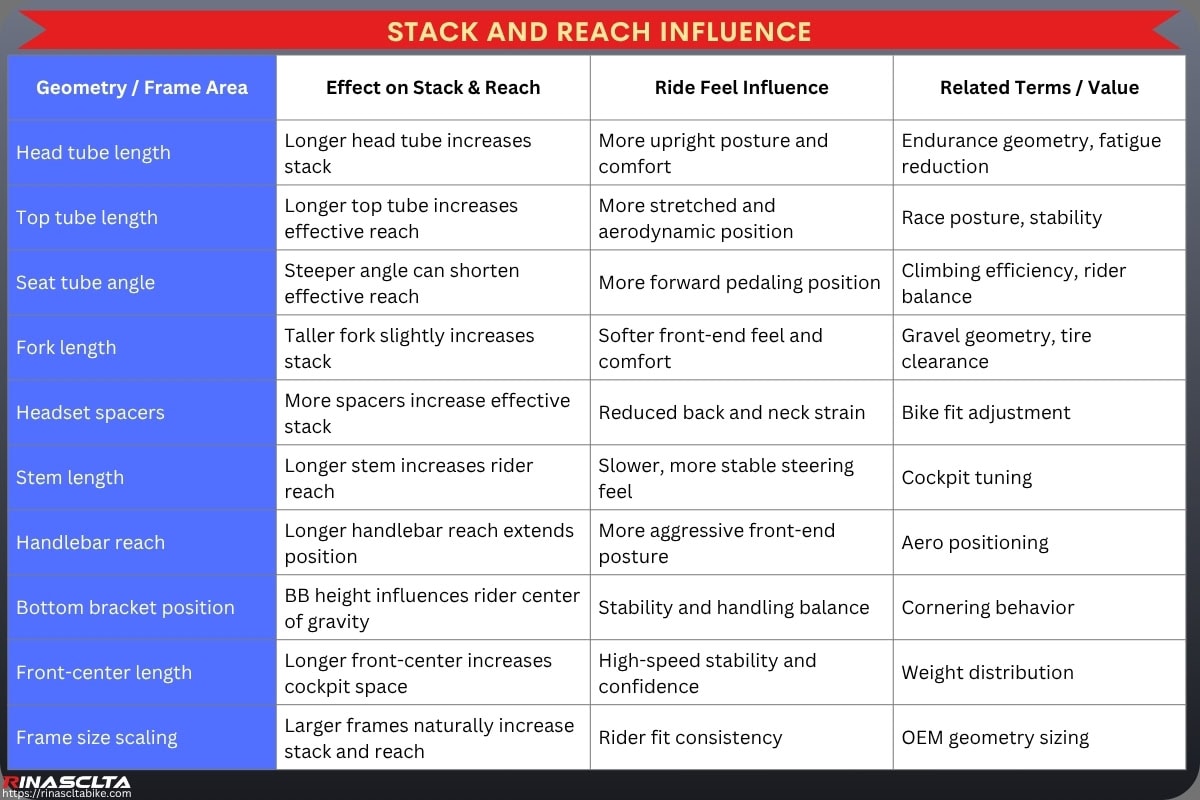
Bikes with low stack and long reach usually feel more aggressive, aerodynamic, and race-focused, improving sprinting efficiency and high-speed stability but increasing rider fatigue over long distances. Bikes with high stack and shorter reach feel more comfortable, stable, and confidence-inspiring, especially for endurance riding, gravel terrain, and long training sessions where comfort and reduced upper-body strain are more important than pure aerodynamic efficiency.
Modern OEM and ODM bicycle brands carefully optimize stack and reach because these two measurements are among the most important factors in bike fit and rider experience. Current trends in endurance and gravel bikes often favor slightly higher stack and shorter reach for comfort and control, while aero race bikes continue using lower stack and longer reach to maximize aerodynamic efficiency and aggressive riding posture.
Wheelbase and handling stability
Wheelbase and handling stability affect bike ride feel because they determine how stable, agile, predictable, and confidence-inspiring the bicycle feels during cornering, descending, sprinting, climbing, braking, and high-speed riding. Wheelbase is the distance between the front and rear wheel axles, and it is influenced by factors such as the head tube angle, fork rake, trail, chainstay length, front-center length, bottom bracket position, wheel size, tire clearance design, and overall frame geometry layout. A shorter wheelbase generally creates quicker and more responsive handling, while a longer wheelbase improves straight-line stability, traction, and control on rough terrain or at high speed.
Handling stability is closely connected to how the rider’s weight is distributed across the frame and wheels. Bikes with shorter wheelbases usually feel more aggressive, lively, and agile because the wheels are positioned closer together, allowing faster steering response and easier directional changes. Longer wheelbase bikes feel calmer and more planted because the larger footprint increases stability and reduces nervous steering behavior, especially on gravel, endurance riding, or fast descents.
| Geometry / Frame Area | Effect on Wheelbase & Stability | Ride Feel Influence | Related Terms / Value |
| Chainstay length | Longer chainstays increase wheelbase | More stability and traction | Gravel stability, climbing control |
| Front-center length | Longer front-center increases wheelbase | Improved high-speed confidence | Weight distribution, descending stability |
| Head tube angle | Slacker angle often increases wheelbase | Slower but more stable steering | Endurance and MTB handling |
| Fork rake and trail | Affects steering stability and wheel positioning | Predictable vs responsive steering | Trail measurement, steering feel |
| Wheel size | Larger wheels can slightly increase wheelbase feel | Improved rollover stability | 700C, 29er dynamics |
| Bottom bracket position | Influences center of gravity and balance | Cornering stability and rider confidence | BB drop, handling balance |
| Tire clearance design | Wider tire compatibility may lengthen frame layout | Smoother and more stable ride feel | Gravel geometry trends |
| Top tube and reach design | Longer front triangle increases wheelbase indirectly | Stable race posture and control | Aero endurance geometry |
| Suspension design (MTB) | Longer travel often increases wheelbase | More downhill stability | Enduro and trail bike control |
| Frame category tuning | Different bike categories target different wheelbase behavior | Race agility vs endurance comfort | OEM geometry philosophy |
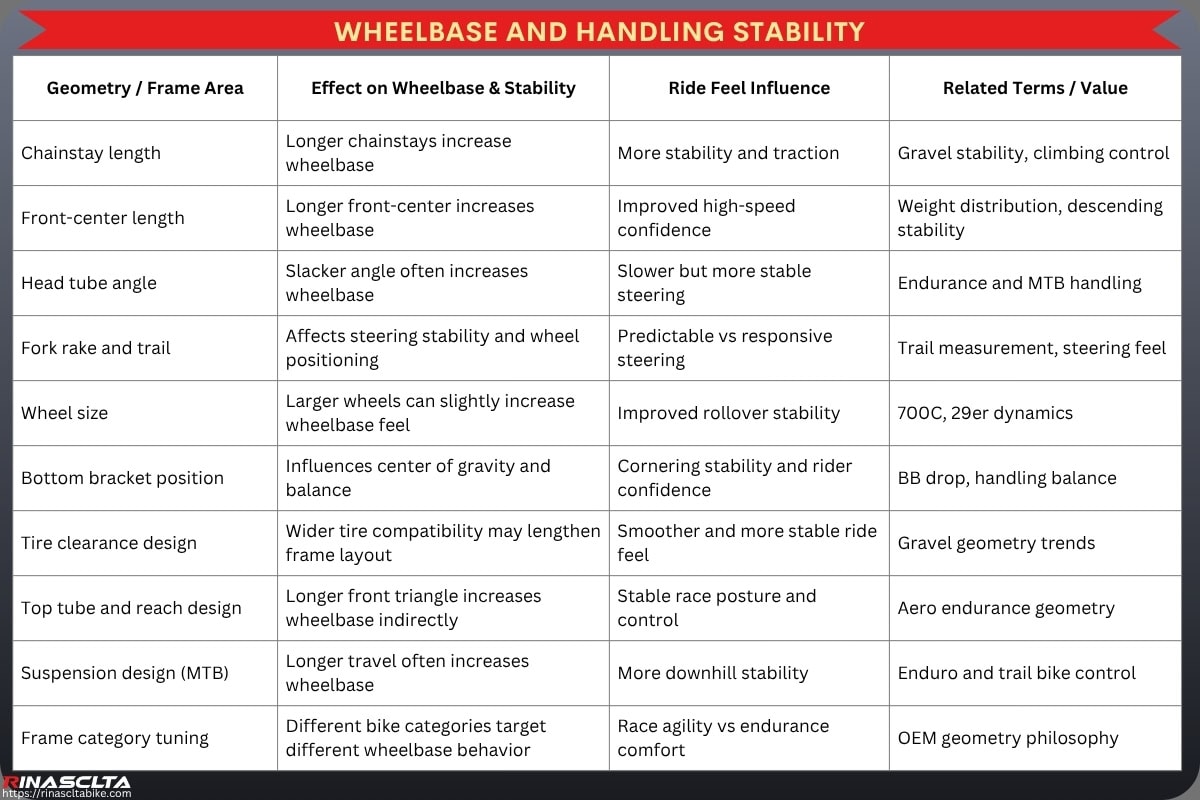
Short wheelbase bikes are commonly used on criterium race bikes, aggressive road bikes, and some XC MTB bikes because they provide fast steering response, rapid acceleration feel, and agile cornering. Longer wheelbase bikes are more common on gravel bikes, endurance road bikes, adventure bikes, and trail/enduro MTB platforms, where stability, traction, comfort, and confidence on rough terrain are more important than ultra-fast steering response.
Modern OEM and ODM bicycle brands carefully tune wheelbase because it strongly affects how riders perceive the bike’s personality. Current industry trends toward wider tires, endurance comfort, and gravel versatility have generally pushed many modern bikes toward slightly longer wheelbases to improve stability, control, and rider confidence across mixed riding conditions.
Chainstay length and responsiveness
Chainstay length and responsiveness affect bike ride feel because the chainstay controls the distance between the bottom bracket and the rear wheel, directly influencing acceleration feel, rear-wheel traction, climbing behavior, cornering agility, wheelbase length, power transfer, weight distribution, and overall bike responsiveness. Chainstay behavior is influenced by factors such as the rear triangle layout, bottom bracket stiffness, tire clearance design, wheel size, drivetrain spacing, dropout position, seat tube shape, rear axle standard, and carbon layup tuning, all of which determine whether the bike feels quick and lively or stable and composed under load.
Shorter chainstays position the rear wheel closer to the rider, creating a more direct and responsive feel because pedaling forces transfer more immediately through the rear triangle. This often makes the bike feel faster during sprinting, climbing, and rapid direction changes. Longer chainstays move the rear wheel farther back, improving stability, traction, and weight balance, especially on gravel, endurance riding, rough terrain, or loaded bikes. Modern carbon engineering carefully balances chainstay length with tire clearance, compliance tuning, and drivetrain requirements because wider tires and modern gravel geometry often require longer rear triangles to maintain stability and clearance.
| Geometry / Frame Area | Effect on Chainstay Length & Responsiveness | Ride Feel Influence | Related Terms / Value |
| Chainstay length itself | Shorter = quicker response, longer = more stability | Agile acceleration vs stable traction | Rear-center length |
| Bottom bracket stiffness | Stiffer BB improves power transfer through chainstays | More direct sprint feel | Drivetrain rigidity |
| Rear triangle design | Shapes force transfer and compliance behavior | Responsive vs compliant rear-end feel | Rear-end tuning |
| Tire clearance design | Wider tire clearance often requires longer stays | Improved comfort and stability | Gravel and endurance geometry |
| Wheelbase relationship | Longer chainstays increase total wheelbase | More stable handling | High-speed confidence |
| Seat tube shaping | Curved or cutaway seat tubes allow shorter stays | Faster acceleration feel | Aero integration |
| Dropout position | Influences rear axle placement | Handling balance and wheel control | Axle interface geometry |
| Carbon layup tuning | Changes lateral stiffness and vertical compliance | Power transfer vs comfort balance | Flex tuning |
| Wheel size | Larger wheels often require slightly longer stays | Stability and rollover behavior | 29er and gravel design |
| Drivetrain spacing | Wide cassettes and tire clearance affect chainstay packaging | Mechanical compatibility | Chainline optimization |
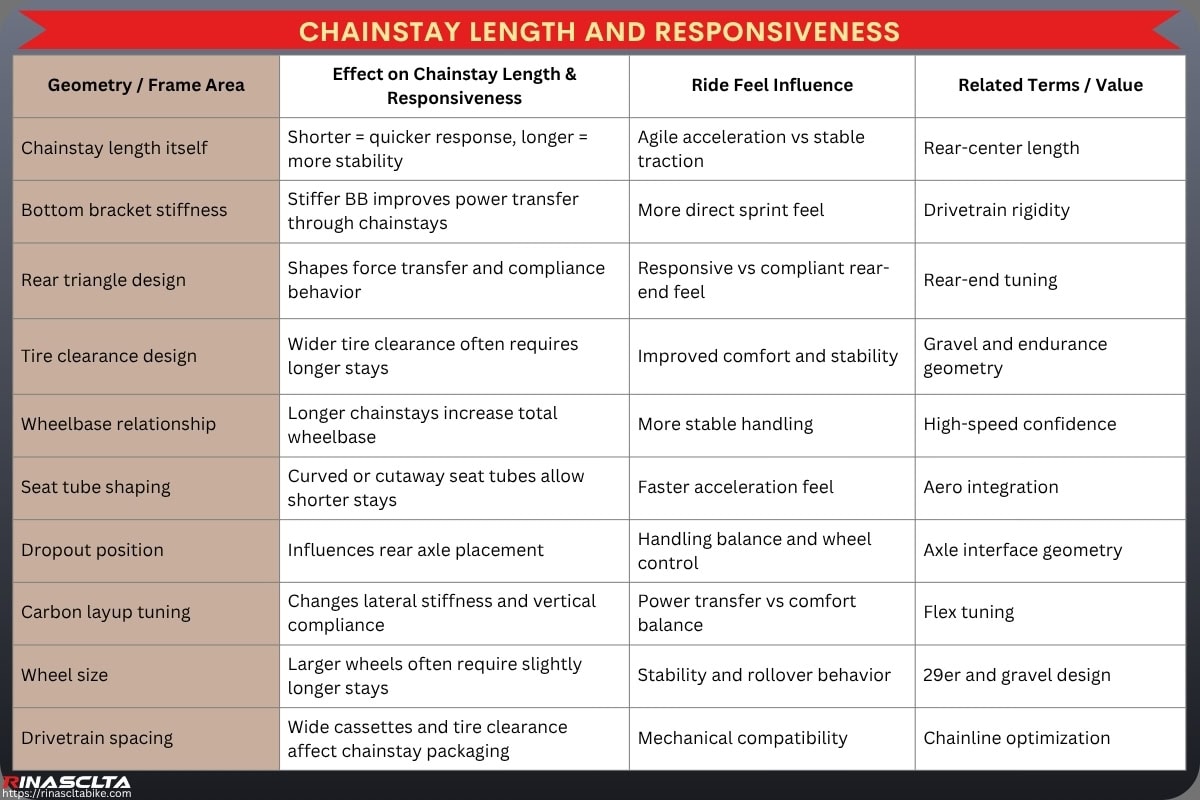
Short chainstays are commonly used on race road bikes, criterium bikes, XC MTB bikes, and aggressive aero platforms because they improve acceleration feel, responsiveness, and fast cornering behavior. Longer chainstays are more common on gravel bikes, endurance road bikes, touring bikes, and trail MTB platforms, where stability, traction, comfort, and control on rough terrain are more important than ultra-fast handling.
Modern OEM and ODM bicycle brands carefully optimize chainstay length because even small changes can significantly alter ride feel and handling personality. Current trends toward larger tire clearance, gravel versatility, and endurance comfort have generally pushed many modern bikes toward slightly longer and more compliant rear triangles to improve traction, stability, and rider confidence without losing too much pedaling responsiveness.
Ride Feel Differences Between Bike Categories
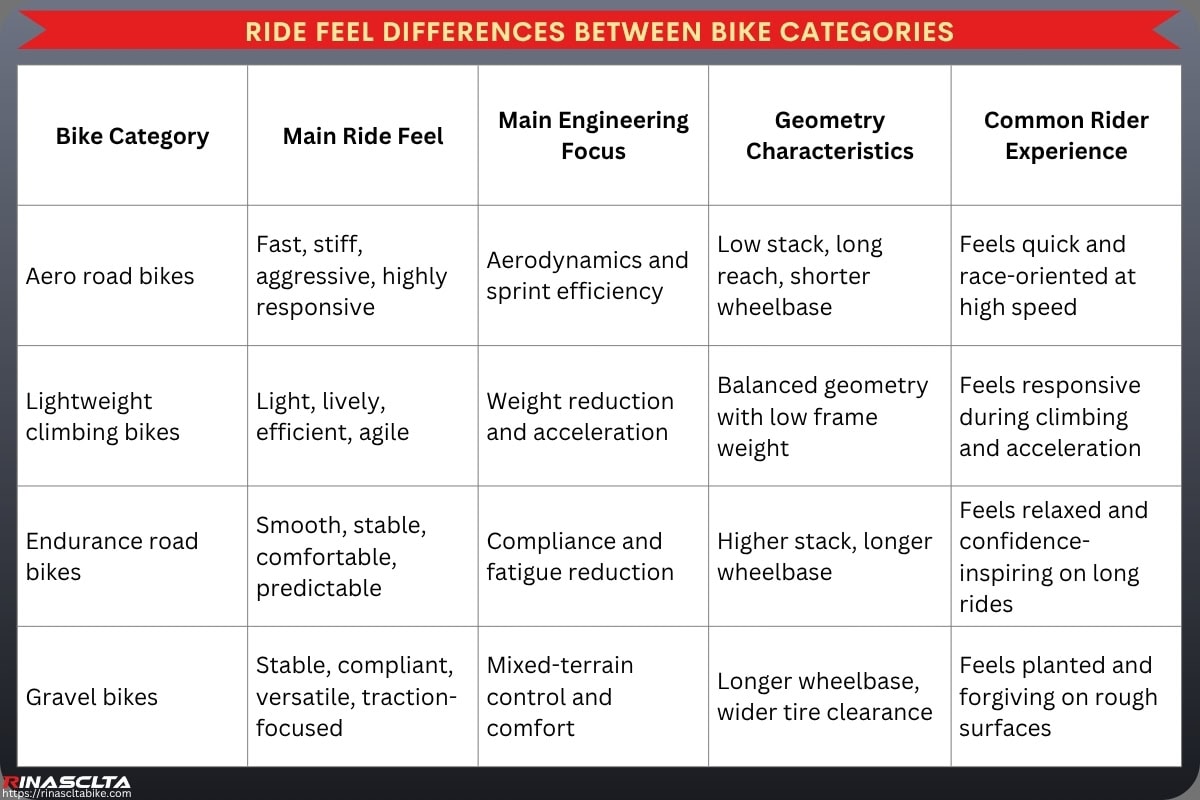
Ride feel differs greatly between bike categories because each type of bicycle is engineered around different priorities such as aerodynamics, stiffness-to-weight ratio, vibration damping, handling stability, rider posture, tire clearance, compliance tuning, and terrain capability. Aero road bikes focus on speed and aerodynamic efficiency, lightweight climbing bikes prioritize low weight and responsive acceleration, endurance road bikes emphasize comfort and stability over long distances, while gravel bikes are designed for mixed-surface control, traction, and vibration absorption. These differences are created through changes in frame geometry, carbon layup, wheelbase, tube shaping, tire clearance, stack and reach, fork design, and stiffness tuning, giving each category a distinct ride character suited to its intended riding conditions and rider expectations.
| Bike Category | Main Ride Feel | Main Engineering Focus | Geometry Characteristics | Common Rider Experience |
| Aero road bikes | Fast, stiff, aggressive, highly responsive | Aerodynamics and sprint efficiency | Low stack, long reach, shorter wheelbase | Feels quick and race-oriented at high speed |
| Lightweight climbing bikes | Light, lively, efficient, agile | Weight reduction and acceleration | Balanced geometry with low frame weight | Feels responsive during climbing and acceleration |
| Endurance road bikes | Smooth, stable, comfortable, predictable | Compliance and fatigue reduction | Higher stack, longer wheelbase | Feels relaxed and confidence-inspiring on long rides |
| Gravel bikes | Stable, compliant, versatile, traction-focused | Mixed-terrain control and comfort | Longer wheelbase, wider tire clearance | Feels planted and forgiving on rough surfaces |
Aero road bikes
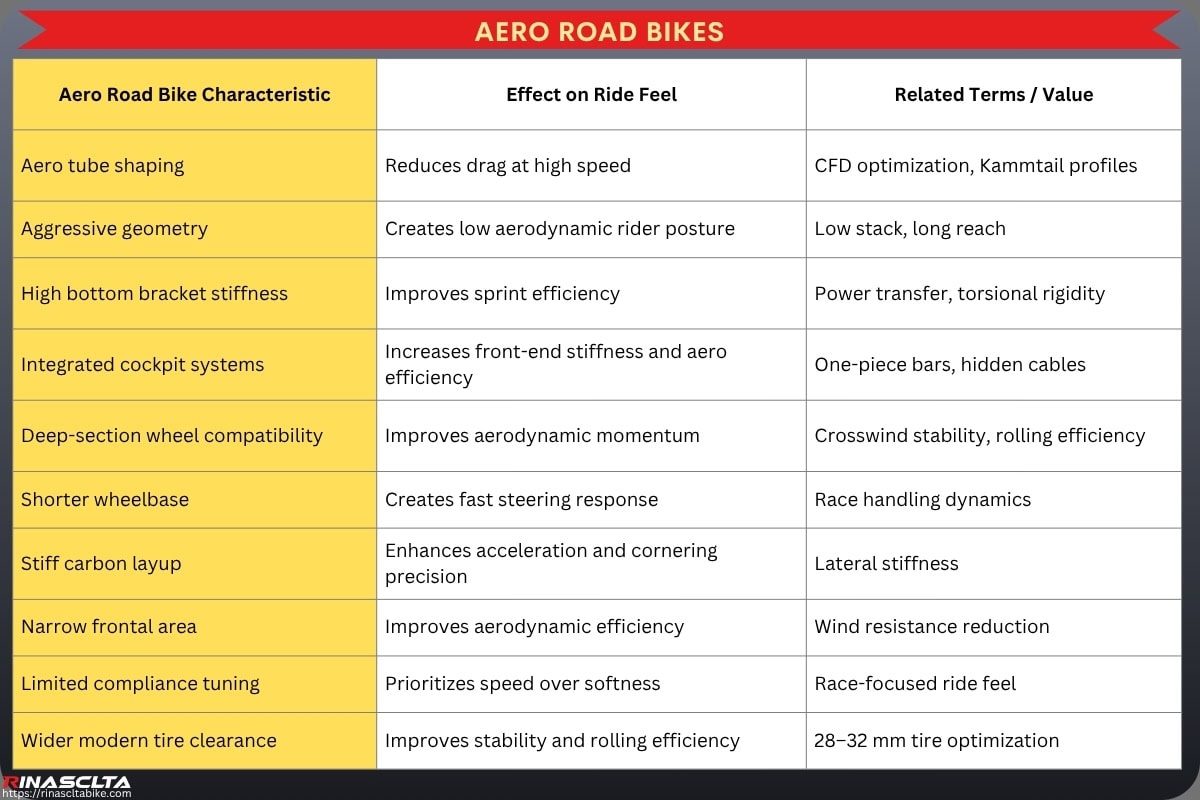
Aero road bikes are performance-focused bicycles engineered primarily for aerodynamic efficiency, high-speed stability, sprint responsiveness, and race performance, using advanced frame shaping, aggressive geometry, and high torsional stiffness to reduce air resistance and maximize speed on flat roads, rolling terrain, and fast race conditions. They are characterized by features such as deep aero tube profiles, truncated airfoil shapes (Kammtail profiles), fully integrated cockpit systems, hidden cable routing, deep-section wheel compatibility, narrow frontal area, low stack, long reach, aggressive rider position, stiff bottom bracket zones, and high lateral rigidity, all designed to improve aerodynamic performance and efficient power transfer at high speeds.
The ride feel of an aero road bike is typically:
- Fast and aggressive
- Very responsive under sprinting
- Stable at high speed
- Direct and stiff during acceleration
- Sharp in cornering response
- Aerodynamically efficient in headwinds
- More race-oriented than comfort-oriented
Because aero bikes prioritize stiffness and aerodynamic efficiency, they often feel firmer and harsher on rough roads compared to endurance or gravel bikes, especially when paired with deep carbon wheels, high tire pressure, and stiff carbon layups. However, modern aero bikes increasingly include features such as dropped seatstays, wider tire clearance, vibration-damping seatposts, optimized carbon layups, and compliance tuning to improve comfort without sacrificing aerodynamic performance.
| Aero Road Bike Characteristic | Effect on Ride Feel | Related Terms / Value |
| Aero tube shaping | Reduces drag at high speed | CFD optimization, Kammtail profiles |
| Aggressive geometry | Creates low aerodynamic rider posture | Low stack, long reach |
| High bottom bracket stiffness | Improves sprint efficiency | Power transfer, torsional rigidity |
| Integrated cockpit systems | Increases front-end stiffness and aero efficiency | One-piece bars, hidden cables |
| Deep-section wheel compatibility | Improves aerodynamic momentum | Crosswind stability, rolling efficiency |
| Shorter wheelbase | Creates fast steering response | Race handling dynamics |
| Stiff carbon layup | Enhances acceleration and cornering precision | Lateral stiffness |
| Narrow frontal area | Improves aerodynamic efficiency | Wind resistance reduction |
| Limited compliance tuning | Prioritizes speed over softness | Race-focused ride feel |
| Wider modern tire clearance | Improves stability and rolling efficiency | 28–32 mm tire optimization |
Modern OEM and ODM manufacturers use technologies such as CFD aerodynamic simulation, FEA stiffness analysis, wind-tunnel testing, integrated cable systems, and advanced carbon layup engineering to optimize aero road bikes for both speed and handling. Today’s aero bikes are no longer only about pure stiffness and speed, but increasingly aim to balance aerodynamics, rider comfort, tire versatility, and real-world efficiency, especially as race bikes evolve toward all-around performance platforms rather than purely aerodynamic machines.
Lightweight climbing bikes
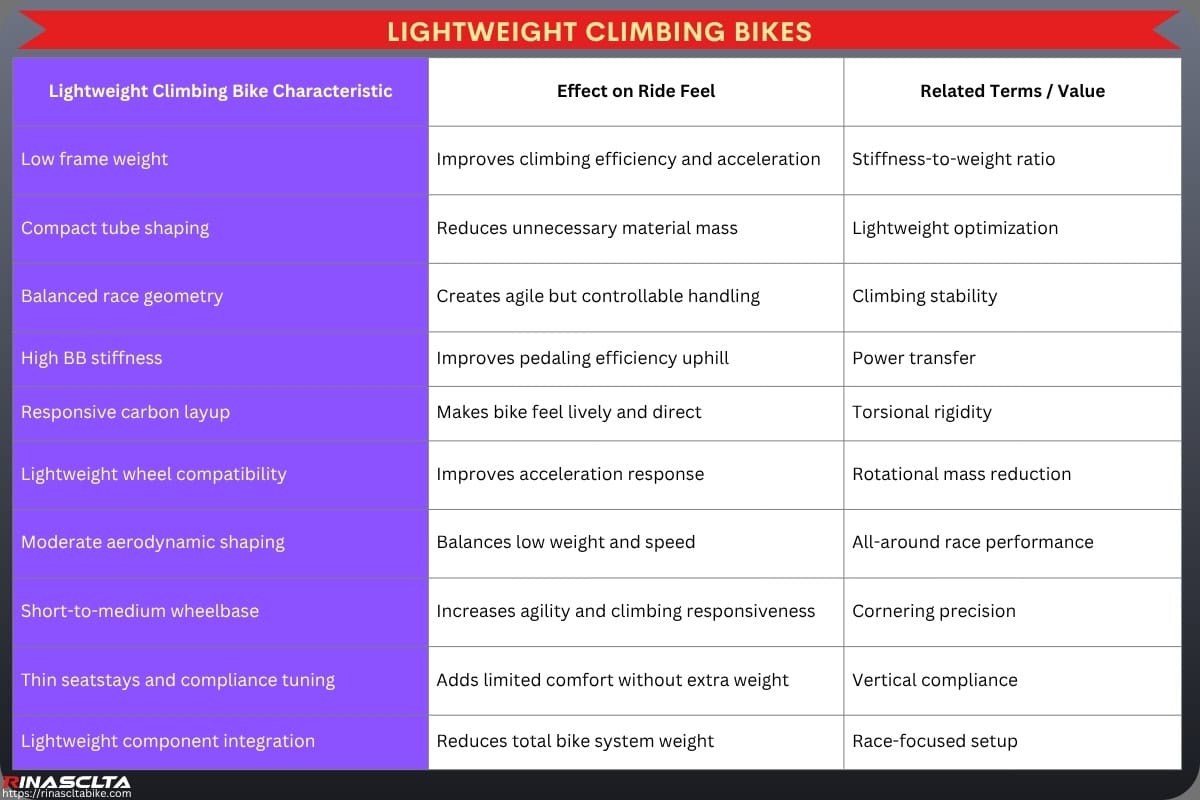
Lightweight climbing bikes are road bicycles engineered primarily for low weight, rapid acceleration, climbing efficiency, responsive handling, and high stiffness-to-weight ratio, making them especially effective on steep climbs, repeated elevation changes, and mountain terrain where reducing total system weight improves rider efficiency and responsiveness. They are characterized by features such as ultra-light carbon layups, thinner tube profiles, compact frame shapes, optimized carbon reinforcement zones, balanced race geometry, lightweight component integration, smaller tube cross-sections, and efficient power-transfer structures, all designed to minimize unnecessary mass while maintaining sufficient stiffness for climbing and out-of-saddle efforts.
The ride feel of a lightweight climbing bike is typically:
- Light and lively
- Quick to accelerate
- Highly responsive during climbing
- Agile in cornering
- Efficient under pedaling load
- Less momentum-focused than aero bikes
- More connected to road feedback
Because lightweight climbing bikes prioritize low mass and climbing efficiency, they often feel more reactive to rider input than aero or endurance bikes, especially during standing climbs, sudden accelerations, and rapid direction changes. Their lighter structure can also create a more “alive” road feel, where riders sense more immediate feedback from the road surface and drivetrain. Modern climbing bikes still require careful stiffness tuning because reducing too much material can negatively affect torsional rigidity, descending stability, impact resistance, and long-term durability, especially around the bottom bracket, head tube, and chainstay junctions.
| Lightweight Climbing Bike Characteristic | Effect on Ride Feel | Related Terms / Value |
| Low frame weight | Improves climbing efficiency and acceleration | Stiffness-to-weight ratio |
| Compact tube shaping | Reduces unnecessary material mass | Lightweight optimization |
| Balanced race geometry | Creates agile but controllable handling | Climbing stability |
| High BB stiffness | Improves pedaling efficiency uphill | Power transfer |
| Responsive carbon layup | Makes bike feel lively and direct | Torsional rigidity |
| Lightweight wheel compatibility | Improves acceleration response | Rotational mass reduction |
| Moderate aerodynamic shaping | Balances low weight and speed | All-around race performance |
| Short-to-medium wheelbase | Increases agility and climbing responsiveness | Cornering precision |
| Thin seatstays and compliance tuning | Adds limited comfort without extra weight | Vertical compliance |
| Lightweight component integration | Reduces total bike system weight | Race-focused setup |
Modern OEM and ODM manufacturers use technologies such as high-modulus carbon fiber, FEA structural simulation, optimized layup schedules, lightweight resin systems, and advanced reinforcement mapping to maximize stiffness while minimizing frame weight. Unlike aero bikes that rely heavily on aerodynamic momentum, climbing bikes are designed to feel quick, efficient, and reactive to rider effort, making them popular among riders who prioritize mountain riding, punchy acceleration, and dynamic ride feel over pure aerodynamic speed.
Endurance road bikes
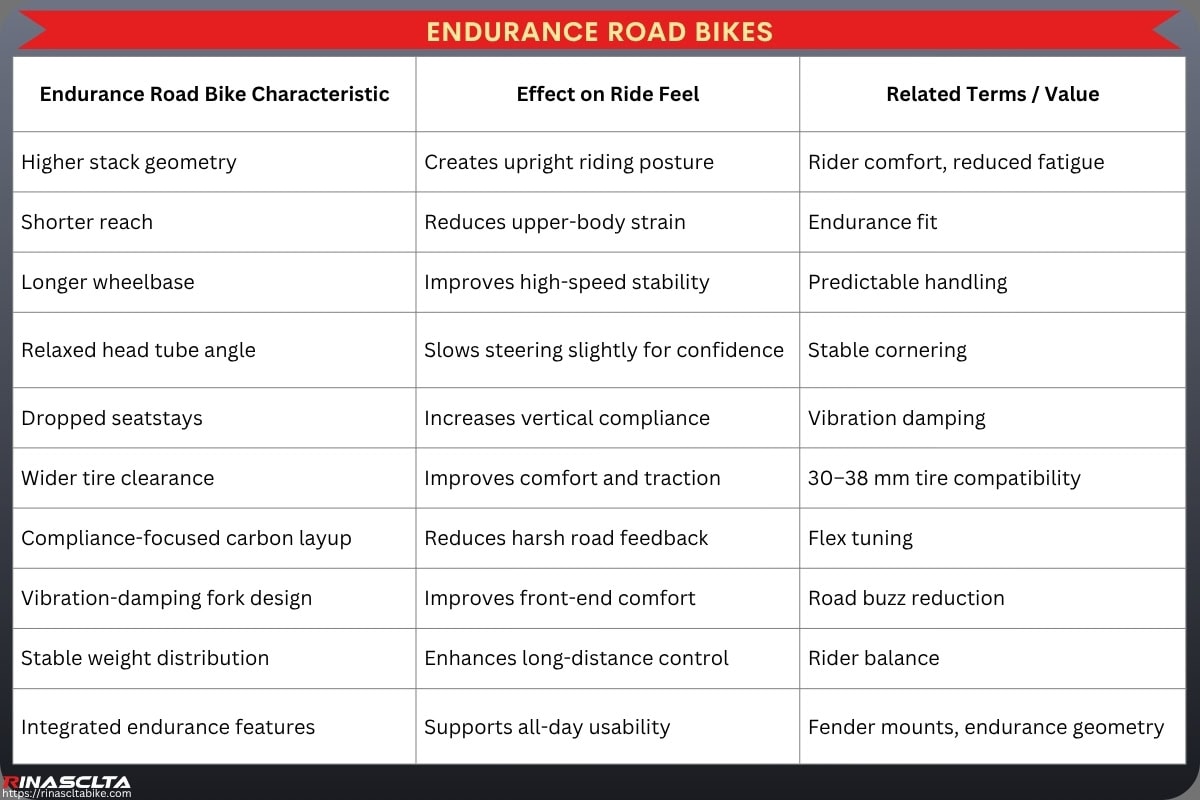
Endurance road bikes are road bicycles engineered primarily for long-distance comfort, stability, vibration reduction, fatigue management, and all-day riding efficiency, making them ideal for riders who spend many hours on rough roads, mixed pavement, endurance events, sportive rides, or general road cycling. They are characterized by features such as higher stack height, shorter reach, longer wheelbase, relaxed head tube angle, dropped seatstays, wider tire clearance, compliance-focused carbon layups, vibration-damping seatposts, and stable handling geometry, all designed to reduce physical strain on the rider while maintaining efficient road-bike performance.
The ride feel of an endurance road bike is typically:
- Smooth and comfortable
- Stable and predictable
- Less aggressive than race bikes
- Confidence-inspiring on descents
- More forgiving on rough roads
- Efficient for long-distance riding
- Less physically tiring over time
Because endurance bikes prioritize rider comfort and control, they usually absorb more road vibration through features such as flex-tuned seatstays, compliant fork blades, larger tire volume, lower tire pressure compatibility, and vertically compliant carbon layups. Compared to aero or lightweight climbing bikes, endurance bikes often feel calmer and less nervous at high speed, with more stable steering and a more upright rider position that reduces pressure on the neck, shoulders, wrists, lower back, and hands during long rides.
| Endurance Road Bike Characteristic | Effect on Ride Feel | Related Terms / Value |
| Higher stack geometry | Creates upright riding posture | Rider comfort, reduced fatigue |
| Shorter reach | Reduces upper-body strain | Endurance fit |
| Longer wheelbase | Improves high-speed stability | Predictable handling |
| Relaxed head tube angle | Slows steering slightly for confidence | Stable cornering |
| Dropped seatstays | Increases vertical compliance | Vibration damping |
| Wider tire clearance | Improves comfort and traction | 30–38 mm tire compatibility |
| Compliance-focused carbon layup | Reduces harsh road feedback | Flex tuning |
| Vibration-damping fork design | Improves front-end comfort | Road buzz reduction |
| Stable weight distribution | Enhances long-distance control | Rider balance |
| Integrated endurance features | Supports all-day usability | Fender mounts, endurance geometry |
Modern OEM and ODM manufacturers increasingly design endurance bikes to blend comfort, speed, tire versatility, and lightweight performance, especially as trends move toward all-road and endurance-focused riding. Many modern endurance bikes now include aerodynamic tube shaping, hidden cable routing, gravel-capable tire clearance, and lightweight carbon construction, allowing them to feel efficient and fast while still maintaining the smooth and stable ride quality expected for long-distance cycling.
Gravel bikes
Gravel bikes are versatile performance bicycles engineered for mixed-surface riding, traction, stability, vibration absorption, and long-distance control across terrain such as gravel roads, dirt paths, broken pavement, forest trails, and adventure routes. They are characterized by features such as longer wheelbase, slacker head tube angle, wider tire clearance, lower tire pressure compatibility, dropped seatstays, endurance-oriented geometry, stable steering behavior, disc brakes, reinforced carbon layups, and multiple mounting points, all designed to improve rider confidence, comfort, and control on unpredictable surfaces while maintaining efficient road-bike pedaling performance.
The ride feel of a gravel bike is typically:
- Stable and confidence-inspiring
- Smooth and compliant on rough terrain
- Less nervous than road race bikes
- Traction-focused during climbing and cornering
- Forgiving over long distances
- More upright and balanced
- Versatile across mixed riding conditions
Because gravel bikes are designed for uneven surfaces, their engineering focuses heavily on vibration damping, tire volume, geometry stability, traction control, and rider fatigue reduction. Compared to road bikes, gravel bikes often feel calmer and more planted because the longer wheelbase, slacker steering geometry, and wider tires improve stability and reduce sudden steering reactions on loose terrain. Lower tire pressures combined with compliant carbon layups and flex-tuned rear triangles help absorb impacts from gravel, washboard roads, rocks, and broken pavement, improving both comfort and wheel traction.
| Gravel Bike Characteristic | Effect on Ride Feel | Related Terms / Value |
| Longer wheelbase | Improves stability on rough terrain | High-speed confidence |
| Slacker head tube angle | Creates calmer steering behavior | Off-road control |
| Wider tire clearance | Increases comfort and traction | 40–50 mm tire compatibility |
| Lower tire pressure compatibility | Improves vibration absorption | Tubeless systems, grip |
| Compliance-focused carbon layup | Reduces rider fatigue on rough surfaces | Vibration damping |
| Dropped seatstays | Increases vertical flex and comfort | Rear-end compliance |
| Stable endurance-style geometry | Improves long-distance control | Rider balance and comfort |
| Reinforced frame zones | Handles rough terrain stress | Impact resistance |
| Disc brake integration | Improves braking control in all conditions | Modulation and traction |
| Multi-surface capability | Balances road speed and off-road stability | Adventure versatility |
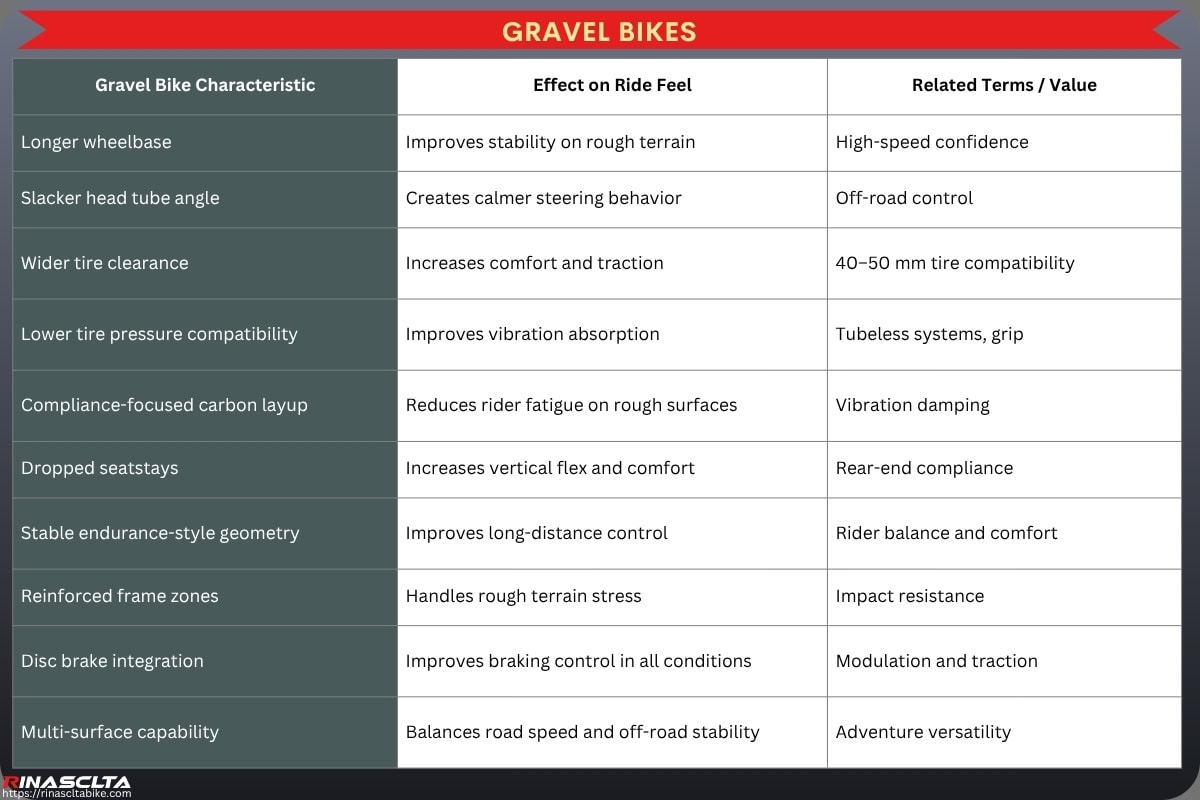
Modern OEM and ODM gravel bike engineering increasingly combines technologies from road, endurance, and MTB categories, using tools such as FEA simulation, vibration analysis, geometry optimization, carbon flex tuning, and tire-clearance integration to create bikes that can ride efficiently on pavement while remaining stable and comfortable on rough terrain. Current industry trends toward all-road versatility, bikepacking, endurance riding, wider tires, integrated storage, and adventure-focused geometry have made gravel bikes one of the fastest-evolving categories in modern carbon bicycle manufacturing.
Comfort vs Performance in Modern Carbon Bikes
Comfort versus performance in modern carbon bikes refers to the engineering balance between creating a bicycle that feels fast, stiff, aerodynamic, and highly responsive, while still remaining smooth, stable, vibration-damping, and physically sustainable for long rides. Modern carbon frame engineering no longer focuses only on maximum stiffness or minimum weight; instead, manufacturers now optimize factors such as carbon layup tuning, frame geometry, vibration damping, compliance zones, torsional stiffness, tire clearance, aerodynamic shaping, rider position, wheelbase stability, and component integration to achieve different ride characteristics for different rider categories and terrain conditions. Performance-focused bikes prioritize speed, acceleration, power transfer, and aerodynamic efficiency, while comfort-focused bikes emphasize fatigue reduction, traction, control, and long-distance ride quality. Most modern OEM and ODM carbon bikes now blend elements of both by using technologies such as dropped seatstays, wider tires, tuned flex zones, integrated cockpits, advanced carbon layups, and endurance geometry to improve comfort without significantly sacrificing efficiency or handling performance.
| Engineering / Ride Factor | Comfort-Focused Carbon Bikes | Performance-Focused Carbon Bikes | Related Terms / Value |
| Frame stiffness | Moderate and controlled | Very high lateral and torsional stiffness | Power transfer vs compliance |
| Carbon layup tuning | Vibration damping prioritized | Sprint response prioritized | Flex zones, modulus selection |
| Ride feel | Smooth and forgiving | Direct and aggressive | Rider fatigue vs responsiveness |
| Geometry | Upright and stable | Low and aerodynamic | Stack, reach, wheelbase |
| Tire clearance | Wider tires for lower pressure | Narrower or race-optimized tires | Comfort and traction |
| Wheelbase | Longer for stability | Shorter for agility | Handling behavior |
| Head tube angle | Slightly slacker | Steeper and quicker | Steering speed |
| Seatstay design | Dropped or flex-tuned | Stiffer rear triangle | Vertical compliance |
| Rider position | Relaxed endurance posture | Aggressive race posture | Aerodynamics vs comfort |
| Aerodynamic shaping | Moderate aero optimization | Maximum drag reduction | CFD tube design |
| Vibration damping | High priority | Secondary to efficiency | Road buzz reduction |
| Weight optimization | Balanced with durability | Aggressive lightweight focus | Stiffness-to-weight ratio |
| Long-distance comfort | Excellent | Moderate depending on setup | Endurance performance |
| Sprint and acceleration feel | Stable but less explosive | Highly reactive and sharp | Drivetrain rigidity |
| Terrain suitability | Rough roads and long rides | Smooth roads and race conditions | Endurance vs race tuning |
| OEM design philosophy | Rider comfort and versatility | Pure speed and efficiency | Market positioning |
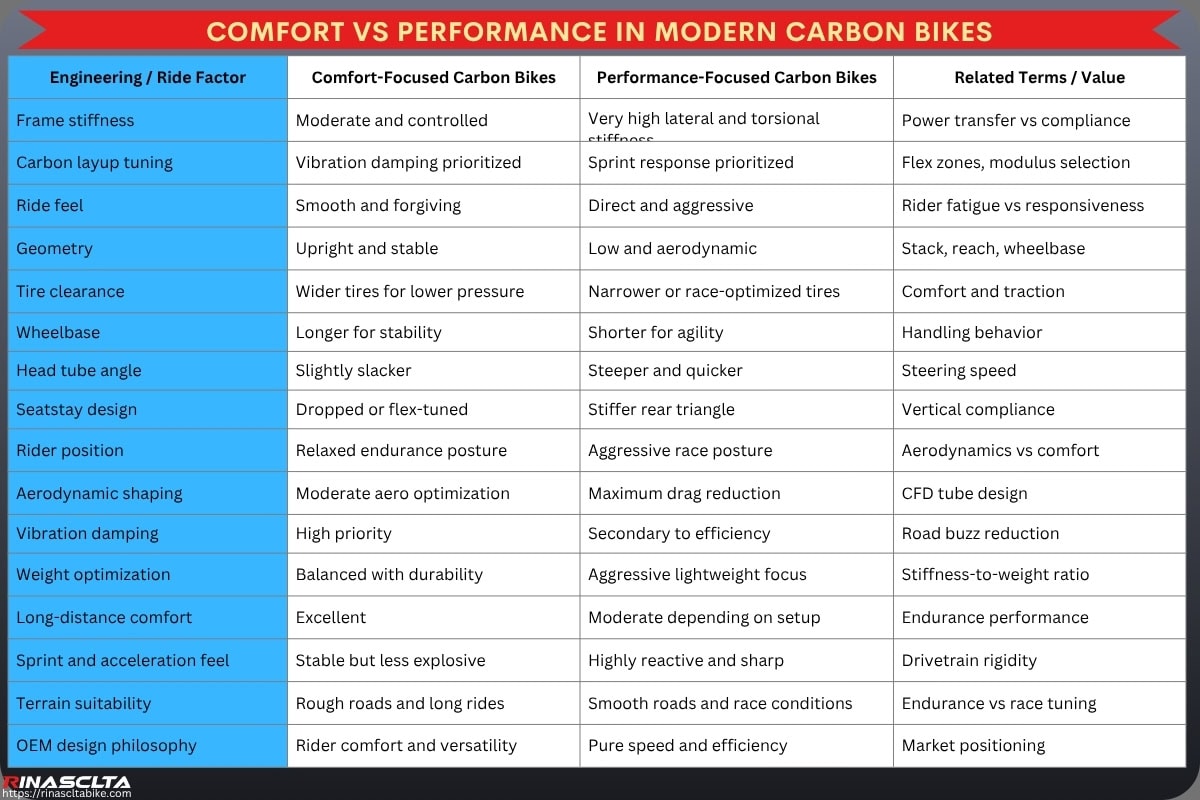
Compliance engineering
Compliance engineering is a carbon bike frame design strategy that intentionally allows specific parts of the bicycle to flex in controlled directions to improve comfort, traction, vibration damping, fatigue reduction, and ride stability without significantly reducing pedaling efficiency, steering precision, or power transfer. In modern carbon bike manufacturing, compliance does not mean the frame is weak or soft; instead, it means engineers carefully tune how the frame behaves under real riding loads by controlling fiber orientation, carbon layup schedules, tube shape, wall thickness, flex zones, seatstay design, fork structure, and seatpost integration.
The goal of compliance engineering is to absorb or reduce high-frequency vibration and harsh road impacts before they reach the rider through the saddle, handlebars, pedals, and frame contact points. This is especially important on rough pavement, gravel roads, cobblestones, washboard terrain, and long endurance rides where continuous vibration increases muscle fatigue, hand numbness, lower-back strain, and rider exhaustion.
Modern carbon bikes usually achieve compliance through features such as:
- Dropped seatstays
- Thin flex-tuned seatstays
- Flattened seatpost designs
- Slim seat tubes
- Fork-blade flex tuning
- Lower seat-clamp positions
- Controlled vertical flex zones
- Wider tire clearance
- Specific carbon fiber orientations
- Lower-pressure tubeless tire systems
Unlike older bike designs that focused almost entirely on stiffness, modern compliance engineering separates vertical compliance from lateral and torsional stiffness. This means the bike can remain stiff during sprinting and cornering while still flexing slightly upward and downward to improve comfort and traction.
| Compliance Engineering Area | Engineering Goal | Effect on Ride Feel | Related Terms / Value |
| Seatstay design | Allow controlled rear-end flex | Smoother ride and reduced fatigue | Vertical compliance |
| Carbon layup tuning | Control flex direction | Balanced comfort and stiffness | Fiber orientation |
| Fork compliance | Reduce front-end vibration | Improved steering comfort | Road buzz damping |
| Seatpost integration | Increase saddle comfort | Reduced harsh impacts | Flex seatpost systems |
| Tire clearance engineering | Enable wider, lower-pressure tires | More traction and vibration absorption | Gravel and endurance tuning |
| Frame geometry | Improve rider stability and comfort | Less physical strain over long rides | Endurance geometry |
| Bottom bracket isolation | Maintain pedaling stiffness | Efficient power transfer | Torsional rigidity |
| Compliance zones | Localize flex to non-critical areas | Controlled comfort without instability | Flex tuning zones |
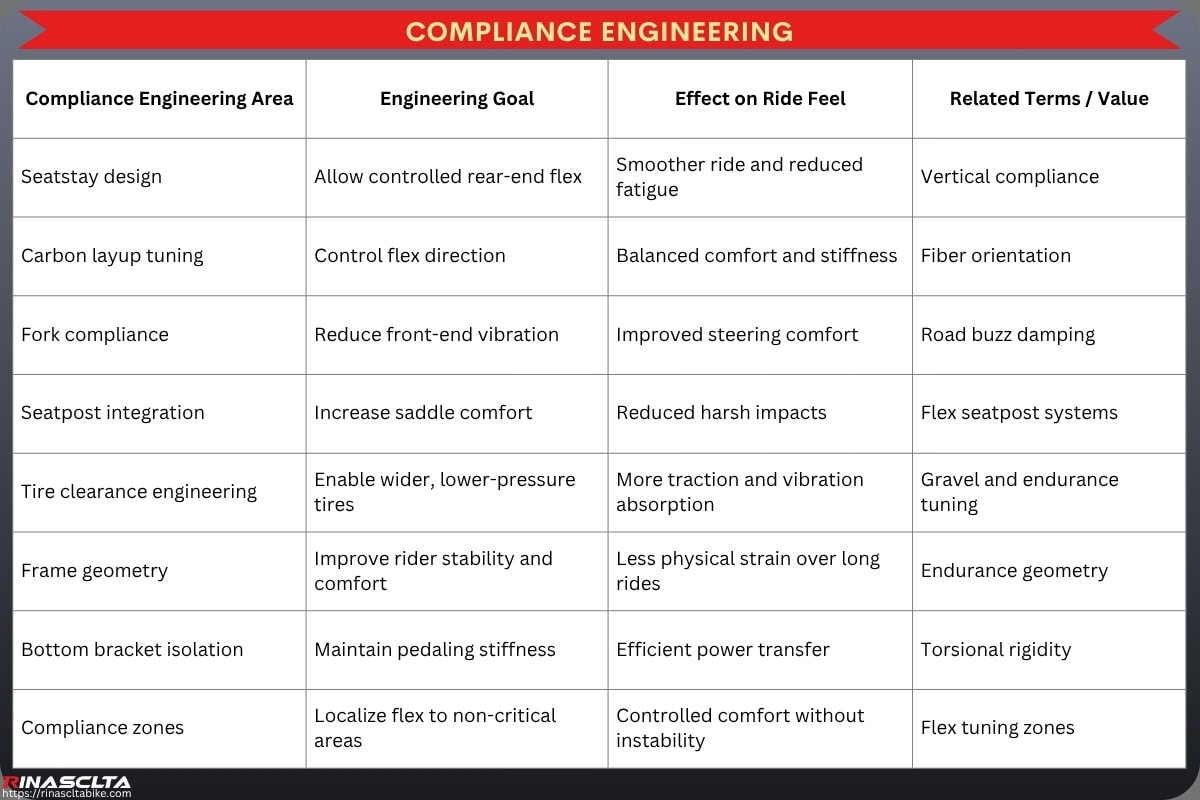
Modern OEM and ODM manufacturers now use technologies such as FEA simulation, vibration-frequency analysis, rider telemetry, strain mapping, and real-world fatigue testing to optimize compliance behavior for different bike categories. Endurance and gravel bikes generally prioritize higher compliance for long-distance comfort and rough terrain control, while aero race bikes use more limited compliance tuning to maintain aggressive handling and sprint responsiveness.
In modern bicycle engineering, compliance engineering is considered one of the key reasons why high-end carbon bikes can feel both efficient and comfortable at the same time. The best designs carefully manage how the frame flexes under load so the rider experiences reduced fatigue and improved traction without sacrificing the fast, responsive ride feel expected from performance carbon bicycles.
Wide tire integration
Wide tire integration is a modern bike frame engineering feature where the frame, fork, geometry, and clearance design are specifically optimized around larger-volume tires to improve comfort, traction, rolling efficiency, vibration damping, stability, and mixed-surface capability. Instead of treating tire clearance as only a compatibility issue, modern carbon bike engineering now treats the tire as an active part of the ride-feel system because wider tires significantly influence how the bicycle absorbs impacts, maintains grip, and transfers rider energy across different terrain. Compared to traditional narrow road tires such as 21–25 mm, modern endurance, all-road, and gravel bikes commonly support 28–50 mm tires, allowing lower air pressures that increase the tire contact patch and reduce vibration transmitted to the rider. Wide tire integration therefore affects important engineering areas such as the fork crown shape, chainstay spacing, seatstay layout, wheelbase tuning, bottom bracket clearance, aerodynamic tube shaping, brake mount positioning, compliance engineering, and drivetrain packaging, helping modern bikes feel smoother, more stable, more confidence-inspiring, and more versatile across rough pavement, gravel roads, and mixed terrain while still maintaining efficient rolling performance.
| Wide Tire Integration Area | Engineering Goal | Effect on Ride Feel | Related Terms / Value |
| Fork and frame clearance | Fit larger tires safely | Increased versatility and comfort | 28–50 mm tire compatibility |
| Tire volume optimization | Increase air cushioning effect | Reduced vibration and smoother ride | Lower tire pressure |
| Wheelbase tuning | Stabilize handling with larger tires | More planted and predictable handling | Gravel and endurance geometry |
| Compliance interaction | Combine tire and frame damping | Lower rider fatigue | Vertical compliance |
| Traction improvement | Increase tire contact patch | Better grip during climbing and cornering | Surface traction |
| Rolling resistance tuning | Improve efficiency on rough surfaces | Faster real-world riding comfort | Energy-loss reduction |
| Mud and debris clearance | Improve off-road usability | Better reliability in rough conditions | Adventure riding capability |
| Aerodynamic adaptation | Reduce drag from wider tires | Balanced speed and comfort performance | Wide-tire aero optimization |
| Brake and drivetrain spacing | Maintain component compatibility | Stable wheel alignment and control | Disc brake integration |
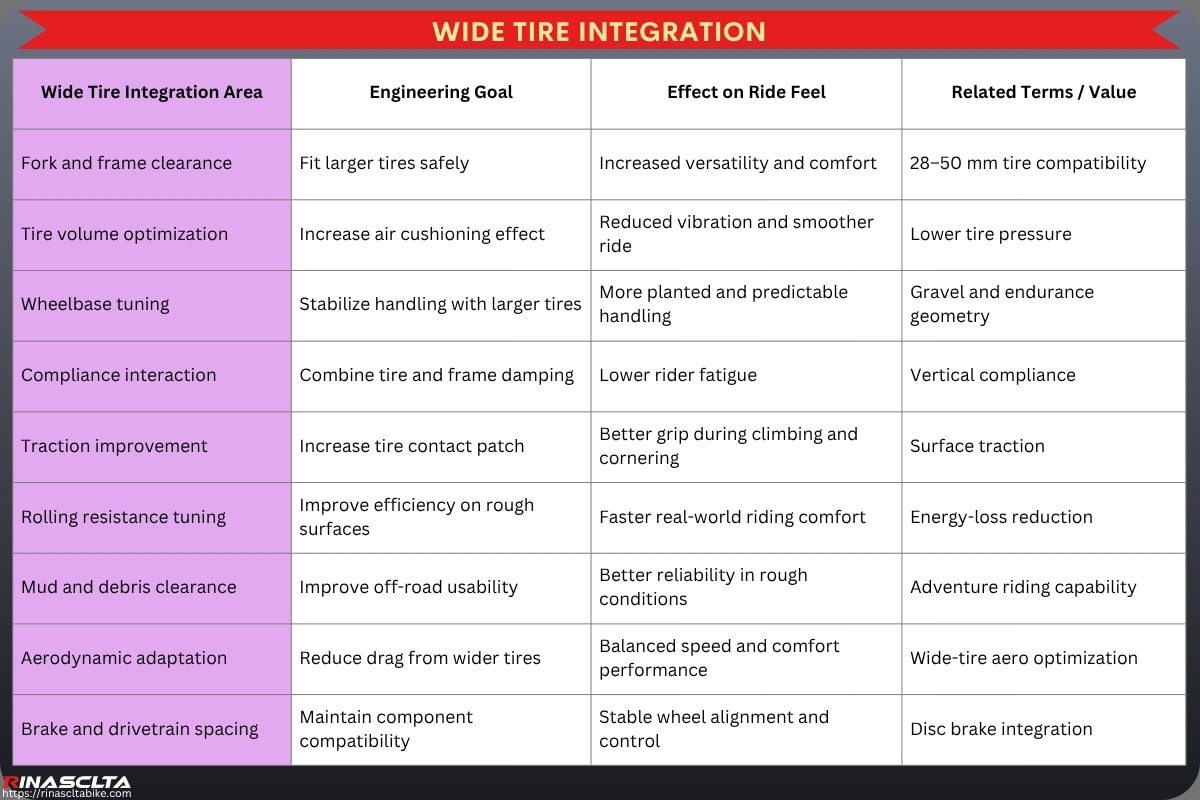
Long-distance comfort considerations
Long-distance comfort considerations in modern carbon bike engineering refer to the design strategies used to reduce rider fatigue, muscle strain, vibration exposure, pressure-point discomfort, and physical stress during extended hours of riding on roads, gravel, or mixed terrain. Unlike older race-focused bike development that prioritized only stiffness and low weight, modern endurance-oriented engineering now focuses on balancing comfort, stability, compliance, efficiency, and rider ergonomics so the bicycle remains fast while still being physically sustainable over long distances. Long-distance comfort is influenced by multiple integrated factors including frame geometry, carbon layup tuning, vibration damping, stack and reach dimensions, wheelbase stability, tire volume, saddle position, cockpit setup, seatpost flex, and rider weight distribution, because rider discomfort usually comes from the accumulation of repeated vibration and poor body positioning rather than single large impacts.
A bike designed with strong long-distance comfort characteristics typically feels:
- Smooth and stable
- Less physically tiring
- Predictable on rough roads
- More forgiving during long rides
- Comfortable for hands, back, neck, and shoulders
- Efficient without feeling harsh
Modern carbon bikes improve long-distance comfort through engineering features such as:
- Higher stack and shorter reach geometry
- Dropped seatstays
- Compliance-tuned carbon layups
- Wide tire integration
- Lower tire pressure compatibility
- Longer wheelbase design
- Flex-tuned seatposts
- Vibration-damping fork structures
- Stable steering geometry
- Balanced rider posture
| Comfort Engineering Area | Main Goal | Effect on Ride Feel | Related Terms / Value |
| Endurance geometry | Reduce rider strain | Upright and stable riding posture | Stack and reach optimization |
| Compliance engineering | Absorb vibration and impacts | Smoother ride quality | Vertical flex tuning |
| Wide tire integration | Improve shock absorption and grip | Reduced road harshness | Lower tire pressure |
| Wheelbase stability | Improve predictability at speed | Confidence on descents and rough roads | Endurance handling |
| Seatpost and saddle flex | Reduce saddle shock transmission | Lower lower-back fatigue | Comfort compliance |
| Fork vibration damping | Reduce front-end harshness | Less hand and wrist fatigue | Road buzz reduction |
| Carbon layup tuning | Balance stiffness and comfort | Efficient but forgiving ride feel | Fiber orientation |
| Rider position optimization | Improve ergonomic efficiency | Better long-term comfort | Bike fit engineering |
| Weight distribution balance | Reduce pressure concentration | More stable rider support | Handling control |
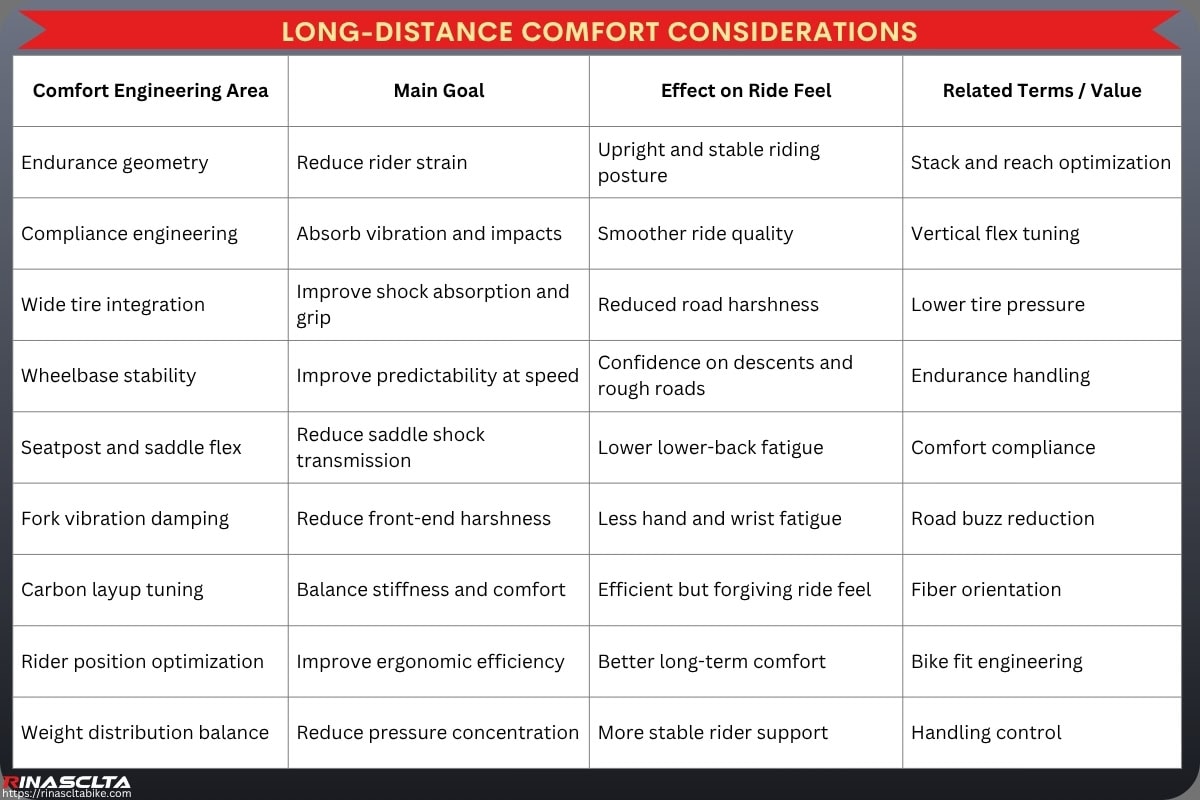
Modern OEM and ODM manufacturers now use technologies such as FEA simulation, vibration-frequency analysis, rider pressure mapping, motion-capture studies, and real-world endurance testing to optimize comfort performance without sacrificing too much speed or responsiveness. Current trends in endurance road bikes, all-road bikes, and gravel bikes increasingly combine aerodynamic shaping, lightweight construction, wider tire clearance, and advanced compliance tuning so riders can maintain efficiency and control over many hours of riding while experiencing significantly lower physical fatigue compared to older stiff race-bike designs.
Modern trends in performance bike design
Modern trends in performance bike design focus on balancing aerodynamics, lightweight construction, stiffness-to-weight ratio, vibration damping, rider comfort, wide tire integration, handling stability, and system integration rather than maximizing only one performance factor such as stiffness or low weight. Modern carbon bike engineering increasingly combines technologies such as CFD aerodynamic optimization, FEA structural simulation, compliance engineering, dropped seatstays, integrated cockpits, hidden cable routing, wide tire clearance, tubeless compatibility, asymmetric frame reinforcement, and category-specific carbon layups to create bikes that are faster, smoother, more stable, and more versatile under real-world riding conditions. Current industry trends also show a shift toward all-road performance, endurance-oriented race geometry, larger tire support (28–40 mm+), lower tire pressures, aerodynamic tube shaping, integrated storage systems, lightweight aero platforms, and rider-fatigue reduction, especially as brands recognize that real-world speed depends not only on pure stiffness or aerodynamics, but also on traction, comfort, control, and sustained rider efficiency over long distances and mixed terrain.
How OEM/ODM Manufacturers Tune Ride Feel?
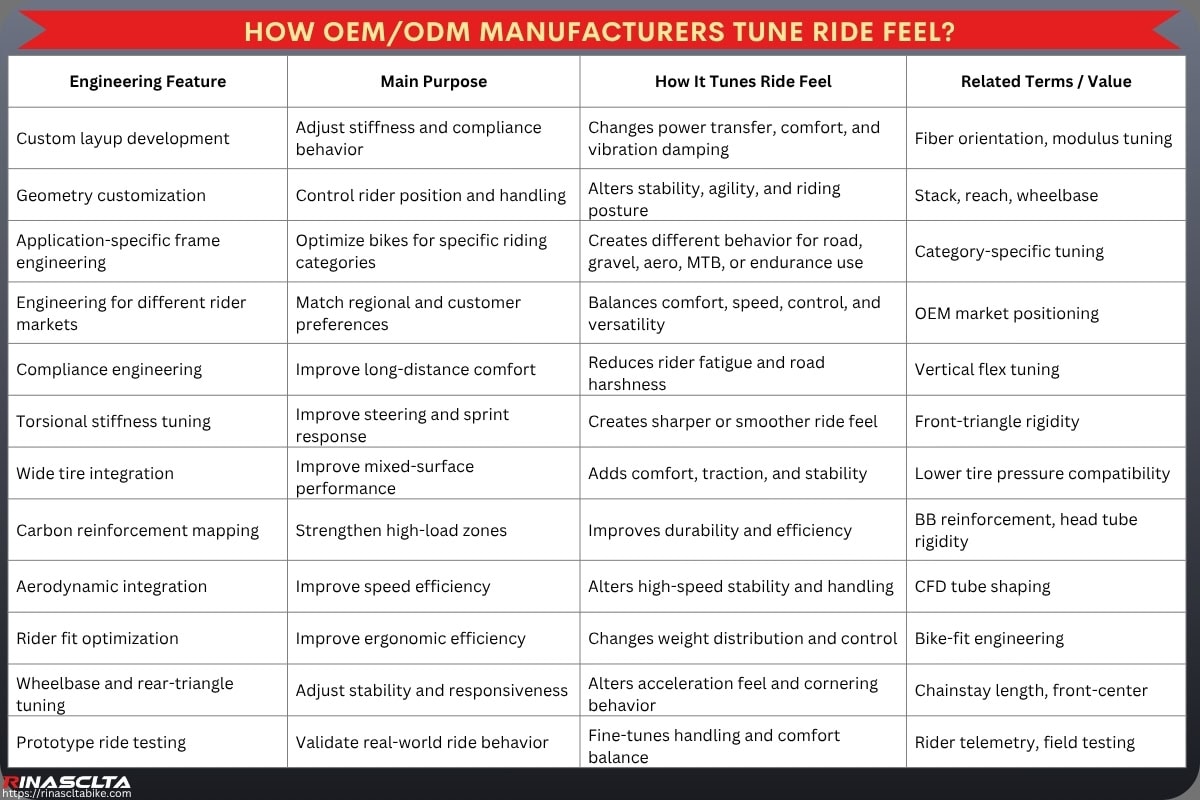
OEM and ODM manufacturers tune ride feel by adjusting factors such as custom carbon layup development, geometry customization, application-specific frame engineering, and rider-market-focused engineering, because different bicycle brands and rider categories require very different combinations of stiffness, comfort, handling stability, aerodynamics, vibration damping, tire compatibility, power transfer, and rider posture. Modern carbon bike manufacturing therefore focuses not only on producing a frame, but on engineering a complete ride character that matches the intended market segment, riding style, terrain, and performance expectations. Using technologies such as FEA simulation, CFD aerodynamic analysis, carbon ply mapping, compliance tuning, geometry optimization, vibration testing, and real-world ride evaluation, OEM and ODM factories can create multiple ride personalities from similar frame platforms while maintaining manufacturing efficiency and consistent QC standards.
| Engineering Feature | Main Purpose | How It Tunes Ride Feel | Related Terms / Value |
| Custom layup development | Adjust stiffness and compliance behavior | Changes power transfer, comfort, and vibration damping | Fiber orientation, modulus tuning |
| Geometry customization | Control rider position and handling | Alters stability, agility, and riding posture | Stack, reach, wheelbase |
| Application-specific frame engineering | Optimize bikes for specific riding categories | Creates different behavior for road, gravel, aero, MTB, or endurance use | Category-specific tuning |
| Engineering for different rider markets | Match regional and customer preferences | Balances comfort, speed, control, and versatility | OEM market positioning |
| Compliance engineering | Improve long-distance comfort | Reduces rider fatigue and road harshness | Vertical flex tuning |
| Torsional stiffness tuning | Improve steering and sprint response | Creates sharper or smoother ride feel | Front-triangle rigidity |
| Wide tire integration | Improve mixed-surface performance | Adds comfort, traction, and stability | Lower tire pressure compatibility |
| Carbon reinforcement mapping | Strengthen high-load zones | Improves durability and efficiency | BB reinforcement, head tube rigidity |
| Aerodynamic integration | Improve speed efficiency | Alters high-speed stability and handling | CFD tube shaping |
| Rider fit optimization | Improve ergonomic efficiency | Changes weight distribution and control | Bike-fit engineering |
| Wheelbase and rear-triangle tuning | Adjust stability and responsiveness | Alters acceleration feel and cornering behavior | Chainstay length, front-center |
| Prototype ride testing | Validate real-world ride behavior | Fine-tunes handling and comfort balance | Rider telemetry, field testing |
Custom layup development
Custom layup development is one of the most important engineering tools used by OEM and ODM carbon bike manufacturers to tune ride feel because it allows the factory to control exactly how the frame behaves under pedaling force, steering load, braking stress, road vibration, cornering pressure, and rider weight transfer. Unlike metal frames that mainly rely on tube dimensions and wall thickness, carbon frames can be tuned internally through the arrangement of fiber orientation, carbon modulus, ply sequence, laminate thickness, reinforcement placement, resin systems, and flex-zone engineering, allowing manufacturers to create completely different ride characteristics even when using the same external frame mold.
In OEM and ODM manufacturing, custom layup development is especially valuable because different bicycle brands often target different rider groups and product identities. One brand may want a frame that feels aggressive, stiff, aerodynamic, and race-focused, while another may prioritize comfort, compliance, gravel stability, endurance efficiency, or lightweight climbing response. Instead of developing a completely new frame platform, factories can modify the internal carbon layup schedule to create different ride personalities while keeping the same mold structure, reducing tooling costs and shortening product-development cycles.
Custom layup development typically involves tuning factors such as:
- Fiber orientation
- Carbon modulus selection
- Ply thickness
- Ply overlap strategy
- Localized reinforcement zones
- Vertical compliance tuning
- Torsional stiffness control
- Bottom bracket rigidity
- Head tube stiffness
- Vibration damping behavior
For example, OEM manufacturers may:
- Add high-modulus carbon around the bottom bracket for stronger sprint response
- Use thinner or differently oriented plies in seatstays for comfort compliance
- Increase torsional reinforcement in the head tube for sharper steering
- Tune fork layups to reduce road vibration
- Strengthen gravel-bike impact zones for durability and traction control
| Custom Layup Area | OEM/ODM Engineering Goal | Effect on Ride Feel | Related Terms / Value |
| Bottom bracket layup | Improve pedaling efficiency | Faster acceleration and sprint response | BB stiffness |
| Head tube reinforcement | Increase steering precision | Sharper front-end handling | Torsional rigidity |
| Seatstay flex tuning | Improve comfort and vibration absorption | Smoother ride quality | Vertical compliance |
| Fork layup optimization | Reduce road harshness | Improved front-end comfort | Vibration damping |
| Chainstay stiffness tuning | Balance acceleration and traction | Responsive but stable rear-end feel | Drivetrain efficiency |
| Gravel-specific reinforcement | Increase durability on rough terrain | More confidence and stability | Impact resistance |
| Endurance layup strategy | Reduce rider fatigue | Long-distance comfort | Compliance engineering |
| Aero race layup | Maximize stiffness and speed | Aggressive race feel | Power transfer optimization |
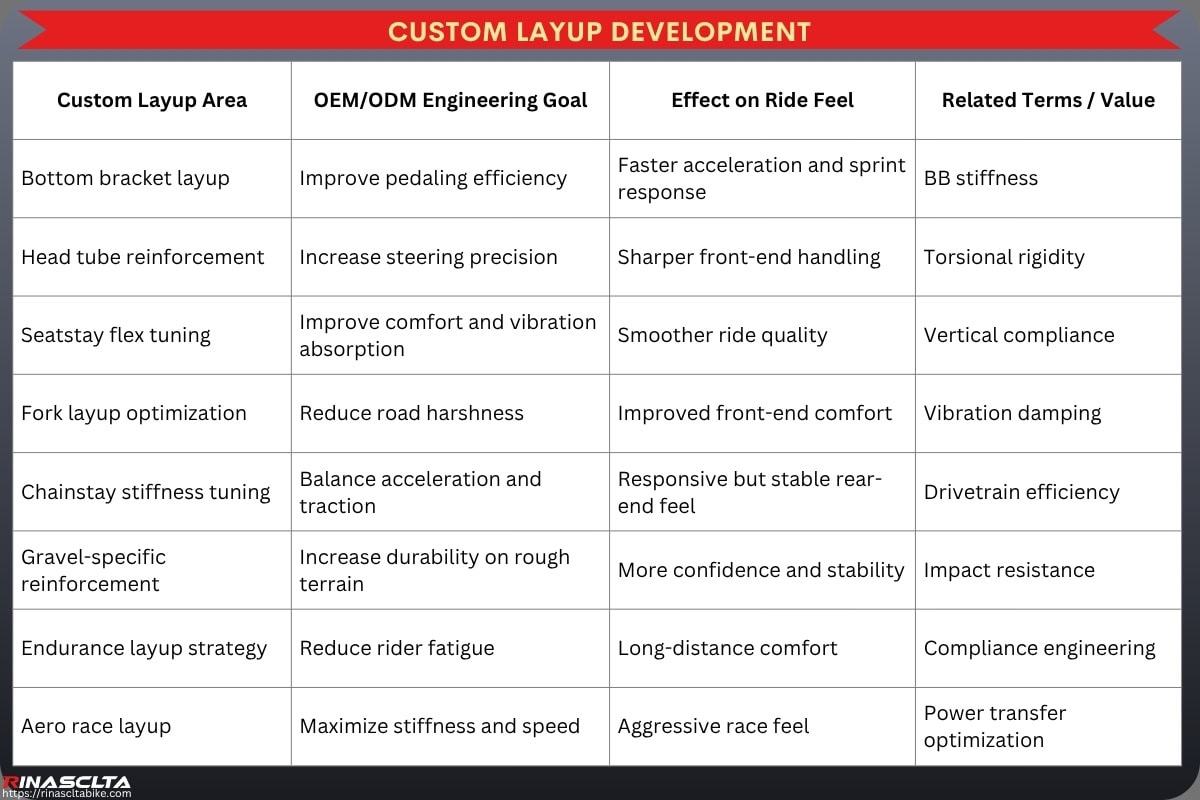
Modern OEM and ODM factories use advanced technologies such as FEA structural simulation, ply-mapping software, vibration analysis, stiffness testing rigs, fatigue-cycle testing, and prototype ride evaluation to optimize layup schedules before mass production. High-end factories also maintain strict process controls through digital ply books, laser-cut carbon plies, curing-cycle monitoring, resin-content control, and QC traceability systems, because even small layup inconsistencies can significantly affect ride feel, stiffness balance, durability, and production consistency.
In modern carbon bicycle manufacturing, custom layup development is considered far more important than simply using expensive carbon fiber because the layup determines how the frame actually rides in real-world conditions. This is why experienced OEM and ODM manufacturers can create multiple ride personalities, market-specific tuning strategies, and category-specific performance characteristics from similar frame platforms through advanced carbon engineering rather than only through material upgrades.
Geometry customization
Geometry customization is an OEM and ODM engineering process where manufacturers modify the frame’s dimensions and structural layout to create specific ride characteristics, rider positions, and handling behavior for different bicycle brands, riding disciplines, and target markets. Unlike cosmetic customization, geometry customization directly changes how the bicycle feels during cornering, climbing, sprinting, descending, braking, long-distance riding, and mixed-terrain control by adjusting factors such as the stack height, reach length, wheelbase, head tube angle, seat tube angle, chainstay length, bottom bracket drop, fork rake, trail, front-center length, and tire-clearance layout. Because these measurements determine rider posture, steering speed, weight distribution, and stability, geometry customization is one of the most powerful tools OEM and ODM manufacturers use to create different ride personalities even from similar frame concepts.
OEM and ODM brands request geometry customization for many reasons, including:
- Race-focused handling
- Endurance comfort optimization
- Gravel stability and control
- Regional rider-fit preferences
- Aerodynamic positioning
- Long-distance fatigue reduction
- Wide tire integration
- Category-specific performance tuning
- Professional team requirements
- Market differentiation
| Geometry Customization Area | OEM/ODM Engineering Goal | Effect on Ride Feel | Related Terms / Value |
| Stack height | Adjust rider uprightness | More comfort or more aerodynamic posture | Endurance vs race fit |
| Reach length | Tune rider extension and cockpit size | Stable high-speed handling or relaxed control | Rider positioning |
| Head tube angle | Control steering speed and stability | Quicker handling or calmer steering | Trail and front-end behavior |
| Wheelbase length | Balance agility and stability | Responsive cornering or planted handling | High-speed confidence |
| Chainstay length | Tune acceleration and traction | Faster response or smoother stability | Rear-wheel behavior |
| Bottom bracket drop | Change center of gravity | Stable cornering or responsive feel | Handling balance |
| Seat tube angle | Optimize pedaling posture | Aggressive climbing or endurance comfort | Rider efficiency |
| Fork rake and trail | Adjust steering precision | Agile or predictable front-end feel | Steering dynamics |
| Tire clearance geometry | Support wider tires and terrain versatility | Increased comfort and traction | Gravel and all-road tuning |
| Front-center length | Improve rider balance and wheel control | Stability during descending and rough terrain | Weight distribution |
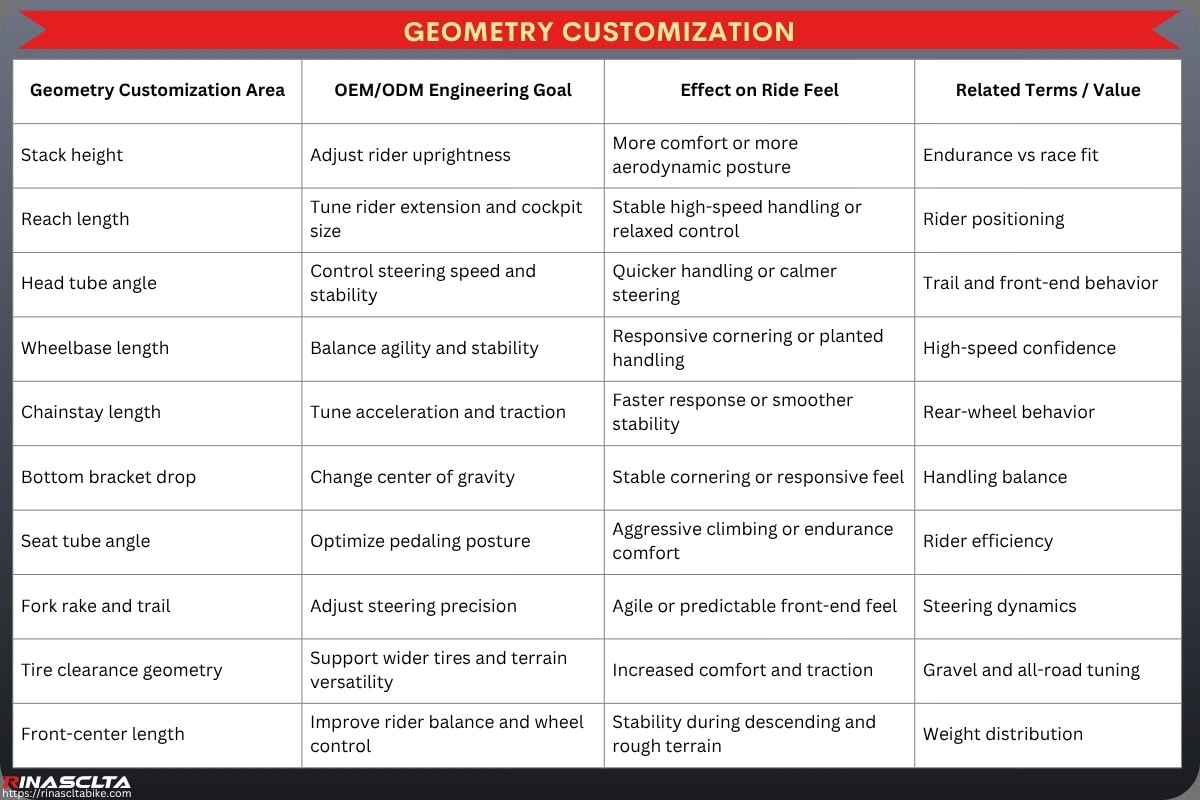
Modern OEM and ODM manufacturers use advanced tools such as bike-fit databases, FEA simulation, motion-capture analysis, rider telemetry, CFD aerodynamic testing, and real-world ride evaluation to optimize geometry for different rider categories and global markets. For example, a European endurance-focused brand may request taller stack geometry and wider tire compatibility for comfort-oriented riding, while a race-focused Asian or professional team brand may prefer longer reach, steeper steering geometry, and more aggressive aerodynamic positioning. Current trends toward all-road versatility, gravel integration, endurance comfort, and wider tire support have also pushed many manufacturers to develop geometry platforms that balance performance with stability and long-distance usability rather than focusing only on pure race responsiveness.
Application-specific frame engineering
Application-specific frame engineering is an OEM and ODM development strategy where carbon bike frames are engineered differently depending on the intended riding category, terrain, rider behavior, and performance goals rather than using one universal frame design for all situations. Modern bicycle brands require very different ride characteristics for aero road racing, lightweight climbing, endurance riding, gravel riding, XC racing, trail MTB, triathlon, bikepacking, or urban performance cycling, so manufacturers tune the frame’s geometry, carbon layup, stiffness profile, compliance behavior, aerodynamic shaping, tire clearance, reinforcement zones, and rider positioning to match the specific application. This approach is important because the same features that make a bike fast and aggressive on smooth pavement may make it unstable, harsh, or inefficient on rough terrain or long-distance rides.
Application-specific engineering usually focuses on factors such as:
- Terrain conditions
- Riding style
- Power-transfer requirements
- Comfort and fatigue management
- Handling stability
- Aerodynamic efficiency
- Impact resistance
- Tire clearance needs
- Rider posture optimization
- Long-term durability
| Bike Application | OEM/ODM Engineering Focus | Effect on Ride Feel | Related Terms / Value |
| Aero road bikes | Aerodynamics and sprint stiffness | Fast, aggressive, highly responsive | CFD shaping, torsional rigidity |
| Lightweight climbing bikes | Low weight and acceleration | Lively and efficient uphill feel | Stiffness-to-weight ratio |
| Endurance road bikes | Comfort and stability | Smooth and fatigue-reducing ride | Compliance tuning |
| Gravel bikes | Mixed-terrain traction and control | Stable and forgiving handling | Wide tire integration |
| XC MTB bikes | Pedaling efficiency and agility | Quick off-road responsiveness | Lightweight trail handling |
| Trail / Enduro MTB bikes | Impact absorption and stability | Controlled descending confidence | Suspension integration |
| Triathlon bikes | Aerodynamic rider positioning | Sustained high-speed efficiency | Aero posture optimization |
| Bikepacking / adventure bikes | Load stability and durability | Predictable long-distance handling | Reinforced frame zones |
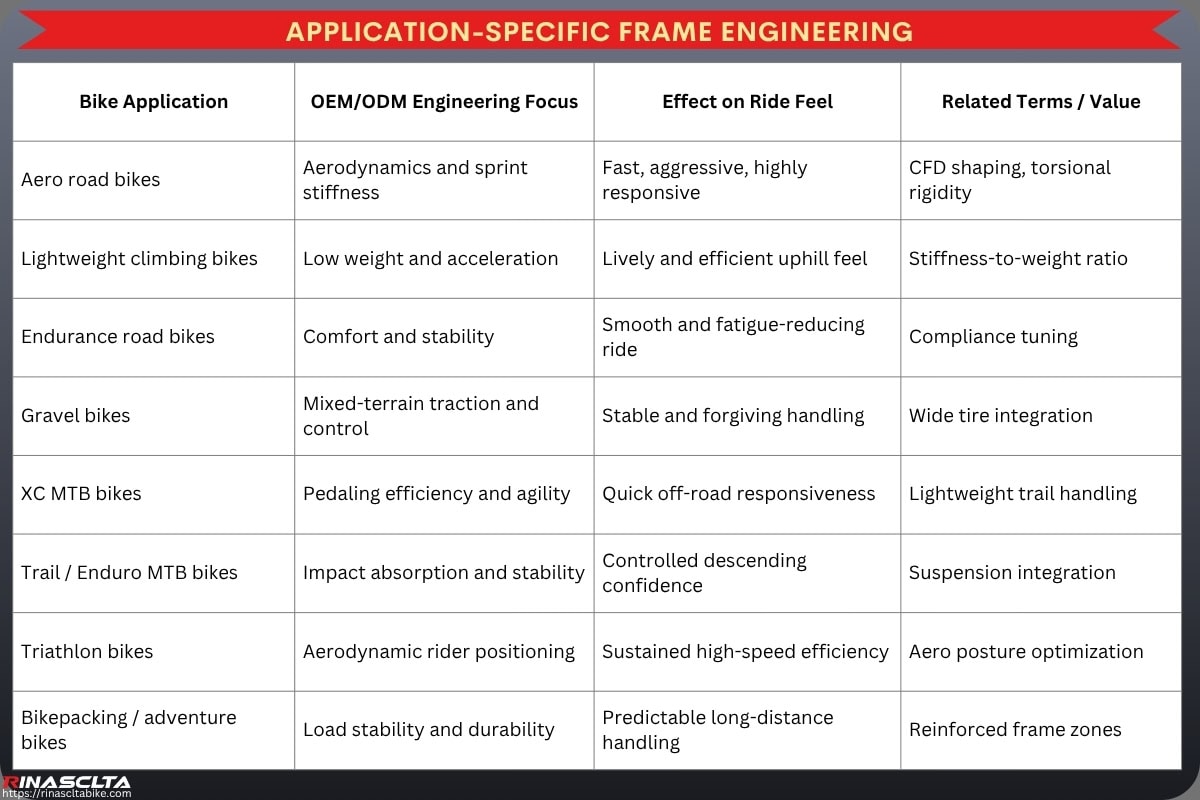
OEM and ODM manufacturers use technologies such as FEA structural simulation, vibration analysis, aerodynamic CFD testing, category-specific geometry platforms, rider telemetry, and real-world prototype testing to tune each frame application differently. For example, an endurance road bike may use more vertical compliance, taller stack geometry, and wider tire clearance to improve long-distance comfort, while an aero race bike may prioritize deep tube shaping, low stack geometry, and maximum bottom bracket stiffness for sprinting and high-speed efficiency. Gravel bikes may require additional reinforcement zones, lower-pressure tire optimization, and stable wheelbase tuning to handle rough terrain and loaded riding conditions.
In modern carbon bike manufacturing, application-specific engineering allows OEM and ODM brands to create highly targeted ride experiences for different markets and rider groups, improving product differentiation and rider satisfaction while maximizing performance in real-world riding conditions rather than optimizing only one aspect such as weight or stiffness.
Engineering for different rider markets
Engineering for different rider markets is an OEM and ODM development strategy where bicycle manufacturers modify frame design, geometry, stiffness tuning, comfort characteristics, tire compatibility, and overall ride behavior to match the preferences, riding habits, terrain conditions, body proportions, and performance expectations of specific regional or consumer markets. Modern global bicycle markets are highly diverse, so riders in different regions often prioritize very different characteristics such as aggressive race handling, endurance comfort, gravel versatility, lightweight climbing efficiency, urban practicality, aerodynamic performance, or rough-road stability. Because of this, OEM and ODM manufacturers do not simply produce one universal carbon frame, but instead tune the bike’s geometry, carbon layup, compliance behavior, tire clearance, rider positioning, aerodynamic integration, and stiffness profile to better fit the target customer group.
Engineering for different rider markets commonly considers:
- Regional riding terrain
- Consumer riding style
- Average rider flexibility and posture
- Local road conditions
- Climate and weather exposure
- Race culture and performance expectations
- Comfort preferences
- Body size distribution
- Tire-size trends
- Market pricing and product positioning
| Rider Market / Segment | OEM/ODM Engineering Focus | Effect on Ride Feel | Related Terms / Value |
| European endurance market | Comfort and long-distance stability | Smooth and fatigue-reducing ride | Endurance geometry |
| North American gravel market | Wide tire integration and versatility | Stable and confidence-inspiring handling | Gravel compliance tuning |
| Asian race-oriented market | Aggressive geometry and responsiveness | Fast steering and aerodynamic posture | Race fit optimization |
| Professional race teams | Maximum efficiency and stiffness | Highly reactive sprint behavior | Power-transfer tuning |
| Recreational riders | Comfort and easy control | Relaxed and forgiving handling | Upright rider position |
| Adventure / bikepacking market | Durability and load stability | Predictable handling under load | Reinforced frame zones |
| Lightweight climbing segment | Weight reduction and acceleration | Lively climbing response | Stiffness-to-weight ratio |
| Urban performance market | Practicality and control | Stable all-around ride feel | Tire clearance and comfort tuning |
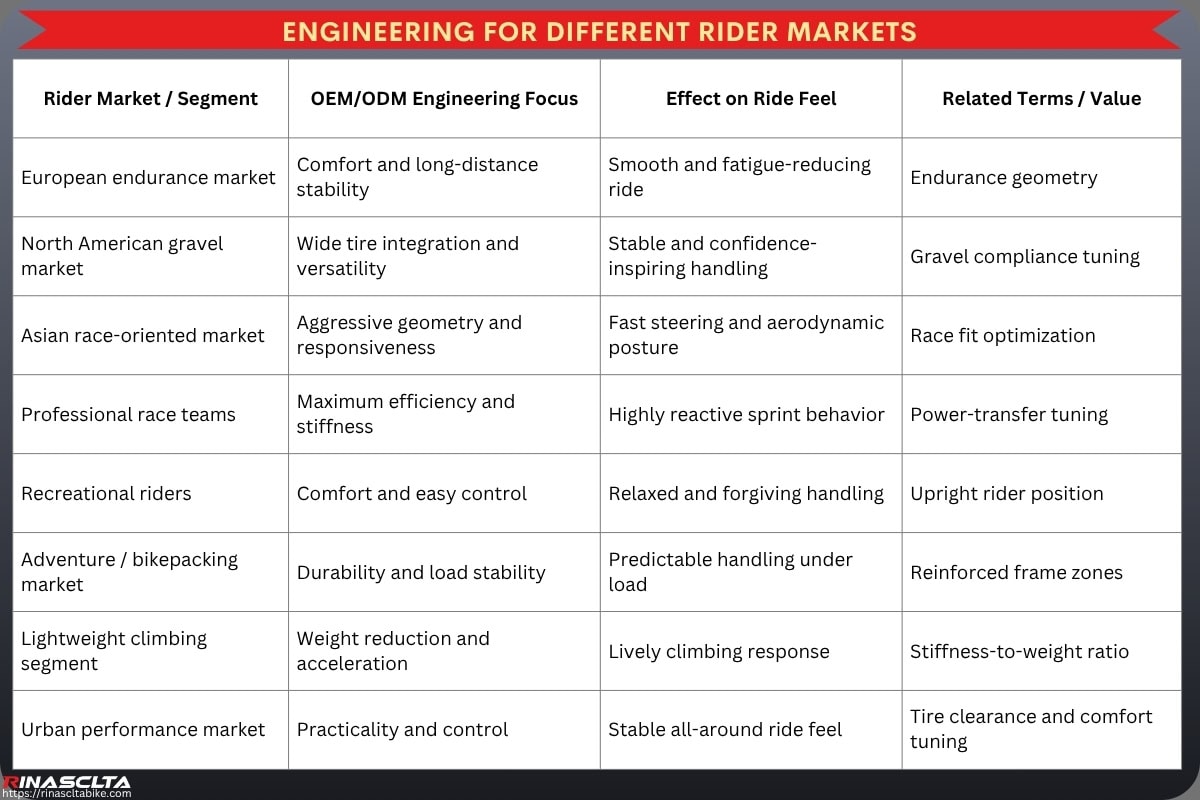
OEM and ODM factories use tools such as market research, bike-fit databases, rider telemetry, FEA simulation, motion-capture analysis, real-world ride testing, and category-specific geometry development to adapt frame engineering to different rider groups. For example, endurance-focused European markets may prefer taller stack geometry, smoother compliance tuning, and wider tire compatibility for rough roads and long-distance riding, while race-focused markets may prefer lower front-end positioning, stiffer carbon layups, and sharper steering for competitive riding performance.
Modern trends toward all-road versatility, endurance comfort, gravel capability, and wider tires have also changed how manufacturers engineer bikes globally, as more riders now expect a combination of speed, comfort, stability, and mixed-surface adaptability rather than pure race stiffness alone. This makes market-specific engineering one of the most important ways OEM and ODM manufacturers help brands create unique ride feel and stronger product differentiation in competitive international bicycle markets.
Why does engineering define real ride quality?
Engineering defines real ride quality because the way a bicycle feels on the road depends far more on how the frame, geometry, carbon layup, stiffness balance, compliance tuning, wheel integration, rider position, and structural load paths are designed than on simple marketing specifications such as carbon grade or frame weight alone. Real ride quality is created through the interaction of multiple engineering factors including frame geometry, fiber orientation, torsional stiffness, vibration damping, wheelbase stability, tire clearance, rider ergonomics, aerodynamic shaping, reinforcement placement, and manufacturing precision, all of which influence how the bike accelerates, corners, climbs, descends, absorbs road vibration, and responds to rider input. A well-engineered carbon bike can feel smooth, stable, efficient, responsive, and confidence-inspiring even if it is not the lightest frame on the market, while a poorly engineered frame made from expensive high-modulus carbon may still feel harsh, unstable, inefficient, or uncomfortable in real riding conditions.
Modern OEM and ODM bicycle manufacturers therefore focus heavily on technologies such as FEA structural simulation, CFD aerodynamic analysis, vibration-frequency testing, custom layup development, compliance engineering, geometry optimization, rider telemetry, and real-world prototype evaluation to fine-tune ride characteristics for different rider groups and bike categories. Today’s high-end carbon bikes are engineered not simply to maximize stiffness or reduce weight, but to balance power transfer, comfort, traction, handling stability, aerodynamic efficiency, durability, and rider fatigue management into one complete riding system. This is why modern ride quality is ultimately defined by the quality of the engineering decisions behind the frame rather than by any single material specification or marketing feature alone.
The importance of balancing stiffness, comfort, and handling
Balancing stiffness, comfort, and handling is one of the most important goals in modern carbon bike engineering because these three characteristics directly determine how efficient, stable, responsive, and sustainable the bicycle feels under real riding conditions. Stiffness is necessary for strong power transfer, sprint efficiency, climbing response, braking stability, and steering precision, but excessive stiffness can make a bike feel harsh, nervous, and physically tiring on rough roads or long rides. Comfort comes from compliance tuning, vibration damping, tire integration, ergonomic rider positioning, and controlled frame flex, helping reduce rider fatigue, muscle strain, road buzz, and traction loss, but too much compliance can reduce acceleration sharpness and handling accuracy. Handling balance controls how confidently the bike corners, descends, changes direction, and maintains stability at speed, depending on factors such as geometry, wheelbase, head tube angle, fork trail, weight distribution, and torsional rigidity.
Modern OEM and ODM carbon bike manufacturers therefore use advanced engineering tools such as FEA simulation, vibration analysis, carbon layup tuning, geometry optimization, CFD aerodynamic testing, and real-world ride evaluation to carefully balance these characteristics for different riding categories and rider markets. A successful modern carbon bike is not simply the stiffest, lightest, or most aerodynamic design, but one that combines efficient power transfer with enough compliance for long-term comfort and enough stability for predictable handling across varying terrain and riding conditions. This balance is especially important today as trends move toward all-road versatility, wider tires, endurance-focused performance, mixed-surface riding, and rider-fatigue reduction, making real-world ride quality more dependent on integrated engineering harmony than on any single performance metric alone.
How does modern carbon engineering improve bike performance?
Modern carbon engineering improves bike performance by allowing manufacturers to precisely control stiffness, weight distribution, compliance, aerodynamics, vibration damping, durability, and rider positioning at a much more advanced level than traditional frame materials. Through technologies such as custom carbon layup development, fiber orientation tuning, FEA structural simulation, CFD aerodynamic optimization, reinforcement-zone engineering, compliance tuning, and integrated frame systems, engineers can design specific parts of the frame to behave differently under pedaling, cornering, braking, climbing, and impact loads. This allows modern carbon bikes to achieve high stiffness-to-weight ratios, efficient power transfer, stable handling, aerodynamic efficiency, reduced rider fatigue, and improved traction simultaneously rather than sacrificing one performance area to improve another.
Modern OEM and ODM carbon manufacturers also use advanced tools such as robotic carbon cutting systems, digital ply mapping, vibration-frequency analysis, wind-tunnel testing, motion-capture rider studies, fatigue-cycle testing, and real-world telemetry evaluation to optimize how the frame performs in actual riding conditions rather than only in laboratory measurements. As a result, modern carbon bikes are now engineered to feel faster, smoother, more stable, and more versatile across different terrains and rider categories, with trends increasingly focusing on wide tire integration, endurance comfort, aerodynamic shaping, all-road capability, and rider-efficiency optimization. This level of engineering precision is why modern high-end carbon bicycles can combine race-level performance with long-distance comfort and predictable handling in ways that were much harder to achieve with older frame technologies.