


Why Packaging Matters for Carbon Bicycles?
Packaging belongs within bike manufacturing quality because it controls what happens to a finished product after the last production operation. Handling hazards include drops, forklift contact, repeated transport vibration, cartons sliding inside a container, and compression from stacked loads. Internal movement can be equally damaging when a wheel, handlebar, or accessory box rubs against the frame for days in transit.
A consistent packaging specification reduces cosmetic claims, missing-part complaints, assembly problems, and avoidable warranty investigation. It also improves customer satisfaction: the first physical experience of the product is the condition of its carton, the order of its components, and the ease of unpacking. Packaging therefore influences both engineering risk and brand image.
Why do carbon bikes require specialized packaging?
Carbon fiber structures combine low mass and high directional stiffness, but they should not be exposed to concentrated loads at unsupported tubes, dropouts, or thin edges. A metal tube may tolerate a small local contact differently; a carbon component needs loads spread through padding and stable supports. Impact sensitivity, hidden laminate damage, and the value of premium paint also justify closer control.
The correct response is not simply “more foam.” Protection must prevent hard-point contact, keep components from moving, support vulnerable interfaces, and avoid clamping forces that create a new risk.
| Packaging requirement | Carbon frame or bike | Aluminum or steel frame or bike |
| Point-load control | High priority; spread loads across padded areas | Important, but local denting or paint damage is often the main concern |
| Dropout and fork support | Use correctly sized spacers or protectors | Commonly used; requirements depend on axle and fork design |
| Surface separation | Full separation at every possible contact point | Surface protection remains necessary, especially on painted products |
| Internal movement | Strictly restricted to prevent repeated impact and abrasion | Restricted to prevent dents, scratches, and component damage |
| Inspection after packing trials | Check for laminate, paint, hardware, and alignment effects | Check for deformation, paint, hardware, and alignment effects |
Packaging as part of product quality
Professional manufacturers treat packaging as the last quality-control gate. The frame is cleaned, its serial number is confirmed, paint and interfaces are inspected, and required hardware is reconciled before any protective layer hides the surface. Packing records connect the finished carton to the product and production batch.
The result should be verifiable: the correct protection is installed, accessories are documented, labels match the contents, and the closed carton meets the release criteria. This disciplined handoff protects the customer experience as effectively as it protects the bicycle.
Common Packaging Materials Used for Carbon Bikes
No single material protects every hazard. A complete system combines soft surface layers, energy-absorbing foam, rigid interface protectors, separators, and a corrugated carton. Material selection should match component mass, surface sensitivity, contact geometry, transport route, and packing method.
| Material or component | Primary function | Typical application |
| EPE foam | Lightweight shock absorption and separation | Tube sleeves, frame blocks, wheel and component separators |
| EVA foam | Denser, resilient support | Reusable pads, precision contact points, premium inserts |
| PE film or paint protection film | Scratch, dust, and rub protection | Painted tubes, forks, contact zones |
| Bubble wrap | Supplemental cushioning | Accessories or irregular components, not structural support alone |
| Corrugated carton | External containment and compression resistance | Frame-set and complete-bike export packaging |
| Dropout spacer or fork protector | Maintains interface spacing and shields ends | Rear dropouts, fork blades, thru-axle interfaces |
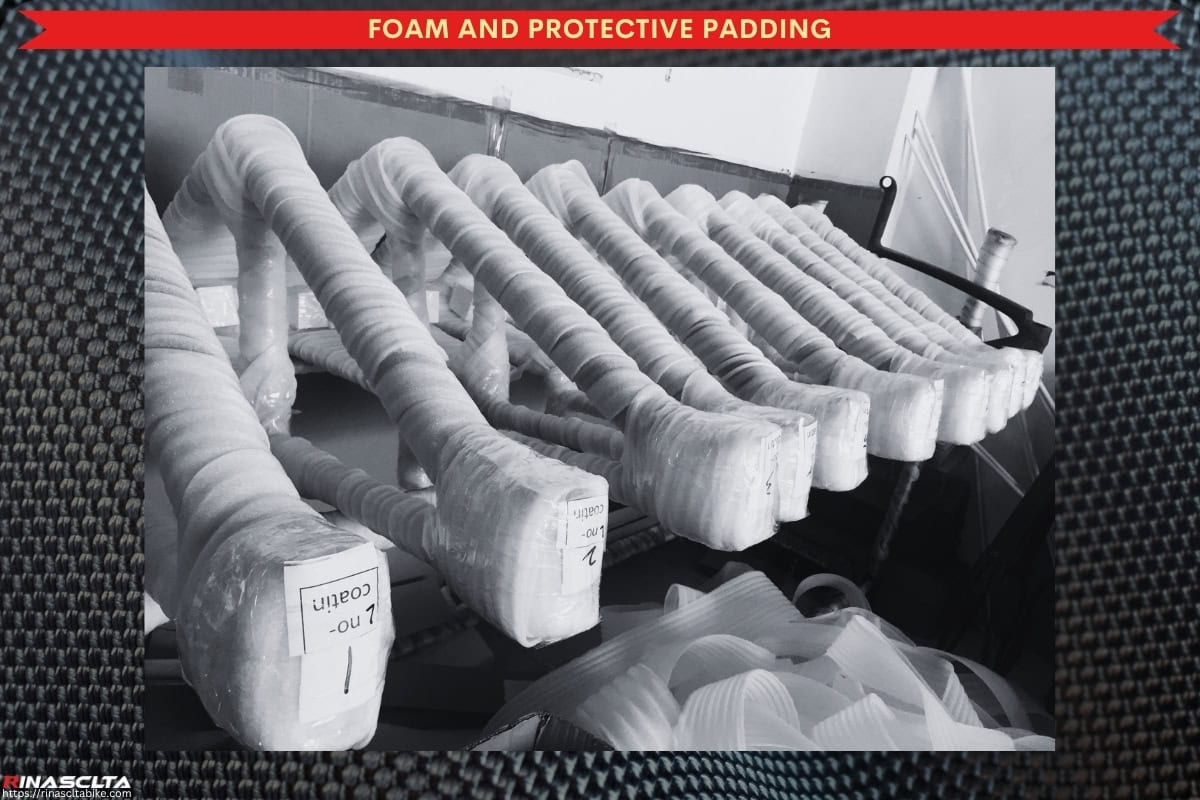

Foam and protective padding
Expanded polyethylene, or EPE foam, is widely used because it is lightweight, flexible, and effective for tube sleeves, edge guards, and spacing blocks. Denser EVA foam can provide more stable support where geometry and repeated compression demand it. Sponge blocks and shaped corner protectors fill controlled gaps, while fork padding and tube sleeves isolate vulnerable surfaces.
Foam thickness is only one variable. Density, recovery, contact area, and position determine shock absorption. A loose sleeve may slide away; an overly tight block may load a cable port or paint edge. Pads should remain in place throughout transport without compressing delicate structures.
Plastic wraps and frame protection films
PE film and dust covers provide clean, lightweight surface protection. Stretch film can retain sleeves or grouped parts, while bubble wrap cushions selected accessories. Paint protection film is useful at predictable rub points, especially where temporary assembly or removal could mark the finish.
Wrapping should never conceal uninspected damage or create pressure ridges. Operators use defined overlap, tension, and tape locations so the wrap stays secure without adhesive touching paint or cables. Moisture should not be trapped against the product during long-term storage.
Cartons and reinforced shipping boxes
A double-wall corrugated carton provides containment, puncture resistance, and compression resistance for stacking. Board grade, flute combination, joint construction, hand holes, dimensions, and moisture exposure all influence performance. The carton must be strong enough for the actual packed mass and distribution environment, not selected by appearance alone.
Internal fit is just as important. Excess space allows acceleration before impact; an overfilled carton transfers external loads directly to the bicycle. Reinforced zones, separate accessory compartments, and wheel panels help the box maintain shape while keeping hard parts away from the frame.
Internal protection components
Dropout spacers and fork blocks protect open interfaces and help resist lateral compression. Rotor spacers prevent brake-pad closure when wheels are removed. Cable guards protect hose bends; wheel separators keep rims, cassettes, and rotors away from painted tubes. Small hardware belongs in labeled bags or a fixed accessory box rather than loose inside the carton.
Each protector must match the bicycle configuration. A spacer that fits one axle standard may be ineffective on another. Packaging bills of materials should therefore be controlled by model and revision, with substitutions reviewed like other manufacturing changes.
Packaging Process for Carbon Bike Frames
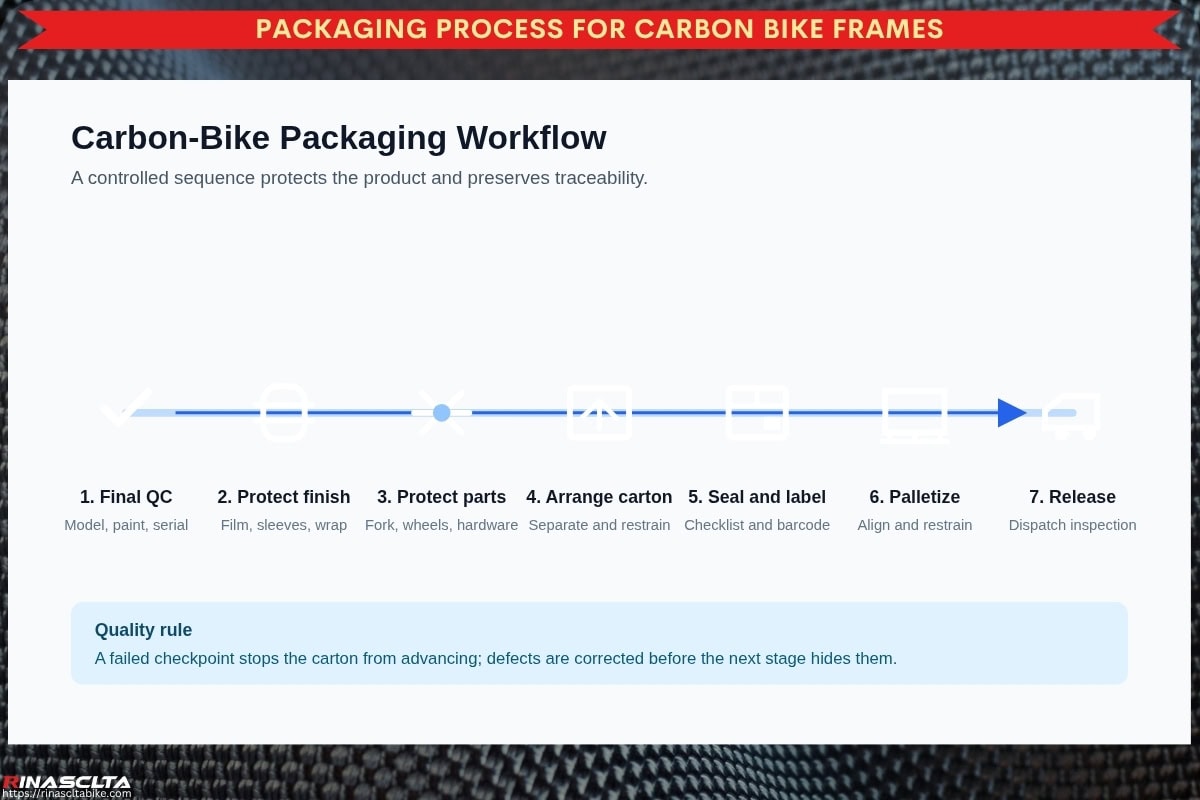
A standardized packing sequence reduces handling damage and makes quality repeatable across operators and shifts. The sequence should be documented with visual work instructions, checkpoints, approved materials, and a final sign-off.
Frame preparation and inspection
Packing starts after final carbon frame quality control and testing. The operator confirms model, size, color, serial number traceability, and required hardware. Paint, bearing seats, threads, dropouts, brake mounts, and bonded interfaces are checked under suitable lighting.
The product is then cleaned and dry. Paint protection film is installed at defined contact zones before sleeves obscure the surface. Any defect, missing part, or mismatch stops release rather than being passed downstream in a sealed carton.
Component protection
Forks receive blade and steerer protection plus a correctly fitted fork protector. Handlebars and seatposts are wrapped separately, with controls positioned so levers cannot press against the frame. Wheels need rim protection, axle-end coverage, and separation around cassettes and brake rotors.
Accessories and hardware are counted, bagged, labeled, and fixed in a predictable location. Nothing should become a free-moving projectile during a drop or vibration event. The same principle applies to complete bikes: partially assembled components must be restrained without placing continuous force on carbon surfaces.
Box assembly and internal arrangement
The carton is formed and reinforced according to the work instruction. The bicycle is positioned so heavy components sit low and loads transfer through approved pads rather than unsupported tubes. Wheel panels, accessory compartments, and molded or cut foam prevent part-to-part contact.
Operators check clearances by gently moving the open carton and verifying that nothing shifts, rattles, or presses against the frame. The arrangement must also be practical to unpack without dragging a rotor, handlebar, or wheel across the paint.
Final sealing and shipment preparation
Before sealing, the packing list and protection checklist are completed. The carton is closed with the specified tape pattern or straps, then marked with model, quantity, orientation, handling, barcode, and destination data. Export documentation is matched to the physical shipment without turning the packaging station into a customs-processing workflow.
Cartons are palletized where required, with edge protection and restraint that do not crush the boxes. Packaging integrity, label readability, pallet stability, and counts are verified before release.
Packaging Considerations for OEM & ODM Projects
OEM packaging rarely remains a generic export carton. Model geometry, assembly level, component selection, retail channel, destination, and branding can change the protection system. These requirements should be defined during the OEM and ODM development process, not after production is complete.
Custom packaging design
Unique aero tubes, integrated cockpits, suspension layouts, or accessories may need custom inserts and revised carton dimensions. CAD envelopes can define clearance, but packing prototypes must confirm that shaped EPE or EVA foam supports the correct zones. Molded foam can improve repeatability for high volumes; cut foam may be more flexible for early production.
Branding and retail presentation
Printed cartons, logos, manuals, warranty cards, QR codes, and organized accessory boxes support a premium unboxing experience. Branding must not interfere with label zones, inspection, or carton strength. The best presentation makes every part easy to identify and remove while keeping protective logic visible.
Packaging optimization for distributors
Distributors benefit from consistent carton dimensions, readable model codes, stable pallet patterns, and quick inventory identification. Packaging optimization considers warehouse handling, pallet density, container utilization, and retailer unpacking together. Reducing empty space is valuable only when shock absorption and compression resistance remain adequate.
Common Causes of Shipping Damage
Shipping damage usually reflects a mismatch between hazards and protection: weak carton structure, insufficient restraint, hard contact points, or handling outside the assumed conditions. Recording damage location, carton condition, serial number, and packing revision helps identify the real cause.
| Damage pattern | Likely mechanism | Prevention method |
| Crushed upper carton or bent components | Excess stacking load or weak pallet pattern | Validate compression resistance; align cartons and protect edges |
| Paint abrasion | Repeated contact during transport vibration | Separate parts, secure sleeves, add film at verified rub zones |
| Fork or dropout damage | Lateral impact or missing spacer | Install model-specific fork protector and dropout spacer |
| Rotor or wheel damage | Inadequate wheel separation | Use rigid separators and protect rotor/cassette sides |
| Loose or missing accessories | Unfixed bags or incomplete reconciliation | Use a closed accessory box, checklist, and weight/count verification |
| Internal carbon damage after impact | Concentrated load or insufficient energy absorption | Increase load-spreading support and validate the complete package |
Compression and stacking loads
Warehouse storage, palletization, and container loading create sustained vertical loads. If cartons are misaligned, soft, or exposed to humidity, upper loads can deform the box and transfer into wheels or frame tubes. Pallet patterns should keep vertical edges aligned, distribute weight, and avoid unsupported overhang.
Impact during transportation
Drops, repeated knocks, forklift handling, road shocks, and movement inside containers create short-duration loads. Transport vibration can also turn light contact into thousands of abrasion cycles. Restraint, shock absorption, and separation must work together; one oversized foam block cannot compensate for loose heavy components.
Moisture and environmental exposure
Humidity, salt air, temperature variation, dust, and extended storage can weaken cartons, affect labels, corrode unprotected hardware, or trap condensation. Dry packing conditions, suitable bags or barriers, desiccant when justified, moisture-resistant labeling, and controlled storage reduce exposure without sealing moisture inside.
Best Practices for International Bicycle Shipping
Reliable international logistics begins with a known hazard profile and a packaging design that can be built consistently. Validation, pallet control, container restraint, warehouse instructions, traceability, and dispatch inspection form one system.
Packaging validation
Packaging validation uses production-representative bicycles, protectors, cartons, and packing methods. Drop tests evaluate vertical impact; compression tests evaluate box and stacking strength; transport-vibration testing reveals movement, abrasion, and loosening. Applicable procedures can be selected from recognized methods such as ISO 2248, ISO 12048, and ISO 13355, then adapted to the product and distribution risks.
After testing, the carton is opened systematically. Inspectors check the bicycle, paint, interfaces, components, protectors, and carton, then record failure modes and update the design. A pass is evidence for that tested configuration—not permission to change foam, carton, or layout without review.
Container loading and palletization
Palletization controls the unit load before container loading. Cartons should be aligned, balanced, restrained, and protected from straps or edges. Pallets must remain stable during forklift movement, and load height should reflect compression capability rather than maximum available space.
Inside the container, voids and unsupported rows allow movement. Securing methods should minimize shifting without crushing cartons. Loading plans also preserve labels and permit safe warehouse handling at the destination.
Inspection before dispatch
Final release confirms carton condition, sealing, labels, pallet stability, quantities, shipping marks, and export documentation. A damaged or wet carton should be replaced and its contents rechecked. Barcode records connect cartons to serial numbers and inspection history.
Dispatch approval should be a defined quality inspection, not a visual glance. Photographic records of pallets or container rows can provide useful evidence of condition and loading arrangement at handoff.
Conclusion
Professional carbon bike packaging extends manufacturing quality beyond the factory. EPE and EVA foam, paint protection film, corrugated cartons, fork protectors, dropout spacers, separators, and fixed accessory boxes each control a different risk. Their effectiveness depends on correct placement, compatibility, and a repeatable packing process.
The complete quality system begins with inspection and serial number traceability, continues through component protection and carton assembly, and ends with packaging validation, palletization, container loading, documentation, and dispatch release. When manufacturers treat export packaging as an engineered product rather than a final logistics chore, they reduce transport damage while protecting structural integrity, appearance, customer satisfaction, and brand trust.