


Why Material Selection Matters in Bicycle Engineering?
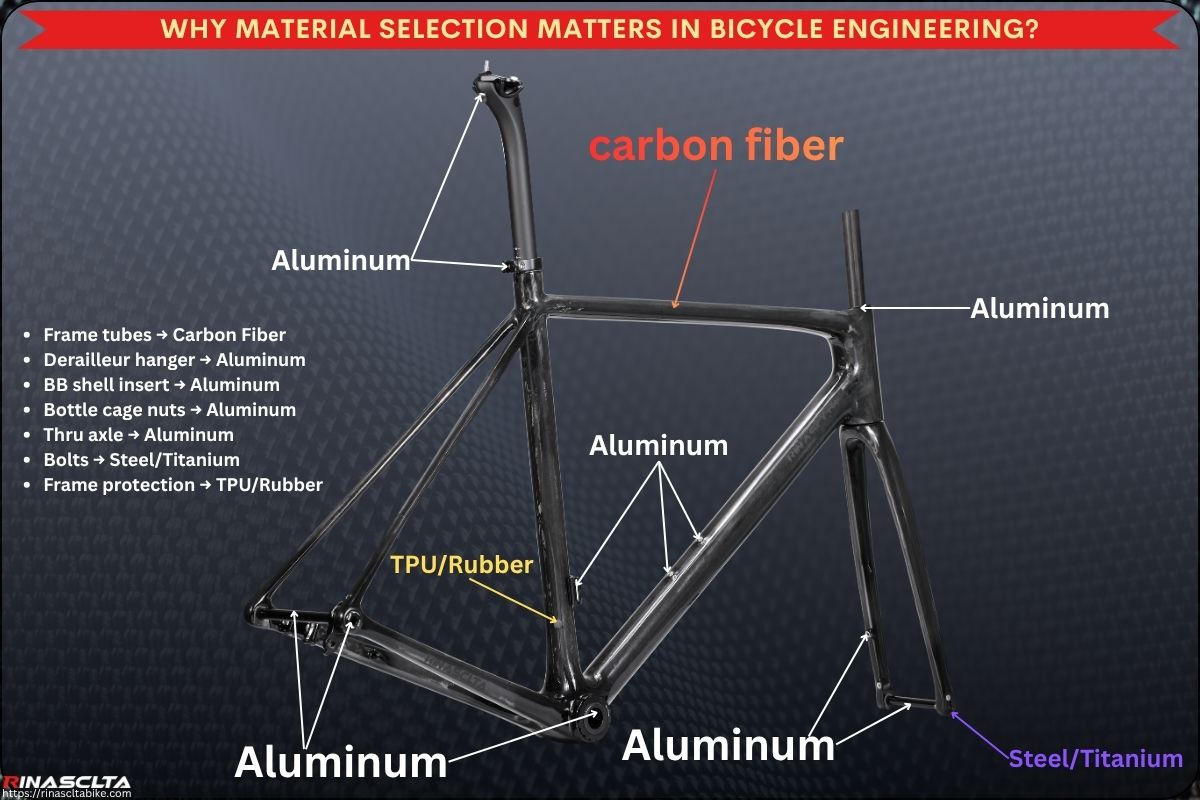
Material selection matters in bicycle engineering because a modern bike frame is not made from one material doing every job; it is a controlled multi-material structure where each part is chosen according to load direction, stiffness requirement, machining accuracy, fatigue resistance, impact behavior, corrosion risk, assembly interface, serviceability, and production cost. In a carbon bike system, the main frame tubes are usually made from carbon fiber composite because carbon provides high stiffness-to-weight ratio, directional layup tuning, aerodynamic shaping freedom, and vibration damping potential, while components such as the derailleur hanger, BB shell insert, bottle cage nuts, and thru axle are commonly made from aluminum because aluminum offers lightweight CNC machinability, accurate threads, replaceability, and stable interface tolerances. Steel or titanium bolts are selected where clamping strength, thread durability, torque reliability, and corrosion resistance are critical, and TPU or rubber frame protection is used in areas exposed to chain slap, cable rub, stone impacts, transport abrasion, and noise vibration because these flexible materials absorb impact energy and protect the carbon surface. This is why professional frame design is not only about choosing “carbon fiber” as the main material, but about engineering the right material for each structural, mechanical, protective, and serviceable function so the final bicycle achieves better ride quality, assembly precision, long-term durability, warranty reliability, and manufacturing value.

Carbon Fiber as the Primary Structural Material
Carbon fiber became the primary structural material for high-performance bicycle frames because it allows manufacturers to control weight, stiffness, strength, aerodynamics, vibration damping, and ride feel more precisely than traditional metal tube construction. Its use in bicycles grew from early experimental and racing applications in the late 20th century into mainstream premium production as prepreg carbon materials, CNC mold technology, EPS/internal molding systems, curing control, and composite QC methods became more mature and repeatable.
The main reason carbon fiber is selected for modern frames, forks, handlebars, seatposts, and integrated cockpit parts is its excellent strength-to-weight and stiffness-to-weight ratio. Instead of adding uniform material everywhere, engineers can place carbon only where the load path requires it, such as the bottom bracket, head tube, downtube, chainstays, fork crown, and seatpost junction, while reducing unnecessary weight in lower-stress zones.
Carbon fiber also allows layup customization, which is the biggest manufacturing advantage compared with aluminum, steel, or titanium. By changing fiber orientation, ply sequence, carbon modulus, wall thickness, overlap design, and reinforcement zones, a manufacturer can create different structural behaviors from the same frame shape, improving torsional stiffness, pedaling efficiency, impact resistance, fatigue life, and production consistency.
This is why carbon fiber offers strong ride tuning possibilities. A race frame can be engineered with higher BB stiffness and head tube rigidity for sprinting and sharp handling, while an endurance or gravel frame can use more controlled compliance in the seatstays, fork blades, seat tube, and top tube to improve vibration damping, traction, and long-distance comfort. In modern manufacturing, carbon fiber is not chosen only because it is light; it is chosen because it gives factories the engineering freedom to build frames with targeted performance, category-specific ride feel, and scalable OEM/ODM product differentiation.
Strength-to-weight advantages
Strength-to-weight advantage means carbon fiber can deliver high structural stiffness and strength with relatively low material mass, which is why it is used for performance-critical parts such as the frame tubes, fork, handlebar, seatpost, integrated cockpit, rims, and high-load junctions. In carbon bike frame design, this matters most around the bottom bracket, head tube, downtube, chainstays, fork crown, and seat cluster, because these areas must resist pedaling torque, steering load, braking force, impact stress, and repeated fatigue cycles without adding unnecessary weight across the whole frame.
Carbon fiber is chosen because it has a high stiffness-to-weight ratio and can be engineered directionally through fiber orientation, carbon modulus, ply thickness, resin content, and reinforcement placement. Unlike aluminum or steel, which mainly rely on tube diameter and wall thickness, carbon allows material to be concentrated exactly along the load path, so manufacturers can build a frame that is stiff under sprinting and climbing, stable under cornering and braking, and still light enough for high-performance road, gravel, MTB, and racing applications.
The real value is not simply “lighter weight,” but efficient structural distribution: stronger layup around the BB shell and head tube improves power transfer and steering precision, while lighter or more compliant layup in lower-load areas improves vibration damping and comfort. This helps modern carbon frames achieve better acceleration response, climbing efficiency, ride feel, fatigue durability, aerodynamic shaping freedom, and premium product positioning compared with many traditional metal frame structures.
Layup customization
Layup customization means carbon fiber plies can be arranged differently in each part of the frame to control stiffness, strength, comfort, vibration damping, impact resistance, and weight distribution. The most important areas include the bottom bracket shell, head tube, downtube, chainstays, seatstays, fork crown, handlebar clamp zone, seatpost clamping area, and dropout interfaces, because each area carries different loads such as pedaling torque, steering force, braking stress, rider weight, road vibration, and axle load.
Carbon fiber is ideal for layup customization because it is directional, so engineers can use 0°, 90°, +45°, and -45° fiber orientations, different carbon modulus grades, varied ply thickness, and localized reinforcement patches to tune each zone separately. For example, more 0° and ±45° reinforcement around the BB and head tube improves power transfer and torsional rigidity, while more compliance-focused layup in the seatstays, fork blades, and seat tube improves comfort, traction, and vibration control.
The value of layup customization is that manufacturers can create different ride characteristics from similar frame platforms, such as aero race stiffness, endurance comfort, gravel durability, or lightweight climbing response, while maintaining controlled fatigue life, impact strength, stiffness-to-weight ratio, and production repeatability.
Ride tuning possibilities
Ride tuning possibilities refer to the ability of carbon fiber to create specific ride characteristics by controlling how different parts of the bicycle respond to pedaling loads, steering inputs, braking forces, road vibration, impacts, and rider weight transfer. Unlike metals, which generally behave uniformly throughout the structure, carbon composites allow engineers to tune each section independently through fiber orientation, ply sequencing, carbon modulus selection, laminate thickness, reinforcement placement, and compliance engineering, making ride feel a controllable design parameter rather than a byproduct of the material itself.
The most important tuning areas are the bottom bracket shell, head tube junction, downtube, chainstays, seatstays, seat tube, top tube, fork blades, fork crown, handlebars, and seatpost. Increasing stiffness around the bottom bracket and chainstays improves acceleration, sprint efficiency, and power transfer, while additional torsional reinforcement around the head tube and fork crown enhances steering precision and cornering stability. At the same time, controlled flex in the seatstays, seat tube, fork blades, handlebar, and seatpost can improve vibration damping, traction, rider comfort, and fatigue reduction without sacrificing overall frame efficiency.
This tuning capability is one of the main reasons carbon fiber dominates modern high-performance bicycle manufacturing. A race-oriented frame can be engineered for maximum lateral stiffness, torsional rigidity, and aerodynamic efficiency, while an endurance or gravel frame can prioritize vertical compliance, vibration absorption, impact resistance, and long-distance comfort. Through advanced tools such as FEA simulation, ply mapping, stiffness testing, vibration-frequency analysis, and prototype ride evaluation, manufacturers can optimize the balance between power transfer, handling stability, comfort, durability, and ride feel, creating category-specific performance characteristics that would be difficult to achieve with traditional metal frame construction.
Why Aluminum Is Still Used in Carbon Bike Frames?
Although carbon fiber is the primary structural material in modern performance bicycle frames, aluminum continues to play an important role in many carbon frame assemblies because certain components require precise machining, durable threads, replaceability, dimensional stability, and tight manufacturing tolerances that are difficult or inefficient to achieve with composite materials alone. As carbon frame technology evolved from early bonded-tube construction to modern monocoque molding, manufacturers discovered that combining carbon fiber with carefully integrated aluminum components created a more practical and reliable engineering solution. Today, aluminum is commonly used for dropouts, derailleur hangers, bottom bracket inserts, bottle cage mounts, cable guides, axle interfaces, and other precision-machined connection points, allowing carbon frames to maintain high performance while improving assembly accuracy and serviceability.
One of the biggest reasons aluminum remains important is its excellent machinability. Components such as UDH derailleur hangers, threaded bottom bracket inserts, thru-axle interfaces, brake mount surfaces, and bottle cage nuts require accurate thread formation, dimensional consistency, and wear resistance over repeated installation cycles. While carbon excels at carrying structural loads and reducing weight, aluminum provides reliable thread engagement, bearing support, interface precision, and replacement capability without requiring excessive reinforcement around small attachment points.
Modern manufacturing has also improved how aluminum is integrated into carbon structures. Advanced processes such as co-molding, bonded inserts, CNC-machined interface components, adhesive bonding systems, surface treatment technology, and galvanic corrosion protection allow aluminum and carbon to work together as a single engineered system. Rather than competing materials, carbon and aluminum now serve complementary functions: carbon provides the optimized stiffness-to-weight ratio, aerodynamic shaping, and ride tuning capability, while aluminum delivers the precise mechanical interfaces needed for assembly, maintenance, durability, and long-term reliability. This multi-material approach has become a standard practice in modern bicycle engineering because it balances performance, manufacturing efficiency, serviceability, and product lifespan more effectively than using either material alone.
Dropouts and derailleur hangers
Dropouts and derailleur hangers are usually made with aluminum interfaces or replaceable aluminum hanger parts in carbon bike frames because these areas require precise axle alignment, accurate thread quality, impact replaceability, and drivetrain serviceability. The dropout area connects the rear triangle, thru axle, rear hub, disc brake rotor, cassette, and derailleur hanger, so it must maintain stable wheel positioning, chainline accuracy, brake rotor alignment, and shifting precision under repeated pedaling loads, braking forces, and road vibration.
Carbon fiber is still used as the main surrounding structure because it provides the stiffness-to-weight ratio, vibration control, and frame load-path strength, but aluminum is preferred for the hanger and axle interface because it can be CNC-machined, threaded, replaced, and tolerance-controlled more easily than carbon. A replaceable aluminum hanger, including modern UDH-style systems, also protects the frame during crash or impact events because the hanger can bend or break before the carbon dropout structure is damaged, improving long-term durability, repairability, and warranty reliability.
Threaded inserts
Threaded inserts are usually made from aluminum or sometimes stainless steel/titanium in carbon bike frames because small threaded areas need precise machining, repeated bolt engagement, torque resistance, wear durability, and dimensional stability that carbon fiber alone cannot provide efficiently. They are commonly used in the bottom bracket shell, bottle cage bosses, derailleur hanger mount, brake hose ports, cable guide mounts, fender/rack mounts, seatpost wedge systems, and accessory mounting points, where bolts must tighten securely without damaging the carbon laminate.
Carbon fiber remains the main frame material because it provides lightweight structure, stiffness-to-weight performance, vibration damping, and layup-based ride tuning, but metal inserts are bonded or co-molded into the frame to create reliable mechanical interfaces. Good threaded insert design improves assembly accuracy, torque safety, serviceability, corrosion control, and long-term durability, while poor insert bonding or weak thread quality can cause bolt loosening, creaking, thread stripping, insert pull-out, water ingress, and warranty failure.
Bottle cage mounts
Bottle cage mounts are small but important attachment points that are typically made using aluminum threaded inserts bonded or co-molded into the carbon frame. They are usually located on the downtube, seat tube, and sometimes the top tube or underside of the downtube, where they must securely support water bottles, tool storage systems, frame bags, and accessory mounts while being exposed to constant road vibration, impact loads, repeated bolt tightening, moisture, dirt, and temperature changes.
Carbon fiber is used for the surrounding frame structure because it provides the required stiffness-to-weight ratio, aerodynamic shaping flexibility, and structural efficiency, but aluminum inserts are preferred at the mounting points because they provide reliable thread engagement, torque resistance, dimensional accuracy, and long-term wear durability. A properly engineered bottle cage mount system distributes loads into the surrounding carbon laminate through localized reinforcement zones, preventing thread pull-out, laminate cracking, insert loosening, and stress concentration around the mounting area.
Professional frame manufacturers carefully control insert positioning, bonding quality, reinforcement layup, thread tolerance, corrosion protection, and torque specifications to ensure the bottle cage mount remains secure throughout the frame’s service life. High-quality bottle cage interfaces improve accessory compatibility, assembly reliability, rider convenience, and long-term durability, while poorly designed systems can lead to creaking, stripped threads, insert movement, water ingress, and premature frame damage.
Precision-machined interfaces
Precision-machined interfaces are usually made with aluminum inserts or aluminum interface parts in carbon bike frames because areas such as the bottom bracket shell, headset bearing seats, thru-axle dropouts, derailleur hanger mount, disc brake mounts, seatpost clamp area, and internal cable-routing ports require tight dimensional tolerance, accurate roundness, flatness, thread quality, and repeatable component fit. Carbon fiber is used for the surrounding frame structure because it provides lightweight strength, stiffness-to-weight efficiency, aerodynamic shaping, and ride tuning, but CNC-machined aluminum is preferred at mechanical contact points because it delivers better bearing support, torque reliability, assembly precision, serviceability, and long-term wear resistance. A well-designed precision interface improves drivetrain alignment, headset stability, brake caliper positioning, wheel tracking, creak prevention, and complete-bike assembly quality, while poor machining or bonding control can cause bearing play, brake rub, thread failure, axle misalignment, creaking, poor shifting, and warranty issues.
Steel and Titanium Components in Bicycle Frames
Steel and titanium continue to play important roles in modern carbon bicycle frames even though they are no longer the primary structural materials. As bicycle engineering evolved from all-steel construction to aluminum and then carbon composite frames, manufacturers retained steel and titanium for specific components where thread strength, clamping force, wear resistance, fatigue life, corrosion resistance, and long-term mechanical reliability are more important than absolute weight savings. Today, these materials are commonly used in fasteners, bolts, axles, pivot hardware, seatpost wedge systems, derailleur mounting hardware, brake hardware, bearing preload components, and other precision-load interfaces that experience repeated assembly, disassembly, and high localized stress.
Steel remains widely used because of its excellent tensile strength, thread durability, impact resistance, torque retention, and cost-effectiveness. High-strength alloy steel fasteners can withstand significant clamping loads while maintaining reliable thread engagement and long service life. Titanium, meanwhile, is often selected for premium applications because it offers a unique combination of high strength, low weight, corrosion resistance, fatigue durability, and premium appearance, making it particularly attractive for high-end performance bicycles where reducing hardware weight is desirable without compromising reliability.
Modern manufacturing increasingly uses a material-specific approach where carbon fiber provides the optimized structural platform, aluminum supplies precision-machined interfaces, and steel or titanium handle critical fastening and hardware functions. This evolution reflects a broader trend in bicycle engineering toward multi-material optimization, where each material is selected according to its mechanical properties, manufacturing advantages, service requirements, and long-term durability characteristics. Rather than attempting to build every component from carbon fiber, professional manufacturers choose steel and titanium where they provide superior performance in areas involving repeated loading, thread engagement, bearing preload control, impact resistance, and maintenance-related wear.
Fasteners and bolts
Fasteners and bolts are usually made from steel or titanium in carbon bicycle frames because they must provide reliable clamping force, thread engagement, torque retention, fatigue resistance, and service durability in small high-load interfaces. They are commonly used in areas such as the seatpost clamp, derailleur hanger, disc brake mounts, bottle cage mounts, stem and handlebar clamp, thru-axle system, suspension pivots, cable guides, and accessory mounts, where repeated tightening, vibration, moisture, and rider load can quickly expose weak hardware.
Carbon fiber remains the main structural material because it provides lightweight stiffness, vibration damping, aerodynamic shaping, and layup-based ride tuning, but carbon is not ideal for small threaded fasteners because it cannot provide the same metal thread strength, torque safety, wear resistance, and replaceability. Steel bolts are preferred for maximum strength and cost efficiency, while titanium bolts are used when brands want lower weight, corrosion resistance, and premium positioning; good fastener selection improves assembly reliability, creak prevention, braking safety, cockpit stability, and long-term serviceability, while poor hardware can cause stripped threads, bolt fatigue, loosening, galvanic corrosion, clamp failure, and warranty issues.
Axles and hardware
Axles and hardware are usually made from aluminum, steel, or titanium in carbon bicycle frames because these parts must handle clamping load, axle shear force, thread engagement, wheel retention, bearing preload, brake alignment, and repeated service cycles with high dimensional accuracy. They are commonly used in areas such as the front and rear thru-axles, dropout interfaces, derailleur hanger fixing system, disc brake hardware, suspension pivots, headset compression parts, seatpost wedge systems, and bottom bracket-related hardware, where precise machining and reliable torque performance are critical.
Carbon fiber remains the main structural material because it provides lightweight stiffness, aerodynamic shaping, vibration damping, and layup-based strength tuning, but carbon is not suitable for most axle and small hardware functions because these areas require metal threads, wear resistance, impact tolerance, replaceability, and tight interface tolerances. Good axle and hardware selection improves wheel tracking, braking stability, drivetrain alignment, bearing life, creak prevention, assembly reliability, and long-term serviceability, while poor hardware can cause axle binding, thread stripping, brake rub, dropout wear, bearing play, loosening, corrosion, and warranty problems.
Durability considerations
Durability considerations mean steel and titanium are selected for parts where repeated tightening, high clamping force, thread wear, vibration, impact, corrosion exposure, and long service life matter more than pure weight reduction. These areas include bolts, thru-axles, brake hardware, derailleur hanger bolts, seatpost clamp hardware, headset compression parts, suspension pivots, bearing preload systems, and accessory mounting points, where carbon fiber remains valuable as the lightweight structural body but is not ideal for small threaded or high-wear contact interfaces. Steel provides excellent strength, torque reliability, fatigue resistance, and cost efficiency, while titanium offers strong corrosion resistance, lower weight, fatigue durability, and premium positioning, helping improve assembly safety, serviceability, creak prevention, warranty reliability, and long-term frame performance in modern multi-material carbon bike design.
Non-Structural Materials in Modern Bike Frames
Non-structural materials have become increasingly important in modern bike frame engineering because manufacturers now focus not only on structural performance, but also on durability, noise reduction, weather protection, cable management, cosmetic preservation, rider experience, and long-term product quality. As bicycle designs evolved toward internal cable routing, integrated cockpits, hidden storage compartments, larger tire clearances, aerodynamic tube shapes, and carbon monocoque construction, engineers introduced materials such as TPU, rubber, thermoplastic elastomers (TPE), polyurethane films, foam inserts, bearing seal materials, and vibration-damping components to solve practical problems that carbon fiber, aluminum, steel, or titanium cannot address efficiently.
Unlike structural materials that carry rider loads and drivetrain forces, these materials are selected for properties such as flexibility, impact absorption, abrasion resistance, sealing performance, vibration damping, chemical resistance, weather resistance, and acoustic control. TPU frame protection systems help prevent damage from chain slap, stone strikes, and transport abrasion; rubber grommets and cable ports improve sealing and cable management; bearing seals protect critical rotating components from water, dirt, and contamination; frame protection films preserve paint and carbon surfaces; and noise reduction inserts eliminate rattling from internally routed cables and hoses. These components may represent only a small percentage of the bicycle’s total weight, but they significantly influence durability, maintenance requirements, cosmetic longevity, perceived quality, and rider satisfaction.
The evolution of these materials reflects the broader trend toward more sophisticated bicycle systems. Early bicycles often used simple rubber plugs or exposed cable routing, but modern premium frames increasingly integrate precision-molded TPU guards, engineered sealing systems, anti-rattle solutions, replaceable protection components, and advanced polymer materials specifically designed for cycling applications. Today, high-quality non-structural materials are considered an essential part of professional frame engineering because they help protect the frame, improve reliability, reduce warranty claims, enhance user experience, and support the long-term value of modern carbon bicycle platforms.
TPU frame protection
TPU frame protection is used on carbon bike frames because carbon fiber provides excellent lightweight stiffness, layup-based strength tuning, and vibration damping, but the painted carbon surface can still be damaged by repeated chain slap, stone strikes, heel rub, cable rub, transport abrasion, and gravel impacts. TPU is commonly applied to the chainstay, downtube, fork inner legs, head tube cable-contact areas, bottom bracket zone, seatstay sections, and cargo/bag contact points, where flexible protection is needed without adding heavy structural material.
TPU is chosen because it offers strong abrasion resistance, impact absorption, flexibility, weather resistance, chemical resistance, and paint-surface protection while remaining lightweight and replaceable. In professional frame design, TPU guards help reduce paint chipping, clear-coat damage, exposed carbon fibers, noise from chain slap, cosmetic warranty claims, and long-term surface wear, making them especially valuable for gravel bikes, MTB frames, adventure bikes, e-bikes, and transport-heavy OEM products where durability and customer satisfaction matter as much as frame weight.
Rubber grommets and cable ports
Rubber grommets and cable ports are used in carbon bike frames to protect and seal the areas where brake hoses, derailleur cables, electronic wires, Di2/EPS cables, dropper-post cables, and internal routing systems enter or exit the frame. These parts matter most around the head tube, downtube, top tube, chainstay, seat tube, bottom bracket area, fork crown, and integrated cockpit routing zones, where cables can rub against the carbon edge or allow water, dust, mud, and noise to enter the frame.
Carbon fiber is used for the main frame because it provides lightweight stiffness, aerodynamic shaping, vibration damping, and layup-based structural tuning, but rubber or TPE grommets are needed at cable interfaces because they provide flexibility, sealing, abrasion protection, vibration isolation, and anti-rattle performance. Good grommet and cable-port design improves cable life, frame protection, waterproofing, noise reduction, clean assembly, and premium user experience, while poor design can cause cable wear, paint damage, water ingress, internal rattling, difficult routing, and higher warranty complaints.
Bearing seals
Bearing seals are used around rotating and press-fit interfaces such as the headset, bottom bracket, hub bearings, suspension pivots, linkage bearings, and integrated headset cable-routing systems to block water, dust, mud, sweat, cleaning chemicals, and road contamination from entering bearing contact surfaces. Carbon fiber is used for the main frame because it provides lightweight stiffness, aerodynamic shaping, vibration damping, and structural layup tuning, but bearing areas still need rubber, polymer, or composite seal systems because carbon alone cannot provide the flexible sealing lip, compression fit, and contamination barrier required for long-term bearing life. Good bearing seal design improves smooth rotation, headset stability, bottom bracket durability, pivot reliability, creak prevention, and maintenance intervals, while poor sealing can lead to bearing corrosion, grinding, water ingress, premature wear, noise, poor preload stability, and warranty issues.
Frame protection films
Frame protection films are transparent or semi-transparent PU/TPU protective layers applied to vulnerable carbon frame surfaces to protect the paint, clear coat, and exposed carbon finish from stone chips, cable rub, heel rub, bag abrasion, transport scratches, chain slap marks, and cleaning wear. They matter most on the downtube, chainstays, seatstays, fork legs, head tube, top tube, bottom bracket area, and bikepacking contact zones, where the frame is exposed to repeated impact, friction, mud, dust, and handling damage.
Carbon fiber is used for the main structure because it provides lightweight stiffness, aerodynamic shaping, layup-based ride tuning, and vibration damping, but the outer coating still needs surface protection because paint and clear coat are much easier to damage than the structural laminate underneath. Good frame protection film improves cosmetic durability, resale value, warranty reliability, long-term brand appearance, and customer satisfaction, while poor or missing protection can lead to paint chipping, clear-coat scratches, visible rub marks, exposed carbon edges, moisture-sensitive damage zones, and higher cosmetic complaints.
Noise reduction inserts
Noise reduction inserts are used inside carbon bike frames to reduce cable rattle, hose vibration, impact noise, chain slap resonance, and hollow-frame acoustic feedback, especially in areas such as the downtube, top tube, chainstay, bottom bracket zone, head tube routing area, integrated cockpit channel, and internal storage compartments. Carbon fiber is chosen for the main frame because it provides lightweight stiffness, aerodynamic shaping, vibration damping, and layup-based ride tuning, but hollow carbon tubes can amplify small internal movements, so foam sleeves, rubber dampers, TPU clips, cable liners, anti-rattle channels, and soft polymer inserts are added to isolate moving parts and absorb vibration. Good noise reduction design improves premium ride feel, internal routing quality, customer satisfaction, assembly consistency, and warranty reliability, while poor control can cause annoying frame rattles, cable slap, hose knocking, perceived low quality, difficult diagnosis, and unnecessary after-sales complaints.
Engineering Challenges of Multi-Material Construction
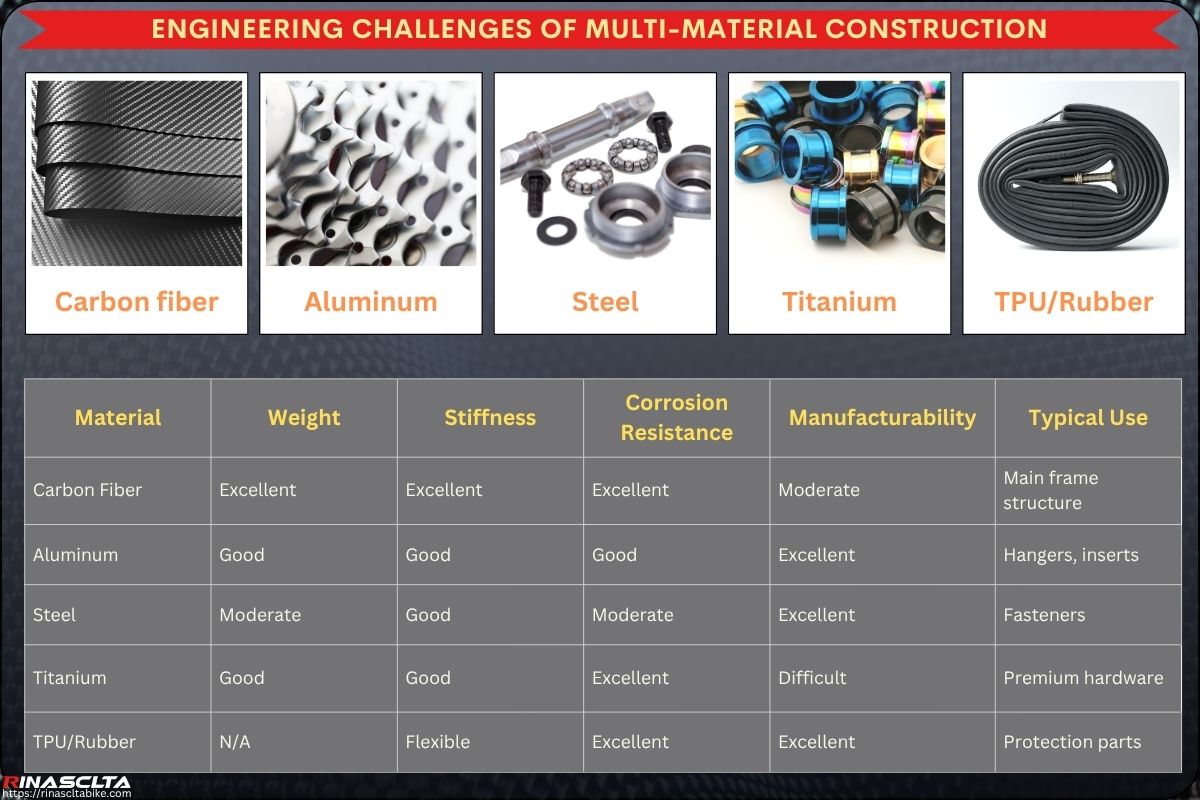
Modern carbon bicycle frames are rarely made from a single material. While carbon fiber forms the primary structural platform, manufacturers routinely integrate aluminum inserts, steel hardware, titanium fasteners, stainless-steel bearing components, TPU protection systems, rubber seals, engineering polymers, and bonded interface parts into the same product. This multi-material approach developed as carbon frame technology matured because engineers realized that no single material can optimize every requirement simultaneously. Carbon fiber excels in stiffness-to-weight ratio, aerodynamic shaping, and ride tuning, while metals provide machining precision, thread durability, wear resistance, and serviceability, and polymers contribute sealing, protection, vibration control, and noise reduction.
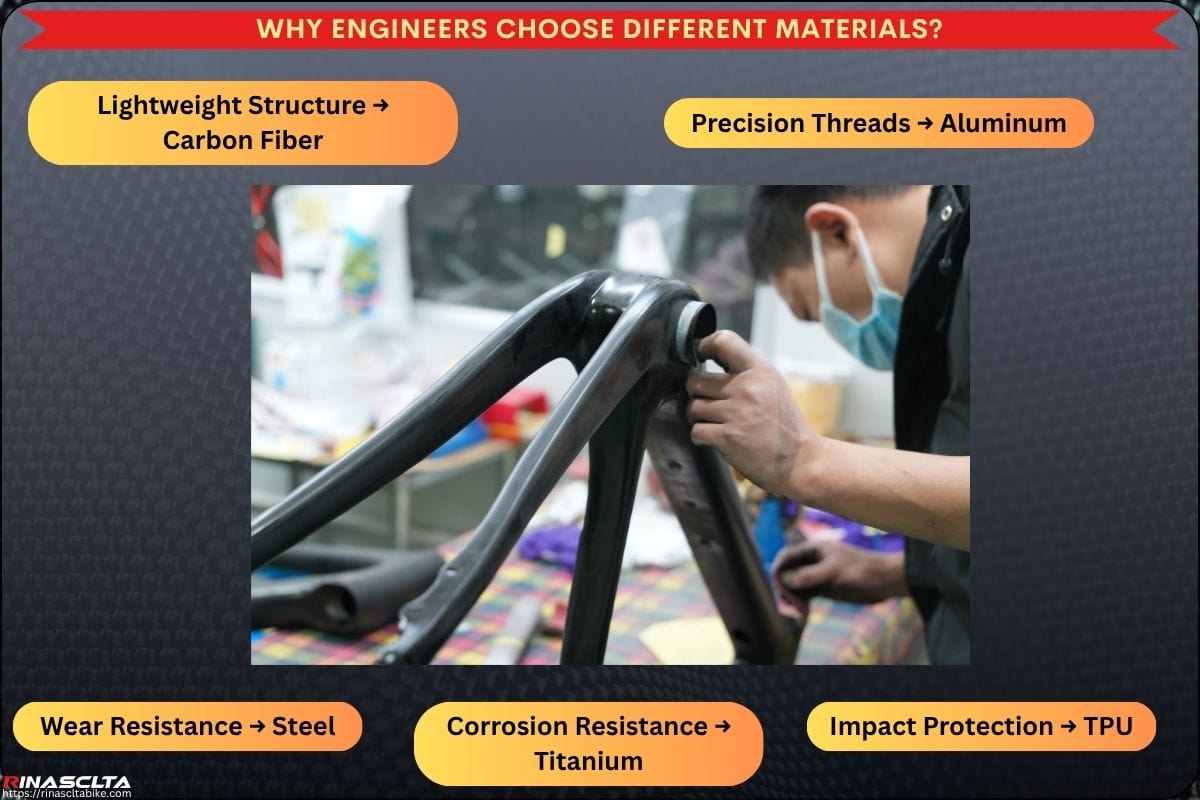
The challenge is that each material behaves differently under load, temperature change, humidity exposure, vibration, fatigue cycles, manufacturing processes, and long-term environmental conditions. Carbon fiber has a low thermal expansion rate and anisotropic mechanical behavior, aluminum expands and contracts differently with temperature, steel offers higher hardness but greater weight, titanium provides excellent corrosion resistance but requires different fastening considerations, and polymers can change flexibility depending on environmental conditions. When these materials are combined into a single frameset, manufacturers must carefully engineer bonding systems, interface design, load transfer paths, assembly tolerances, corrosion protection, adhesive selection, insert integration, and dimensional stability to ensure the components function together as one reliable structure.
As bicycle engineering has evolved, factories have developed advanced solutions such as co-molded inserts, structural adhesive systems, CNC-machined interfaces, isolation coatings, precision tolerance control, FEA load-path analysis, automated assembly fixtures, and environmental durability testing to overcome these challenges. Today, successful multi-material construction is not simply about combining different materials; it is about managing the interaction between those materials throughout the entire product lifecycle to achieve optimal performance, durability, assembly quality, serviceability, warranty reliability, and long-term rider satisfaction.
Bonding different materials
Bonding different materials is one of the most critical engineering processes in modern carbon bike frame manufacturing because many components made from aluminum, steel, titanium, stainless steel, TPU, rubber, and engineering polymers must be securely integrated into a carbon fiber structure. The most important bonded areas include the bottom bracket inserts, headset bearing seats, derailleur hanger interfaces, bottle cage bosses, cable-routing ports, seatpost wedge systems, dropout assemblies, brake mount interfaces, frame protection components, and internal hardware mounts, where loads must be transferred reliably between materials with very different mechanical properties.
Carbon fiber is used as the primary structural material because it provides excellent stiffness-to-weight ratio, directional strength, aerodynamic freedom, vibration damping, and ride-tuning capability, but carbon alone cannot efficiently provide threaded interfaces, bearing seats, wear surfaces, or replaceable hardware mounts. As a result, manufacturers use structural epoxy adhesives, co-molding processes, insert bonding systems, surface treatments, adhesive primers, mechanical locking features, and controlled curing procedures to join carbon with metal or polymer components.
The challenge is that carbon, aluminum, steel, titanium, and polymers all respond differently to load, vibration, thermal expansion, moisture, and fatigue cycles. A properly engineered bond must provide sufficient shear strength, peel resistance, fatigue durability, impact tolerance, environmental stability, and long-term adhesion without creating stress concentrations or weakening the surrounding laminate. Good bonding design improves structural integrity, assembly precision, durability, service life, creak prevention, and warranty reliability, while poor bonding can cause insert loosening, creaking, interface movement, water ingress, adhesive failure, delamination, and premature structural damage. For this reason, advanced manufacturers invest heavily in surface preparation, bond-line thickness control, curing validation, environmental testing, pull-out testing, fatigue testing, and process traceability to ensure reliable multi-material integration throughout the frame’s lifecycle.
Galvanic corrosion prevention
Galvanic corrosion prevention is an important consideration in carbon bike frame engineering because carbon fiber is electrically conductive and can create a galvanic reaction when it comes into direct contact with certain metals in the presence of moisture, sweat, salt, cleaning chemicals, or environmental contaminants. The most critical areas include the bottom bracket inserts, headset bearing seats, derailleur hanger interfaces, bottle cage mounts, thru-axle dropouts, brake mounts, seatpost wedge systems, threaded inserts, titanium bolts, steel hardware, and aluminum interface components, where carbon and metal are located in close proximity for long periods of time.
Carbon fiber is used as the primary structural material because it provides superior stiffness-to-weight ratio, fatigue performance, aerodynamic shaping freedom, and ride tuning capability, but its conductive nature means manufacturers must carefully isolate it from susceptible metals, especially aluminum. Without proper protection, galvanic corrosion can gradually attack the metal component, leading to surface oxidation, thread degradation, reduced clamping force, insert damage, assembly difficulty, creaking, and long-term durability issues.
Professional manufacturers prevent galvanic corrosion through anodized aluminum surfaces, isolation coatings, epoxy bonding layers, adhesive barriers, anti-corrosion compounds, stainless steel washers, sealed interfaces, controlled drainage paths, protective paints, and proper hardware selection. These solutions create a physical barrier between carbon and metal while preventing moisture accumulation inside the interface. Good galvanic corrosion management improves service life, assembly reliability, thread durability, maintenance performance, warranty stability, and long-term structural integrity, making it a critical part of modern multi-material bicycle design rather than simply a maintenance concern.
Tolerance management
Tolerance management is the process of controlling dimensional accuracy across all critical interfaces in a carbon bicycle frame to ensure that components fit together correctly, function reliably, and maintain consistent performance throughout the product lifecycle. It is especially important in multi-material construction because carbon fiber, aluminum, steel, titanium, bearings, and polymer components are manufactured using different processes and have different dimensional behaviors. The most critical areas include the bottom bracket shell, headset bearing seats, thru-axle dropouts, derailleur hanger interface, disc brake mounts, seatpost insertion area, fork steerer interface, bottle cage inserts, internal routing ports, and suspension pivot locations, where even small dimensional variations can affect assembly quality and ride performance.
Carbon fiber is selected as the primary structural material because it provides excellent stiffness-to-weight ratio, aerodynamic shaping flexibility, vibration damping, and layup-based ride tuning, but composite manufacturing naturally introduces variables such as resin flow, curing shrinkage, laminate thickness variation, mold wear, thermal expansion differences, insert positioning, and post-processing tolerances. Unlike CNC-machined metal parts, carbon structures require careful control of the entire molding and curing process to maintain dimensional consistency.
Professional manufacturers manage tolerances through precision molds, CNC-machined inserts, alignment fixtures, CMM measurement systems, laser inspection, go/no-go gauges, GD&T specifications, process capability studies, and statistical quality control, ensuring that each interface remains within the required dimensional window. Good tolerance management improves bearing fit, wheel alignment, brake positioning, drivetrain accuracy, headset performance, assembly efficiency, creak prevention, and overall ride consistency, while poor tolerance control can lead to bearing play, press-fit noise, brake rub, shifting problems, axle misalignment, component incompatibility, premature wear, and warranty issues. In modern carbon frame engineering, tolerance management is one of the key factors that separates a well-engineered premium frameset from a visually similar but lower-quality product.
How Manufacturers Choose Materials for Different Applications?
Manufacturers choose materials for different bicycle applications by balancing a combination of performance targets, structural requirements, geometry constraints, weight goals, durability expectations, manufacturing capability, testing results, assembly requirements, cost targets, and intended rider use cases rather than selecting materials based on a single property. The material selection process typically begins during the product-definition stage, where engineers establish key objectives such as frame weight, stiffness targets, fatigue life, impact resistance, aerodynamic performance, tire clearance, rider positioning, load capacity, serviceability, and product price point. These targets then determine which materials are most suitable for each area of the bicycle.
For example, a lightweight climbing frame may prioritize high stiffness-to-weight ratio, reduced laminate mass, and optimized reinforcement placement, while a gravel or adventure platform may prioritize impact resistance, durability, wider tire clearance, accessory mounting strength, and long-term fatigue performance. Engineers use tools such as FEA simulation, load-path analysis, stiffness testing, fatigue-cycle testing, impact testing, vibration analysis, CFD evaluation, and prototype ride validation to determine whether a material and design combination can meet the intended performance requirements.
Material selection is also highly influenced by manufacturing and assembly considerations. Carbon fiber may be chosen for the main frame structure because it offers excellent layup customization, ride tuning capability, aerodynamic freedom, and weight optimization, while aluminum may be selected for machined interfaces, threaded inserts, and replaceable components due to its dimensional precision and serviceability. Steel and titanium may be used where thread durability, clamping force, corrosion resistance, and long-term fatigue reliability are more important than minimal weight. TPU, rubber, engineering polymers, and sealing materials are selected when impact protection, weather resistance, noise reduction, cable management, or bearing protection are required.
Cost is another major factor. Engineers must evaluate not only raw material cost but also tooling investment, manufacturing complexity, production yield, machining requirements, labor intensity, quality-control requirements, warranty risk, and lifecycle value. A material may offer excellent performance but become impractical if it significantly increases production cost, assembly difficulty, or long-term reliability concerns. Therefore, modern bicycle engineering increasingly relies on multi-material optimization, where each component is manufactured from the material best suited to its specific function.
Ultimately, the best material choice is the one that delivers the required balance of performance, durability, manufacturability, weight, ride quality, assembly precision, safety margin, cost efficiency, and long-term reliability for the intended bicycle category. This is why professional manufacturers evaluate materials as part of a complete engineering system rather than comparing carbon, aluminum, titanium, steel, or polymers in isolation.
Future Trends in Bicycle Material Engineering
Future trends in bicycle material engineering are increasingly focused on achieving better performance through smarter engineering, advanced composite design, optimized layup architecture, digital simulation, and material integration, rather than relying solely on newer or more expensive raw materials. While carbon fiber will remain the dominant structural material for high-performance bicycles, future development is expected to center on how materials are engineered, tested, and combined to achieve specific performance targets related to weight reduction, stiffness control, impact resistance, fatigue durability, aerodynamics, comfort, and manufacturing efficiency.
One of the biggest trends is the continued advancement of carbon layup engineering. Modern manufacturers are investing heavily in FEA-driven ply mapping, digital load-path optimization, variable laminate thickness design, localized reinforcement strategies, hybrid modulus layups, and category-specific stiffness tuning. Instead of simply making frames lighter, future designs will focus on placing material more efficiently according to real-world stress data, allowing engineers to optimize power transfer, vibration damping, compliance, and durability simultaneously. This approach is increasingly supported by strain-gauge testing, rider telemetry, fatigue-cycle analysis, impact simulation, and prototype validation, creating more accurate links between engineering models and actual ride performance.
Geometry and material engineering are also becoming more closely integrated. Future frame platforms will be designed as complete systems where geometry, tire volume, carbon layup, frame compliance, wheel stiffness, and rider positioning are optimized together. Rather than treating geometry and materials as separate disciplines, manufacturers increasingly use combined CAD development, FEA analysis, CFD evaluation, kinematic studies, and ride testing to tune the entire bicycle around specific riding applications such as aero road, endurance, gravel, XC, trail, or all-road use.
Material development itself is continuing to evolve. Newer technologies include toughened epoxy resin systems, nano-enhanced resin formulations, impact-resistant composites, recycled carbon fiber materials, thermoplastic carbon composites, hybrid carbon-glass laminates, bio-based resin systems, and advanced fiber-reinforced polymers. While many of these technologies are still developing, their primary goals are improving impact resistance, damage tolerance, sustainability, repairability, production efficiency, and lifecycle performance without sacrificing weight or stiffness targets.
Manufacturing and testing technologies are also shaping future material engineering. Factories are increasingly using automated prepreg cutting, laser-guided layup positioning, digital curing control, ultrasonic inspection, AI-assisted defect detection, CT scanning, virtual prototyping, and real-time quality monitoring to improve consistency and reduce manufacturing variation. These tools allow engineers to validate material performance earlier in development and achieve tighter control over fiber orientation, resin distribution, wall-thickness consistency, dimensional accuracy, and fatigue reliability.
Ultimately, the future of bicycle material engineering is likely to be defined less by a single breakthrough material and more by the combination of advanced geometry design, intelligent carbon layup optimization, data-driven testing, digital engineering tools, sustainable composite technologies, and multi-material integration strategies. The manufacturers that succeed will be those capable of using these technologies together to deliver lighter, stronger, more durable, more comfortable, and more application-specific bicycles while maintaining production consistency and long-term reliability.