What are heart rate monitors for bikes?
Heart rate monitors for bikes are wearable electronic devices that measure a cyclist’s heart rate in beats per minute (BPM) during riding, first introduced to sports training in the 1970s in Northern Europe by innovators such as Polar, and later refined and popularized worldwide by brands like Garmin through wireless chest straps and optical sensors. Over time they evolved from standalone monitors into fully connected tools using ANT+ and Bluetooth to integrate with bike computers, smart trainers, and apps, and today they play a vital role in modern road cycling, mountain biking, commuting, gravel riding, and e-bikes by guiding training zones, pacing effort, improving recovery, and supporting safer, data-driven riding across all cycling styles.
How do heart rate monitors for bikes work?
Heart rate monitors for bikes work by detecting the body’s heartbeat and converting it into beats per minute (BPM) using either electrical or optical sensing methods, then transmitting that data wirelessly to a bike computer, smartwatch, or training app for real-time feedback.
Electrical heart rate monitors (electrocardiography, ECG) use chest straps with conductive electrodes that sense the heart’s electrical signals directly through the skin, delivering highly accurate and responsive data ideal for high-intensity riding, structured training, and safety-focused pacing.
Optical heart rate monitors (photoplethysmography, PPG) use light-emitting sensors on the wrist or arm to detect changes in blood flow beneath the skin, offering convenient, cable-free monitoring that integrates easily with bikes, e-bikes, and everyday fitness setups, though with slightly less precision during vibration or rapid effort changes.
Do I need a heart rate monitor for cycling?
Yes, you need a heart rate monitor if you want to train or ride based on effort and physiological response rather than speed alone, because heart rate helps manage intensity, prevent overexertion, and improve endurance across road, mountain, commuter, and e-bike riding.
Are heart rate monitors worth it?
Yes, heart rate monitors are worth it if you want an affordable, reliable training metric that works across all bikes and conditions, delivering long-term value for fitness tracking, recovery monitoring, and safer pacing without the high cost of power meters.
Why do athletes use heart rate monitors?
Athletes use heart rate monitors because heart rate provides a direct, real-time indicator of cardiovascular effort, training intensity, fatigue, and recovery, allowing workouts to be structured around heart rate zones rather than guesswork. By tracking metrics such as aerobic threshold, lactate response, resting heart rate, and heart rate variability (HRV), athletes can optimize training load, avoid overtraining, improve endurance and efficiency, and train more safely and consistently over time.
Are heart rate monitors Bluetooth?
Yes, heart rate monitors are Bluetooth if they support Bluetooth Low Energy (BLE) for pairing with phones, bike computers, and apps—but many modern models also include ANT+, adding value through wider compatibility and multi-device connections.
What are heart rate monitors for bikes made of?
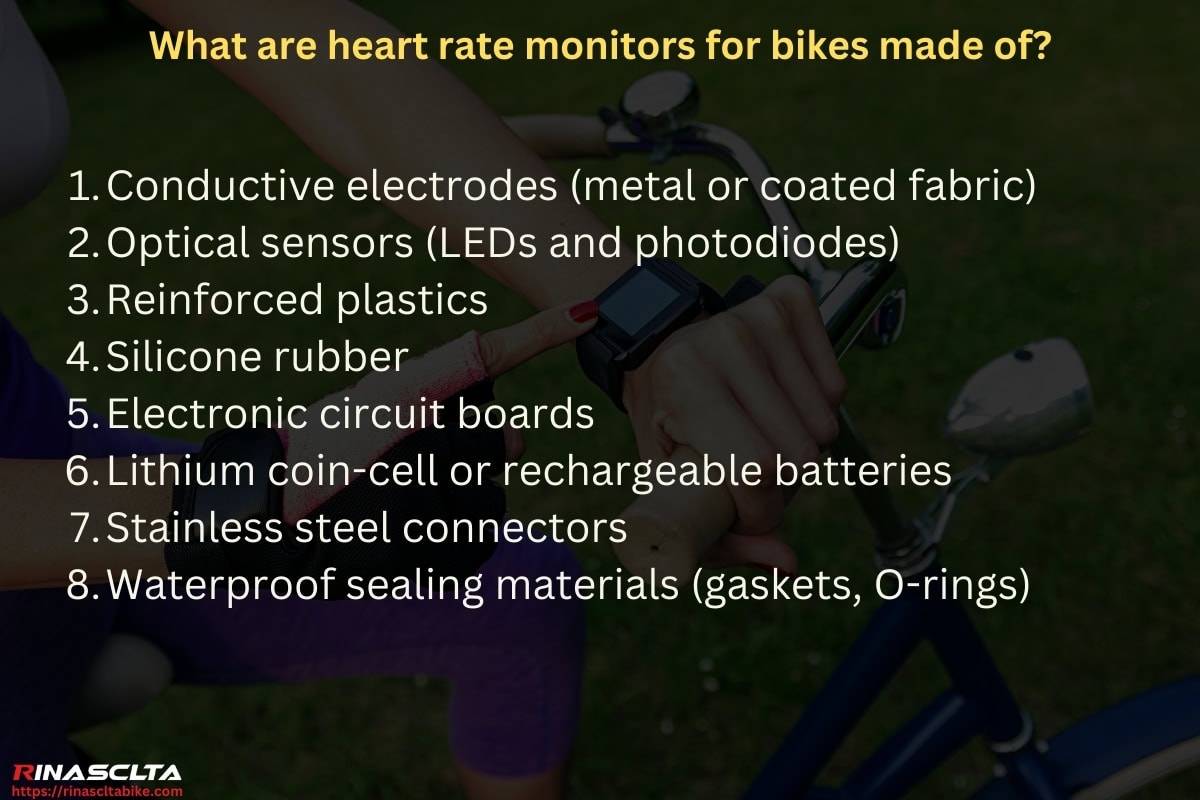
Heart rate monitors for bikes are made of conductive electrodes, reinforced plastics, silicone rubber, electronic circuit boards, optical sensors or electrodes, lithium coin-cell or rechargeable batteries, stainless steel connectors, and waterproof sealing materials, because these materials must balance skin contact sensitivity, comfort, durability, signal accuracy, and weather resistance during cycling.
- Conductive electrodes (metal or coated fabric): Detect the heart’s electrical signals accurately in chest-strap monitors.
- Optical sensors (LEDs and photodiodes): Measure blood flow changes in wrist or arm-based monitors using light.
- Reinforced plastics: Form the sensor housing, keeping the unit lightweight and impact resistant.
- Silicone rubber: Used in straps and contact surfaces for comfort, flexibility, sweat resistance, and secure fit.
- Electronic circuit boards: Process electrical or optical signals and manage wireless data transmission.
- Lithium coin-cell or rechargeable batteries: Power the sensor with long life or convenient recharging.
- Stainless steel connectors: Provide durable, corrosion-resistant electrical contacts between the sensor and the strap.
- Waterproof sealing materials (gaskets, O-rings): Protect internal electronics from sweat, rain, and washing.
What are the types of heart rate monitors for bikes?
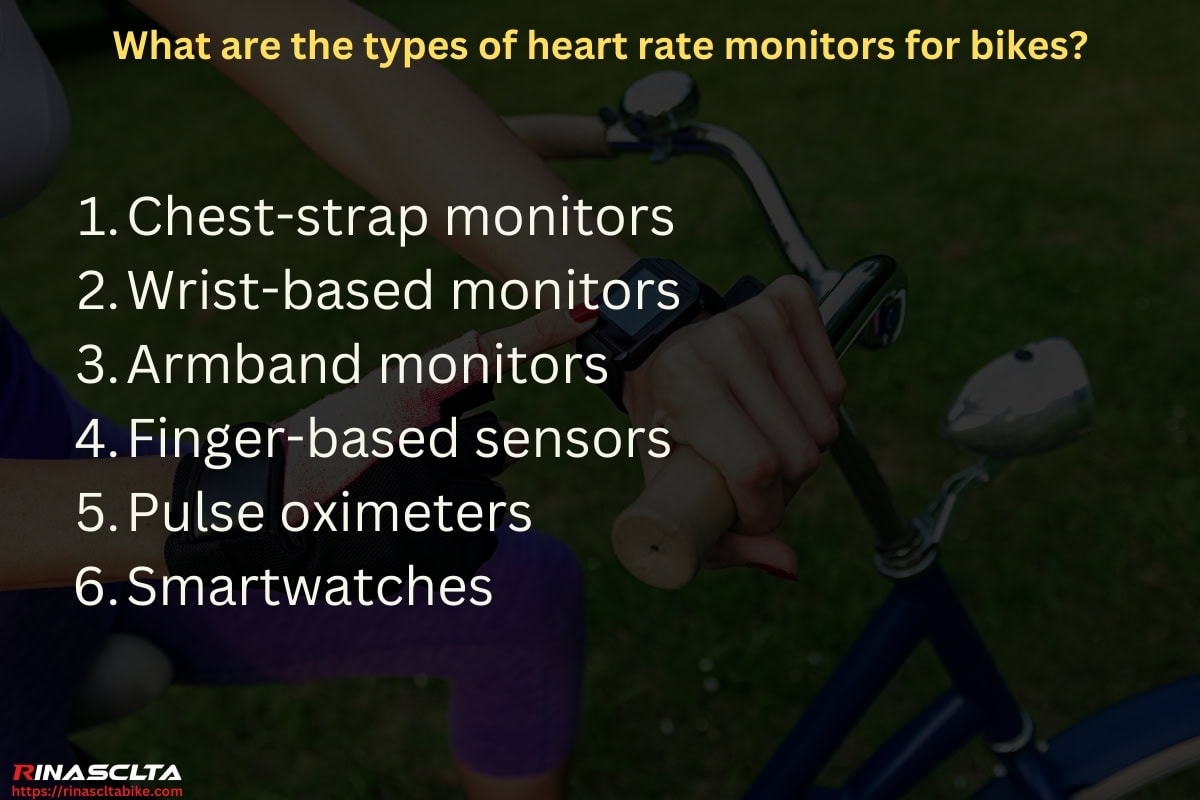
Heart rate monitors for bikes include chest-strap monitors, wrist-based monitors, armband monitors, finger-based sensors, pulse oximeters, and smartwatches, because heart rate can be measured from different body locations using either electrical or optical sensing, each with trade-offs in accuracy, comfort, and convenience.
- Chest-strap monitors: Use electrical signals (ECG) from the chest to deliver the highest accuracy, especially during intense cycling.
- Wrist-based monitors: Rely on optical sensors to provide convenient, everyday heart rate tracking with moderate accuracy while riding.
- Armband monitors: Use optical sensors on the upper arm for improved stability and accuracy compared with wrist placement.
- Finger-based sensors: Measure pulse through the fingertip but are impractical for continuous cycling use due to movement and grip requirements.
- Pulse oximeters: Track blood oxygen saturation alongside pulse but are mainly for health checks rather than real-time cycling training.
- Smartwatches: Combine optical heart rate monitoring with GPS and fitness tracking, offering multi-sport convenience at the expense of on-bike visibility and cycling-specific accuracy.
Are heart rate monitors accurate?
Yes, heart rate monitors are accurate because they are designed to measure heart activity directly using either electrical signals (ECG) or optical blood-flow detection (PPG), providing reliable real-time data for training intensity, pacing, and recovery when worn correctly.
Are chest heart rate monitors more accurate?
Yes, chest heart rate monitors are more accurate because they use electrocardiography (ECG) to detect the heart’s electrical impulses directly at the chest, making them the gold standard for high-intensity cycling, intervals, and professional training.
How accurate are chest strap heart rate monitors?
Chest strap heart rate monitors are highly accurate (often within ±1–2 BPM) because they use electrocardiography (ECG) to detect the heart’s electrical signals directly at the chest, providing instant response to intensity changes. This makes them the gold standard for cycling, especially during intervals, sprints, climbing, and structured training where precision and safety pacing matter.
Are armband heart rate monitors accurate?
Yes, armband heart rate monitors are accurate because they use optical sensors placed on the upper arm, which is more stable and has better blood flow than the wrist, resulting in higher accuracy during cycling compared with wrist-based sensors.
How accurate is a wrist heart rate monitor?
Wrist heart rate monitors are moderately accurate for steady efforts but less reliable during cycling, because optical photoplethysmography (PPG) at the wrist is affected by vibration, handlebar grip pressure, sweat, temperature, and arm movement. Accuracy improves at steady endurance pace but can lag or spike during high-intensity riding, reducing training value for intervals.
Are chest heart rate monitors more accurate than wrist monitors?
Yes, chest heart rate monitors are more accurate than wrist monitors because ECG-based chest straps respond instantly to heart rate changes and are less affected by vibration, sweat, grip pressure, or arm movement common in cycling.
Are finger heart rate monitors accurate?
No, finger heart rate monitors are not accurate for cycling because they require stillness and consistent finger pressure, making them unsuitable for real-time monitoring while gripping handlebars and riding.
How accurate are finger heart rate monitors?
Finger heart rate monitors are accurate at rest or when still but not accurate for cycling, because they require stable finger pressure and minimal movement—conditions that don’t exist while riding. As a result, they are unsuitable for real-time bike training, pacing, or safety monitoring.
How accurate are Garmin heart rate monitors?
Garmin heart rate monitors are very accurate, especially their chest strap models, which use ECG sensing and are validated extensively in endurance sports. Garmin’s wrist-based sensors offer good everyday accuracy, but for cycling-specific training, Garmin chest straps deliver the highest data quality, fastest response, and best integration with bike computers and training platforms.
Is a heart rate monitor better than a watch?
Yes, a dedicated heart rate monitor is better than a watch because chest straps and armband sensors provide higher accuracy, faster response, and better compatibility with bike computers, while watches prioritize convenience and multi-sport use over cycling-specific precision.
How do you choose heart rate monitors for a bike?
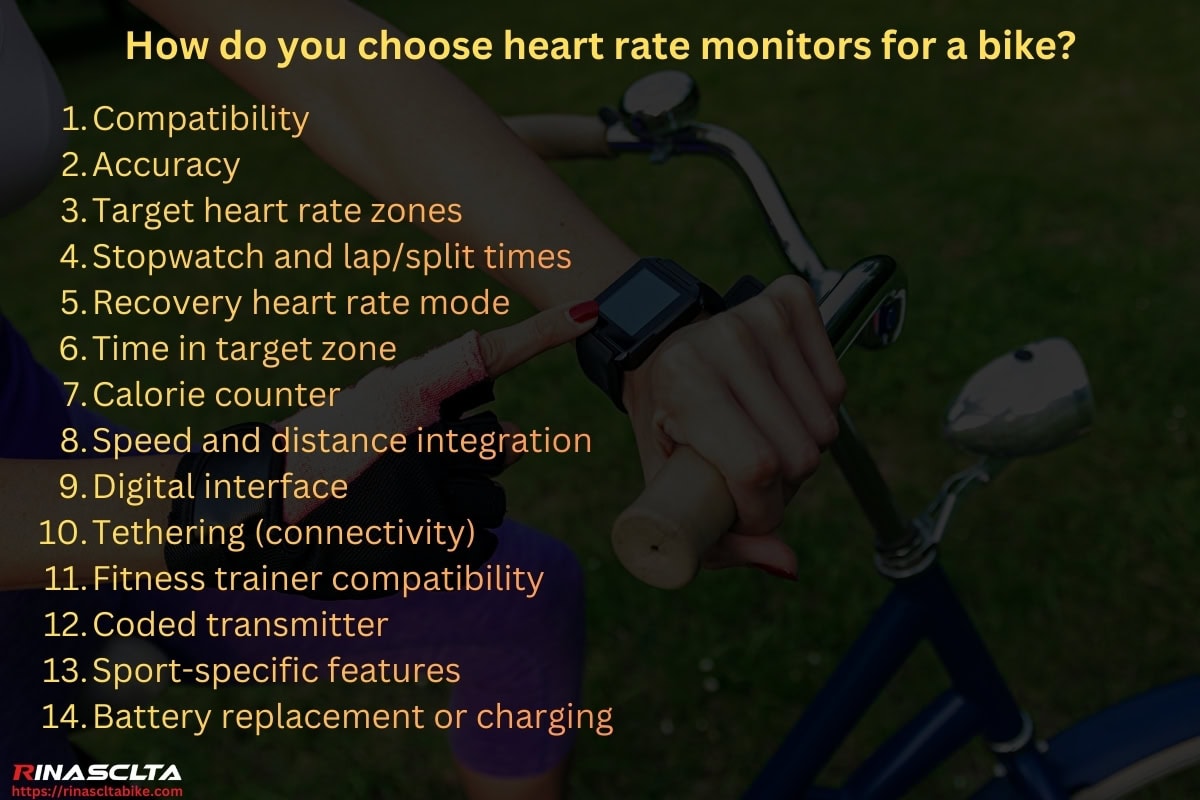
You choose a heart rate monitor for a bike by evaluating compatibility, accuracy, target zones, sport-specific features, data tracking functions, connectivity, battery type, and long-term usability, because these factors determine how reliably the monitor measures effort, integrates with your cycling setup, and supports training, safety, and recovery over time.
- Compatibility: Ensure the monitor works with your bike computer, smartphone, or watch via Bluetooth and/or ANT+ for seamless data syncing.
- Accuracy: Prefer chest straps or high-quality armband sensors if you need precise, fast-responding heart rate data during cycling.
- Target heart rate zones: Look for zone support to train at the correct intensity for endurance, tempo, or interval workouts.
- Stopwatch and lap/split times: Useful for structured training, intervals, and performance analysis during rides.
- Recovery heart rate mode: Helps assess post-ride recovery and overall cardiovascular fitness.
- Time in target zone: Shows how long you maintain specific effort levels, adding value to training efficiency.
- Calorie counter: Estimates energy expenditure to support nutrition planning and weight management.
- Speed and distance integration: Allows combined analysis when paired with GPS bike computers or sensors.
- Digital interface: Clear data display and app dashboards make interpretation and training decisions easier.
- Tethering (connectivity): Stable wireless connections prevent dropouts and data loss during rides.
- Fitness trainer compatibility: Important if you use smart trainers or indoor cycling platforms.
- Coded transmitter: Prevents signal interference in group rides, races, or indoor training environments.
- Sport-specific features: Cycling-optimized metrics improve relevance compared with general fitness monitors.
- Battery replacement or charging: Decide between replaceable coin cells for long life or rechargeable batteries for convenience.
How do you read a heart rate monitor?
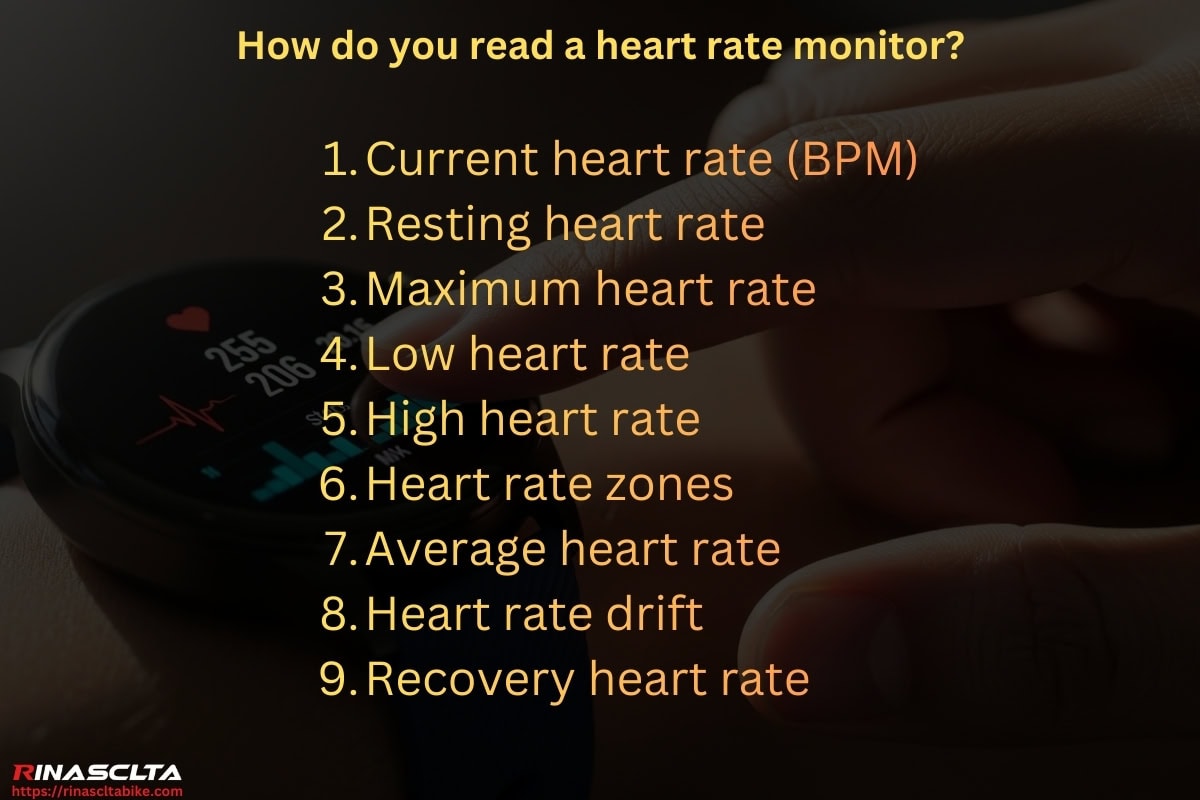
You read a heart rate monitor by interpreting the beats per minute (BPM) value in context of your resting heart rate, maximum heart rate, and training zones, because the number alone only becomes meaningful when compared to your personal cardiovascular baseline.
- Current heart rate (BPM): The live number showing how hard your heart is working at that moment.
- Resting heart rate: Your lowest heart rate at rest (often measured in the morning); lower values usually indicate better cardiovascular fitness.
- Maximum heart rate: Your estimated or tested upper limit, used to calculate training zones and safe intensity ceilings.
- Low heart rate: Indicates recovery, warm-up, or very light effort where fat metabolism and circulation dominate.
- High heart rate: Shows intense effort, anaerobic work, or near-max exertion that cannot be sustained for long.
- Heart rate zones: Percentage ranges of your max heart rate that define training intensity (e.g., recovery, endurance, tempo, threshold, VO₂ max).
- Average heart rate: Helps assess overall ride intensity and fatigue load.
- Heart rate drift: Rising heart rate at steady power, signaling dehydration or fatigue.
- Recovery heart rate: How quickly your heart rate drops after stopping, a key indicator of fitness and recovery quality.
Does a heart rate monitor tell you calories burned?
Yes, a heart rate monitor can tell you calories burned if it is paired with a bike computer, watch, or app that uses heart rate data, ride duration, body metrics (age, weight, sex), and activity type to estimate energy expenditure.
Does a heart rate monitor make calories more accurate?
Yes, a heart rate monitor makes calorie estimates more accurate if it provides real-time cardiovascular effort data, because heart rate reflects physiological load better than speed or distance alone—though calorie calculations are still estimates and are most accurate when combined with power meter data.
How to check your heart rate without a monitor?
You can check your heart rate without a monitor by using manual pulse methods, which rely on feeling and counting your heartbeat at key pulse points and provide a practical baseline for effort and safety awareness.
- Wrist pulse (radial artery): Place two fingers on the inside of your wrist below the thumb, count beats for 15 seconds, and multiply by four to estimate BPM.
- Neck pulse (carotid artery): Gently press two fingers beside the windpipe, count beats for 15 seconds, and multiply by four, useful after exercise.
- Resting heart rate check: Measure your pulse first thing in the morning before getting out of bed to assess baseline fitness and recovery.
- Talk test: If you can speak in full sentences, your heart rate is low to moderate; if speaking is difficult, you’re at high intensity.
- Breathing rate observation: Faster, deeper breathing usually corresponds to higher heart rate and exertion.
How should you use a heart rate monitor?
You should use a heart rate monitor by fitting it correctly, pairing it with a device, setting personal data and zones, monitoring heart rate during activity, and reviewing post-ride data, because each step ensures accurate measurement, meaningful interpretation, and safe, effective training.
- Fit the monitor correctly: Wear the chest strap snugly below the chest muscles or place the optical sensor firmly on the wrist or upper arm to ensure consistent skin contact and accurate readings.
- Pair it with a device: Connect the monitor to a bike computer, smartwatch, or phone app via Bluetooth or ANT+ so heart rate data is recorded and displayed in real time.
- Set personal data and zones: Enter age, weight, and maximum heart rate (or test-based values) to calculate accurate heart rate zones for training and safety.
- Monitor heart rate during the ride: Use live BPM and zone indicators to control intensity, avoid overexertion, and pace climbs, intervals, or long rides effectively.
- Review post-ride data: Analyze average heart rate, time in zones, peak values, and recovery trends to assess fitness, fatigue, and progress over time.
How to wear a chest heart rate monitor?
You can wear a chest heart rate monitor by positioning the strap just below the chest muscles, tightening it so it sits snug but comfortable, and lightly moistening the electrodes to improve skin contact, because chest straps use electrocardiography (ECG) to detect the heart’s electrical signals accurately. Proper placement ensures fast response, minimal signal dropouts, and high accuracy during cycling, intervals, and high-intensity training.
How to wear a wrist heart rate monitor?
You can wear a wrist heart rate monitor 1–2 finger widths above the wrist bone, snug enough to prevent movement without restricting circulation, because wrist-based monitors rely on optical photoplethysmography (PPG) that is sensitive to motion and loose fit. Correct placement improves signal stability and provides better heart rate estimates during steady cycling.
How to wear an arm heart rate monitor?
You can wear an arm heart rate monitor on the upper arm or forearm, away from joints and tightened securely against the skin, because this location reduces vibration and improves optical sensor accuracy compared with the wrist. Armband monitors offer a strong balance between comfort and accuracy for cycling without the tightness of a chest strap.
How do heart rate monitors improve training?
Heart rate monitors improve training by allowing cyclists to train within specific heart rate zones, manage fatigue, track recovery, and control intensity based on physiological response rather than speed alone. This leads to safer pacing, better endurance development, reduced overtraining risk, and more consistent long-term fitness gains.
Can you connect a Garmin heart rate monitor to an Apple Watch?
Yes, you can connect a Garmin heart rate monitor to an Apple Watch if the monitor supports Bluetooth Low Energy (BLE), because Apple Watch accepts external Bluetooth heart rate sensors for workouts—but not if the monitor is ANT+-only, since Apple Watch does not support ANT+.
In practice, many Garmin chest straps (such as dual ANT+/Bluetooth models) pair directly with Apple Watch during activities, adding value through higher accuracy, faster response, and more reliable heart rate data than the watch’s built-in wrist sensor, especially during cycling and high-intensity training.
How to calibrate a Garmin heart rate monitor?
You don’t manually calibrate a Garmin heart rate monitor, but you should ensure accuracy by wearing it correctly, updating firmware, pairing it properly, and setting accurate personal data (age, weight, max HR) in the device or app. For best results, Garmin chest straps automatically self-adjust, while wrist-based sensors benefit from consistent placement and regular firmware updates to maintain reliable readings.
Who should use a heart rate monitor for biking?
Anyone who wants to ride with better control, safety, and fitness insight should use a heart rate monitor for biking, because heart rate reflects the body’s real physiological effort rather than just speed or terrain. In practice, heart rate monitors are especially valuable for beginners learning pacing, fitness-focused riders building endurance, performance cyclists training in zones, commuters and e-bike riders managing exertion, and older or health-conscious riders monitoring cardiovascular stress—making them a low-cost, high-value tool for smarter and safer cycling across all riding styles.
What are the risks of using heart rate monitors?
The risks of using heart rate monitors include data misinterpretation, overreliance on numbers, inaccurate readings, skin irritation, technical failures, and psychological stress, because heart rate is influenced by many factors beyond fitness and the devices themselves are not medical instruments.
- Data misinterpretation: Riders may misread heart rate values without understanding zones, fatigue, or cardiac drift, leading to poor training decisions.
- Overreliance on numbers: Focusing too much on BPM can cause cyclists to ignore perceived exertion, terrain, weather, or safety conditions.
- Inaccurate readings: Optical sensors can be affected by vibration, sweat, cold, or poor fit, resulting in misleading data during rides.
- Skin irritation or discomfort: Chest straps and tight bands can cause chafing, rashes, or pressure discomfort during long or hot rides.
- Technical failures: Battery depletion, signal dropouts, or pairing issues can interrupt data collection and reduce reliability.
- Psychological stress: Constant monitoring may increase anxiety or reduce enjoyment by turning every ride into a performance test rather than a recreational activity.
Heart rate monitors for bike brands and manufacturers
The heart rate monitor industry for cycling grew out of sports science and medical signal detection in the 1970s, evolving from simple chest electrodes into today’s wireless, app-connected, multi-sport training tools. Modern brands and manufacturers differentiate themselves through measurement accuracy (ECG vs optical), Bluetooth/ANT+ compatibility, ecosystem integration, durability, and training analytics, serving cyclists from beginners to professionals across road, mountain, commuting, indoor training, and e-bike use.
| Brand | Since | Country / Region | Special Features |
| Garmin | 1989 | USA | Highly accurate ECG chest straps, dual ANT+/Bluetooth support, deep integration with Garmin bike computers and training platforms |
| Polar | 1977 | Finland | Pioneer of heart rate monitoring, industry-leading ECG accuracy, strong physiology-based training metrics |
| COROS | 2016 | USA | Long battery life, efficient algorithms, performance-focused heart rate tracking for endurance athletes |
| Wahoo | 2009 | USA | Reliable chest straps with stable connectivity, seamless pairing with bike computers and smart trainers |
| iFit | 2007 | USA | App-centric heart rate monitoring designed for guided workouts and connected fitness ecosystems |
| Suunto | 1936 | Finland | Rugged chest straps and optical sensors, strong outdoor and endurance sport heritage |