What is a child bike seat?
A child bike seat is a secure, impact-resistant seat designed to carry a young child on an adult bicycle using mounting brackets, harness straps, foot guards, and a protective shell to ensure stability and safety while riding. Originally appearing in Europe in the 1970s as simple rear-mounted carriers, child bike seats have evolved into modern, ergonomically designed systems with 5-point harnesses, shock-absorbing materials, reclining functions, and compatibility with city, touring, and e-bikes, providing families a safe and convenient way to commute, travel, and enjoy recreational cycling together.
How does a child bike seat work?
A child bike seat works by securely attaching to the bike’s frame, rear rack, or front handlebar area using reinforced mounting hardware, then holding the child in place with a 3- or 5-point harness, foot straps, and an impact-resistant shell that absorbs vibration and protects against sudden movements. The seat distributes the child’s weight evenly to maintain bike stability, while features like shock-absorbing materials, high-back support, side panels, and adjustable footrests enhance comfort and safety during transport. Together, these components ensure safe family commuting, recreational rides, and urban mobility, providing protection from bumps, falls, and shifting weight while maintaining predictable handling for the rider.
Is it necessary to have a child bike seat?
Yes, a child bike seat is necessary if you plan to carry a young child on your bicycle, because it provides essential safety features such as a harness, side protection, foot guards, and stable mounting that prevent falls and injuries. Without a proper child seat, a child cannot safely sit on the bike due to balance issues, lack of support, and exposure to moving parts, making certified seats the only safe method for family cycling.
Do child bike seats fit all bikes?
No, child bike seats do not fit all bikes, because compatibility depends on frame geometry, mounting points, rear rack strength, seat tube diameter, brake type, and wheel size. Some bikes—like full-suspension MTBs, carbon race bikes, or bikes with non-standard frames—may not support certain mounts, so choosing a seat requires matching the mounting style (frame, rack, or front) to the bike’s design and structural limitations.
How to make a child bike seat?
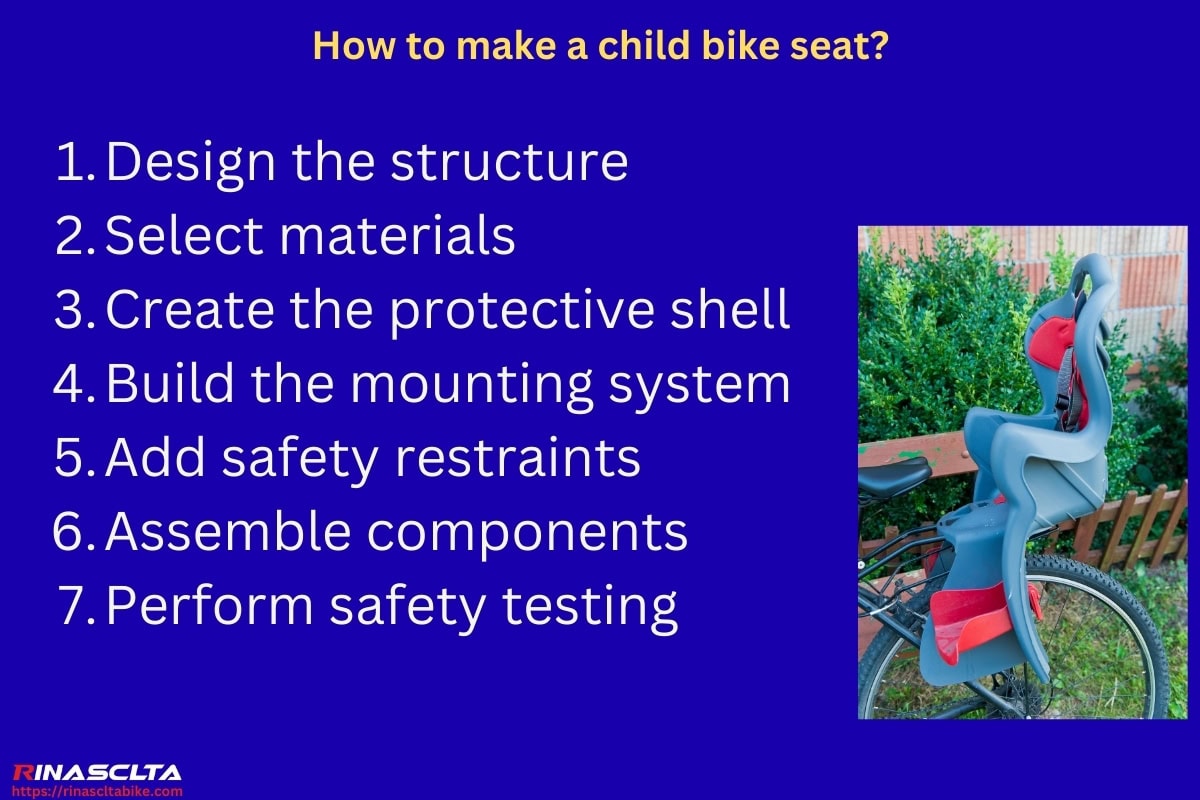
To make a child bike seat, a manufacturer must complete all major steps including designing the structure, selecting materials, creating the protective shell, building the mounting system, adding safety restraints, assembling components, and performing safety testing, because each step ensures the seat is strong, secure, ergonomic, and compliant with child safety standards.
- Design the structure: Engineers create the seat’s shape, backrest angle, and side protection to ensure ergonomic support and proper child posture.
- Select materials: Manufacturers choose impact-resistant plastics, reinforced metal mounts, and padded fabrics to balance durability, safety, and comfort.
- Create the protective shell: The outer seat body is molded using high-strength plastic to absorb shocks and protect the child during bumps or sudden movements.
- Build the mounting system: Metal brackets or racks are fabricated to securely attach the seat to the bike frame, rear rack, or handlebar area.
- Add safety restraints: Install 3-point or 5-point harnesses, adjustable footrests, and foot straps to prevent slipping and contact with moving parts.
- Assemble components: All parts are fitted together, including padding, guards, handles, and hardware, ensuring every piece aligns and locks securely.
- Perform safety testing: Seats undergo structural tests, vibration tests, impact tests, and certification checks (e.g., EN 14344), ensuring they meet strict safety requirements for carrying children on bikes.
What are child bike seats made of?
Child bike seats are made of impact-resistant plastic, aluminum, steel, foam padding, polyester fabric, nylon straps, and rubber footrests, because these materials provide the ideal balance of strength, shock absorption, durability, comfort, lightweight construction, and child safety needed for secure cycling with young passengers.
- Impact-resistant plastic: Forms the main seat shell because it is lightweight, durable, and able to absorb shocks and vibrations.
- Aluminum: Used in mounting brackets and support arms because it is strong, corrosion-resistant, and lighter than steel.
- Steel: Added to structural mounts or reinforcement points for maximum load-bearing strength and long-term durability.
- Foam padding: Provides cushioning on the backrest and seat to keep the child comfortable on longer rides.
- Polyester fabric: Covers padded areas because it is breathable, easy to clean, and resists moisture and wear.
- Nylon straps: Used for 3- or 5-point harnesses because nylon is extremely strong, abrasion-resistant, and secure under load.
- Rubber footrests: Provide grip and comfort for the child’s feet while preventing slipping and adding vibration dampening.

What are the types of child bike seats?
The types of child bike seats include mounting-position types, age-based types, special-feature types, and bike-specific types, because each category addresses different needs for safety, compatibility, stability, and developmental comfort depending on where the seat attaches, the child’s size, and the bicycle’s design. These classifications help parents choose a seat that fits their bike properly, supports their child’s age and weight, and offers the right mix of protection, convenience, and riding style.
Child bike seat types based on mounting position
Child bike seat types based on mounting position include front-mounted seats, rear-mounted seats, and top-tube-mounted seats, because each location offers different levels of visibility, weight distribution, handling stability, and age suitability, allowing parents to choose the setup that best fits their riding style and bike design.
- Front-mounted child bike seat: Positioned near the handlebars, it keeps the child in the rider’s view and improves bonding, ideal for younger toddlers and slow, stable rides.
- Rear-mounted child bike seat: Mounted on the rear rack or frame, it provides more space, higher weight capacity, and better stability for older or heavier children.
- Top-tube-mounted child bike seat: Installed on the bike’s top tube, it keeps the child centered between the rider’s arms, offering good balance and easy communication for short rides or commuting.
Front vs rear-mounted child bike seat
Front vs. rear-mounted child bike seats differ mainly in visibility, handling, weight capacity, and age suitability, because the mounting position changes how the bike balances, how much the rider can see and interact with the child, and how much space is available for support features. Front-mounted seats keep the child within the rider’s view and promote interaction but offer less room and lower weight limits, while rear-mounted seats provide greater stability, more protection, and higher capacity for older or larger children. Together, these options allow families to choose based on riding style, bike geometry, and child age.
| Child Bike Seat Feature | Front-Mounted Child Seat | Rear-Mounted Child Seat |
| Position | Mounted near the handlebars. | Mounted on rear rack or frame. |
| Visibility | High — child is always in view. | Moderate — child rides behind. |
| Handling | More interactive but can feel cramped. | More stable with better weight distribution. |
| Weight Capacity | Lower (typically up to ~15 kg / 33 lb). | Higher (up to 22–25 kg / 48–55 lb). |
| Best for Child Age | Younger toddlers (9 months – 2.5 years). | Older toddlers and kids (2 – 6 years). |
| Protection | Less surrounding protection. | More sidewalls, padding, and reinforced shells. |
| Rider Comfort | May reduce leg/knee space. | No interference with pedaling. |
| Bike Compatibility | Limited — requires stable handlebar stem area. | More universal — works with most bikes with racks or frame space. |
| Special Features | Great visibility, bonding, fun for kids. | High protection, recline options, suspension mounts. |
| Best Use | Short city rides, slow commutes, bonding rides. | Longer rides, touring, rougher terrain, growing kids. |

Is a front or rear child bike seat safer?
A rear-mounted child bike seat is safer than a front-mounted seat if your priority is maximum protection, stability, and higher weight capacity, because rear seats have larger impact-resistant shells, better side protection, stronger mounting systems, and improved bike handling for the adult rider. But a front-mounted child seat can be safer for very young children on short, slow rides, because the child sits within the rider’s arms, remains fully visible, and experiences less wind and road spray—making it more controlled and interactive, though less protective in a crash scenario.
Frame mount vs rack mount child bike seat
Frame-mount child bike seats and rack-mount child bike seats differ in how they attach to the bike, how much weight they support, the type of bikes they fit, and how they affect handling, because the mounting position changes the load distribution, vibration absorption, compatibility, and overall ride stability. Frame-mount seats attach directly to the seat tube, providing better shock absorption and a smoother ride, while rack-mount seats attach to a rear cargo rack, offering higher weight capacity and wider compatibility with commuter and touring bikes.
| Child Bike Seat Feature | Frame-Mount Child Seat | Rack-Mount Child Seat |
| Where It Mounts | Attaches to the bike’s seat tube using a clamp. | Attaches directly onto a rear cargo rack. |
| Ride Comfort | High — built-in suspension absorbs vibration. | Moderate — depends on rack stiffness and bike type. |
| Weight Capacity | Typically supports up to 18–22 kg (40–48 lb). | Often higher, up to 22–25 kg (48–55 lb). |
| Bike Handling | More natural feel because weight is directly on the frame. | Slightly stiffer handling depending on rack stability. |
| Compatibility | Limited — needs a round, strong seat tube; not for carbon frames. | Broad — fits bikes with standard rear racks rated 25 kg or higher. |
| Stability | Stable and flexible, with built-in suspension arms. | Very stable if rack is sturdy and well-supported. |
| Installation | Requires proper seat-tube clearance. | Easier if rack is already installed. |
| Special Features | Better shock absorption, more comfortable for the child. | Higher capacity, better for touring and heavier kids. |
| Best For | Comfort-focused rides, mixed terrain, everyday commuting. | Heavier children, long-distance rides, bikes with strong racks. |

Are front child bike seats safe?
Yes, front child bike seats can be safe if used with children within the recommended age and weight range (usually 9 months to ~2.5 years) and installed on a bike with compatible handlebars and frame geometry. They offer excellent visibility, rider–child interaction, and low-speed control, but they are less protective in a crash and can reduce knee clearance, so they are safest for slow, stable, short-distance rides.
Are rear child bike seats safe?
Yes, rear child bike seats are safe if they are properly installed on a strong rack or compatible frame mount and meet safety standards like EN 14344. They offer better impact protection, higher weight capacity, sidewalls, and recline options, making them safer for older, heavier children or longer rides, though the rider must check balance and loading carefully.
Should kids ride in a front or back bike seat?
Kids can ride in either a front or rear seat depending on age, weight, and riding style. Front seats are better for younger toddlers on short, slow rides because they allow close supervision, while rear seats are better for older or heavier children, offering more stability, protection, and comfort on longer or faster rides.
What is the child bike seat weight limit?
The weight limit for most child bike seats ranges from 15–25 kg (33–55 lb), depending on the mounting style, seat design, and certification standards. Front-mounted seats usually support up to 15 kg (33 lb) because they attach near the handlebars, where excess weight affects steering and stability, while rear-mounted seats typically support 22–25 kg (48–55 lb) due to stronger frame mounts or rear racks that can safely carry more load. These limits ensure proper balance, structural integrity, crash protection, and predictable handling, keeping both rider and child safe.
What are the child bike seat safety standards?
The child bike seat safety standards include international and regional certifications such as ASTM F1625 in the United States and EN 14344 in Europe, each defining strict requirements for structural strength, harness safety, mounting integrity, stability, weight limits, and impact protection to ensure a child can be carried safely on a bicycle.
| Child Bike Seat Safety Standard | Region | Weight Limits / Categories | Covers Front or Rear Seats | Key Safety Requirements |
| ASTM F1625 | United States | Up to ~25 kg (55 lb) | Rear-mounted seats only | Structural load testing, 3- or 5-point harness strength, foot protection, vibration resistance, chemical safety, and secure mounting integrity. |
| EN 14344 | Europe | A15: up to 15 kg (33 lb) A22: up to 22 kg (48 lb) A25: up to 25 kg (55 lb) | Both front- and rear-mounted seats | Impact resistance, sharp-edge avoidance, harness safety, side/foot protection, chemical compliance, and mounting strength with dynamic-load testing. |

Child bike seat types based on child age
Child bike seat types based on child age include 2-year, 3-year, 4-year, 5-year, and 6-year age ranges, because children grow quickly and each stage requires different weight limits, support levels, harness types, and protection features to ensure safe and comfortable cycling.
- For 2-year-olds: Seats with high back support and 5-point harnesses are ideal because toddlers need maximum stability and head/neck support.
- For 3-year-olds: Rear-mounted seats with adjustable footrests work well because kids at this age are taller and heavier, requiring more legroom and protection.
- For 4-year-olds: Larger rear seats with higher weight capacity (up to 22–25 kg) are suitable because children in this age range need more space and side protection.
- For 5-year-olds: Seats with reinforced shells and strong rack mounts are preferred because older kids shift their weight more and require better balance support.
- For 6-year-olds: Only high-capacity rear seats or junior bike seats work, as children near the upper weight limit and need robust mounting systems for safe rides.
Can 6 years old fit a child seat behind a bike?
Yes, a 6-year-old can fit in a child seat behind a bike if they are within the seat’s weight and height limits, typically up to 22–25 kg (48–55 lb) as defined by standards like EN 14344 (A22/A25). Rear-mounted seats designed for older children offer higher backrests, reinforced shells, adjustable footrests, and stronger rack or frame mounts, making them suitable for many 6-year-olds. However, if the child exceeds the limit or sits too high for stable handling, a tag-along bike, trailer, or junior seat becomes a safer option.
At what age can a child go in a bike seat?
At around 9–12 months old, a child can go in a bike seat, because this is the age when most children can sit upright independently, support their head and neck, and safely handle bumps and movement, which are essential for riding in a properly certified child bike seat. Safety standards like EN 14344 recommend waiting until the child has full neck stability, and pediatricians advise that infants younger than 9 months lack the muscular control needed to ride safely.
What is the allowed weight front a child bike seat?
The allowed weight for a front child bike seat is typically up to 15 kg (33 lb), because front-mounted seats attach near the handlebars and stem, where extra weight directly affects steering control, balance, and rider stability. Safety standards like EN 14344 (A15 category) set this limit to ensure that the bike remains predictable to handle and that the mounting hardware can safely support the child without compromising maneuverability.
What is the safest child bike seat?
The safest child bike seat is a high-quality rear-mounted seat with a 5-point harness, side protection panels, reinforced shell, and compliance with EN 14344 or ASTM F1625 safety standards, because this design offers the best combination of impact protection, stability, weight capacity, and secure mounting. Rear-mounted seats keep the child away from the handlebars, provide stronger structural support, handle higher weights (22–25 kg), and reduce the risk of injury during sudden stops or falls, making them the safest choice for most families.
Child bike seat types based on special features
Child bike seat types based on special features include single-child seats, double-child setups, reclining seats, suspension seats, quick-release seats, foldable seats, rain-cover-compatible seats, and high-back protective seats, because different riding situations and family needs require added comfort, safety, adjustability, and convenience beyond standard mounting styles.
- Single-child child bike seat: Designed for one child with optimized weight distribution and maximum safety features for everyday commuting.
- Double-child setups: Achieved using a rear seat plus a front seat or a combination system, allowing two children to ride safely when within total weight limits.
- Reclining child bike seat: Offers adjustable backrest angles to support sleeping toddlers and reduce neck strain on longer rides.
- Suspension child bike seat: Features built-in shock absorbers to smooth out bumps, ideal for uneven roads or gravel paths.
- Quick-release child bike seat: Uses a fast-mount mechanism to attach or remove the seat within seconds for flexible commuting and storage.
- Foldable child bike seat: Designed to collapse for travel or easy storage, useful for apartment living or multi-bike families.
- Rain-cover-compatible child bike seat: Built to work with weather shields or integrated canopies to protect children in wet or windy conditions.
- High-back protective child bike seat: Provides extended sidewalls and head support for extra protection, especially for younger or more active children.
Child bike seat types based on bike type
Child bike seat types based on bike type include city bike seats, cargo bike seats, mountain bike seats, road bike seats, gravel bike seats, and e-bike seats, because different bicycles have unique frame geometries, mounting points, suspension behavior, and riding conditions, requiring seats designed for safe compatibility and stable handling.
- City bike child seat: Built for upright bikes with strong frames and racks, offering easy mounting and excellent stability for everyday commuting.
- Cargo bike child seat: Designed to fit long-tail or front-loading cargo bikes, allowing secure multi-child seating with reinforced mounts and extra side protection.
- Mountain bike child seat: Features stronger clamps and vibration-dampening systems to handle rough terrain and off-road bumps safely.
- Road bike child seat: Lightweight and aerodynamic, fitting bikes with narrow frames but usually limited to rear-rack options due to frame clearance.
- Gravel bike child seat: Provides enhanced stability and suspension-friendly features for mixed surfaces without compromising steering control.
- E-bike child seat: Includes reinforced mounting hardware and compatibility with rear racks rated for higher loads due to the bike’s added weight and motor assistance.
How do you choose a child bike seat?
You can choose a child bike seat by considering mounting position, frame or rack compatibility, child’s age and weight, bike type, safety certifications, harness system, protection features, material quality, suspension or vibration control, ease of installation, comfort features, and price, because each factor affects how safely and comfortably the child rides, how the bike handles, and whether the seat fits your specific bicycle correctly.
- Mounting position: Choose between front, rear, or top-tube seats depending on how much visibility, interaction, and stability you want during the ride.
- Frame or rack compatibility: Check whether your bike supports a seat-tube clamp or a rear rack mount, as not all bikes fit both systems.
- Child’s age and weight: Match the seat to your child’s size—front seats work for younger toddlers, while rear seats support older or heavier children up to 22–25 kg.
- Bike type: Ensure the seat fits your city bike, MTB, road bike, gravel bike, cargo bike, or e-bike, as each has different geometry and mounting limitations.
- Safety certifications: Look for standards like EN 14344 or ASTM F1625 to ensure the seat meets structural, harness, and impact-protection requirements.
- Harness system: A 5-point harness is safest because it prevents slipping, twisting, or leaning during the ride.
- Protection features: Sidewalls, high backs, foot guards, and padded shells improve stability and protect against falls or contact with moving parts.
- Material quality: Strong plastics, aluminum mounts, and durable fabrics ensure long-term safety and resist UV, weather, and vibration damage.
- Suspension or vibration control: Seats with built-in suspension arms or shock-absorbing mounts keep the ride smoother on rough roads.
- Ease of installation: Quick-release mounts or simple clamps make it easier to remove the seat when switching between bikes or storing indoors.
- Comfort features: Reclining backs, adjustable footrests, ventilation panels, and cushioned seats improve long-ride comfort for the child.
- Price: Budget seats work for occasional rides, while mid-range or premium seats offer better protection, stability, and durability for daily commuting.

How to install a bike seat for a child?
To install a bike seat for a child, you must follow all key steps including choosing the correct mounting position, attaching the mounting bracket, securing the seat to the bracket, adjusting the harness and footrests, checking stability, and performing a safety test ride, because each step ensures the seat is properly supported, securely fastened, and safe for the child before riding.
- Choose the correct mounting position: Select front, rear, or rack-mounted depending on your bike’s frame compatibility and your child’s age and weight.
- Attach the mounting bracket: Install the frame clamp or rear-rack adapter tightly, as this hardware carries the full load of the child seat.
- Secure the seat to the bracket: Slide or lock the child seat into the mount until it clicks or bolts into place to prevent movement or accidental release.
- Adjust the harness system: Set the 3-point or 5-point harness to fit snugly so the child stays secure even during bumps or sudden stops.
- Set the footrests and straps: Adjust footrest height and tighten foot straps to keep the child’s feet away from the wheels and drivetrain.
- Check all bolts and connections: Ensure every clamp, screw, and latch is fully tightened to maintain structural stability and prevent wobbling.
- Perform a safety test ride: Ride slowly for a few meters without the child to check balance, handling, and seat stability before placing your child in the seat.
How to adjust a bike seat for a child?
You can adjust a bike seat for a child by loosening the seat clamp, raising or lowering the saddle to match the child’s leg length, and then tightening the clamp securely so the seat doesn’t move. Make sure the child can reach the pedals with a slight knee bend at the bottom of the stroke, and adjust the seat angle so it stays level for proper comfort and balance. This ensures efficient pedaling, reduces strain on the knees, and keeps the child stable while riding.
How high should a bike seat be for a child?
You can set a child’s bike seat height so that their knee has a slight bend (about 20–30 degrees) when the pedal is at its lowest point, ensuring comfort and proper biomechanics. The child should also be able to touch the ground with the balls of their feet while seated for safety during starts and stops. This height provides the best mix of control, stability, pedaling efficiency, and confidence for young riders.
Can you put a child seat on an electric bike?
Yes, you can put a child seat on an electric bike if the e-bike has a strong rear rack or compatible frame mount rated for the child’s weight, because e-bikes are heavier and require reinforced mounting hardware. But no, some lightweight or rear-hub–motor designs may not support front seats or frame clamps due to wiring, battery placement, or frame stress limits.
Can child seat attachments be added to any bike?
No, child seat attachments cannot be added to every bike, because compatibility depends on frame geometry, seat-tube shape, rack strength, brake type, and weight capacity. Bikes with carbon frames, unusual designs, or rear suspension may not support frame-mounted seats safely.
Can you put a child seat on a folding bike?
Yes, you can put a child seat on some folding bikes if they have a strong rear rack and are rated to carry child-seat loads, because compact city-oriented folders are often designed for cargo use. But no, many folding bikes lack the frame strength or mounting points for standard child seats due to their hinge mechanisms.
Can you put a child seat on a gravel bike?
Yes, you can put a child seat on a gravel bike if it has a properly rated rear rack or compatible seat-tube diameter, because gravel bikes have sturdy frames suitable for off-road handling. However, front seats may interfere with drop bars, limiting mounting options.
Can you put a child seat on a carbon bike?
No, you generally cannot put a child seat on a carbon bike, because carbon frames are not engineered to handle the clamping forces or additional torsional loads from child seats, risking frame cracking, delamination, or voided warranty. Only a rear-rack system rated for child loads might work, and only if the frame supports mounting points.
Do child seats on bikes get stolen?
Yes, child seats can be stolen if left outside unsecured, because they often use quick-release mounts or removable hardware that thieves can easily detach. Using a lock-through mount, anti-theft bolts, or removing the seat when parked reduces theft risk significantly.
Child bike seat vs trailer, which is better?
A child bike seat is better for short trips, city riding, and close parent–child interaction, while a bike trailer is better for long rides, higher stability, multi-child transport, and maximum protection, because seats keep the child close to the rider and make the bike more compact, whereas trailers offer a fully enclosed, low-center-of-gravity design that improves comfort and safety on longer or uneven routes. The “better” option depends on distance, terrain, storage, child age, and riding style—each excels in different situations.
| Feature | Child Bike Seat | Bike Trailer |
| Position | Mounted on the bike (front or rear). | Pulled behind the bike on wheels. |
| Safety Level | Safe but child is higher and more exposed. | Very safe with low center of gravity and enclosed protection. |
| Protection | Open-air; limited impact shielding. | Enclosed cabin with roll bars and weatherproof cover. |
| Handling | More direct weight on the bike; affects balance. | Stable and smooth; minimal effect on rider balance. |
| Comfort for Child | Good for short rides but bumps are felt more. | Excellent comfort with suspension and cabin space. |
| Ideal Use | City riding, short trips, daycare runs. | Long rides, touring, mixed terrain, multi-child transport. |
| Child Age/Weight | Up to 22–25 kg (48–55 lb). | Typically 1 or 2 kids up to 45–50 kg total. |
| Weather Protection | Minimal; exposed to rain and wind. | Excellent; includes rain shields and sun covers. |
| Storage Needs | Small; stays on the bike or removes easily. | Large; needs storage space for the trailer. |
| Cost | Lower ($80–$250). | Higher ($200–$900+). |

How to get off a bike with a child seat?
You can get off a bike with a child seat by first holding the bike firmly upright, then applying the brakes, and carefully swinging your leg over while keeping one hand on the handlebars to prevent tipping. Once you’re standing beside the bike, ensure the kickstand or your grip stabilizes the bike, then unbuckle and lift the child out safely. This method keeps the bike balanced and prevents sudden shifts in weight that could cause falls.
How to use a basket with a child bike seat?
You can use a basket with a child bike seat by choosing a rear basket for a front-mounted seat, or a front or handlebar basket for a rear-mounted seat, ensuring that neither accessory interferes with mounting hardware, pedaling space, or steering movement. Make sure the basket is securely attached and does not block the harness, footrests, or wheel clearance, allowing you to carry cargo safely without compromising the child’s comfort or bike handling.
Child bike seat brands and manufacturers
The child bike seat industry has expanded significantly as more families use bicycles for daily commuting, school drop-offs, fitness, and urban mobility, creating demand for safer, more comfortable, and better-engineered seats. Early child seats offered basic rear mounting and limited protection, but modern brands now integrate 5-point harness systems, suspension mechanisms, ergonomic shells, airflow panels, reclining functions, and EN/ASTM-certified mounting hardware. Manufacturers across Europe, the U.S., and Asia specialize in different styles—front seats for close interaction, rear seats for stability and higher weight capacity, and cargo-bike solutions for family transport. Today’s leading brands emphasize safety standards, durability, ease of installation, compatibility with city, MTB, road, gravel, and e-bikes, making child bike seats an essential part of modern family cycling culture.
| Child Bike Seat Brand | Founded | Country / Region | Special Features |
| Thule | 1942 | Sweden | Premium EN-certified seats with suspension, magnetic buckles, and ergonomic design. |
| Bell | 1954 | USA | Affordable rear seats for casual family riding; easy-to-install designs. |
| Burley (Dash) | 1978 | USA | Lightweight, breathable seats with integrated rear racks and modern styling. |
| Hamax (Caress) | 1958 | Norway | High-back reclining seats with suspension and EN 14344 certification. |
| Schwinn | 1895 | USA | Budget-friendly rear seats compatible with most city and hybrid bikes. |
| WeeRide | 1996 | USA | Top-tube-mounted front seats with a central positioning for balance. |
| Bellelli | 1994 | Italy | Eco-friendly child seats made with non-toxic materials and ergonomic padding. |
| Topeak | 1991 | Taiwan, China | Modular QuickTrack mounting system with suspension and easy removal. |
| B’Twin (Decathlon) | 1976 | France | Budget-friendly seats with solid European safety compliance. |
| Aventon | 2013 | USA | E-bike–compatible child seats with reinforced rack mounts. |
| Rad Power Bikes | 2007 | USA | E-bike–specific child seat accessories designed for heavy-duty racks. |
| Adams | 1986 | USA | Known for trail-a-bike systems and child tow solutions. |
| Avenir | 2000s | UK | Reliable entry-level seats for commuting and occasional rides. |
| BETO | 1989 | Taiwan, China | Affordable rear child seats with secure foot guards and rack mounts. |
| Bobike (GO Series) | 1978 | Netherlands | Double-walled Dutch safety design with high-side protection and ergonomic shape. |
| Boodie | 1990s | Europe | Simple, lightweight rear seats ideal for short city rides. |
| Britax | 1939 | UK | Premium safety engineering with strong harness systems and side protection. |
| Brompton | 1975 | UK | Compact front seats and accessories designed specifically for folding bikes. |
| Bullitt (Larry vs Harry) | 2008 | Denmark | Cargo-bike child seating systems with harness integration for front boxes. |