What is a bike water bottle?
A bike water bottle is a specially designed container used by cyclists to store and drink water or sports fluids while riding, typically mounted in a bottle cage attached to the bike frame. The earliest versions appeared in Europe in the early 20th century, when competitive cyclists carried metal flasks or glass bottles for hydration during long races, later evolving into lightweight plastic squeeze bottles in the 1960s to improve convenience and safety. Today, bike bottles are made in various materials (BPA-free plastic, stainless steel, carbon, insulated composites) and feature ergonomic shapes, wide-mouth openings, dust caps, and high-flow nozzles, balancing hydration efficiency, aerodynamics, and hygiene. Related terms include hydration system, bottle cage, nozzle design, insulation, squeeze capacity, and dirt cover, all reflecting their role in modern cycling. A bike water bottle is therefore not just a container but an essential performance accessory, valued for keeping riders hydrated, comfortable, and efficient across road, mountain, gravel, and commuting rides.
How do bike water bottles work?
Bike water bottles work through a squeeze-and-sip mechanism designed for quick, one-handed hydration while riding. The bottle body is typically made from flexible BPA-free plastic or composite material, which allows the rider to squeeze it, creating air pressure that pushes liquid up through the nozzle or bite valve. The cap and tip system—often a pull-push nozzle, self-sealing valve, or soft bite tip—prevents leaks when not in use and enables fast flow when drinking, even at high cadence. Many cycling bottles also feature ergonomic shapes, grooves for grip, and dust covers to protect the mouthpiece from dirt on gravel or mountain rides. Related terms include hydration system, squeeze bottle, high-flow nozzle, dust cap, and bottle cage compatibility. The value lies in providing fast, efficient, and safe access to fluids without breaking pedaling rhythm, making bike water bottles a critical accessory for endurance, comfort, and performance.
Can I use a bike water bottle for other activities?
Yes, you can use a bike water bottle for other activities if it is made from safe, BPA-free materials and has a leak-proof nozzle, because it functions like any reusable sports bottle. They are commonly used for running, hiking, gym workouts, or everyday hydration, offering the same benefits of being lightweight, squeezable, and easy to clean. But bike bottles are specifically designed to fit into a bike cage, so their shape, grip grooves, and nozzle style may not always be as convenient as bottles designed for casual use. The value lies in their durability, portability, and hydration efficiency, making them versatile beyond cycling while still optimized for the bike.
What are bike water bottle made of?
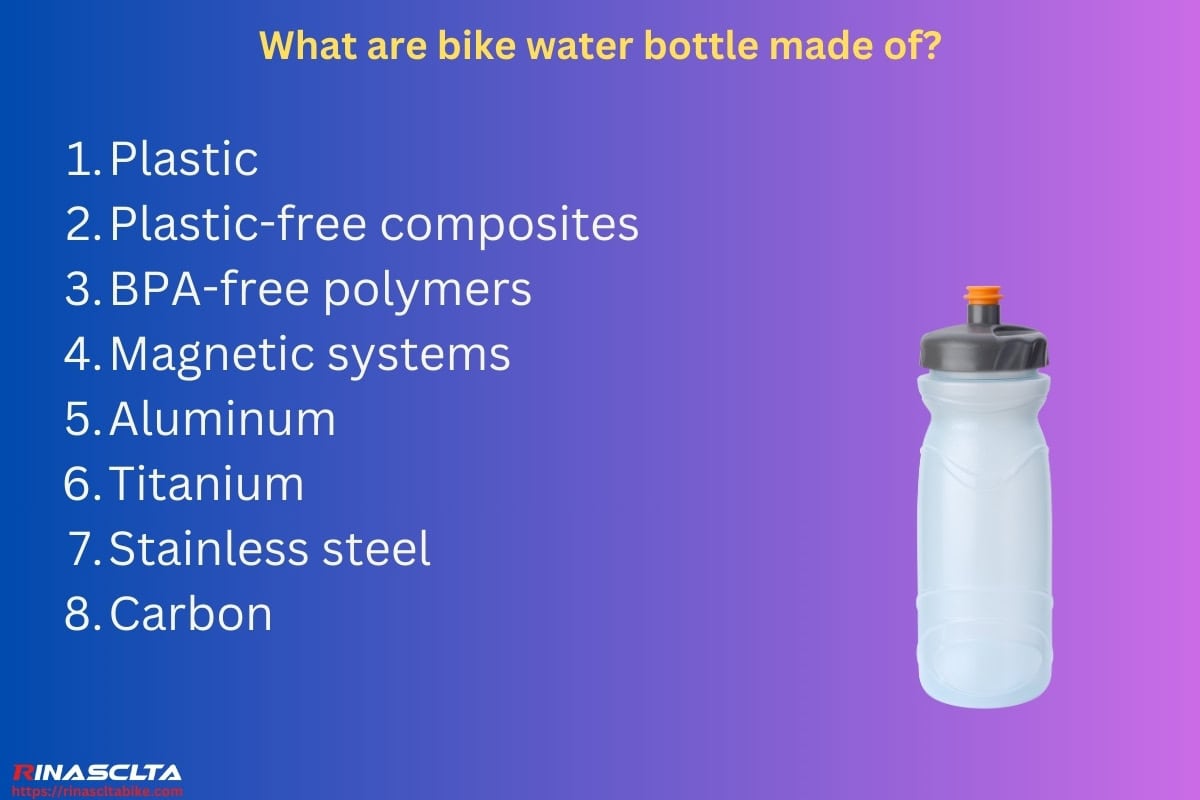
Bike water bottles are commonly made of plastic, plastic-free composites, BPA-free polymers, magnetic systems, aluminum, titanium, stainless steel, and carbon, because each material offers different benefits in terms of weight, safety, durability, insulation, and performance. These materials reflect how bottles adapt to the needs of road cyclists, mountain bikers, commuters, and endurance riders.
- Plastic: Lightweight, affordable, and easy to squeeze, making it the most common choice for cycling bottles.
- Plastic-free composites: Eco-friendly alternatives that reduce reliance on petroleum-based plastics while remaining durable.
- BPA-free polymers: Safe for health, preventing harmful chemicals from leaching into drinks.
- Magnetic systems: Incorporate magnetic mounts instead of cages, improving quick access and security.
- Aluminum: Provides durability and a reusable, recyclable option, though less flexible than plastic.
- Titanium: Extremely strong, lightweight, and corrosion-resistant, used for premium bottles.
- Stainless steel: Durable, insulated, and easy to clean, often used for keeping drinks cold or hot.
- Carbon: Ultra-lightweight and aerodynamic, designed for high-performance racing setups.
How are bike water bottles made?
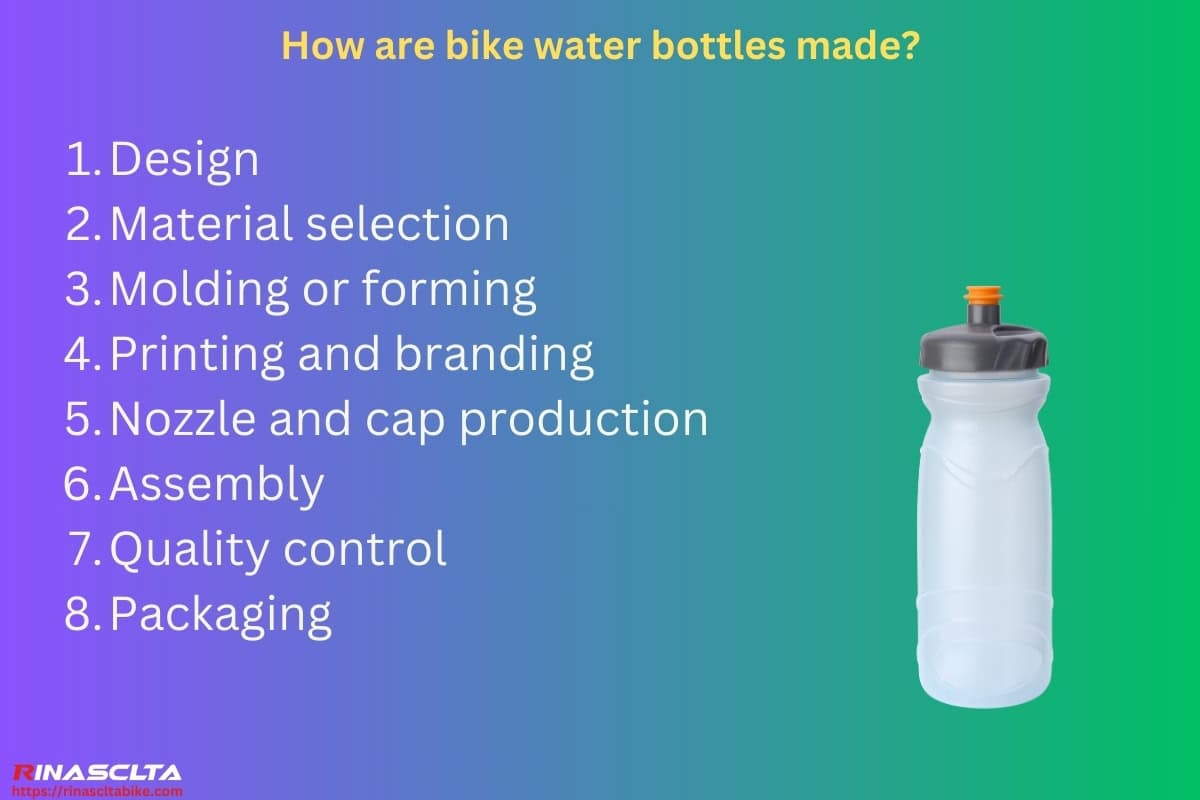
Bike water bottles are made through several key steps including design, material selection, molding or forming, printing and branding, nozzle and cap production, assembly, quality control, and packaging, because each stage ensures the bottle is safe, durable, easy to use, and optimized for cycling performance. These steps guarantee bottles remain lightweight, leak-proof, and compatible with bike cages while meeting health and safety standards.
- Design: Engineers create ergonomic shapes with grooves for grip, volume capacity, and cage compatibility.
- Material selection: Manufacturers choose plastic, stainless steel, titanium, or composites based on weight, durability, and cost.
- Molding or forming: Plastic bottles are made with blow molding, while metal bottles are shaped through forging and welding.
- Printing and branding: Logos, measurements, and graphics are applied for brand identity and rider usability.
- Nozzle and cap production: Specialized bite valves, push-pull caps, or magnetic systems are manufactured for flow control and leak prevention.
- Assembly: The bottle body, cap, and nozzle are combined and tested for airtight fit.
- Quality control: Each bottle is checked for leaks, material safety (BPA-free), and durability under pressure.
- Packaging: Bottles are labeled, boxed, and prepared for shipment to shops or direct customers.
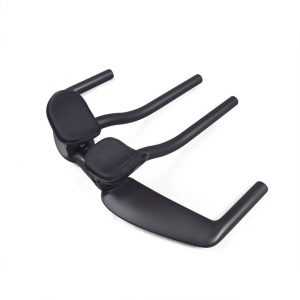
Why do bike water bottle cages look the same?
Bike water bottle cages look the same because they are built around a universal standard bottle diameter of about 74 mm, ensuring that nearly all bottles fit securely regardless of brand or bike type. This standardized design improves compatibility, stability, and ease of access while keeping manufacturing simple and affordable. Related terms include cage retention, bottle grip, frame clearance, weight optimization, and aerodynamics. The value of this uniformity is that riders can switch between bottles and cages without worrying about fit, making hydration systems reliable, interchangeable, and convenient across the cycling industry.
Why do plastic bike water bottles taste like plastic?
Plastic bike water bottles taste like plastic because some are made from low-grade polymers that can leach chemicals such as BPA or residual manufacturing compounds into the water, especially when bottles are new, exposed to heat, or not properly cleaned. Related terms include BPA-free, food-grade plastic, odor-resistant coating, taste neutrality, and polymer safety standards. The value of using BPA-free and high-quality bottles is that they eliminate this issue, providing a clean, neutral taste and ensuring safe, enjoyable hydration during rides.
Are bike water bottles dishwasher safe?
Yes, bike water bottles can be dishwasher safe if they are made from BPA-free, heat-resistant plastics or stainless steel, because these materials can withstand high temperatures without warping or releasing harmful chemicals. But not all bottles are designed for dishwashers—some lightweight plastics, insulated layers, or printed graphics may degrade over time, so it’s best to check the manufacturer’s cleaning instructions. The value lies in ensuring both hygiene and durability, keeping the bottle safe to use while maintaining its performance features.
What are the different types of bike water bottles?
Bike water bottles can be categorized by design, cap type, material, function, and bike type, because each reflects how bottles are shaped, how they dispense fluids, what they are made of, and how they are adapted for specific cycling needs. By grouping bottles this way—such as aerodynamic or fork-mounted designs, push-pull or lid-equipped caps, plastic or stainless-steel builds, insulated or lightweight functions, and bottles tailored for road, MTB, gravel, or commuter bikes—cyclists can easily compare options based on performance, convenience, and compatibility with their riding style.
Bike water bottle types based on design
Bike water bottle types based on design include aerodynamic bottles, bottles for bike forks, bottles for handlebars, and 3D-printed bottles, because each design adapts to different riding styles, storage needs, and performance goals while maintaining hydration efficiency. These variations exist to optimize aerodynamics, accessibility, weight distribution, and customization for cyclists.
- Aerodynamic water bottle: Designed with flat or teardrop shapes to reduce wind drag, commonly used in time trials and triathlons.
- Bottle for bike fork: Mounted on the bike fork to carry extra hydration on long-distance or adventure rides.
- Bottle for handlebar: Positioned on the handlebar for easy access, often used in endurance, gravel, or bikepacking setups.
- 3D-printed water bottle: Custom-made designs offering unique shapes, textures, or lightweight structures tailored to the rider’s needs.
Bike water bottle types based on cap type
Bike water bottle types based on cap type include push-pull caps, squeeze caps, and lid-equipped caps, because each style controls how fluid is dispensed, balancing speed, leak prevention, and hygiene depending on the rider’s environment and preference. These types exist to make drinking on the move easier, cleaner, and more efficient.
- Push-pull cap: Features a nozzle that opens or closes with a simple pull, offering quick access and spill resistance.
- Squeeze cap: Uses a soft valve that dispenses water when the bottle is squeezed, allowing fast, one-handed hydration.
- Lid-equipped cap: Adds a protective cover over the nozzle to keep dirt and dust out, especially valuable for gravel and mountain biking.
Bike water bottle types based on material
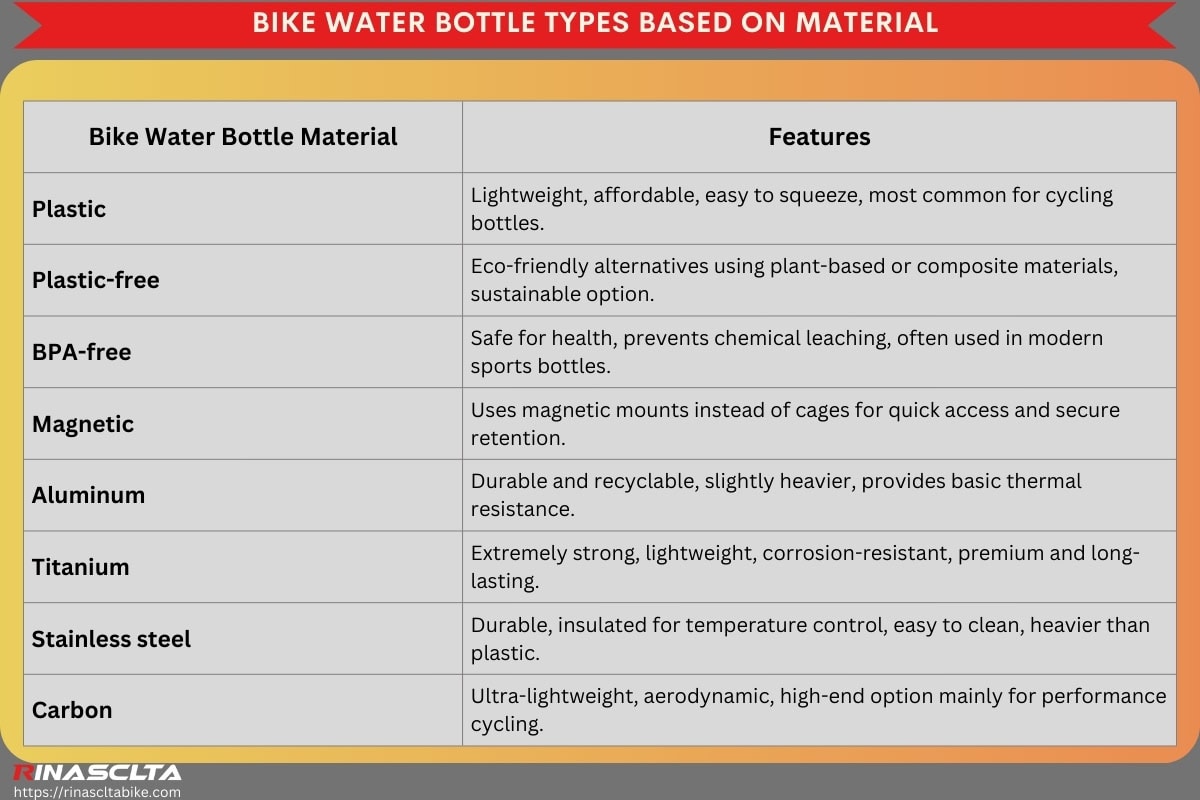
Bike water bottle types based on material include plastic, plastic-free, BPA-free, magnetic, aluminum, titanium, stainless steel, and carbon bottles, because each material offers unique advantages in terms of weight, safety, durability, insulation, and performance. Riders choose among these based on whether they prioritize lightweight speed, eco-friendliness, premium feel, or long-lasting durability.
| Bike Water Bottle Material | Features |
| Plastic | Lightweight, affordable, easy to squeeze, most common for cycling bottles. |
| Plastic-free | Eco-friendly alternatives using plant-based or composite materials, sustainable option. |
| BPA-free | Safe for health, prevents chemical leaching, often used in modern sports bottles. |
| Magnetic | Uses magnetic mounts instead of cages for quick access and secure retention. |
| Aluminum | Durable and recyclable, slightly heavier, provides basic thermal resistance. |
| Titanium | Extremely strong, lightweight, corrosion-resistant, premium and long-lasting. |
| Stainless steel | Durable, insulated for temperature control, easy to clean, heavier than plastic. |
| Carbon | Ultra-lightweight, aerodynamic, high-end option mainly for performance cycling. |
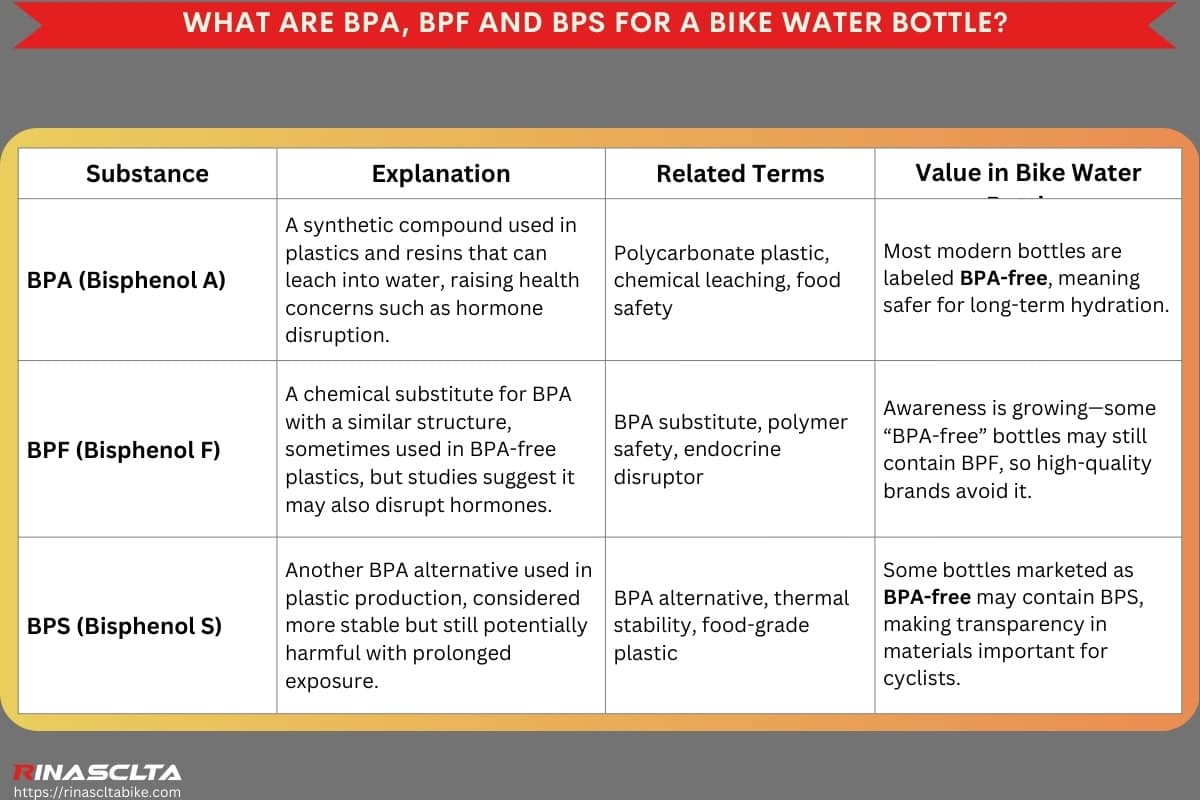
What are BPA, BPF and BPS for a bike water bottle?
BPA, BPF, and BPS are chemical compounds used in the production of plastics, including some older or low-quality bike water bottles. They are part of the bisphenol family, which can leach into liquids and potentially act as endocrine disruptors, raising health and safety concerns for cyclists who rely on bottles daily. Modern cycling bottles are often marketed as BPA-free, but awareness of BPF and BPS is growing, since these substitutes can carry similar risks. Understanding these terms helps riders choose bottles that are not only lightweight and durable but also safe for long-term hydration.
| Substance | Explanation | Related Terms | Value in Bike Water Bottles |
| BPA (Bisphenol A) | A synthetic compound used in plastics and resins that can leach into water, raising health concerns such as hormone disruption. | Polycarbonate plastic, chemical leaching, food safety | Most modern bottles are labeled BPA-free, meaning safer for long-term hydration. |
| BPF (Bisphenol F) | A chemical substitute for BPA with a similar structure, sometimes used in BPA-free plastics, but studies suggest it may also disrupt hormones. | BPA substitute, polymer safety, endocrine disruptor | Awareness is growing—some “BPA-free” bottles may still contain BPF, so high-quality brands avoid it. |
| BPS (Bisphenol S) | Another BPA alternative used in plastic production, considered more stable but still potentially harmful with prolonged exposure. | BPA alternative, thermal stability, food-grade plastic | Some bottles marketed as BPA-free may contain BPS, making transparency in materials important for cyclists. |
Bike water bottle types based on function
Bike water bottle types based on function include bike jersey bottles, bike saddle bottles, insulated bottles, BPA-free bottles, and lightweight bottles, because each serves a specific purpose depending on whether the cyclist prioritizes storage convenience, temperature control, health safety, or reduced weight. These functional categories allow riders to choose bottles that match their riding style, terrain, and performance needs.
- Bike jersey bottle: Slim and compact, designed to fit into a cyclist’s jersey pocket for rides without bottle cages.
- Bike saddle bottle: Mounted behind the saddle, often used in triathlons or long-distance cycling for extra hydration storage.
- Insulated bottle: Keeps drinks cold (or hot) for longer rides by using double-wall or thermal materials.
- BPA-free bottle: Made from safe, food-grade plastics that prevent harmful chemical leaching into water.
- Lightweight bottle: Ultra-thin or carbon-enhanced construction to reduce overall bike weight for performance cycling.
Are insulated cycling water bottles worth it?
Yes, insulated cycling water bottles are worth it if you ride in hot weather, long distances, or variable climates, because they use double-wall or vacuum insulation to keep drinks cold (or hot) for hours, improving comfort and hydration. But they are usually heavier, more expensive, and less squeezable than standard bottles, which may not suit riders focused on minimal weight or quick water flow. The value lies in balancing temperature control and riding efficiency, making them especially beneficial for endurance, gravel, and summer road cycling.
Bike water bottle types based on bike type
Bike water bottle types based on bike type include mountain bike bottles, road bike bottles, gravel bike bottles, triathlon bottle holders, dirt bike bottles, time trial bottles, bottles for electric bikes, Peloton bottles, fat bike bottles, and recumbent bike bag bottles, because each cycling discipline has different hydration needs, storage setups, and environmental demands. These types ensure that bottles and holders are optimized for terrain, aerodynamics, accessibility, and compatibility with the specific bike.
- Mountain bike water bottle: Built with dust caps and durable materials to handle rough trails and muddy conditions.
- Road bike water bottle: Lightweight and aerodynamic, designed for easy access during high-speed rides.
- Gravel bike water bottle: Often insulated or lid-equipped to keep fluids clean on long mixed-terrain adventures.
- Triathlon bike water bottle holder: Integrated into aerobars or behind the saddle to support aerodynamic hydration.
- Dirt bike water bottle: Heavier-duty, sometimes paired with hydration packs for off-road motorcycling.
- Time trial bike water bottle: Aerodynamically shaped and mounted to reduce drag during racing.
- Electric bike water bottle: Compact bottles that fit around bulky e-bike frames and batteries.
- Peloton bike water bottle: Gym-style bottles designed for indoor cycling, with quick-sip nozzles.
- Fat bike water bottle: Large-capacity bottles, sometimes insulated, to handle cold-weather or snow rides.
- Recumbent bike bag water bottle: Bottles stored in side bags or holders, designed for reclined rider access.
Do all bikes have standard water bottle holders?
No, not all bikes have standard water bottle holders because only frames with pre-drilled mounting bosses (usually two bolts, 64 mm apart) can fit a standard cage, and some bikes like BMX, kids’ bikes, or certain full-suspension MTBs may lack these mounts. But riders can still use adapter mounts, handlebar cages, or saddle-mounted systems to carry bottles if needed.
Does Ironman provide water bottles for your bike?
Yes, Ironman does provide water bottles for your bike because aid stations along the course typically hand out standard cycling bottles pre-filled with water or sports drinks, ensuring hydration support during the race. But athletes must still bring their own cages or hydration systems, since rules require bottles to fit standard holders for safe handoffs and quick swaps.
What are the different types of bike water bottle holders?
The different types of bike water bottle holders include bike fork cages, handlebar holders, kids’ bike holders, Peloton holders, double holders, and adjustable holders, because each design addresses different mounting positions, rider needs, and bike setups for convenient hydration. These variations exist to provide accessibility, stability, and compatibility across cycling disciplines and rider preferences.
- Bike fork water bottle cage: Mounted on the fork for extra hydration, often used in gravel, touring, or bikepacking.
- Handlebar bike water bottle holder: Places the bottle within easy reach on the handlebar, common in commuting or long-distance rides.
- Kids’ bike water bottle holder: Smaller in size and often colorful, designed to fit children’s frames and bottles.
- Peloton bike water bottle holder: Integrated into the indoor exercise bike frame for quick access during workouts.
- Bike double water bottle holder: Carries two bottles, usually mounted behind the saddle or on large frames for endurance riding.
- Adjustable bike water bottle holder: Flexible cage design that expands or contracts to fit different bottle sizes securely.
Do all bikes come with mounts for water bottles?
No, not all bikes come with mounts for water bottles because only certain frames—mainly road, gravel, hybrid, and many mountain bikes—are built with pre-drilled mounting bosses (standard 64 mm apart) on the down tube or seat tube. Smaller bikes like kids’ bikes, BMX, some full-suspension MTBs, and budget commuter bikes may skip them to save space, cost, or weight. But riders can still add hydration options with adapter brackets, handlebar holders, fork cages, or saddle-mounted systems, ensuring bottle compatibility even without built-in mounts.
Why do bike water bottle cages look the same?
Bike water bottle cages look the same because they follow an industry-standard diameter of about 74 mm, ensuring that nearly all cycling bottles fit securely across different brands and bike types. This uniform design improves compatibility, stability, and accessibility, while keeping manufacturing simple and cost-effective. Related factors include cage retention, frame clearance, aerodynamics, and lightweight construction, all of which benefit from a standardized shape. The value lies in giving cyclists confidence that any bottle will work with any cage, making hydration systems universally reliable and interchangeable.
Are bike water bottle holders universal?
No, not all bike water bottle holders are universal because while most follow the standard 74 mm diameter to fit common cycling bottles, variations exist in mounting systems, adjustability, and intended use. Some cages are made for oversized bottles, insulated flasks, or non-standard shapes, and not every bike frame has the same mounting bosses, spacing, or clearance. But most modern holders are designed to be compatible with the majority of bottles and frames, and riders can use adjustable cages or adapter mounts to achieve a near-universal fit.
How do you choose a bike water bottle?
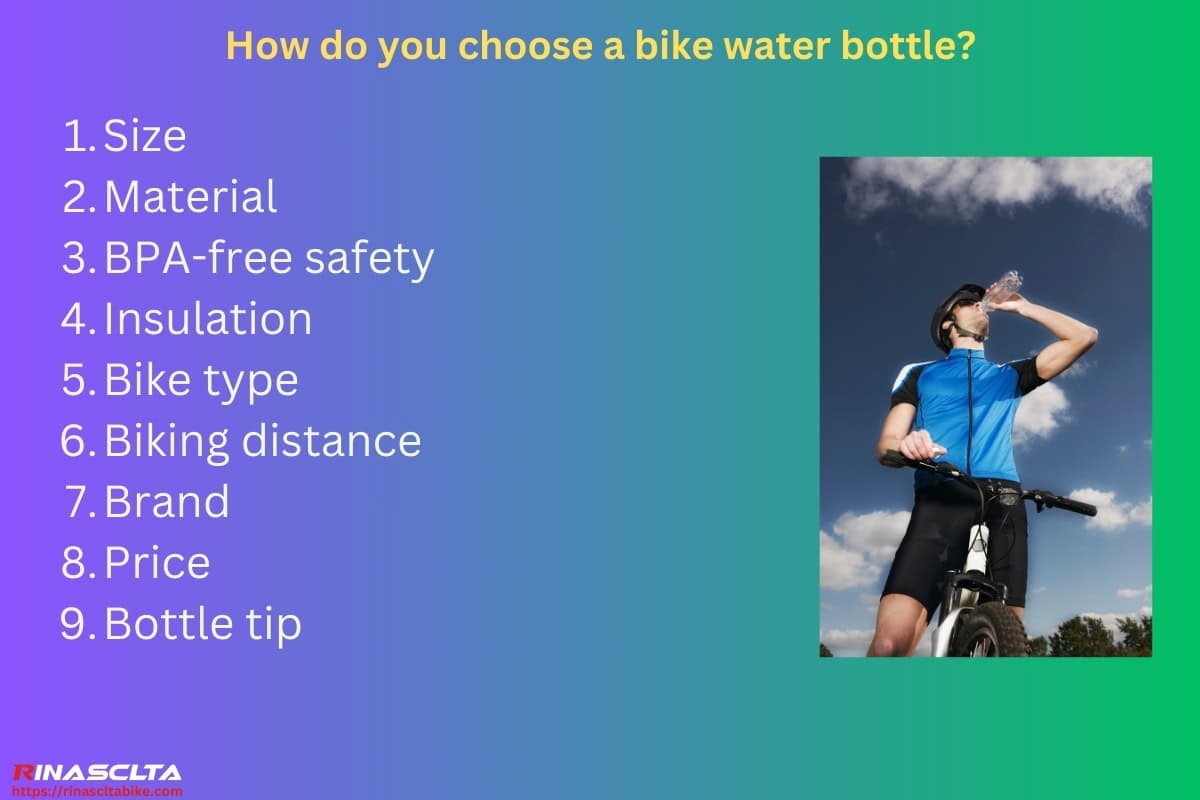
You can choose a bike water bottle by considering factors like size, material, BPA-free safety, insulation, bike type, riding distance or racing needs, brand, price, and bottle tip design, because each influences hydration efficiency, comfort, health, and performance on the bike. These considerations ensure the bottle matches your cycling style, conditions, and preferences.
- Size: Determines how much fluid you can carry, usually between 500 ml and 1 liter depending on ride length
- Material: Affects weight, durability, and taste—plastic is light, stainless steel is durable, and carbon is ultra-light.
- BPA-free safety: Ensures no harmful chemicals leach into your drink, making it safe for regular use.
- Insulation: Keeps drinks cold (or hot) for longer, important for endurance or hot-weather rides.
- Bike type: Road, MTB, gravel, or triathlon setups may need aerodynamic, dust-proof, or extra-capacity bottles.
- Long distance, short rides, or racing: Endurance riders need bigger or multiple bottles, while racers prefer lightweight aerodynamic options.
- Brand: Trusted brands often provide better quality, safety standards, and compatibility with cages.
- Price: Balances budget with features—basic plastic bottles are cheap, insulated or premium models cost more.
- Bottle tip: Push-pull, bite valve, or lid-equipped tips affect flow rate, hygiene, and ease of use while riding.
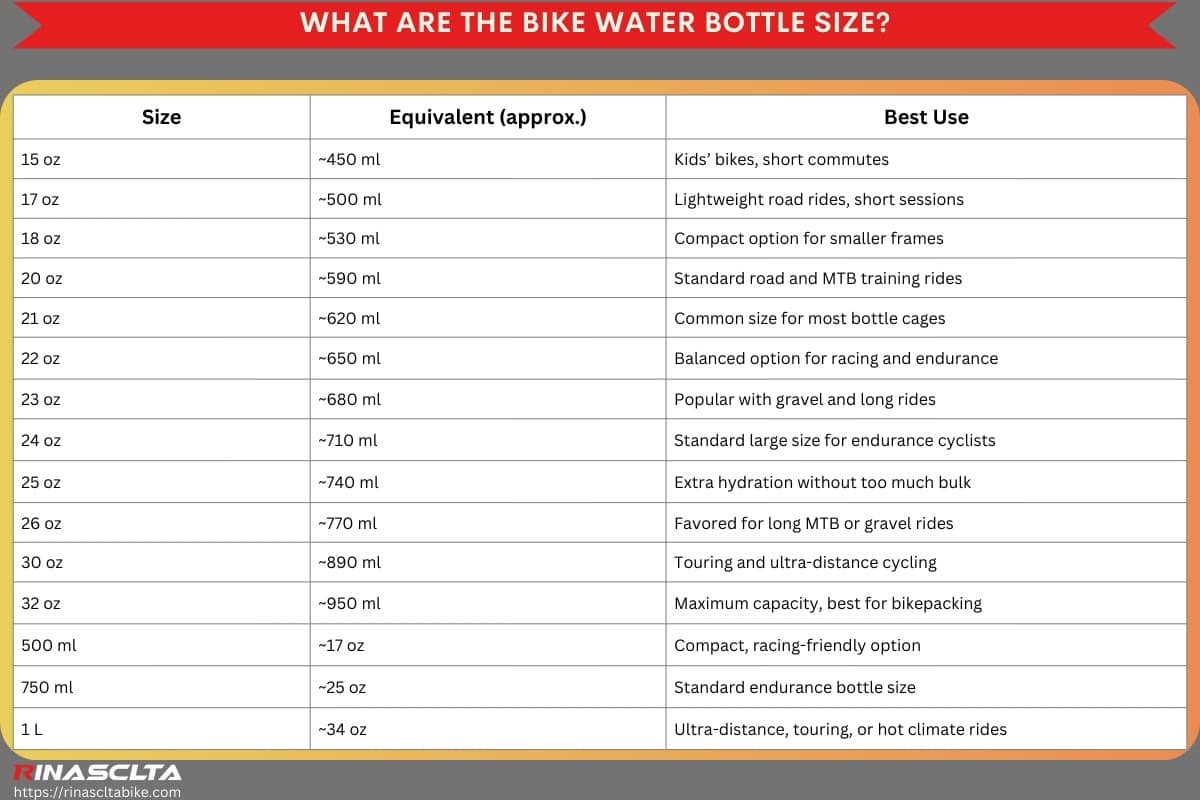
What are the bike water bottle size?
Bike water bottle sizes commonly include 15, 17, 18, 20, 21, 22, 23, 24, 25, 26, 30, and 32 oz, as well as 500 ml, 750 ml, and 1 liter, because different riders and disciplines require varying hydration capacities. Smaller bottles are lighter and easier to handle for short rides or racing, while larger bottles are favored for endurance, touring, or hot-weather cycling. Standardization ensures bottles fit into most 74 mm diameter cages, balancing capacity with frame clearance and rider needs.
| Size | Equivalent (approx.) | Best Use |
| 15 oz | ~450 ml | Kids’ bikes, short commutes |
| 17 oz | ~500 ml | Lightweight road rides, short sessions |
| 18 oz | ~530 ml | Compact option for smaller frames |
| 20 oz | ~590 ml | Standard road and MTB training rides |
| 21 oz | ~620 ml | Common size for most bottle cages |
| 22 oz | ~650 ml | Balanced option for racing and endurance |
| 23 oz | ~680 ml | Popular with gravel and long rides |
| 24 oz | ~710 ml | Standard large size for endurance cyclists |
| 25 oz | ~740 ml | Extra hydration without too much bulk |
| 26 oz | ~770 ml | Favored for long MTB or gravel rides |
| 30 oz | ~890 ml | Touring and ultra-distance cycling |
| 32 oz | ~950 ml | Maximum capacity, best for bikepacking |
| 500 ml | ~17 oz | Compact, racing-friendly option |
| 750 ml | ~25 oz | Standard endurance bottle size |
| 1 L | ~34 oz | Ultra-distance, touring, or hot climate rides |
How many ounces are in a bike water bottle?
A bike water bottle typically holds between 20 and 24 ounces (about 590–710 ml), which has become the industry standard because it balances hydration capacity, weight, and frame compatibility with the universal 74 mm cage size. Smaller bottles (15–18 oz / 450–530 ml) are common for kids’ bikes or racing, while larger ones (25–32 oz / 740–950 ml) are favored for endurance, gravel, or touring rides. Related terms include capacity, fluid ounces, milliliters, bottle cage fit, and hydration efficiency. The value lies in choosing the right size for your ride length—short rides benefit from lighter bottles, while long-distance rides require larger volumes to avoid frequent refills.
What size water bottle fits in a bike holder?
A bike water bottle that fits in a standard holder is usually between 20 and 24 ounces (about 590–710 ml) with a 74 mm diameter, because most bike cages are built around this industry standard for universal compatibility. Smaller bottles like 500 ml (17 oz) fit easily and are common for racing or compact frames, while larger bottles up to 750 ml (25 oz) or even 1 liter can fit if the frame has enough clearance. Related terms include bottle cage standard, frame geometry, clearance, diameter, and capacity. The value of this standard sizing is that riders can switch between brands without worrying about fit, ensuring reliable hydration, stability, and convenience on every ride.
What is a standard size bike water bottle?
A standard size bike water bottle is about 20–24 ounces (590–710 ml) in capacity with a 74 mm diameter, because this size fits universally into nearly all bike bottle cages designed around the cycling industry standard. This dimension provides the best balance of hydration capacity, weight, frame clearance, and cage retention, making it the most common choice for road, mountain, gravel, and commuter bikes. Related terms include bottle cage fit, fluid ounces, milliliters, capacity standard, and universal compatibility. The value of this standard is that riders can confidently use bottles from different brands without worrying about fit, ensuring reliable hydration and convenience across all cycling disciplines.
Can you get 1L water bottles for the bike?
Yes, you can get 1L water bottles for the bike if your frame has enough clearance and cage compatibility, because some manufacturers produce 1-liter (32–34 oz) bottles specifically for endurance, gravel, touring, and bikepacking. These bottles are taller than standard 20–24 oz (590–710 ml) bottles, so they may not fit in smaller frames or compact geometries. Related terms include oversized cage, frame clearance, hydration capacity, and endurance cycling. The value of a 1L bottle is in reducing refills and carrying more fluid for long-distance or hot-weather rides, but riders must ensure their bike can securely hold the larger size.
How do you install water bottle holder on a bike?
You can install a water bottle holder on a bike by aligning the cage with the pre-drilled mounting bosses on the frame’s down tube or seat tube, then securing it with M5 hex bolts using a 4 mm Allen key. If your bike doesn’t have built-in mounts, you can use adapter systems such as clamp-on brackets, Velcro straps, or magnetic mounts to attach the cage to the frame, fork, or handlebars. Related terms include bottle cage standard (74 mm), bolt spacing (64 mm), torque setting, and frame clearance. The value of proper installation is ensuring the bottle stays secure, accessible, and rattle-free, giving riders reliable hydration across road, mountain, and gravel rides.
How do you install water bottle holder on bike without holes?
You can install a water bottle holder on a bike without holes by using adapter systems such as clamp-on brackets, Velcro straps, zip ties, or magnetic mounts, which attach securely to the frame, handlebars, or seat post without needing factory-drilled bosses. Some riders also use saddle-mounted cages, fork-mounted cages, or frame bags with integrated bottle holders for added hydration options. Related terms include universal cage mount, strap-on system, frame clearance, and cage compatibility. The value of these solutions is that they let bikes without bottle mounts—like BMX, kids’ bikes, or some full-suspension MTBs—still carry hydration reliably and conveniently.
Where do you add water bottles to a mountain bike?
You add water bottles to a mountain bike on the down tube or seat tube mounts if available, since these are the standard positions with pre-drilled bosses (64 mm spacing) for secure cage installation. On full-suspension MTBs or smaller frames with limited space, riders often use fork-mounted cages, handlebar holders, saddle-mounted systems, or frame bags with bottle pockets. Related terms include bottle cage clearance, frame geometry, suspension design, hydration placement, and accessibility. The value of these options is that they ensure secure storage, quick access, and dirt protection, helping mountain bikers stay hydrated on rough trails and long rides.
Can two water bottle holders fit on my bike?
Yes, you can fit two water bottle holders on your bike if your frame has mounting bosses on both the down tube and the seat tube, which is common on road, gravel, and endurance bikes. Larger frames often have enough clearance for two standard bottles, while smaller or full-suspension MTB frames may only fit one. Related terms include bolt spacing (64 mm), frame geometry, cage clearance, and hydration capacity. The value of having two holders is carrying more fluid for long-distance rides, hot conditions, or racing, reducing the need for frequent refills.
How do you clean bike water bottles?
You clean bike water bottles by rinsing them immediately after use, then washing the bottle body, cap, and nozzle separately with warm water, mild dish soap, and a bottle brush to remove residue and bacteria. For deeper cleaning, you can use baking soda, vinegar, or sterilizing tablets, especially if the bottle was used with sports drinks. Many BPA-free plastic and stainless steel bottles are dishwasher safe, but check manufacturer instructions to avoid warping or damaging insulation. Related terms include nozzle cleaning, mold prevention, odor removal, and hygiene maintenance. The value of proper cleaning is ensuring your bottle stays safe, odor-free, and durable, providing fresh hydration every ride.
How do you clean the bike water bottle head?
You clean a bike water bottle head by first removing it from the bottle, then disassembling the nozzle, push-pull cap, or bite valve if possible to expose hidden areas where bacteria and mold can grow. Wash the parts with warm water, mild soap, and a small brush or cotton swab to scrub inside the valve and crevices. For stubborn residue or odors, soak the head in a solution of baking soda, vinegar, or denture-cleaning/sterilizing tablets. Related terms include nozzle flow, leak prevention, hygiene, and mold control. The value of cleaning the head separately is maintaining sanitary drinking surfaces, preventing blockages, and extending the bottle’s usability for safe hydration.
Are bike water bottles easy to clean?
Yes, bike water bottles can be easy to clean if they are made from BPA-free plastic or stainless steel with wide-mouth openings and removable nozzles, because these designs allow better access for scrubbing and rinsing. But bottles with narrow necks, non-removable caps, or insulated double-walls can trap residue and require extra effort or special brushes. Related terms include dishwasher safe, nozzle disassembly, mold prevention, and hygiene maintenance. The value is that choosing an easy-to-clean bottle ensures long-term durability, odor-free use, and safe hydration for every ride.
Bike water bottle brands and manufacturers
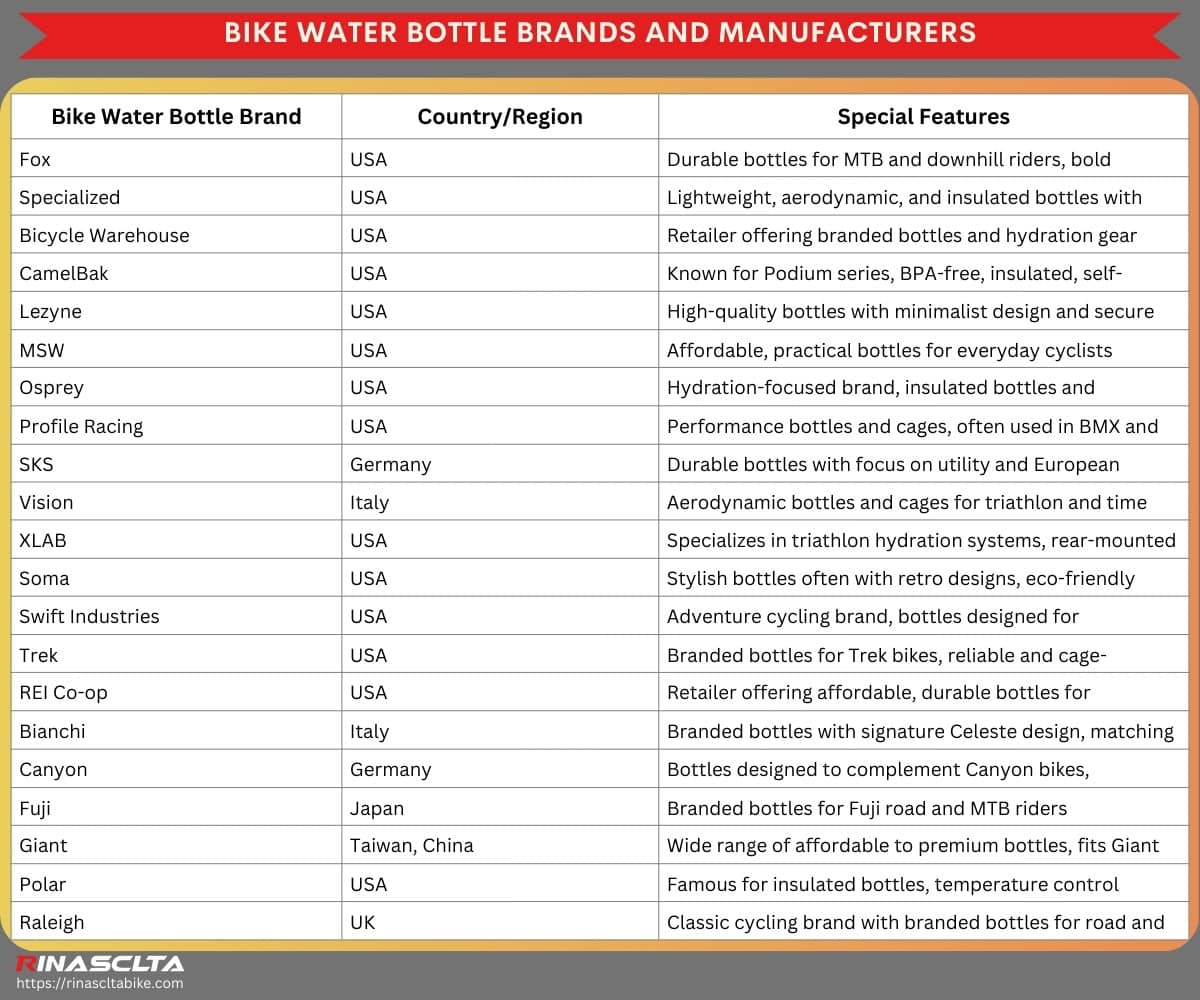
Bike water bottle brands and manufacturers form an important part of the cycling accessory industry, producing bottles and hydration systems tailored for different bike types, riding styles, and environments. They matter because the right bottle balances capacity, material safety (BPA-free), ease of cleaning, durability, and compatibility with standard cages, ensuring riders stay hydrated during training, racing, and commuting. Over the years, brands have introduced innovations like insulated bottles, aerodynamic shapes, magnetic mounts, and dust-protected caps, reflecting how hydration technology has evolved with cycling itself. Choosing a trusted manufacturer provides value in terms of safety, performance, and reliability.
| Bike Water Bottle Brand | Country/Region | Special Features |
| Fox | USA | Durable bottles for MTB and downhill riders, bold designs |
| Specialized | USA | Lightweight, aerodynamic, and insulated bottles with wide compatibility |
| Bicycle Warehouse | USA | Retailer offering branded bottles and hydration gear |
| CamelBak | USA | Known for Podium series, BPA-free, insulated, self-sealing Jet Valve technology |
| Lezyne | USA | High-quality bottles with minimalist design and secure cage fit |
| MSW | USA | Affordable, practical bottles for everyday cyclists |
| Osprey | USA | Hydration-focused brand, insulated bottles and hydration packs |
| Profile Racing | USA | Performance bottles and cages, often used in BMX and track cycling |
| SKS | Germany | Durable bottles with focus on utility and European design |
| Vision | Italy | Aerodynamic bottles and cages for triathlon and time trial bikes |
| XLAB | USA | Specializes in triathlon hydration systems, rear-mounted bottle carriers |
| Soma | USA | Stylish bottles often with retro designs, eco-friendly materials |
| Swift Industries | USA | Adventure cycling brand, bottles designed for bikepacking aesthetics |
| Trek | USA | Branded bottles for Trek bikes, reliable and cage-compatible |
| REI Co-op | USA | Retailer offering affordable, durable bottles for recreational riders |
| Bianchi | Italy | Branded bottles with signature Celeste design, matching Bianchi bikes |
| Canyon | Germany | Bottles designed to complement Canyon bikes, aerodynamic focus |
| Fuji | Japan | Branded bottles for Fuji road and MTB riders |
| Giant | Taiwan, China | Wide range of affordable to premium bottles, fits Giant cages |
| Polar | USA | Famous for insulated bottles, temperature control technology |
| Raleigh | UK | Classic cycling brand with branded bottles for road and city bikes |