What is a bike travel case?
A bike travel case is a protective transport container designed to hold and secure a bicycle during air travel, long-distance transport, or shipping, using structured shells, padding, internal straps, and wheel pockets to prevent damage to the frame, fork, wheels, and drivetrain. First used by professional road racers and touring cyclists in the late 20th century as international travel increased, early cases were simple padded bags that evolved into today’s highly engineered hard-shell ABS/Polycarbonate cases, padded soft bags, and hybrid designs built for carbon bikes and disc brake setups. In modern cycling, bike travel cases play a vital role by offering impact protection, airline-compliant dimensions, organized packing, and safe transport, ensuring bikes arrive undamaged whether used by racers, adventure cyclists, or travelers flying with high-value machines.
What is a bike travel bag?
A bike travel bag is a padded, soft-sided transport bag designed to carry and protect a bicycle during air travel, car trips, trains, or long-distance transport, using foam padding, internal straps, wheel sleeves, and reinforced panels to shield the frame, fork, and components. It emerged as a lighter, more flexible alternative to hard cases in the late 20th century, especially among touring cyclists, triathletes, and amateur racers who needed easier packing and lower baggage weight. Over time, travel bags evolved from simple nylon sleeves into today’s advanced designs with rigid base plates, impact zones, thru-axle mounts, and roller wheels, making them more airline-friendly and protective. In modern cycling, bike travel bags provide a balance of portability, weight savings, and practical protection, allowing riders to travel conveniently with their bikes while maintaining enough structural support for carbon frames and delicate components.
Is there a bag that can transport any type of bike?
No, one single bag cannot transport every type of bike because different bikes—such as road, gravel, MTB, fat bikes, e-bikes, BMX, and full-suspension models—have very different frame sizes, wheel widths, axle standards, handlebar shapes, and overall dimensions that no universal bag can perfectly fit or protect. But many high-end adjustable soft bags and hybrid travel bags (with modular padding, removable fork mounts, and expandable wheel compartments) can accommodate most standard bikes, as long as the bike fits within the bag’s maximum length, width, and wheel-size range, making them the closest option to a universal transport system.
Why should I use a bike box or bike bag?
You should use a bike box or bike bag because it protects your bicycle from impacts, crushing forces, scratches, and handling damage during air travel, shipping, or long-distance transport, keeping vulnerable components like the carbon frame, derailleur hanger, disc rotors, and wheels safe. It also helps you meet airline size and weight rules, organizes parts using padding, straps, and wheel pockets, and makes the entire packing and transport process smoother through roller wheels, handles, and structured interiors, ensuring your bike arrives in one piece and ready to ride.
How does the bike travel case work?
The bike travel case works by enclosing your bicycle inside a rigid or semi-rigid protective shell and securing every component with internal straps, padded panels, wheel pockets, and structural mounts so the bike cannot move or be crushed during transport. The case transfers external impacts into the hard shell (ABS, polycarbonate, aluminum) or reinforced soft structure, while internal supports protect the frame, fork, derailleur, bars, and wheels from pressure, drops, or baggage handling. It also maintains airline-safe dimensions, locks closed for security, and uses roller wheels, handles, and compression systems to make long-distance travel easy, ensuring the bike remains stable and undamaged from check-in to arrival.
How does a bike travel bag work?
The bike travel bag works by surrounding your bike with a padded, soft-sided structure made of durable materials like nylon, polyester, EVA panels, or reinforced fabric, and securing each component using internal straps, padded sleeves, fork mounts, and wheel pockets so nothing moves or gets damaged during transport. The bag absorbs minor impacts through foam padding and reinforced zones, distributes weight across a rigid base plate, and protects delicate parts like the frame, derailleur, handlebar, and disc rotors from pressure or abrasion. Many bags include zippers, buckles, compression straps, and lockable compartments for added security, while roller wheels and lift handles make airport navigation easier. In modern cycling, a travel bag provides a balance between portability and protection, offering enough structure for safe airline transport while staying lighter, easier to store, and more adaptable to different bike types than a hard case.
What are bike travel cases made of?
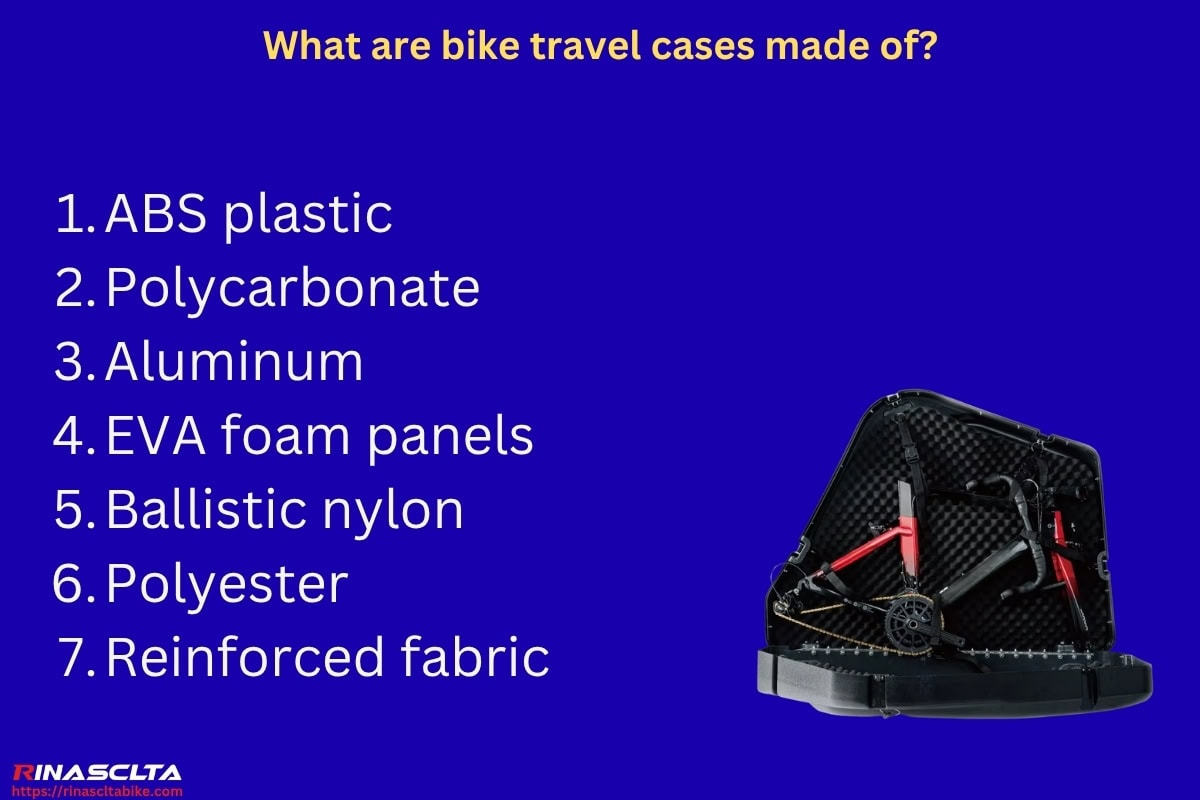
Bike travel cases are made of ABS plastic, polycarbonate, aluminum, EVA foam panels, ballistic nylon, polyester, reinforced fabric, and internal foam padding, because these materials provide the necessary balance of impact resistance, structural strength, durability, and lightweight protection required for air travel and long-distance transport.
- ABS plastic: A rigid, durable shell that absorbs heavy impacts and resists crushing during baggage handling.
- Polycarbonate: Stronger and more flexible than ABS, offering high impact resistance while keeping weight manageable.
- Aluminum: Provides excellent structural rigidity for premium hard cases, protecting against deformation and external pressure.
- EVA foam panels: Semi-rigid foam used in hybrid bags for lightweight structure and shock absorption.
- Ballistic nylon: Extremely tough woven fabric that resists abrasion, tearing, and repeated handling.
- Polyester: A lightweight, weather-resistant fabric used in many soft bags for durability and easy maintenance.
- Reinforced fabric: Strengthened textile layers that protect high-stress zones like corners, wheels, and base plates.
- Internal foam padding: Cushions the frame, wheels, and components from vibration, impacts, and abrasion during travel.
What are bike travel bags made of?
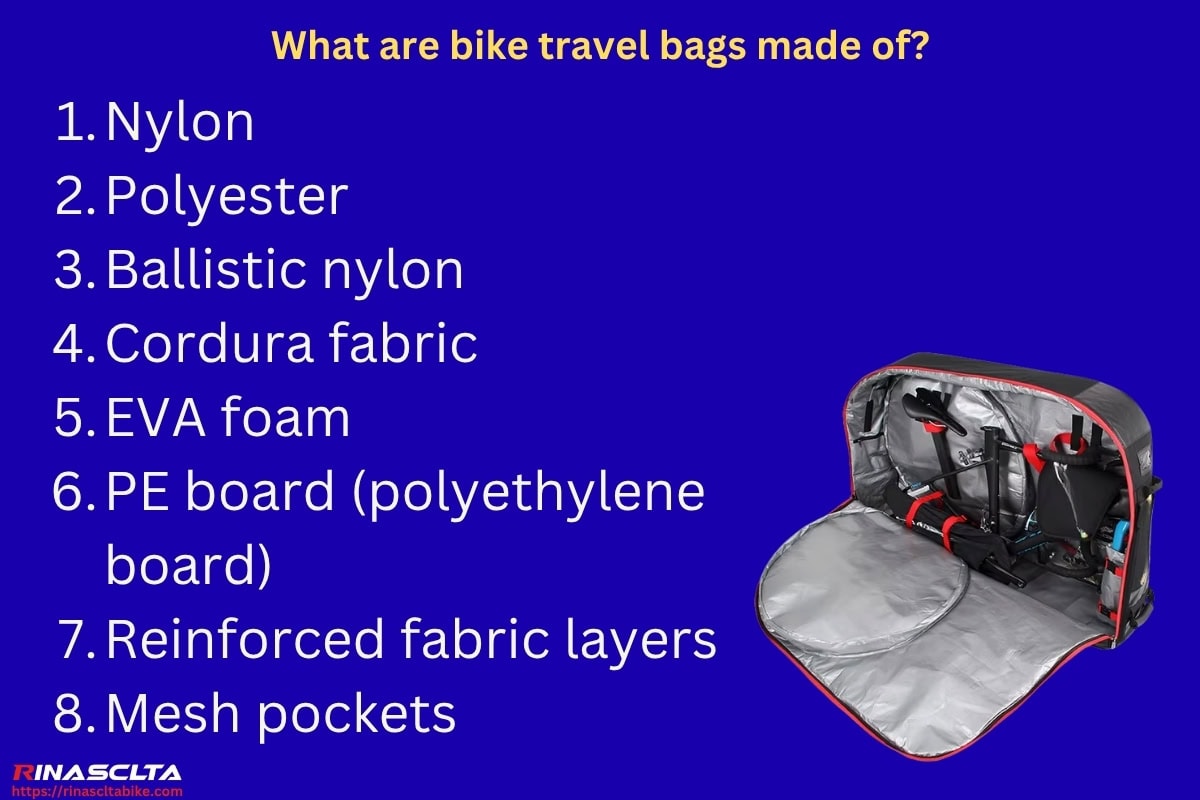
Bike travel bags are made of nylon, polyester, ballistic nylon, Cordura fabric, EVA foam, PE board, reinforced fabric layers, mesh pockets, and internal foam padding, because these materials provide the ideal combination of lightweight strength, flexibility, abrasion resistance, impact absorption, and packability needed for safe and convenient bike transport.
- Nylon: A durable, lightweight fabric that resists tearing and handles repeated airport handling well.
- Polyester: Affordable, weather-resistant, and stable under tension, making it ideal for large soft-sided travel bags.
- Ballistic nylon: Extremely tough and abrasion-resistant, used in high-stress areas for maximum durability.
- Cordura fabric: Premium, rugged nylon known for exceptional strength and long-term wear resistance.
- EVA foam: Semi-rigid foam panels that add structure and absorb impacts without adding excessive weight.
- PE board (polyethylene board): A lightweight, stiff sheet inserted into the bag base or walls to maintain shape and protect the frame.
- Reinforced fabric layers: Extra-strong layers placed in stress zones (corners, wheel pockets, base) to prevent punctures or deformation.
- Mesh pockets: Flexible internal compartments used to store wheels, small parts, or tools securely during transit.
- Internal foam padding: Cushions the frame, fork, handlebar, and drivetrain, preventing scratches and absorbing vibrations during transport.
What are the types of bike travel cases and bags?
The types of bike travel cases and bags include categories based on design and based on bike type, because each design determines the level of protection, weight, portability, and packing method, while each bike type requires specific space, wheel-size compatibility, and mounting standards. These categories help riders choose the most suitable travel solution by matching the case or bag’s structure, protection level, and internal layout to their bicycle’s geometry, components, and travel demands, ensuring safe and efficient transport.
Bike travel case and bag types based on design
Bike travel case and bag types based on design include hard cases, bike travel bags, bike frame bags, and bike wheel bags, because each design offers a different balance of protection, weight, portability, and packing complexity, allowing riders to choose the best option for air travel, car transport, or everyday mobility.
- Hard case: A rigid ABS/polycarbonate/aluminum shell that provides maximum impact and crush protection for flights and long-distance transport.
- Bike travel bag: A padded soft-sided bag that offers lighter weight, easier storage, and flexible packing with moderate-to-high protection.
- Bike frame bag: A small, soft bag that holds only the bike frame (often partially disassembled), ideal for compact transport or train travel.
- Bike wheel bag: A padded bag designed to carry one or two wheels separately, preventing scratches, rotor bending, or spoke damage during transport.
Bike travel case and bag types based on bike type
Bike travel case and bag types based on bike type include road, mountain, gravel, triathlon, BMX, fat bike, folding bike, and tandem travel systems, because each bike category has unique geometry, wheel size, handlebar shape, axle standards, and frame length, requiring different internal layouts and protective structures to fit securely and safely during transport.
- Road: Slim, lightweight cases designed for narrow drop bars, 700c wheels, and compact frame geometry.
- Mountain: Larger, reinforced cases that accommodate wide handlebars, suspension forks, 27.5″/29″ wheels, and bulkier frames.
- Gravel: Versatile cases sized for endurance geometry and wider tires, often with extra rotor and frame protection.
- Triathlon: Tall, long cases with special compartments for aero bars, deep-section wheels, and fragile aero seatposts.
- BMX: Compact, easy-fit bags sized for 20″ wheels and smaller frames, optimized for quick packing.
- Fat bike: Oversized cases with increased width to fit fat tires and wider hubs.
- Folding bike: Small, box-shaped cases built to fit bikes like Brompton or Tern with minimal disassembly.
- Tandem: Extra-long, reinforced travel cases that accommodate the extended frame and split-frame designs of tandem bicycles.
How do you choose a bike travel case?
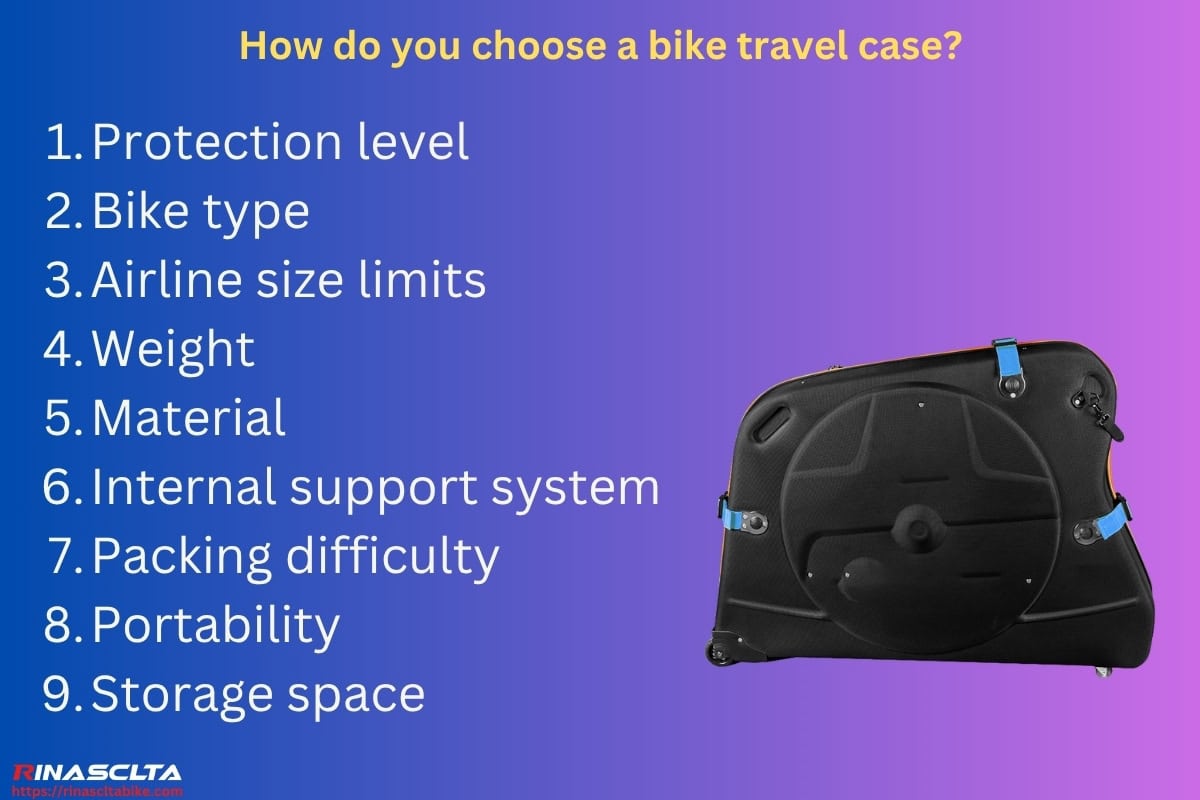
You can choose a bike travel case by considering protection level, bike type, airline size limits, weight, material, internal support system, packing difficulty, portability, storage space, and budget, because each factor determines how safely, easily, and cost-effectively your bike will travel by air, car, or train.
- Protection level: Decide between hard cases (maximum protection) and soft bags (lighter, flexible) based on how rough the transport conditions will be.
- Bike type: Ensure the case fits your road, MTB, gravel, triathlon, BMX, fat, or folding bike geometry and wheel size.
- Airline size limits: Check external dimensions and weight to avoid oversize or overweight baggage fees—especially important for air travel.
- Weight: Lighter cases reduce baggage fees and make airport maneuvering easier, especially with long walks and transfers.
- Material: Choose polycarbonate/ABS for impact resistance, EVA for hybrid protection, or nylon/polyester for lightweight flexibility.
- Internal support system: Look for fork mounts, thru-axle blocks, frame stabilizers, padded wheel sleeves, and anti-crush bars to keep parts from shifting.
- Packing difficulty: Some cases require full disassembly, while others need only wheels removed—choose based on your mechanical comfort level.
- Portability: Consider features like roller wheels, handles, and collapsible frames for easy transport through airports.
- Storage space: Hard cases take more room at home; soft bags fold down for compact storage when not in use.
- Budget: Prices vary widely, so consider how often you travel—frequent flyers benefit from premium protection, while occasional travelers may prefer affordable soft bags.
How do you choose a bike travel bag?
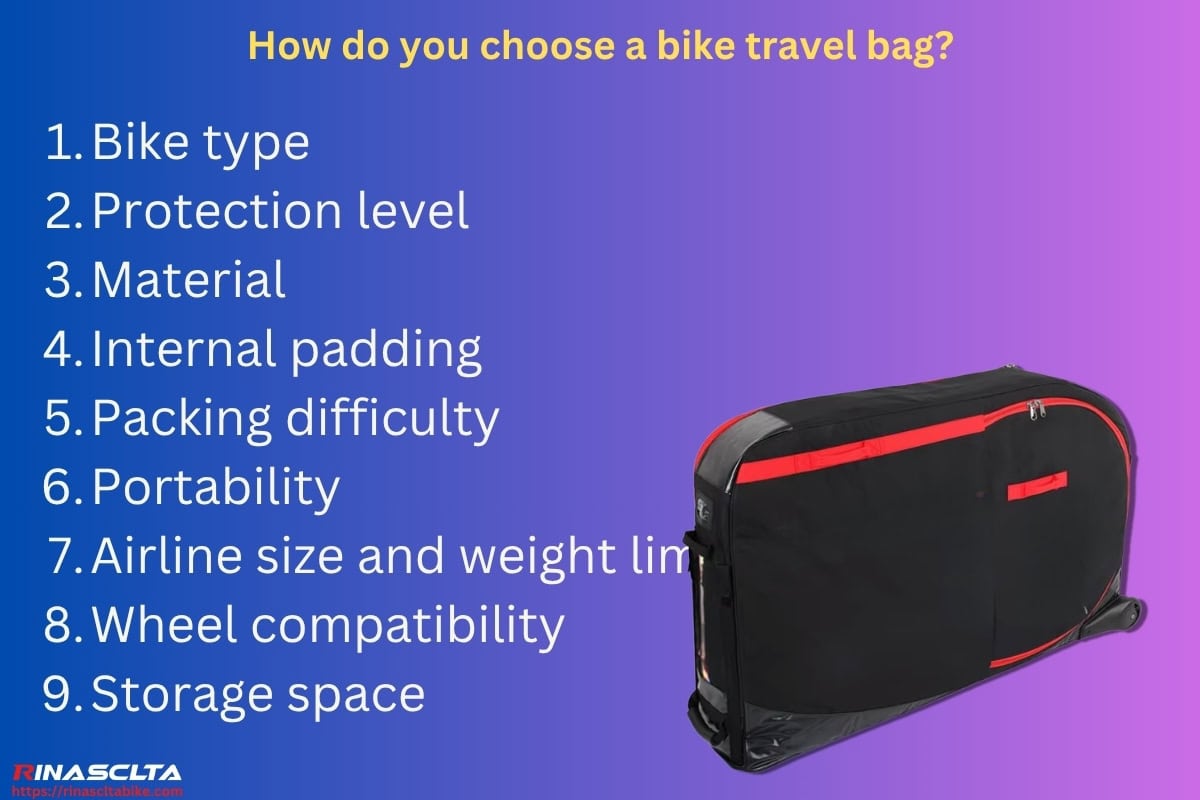
You can choose a bike travel bag by considering bike type, protection level, material, internal padding, packing difficulty, portability, airline size and weight limits, wheel compatibility, storage space, and budget, because each factor determines how safely your bike travels, how easy the bag is to use, and how convenient it is for long-distance transport.
- Bike type: Ensure the bag fits your road, MTB, gravel, triathlon, BMX, fat, or folding bike and accommodates its geometry and components.
- Protection level: Choose a bag with enough padding, base reinforcement, and structural panels for the type of transport you expect.
- Material: Look for ballistic nylon, polyester, or Cordura for durability and abrasion resistance during airport handling.
- Internal padding: Verify the bag includes padded wheel sleeves, fork mounts, frame straps, and EVA or PE board reinforcement to keep parts from shifting.
- Packing difficulty: Some bags require removing handlebars or the fork, while others are designed for minimal disassembly, depending on your comfort level.
- Portability: Features like roller wheels, multiple handles, and lightweight construction make it easier to move through airports and hotels.
- Airline size and weight limits: Confirm the bag meets your airline’s linear dimension rules and stays under weight limits to avoid fees.
- Wheel compatibility: Check that the bag supports your wheel size (20″, 26″, 27.5″, 29″, 700c, or fat bike).
- Storage space: Soft bags fold smaller than hard cases, making them easier to store in apartments or small homes.
- Budget: Higher-end models offer better protection, but budget options are suitable for occasional travel or car/train transport.
What are the dimensions of the bike travel case?
The dimensions of a bike travel case typically range from 110–130 cm (43–51 in) in length, 80–95 cm (31–37 in) in height, and 28–40 cm (11–16 in) in width, because hard cases must fit a fully disassembled or partially disassembled bike—including wheels, frame, fork, and handlebar—while staying within common airline oversize limits. Premium hard-shell models (such as polycarbonate or ABS cases) tend to be larger to provide crush protection, foam clearance, wheel pockets, and internal mounts, while still balancing weight and airport maneuverability.
What are the dimensions of the bike travel bag?
The dimensions of a bike travel bag generally range from 118–125 cm (46–49 in) in length, 85–90 cm (33–35 in) in height, and 25–35 cm (10–14 in) in width, because soft bags are designed to be lighter, more compact, and flexible, allowing them to fit road, gravel, and MTB bikes with less rigid structure. These sizes accommodate padded wheel sleeves, foldable frames, EVA panels, and reinforced bases, while keeping the overall bag within typical airline linear dimension requirements and providing easier storage at home or in hotels.
What should I know before buying a bike travel bag?
You should know how expensive your bike is, what airline you fly with, how long your bike is, your wheel size, how much protection you need, how much storage space you have at home and at your destination, how heavy the bag is, and how much disassembly you’re comfortable with, because each factor affects safety, airline fees, compatibility, convenience, and overall travel experience.
- How expensive is your bike: Higher-value carbon bikes need bags with stronger padding, fork mounts, and rigid bases to avoid damage.
- What airline do you fly with: Each airline has different size, weight, and oversize fee rules, which can influence which bag fits within limits.
- How long is your bike: Larger frames (XL road, long-travel MTB, triathlon bikes) require bags with longer internal dimensions and adjustable mounts.
- Wheel size: Ensure the bag supports 700c, 27.5”, 29”, 20”, or fat bike wheels, as not all travel bags fit larger or wider wheels.
- Protection level: Choose based on how rough your transport will be—flights require more protection than car or train trips.
- Storage at home and destination: Soft bags fold down small, while hard cases need significant storage space in hotels or apartments.
- Bag weight: Heavier bags may trigger overweight baggage fees; lighter bags are easier to move through airports.
- Disassembly required: Some travel bags require removing the fork, handlebar, derailleur, or cockpit, so pick one that matches your mechanical comfort.
- Internal support system: Look for fork mounts, anti-crush bars, frame straps, wheel sleeves, and padding for maximum stability.
- Budget: Prices range widely, so choose based on how often you fly—frequent travelers benefit from a more protective, long-lasting bag.
Is it worth buying a bike travel bag for just a few trips?
Yes, a bike travel bag is worth buying if you take even a few trips and you are traveling with a carbon bike, expensive components, or flying with airlines known for rough handling, because the bag protects your frame, wheels, derailleur, and disc rotors from impact, crushing, and abrasion. If your trips involve multiple transfers, long airport walks, or tight rental-car space, a travel bag also adds value through roller wheels, lighter weight, and easier storage. But if you travel only once, have a low-value or older bike, or can borrow or rent a bag, then buying may not be necessary—so the value depends on your bike’s cost and how much protection and convenience you need.
How much should I spend on a bike travel bag?
You should spend between USD 150–600 (EUR 140–550 / GBP 120–500) on a bike travel bag because the right price depends on how often you travel, how valuable your bike is, and how much protection you need.
- USD 150–250: Good for occasional trips, basic protection, road/gravel/MTB compatibility, and car/train transport.
- USD 250–400: Best value for air travel, with stronger padding, wheel sleeves, reinforced bases, and better zippers/handles.
- USD 400–600+: Premium bags for frequent flyers and high-end carbon bikes, offering rigid frames, fork mounts, anti-crush bars, and airline-durable construction.
In general, the more valuable your bike and the more often you fly, the more worthwhile it is to invest in a higher-end travel bag.
Should I get a hard or soft bike case?
Yes, you should get a hard case if you want maximum protection, because hard shells made of ABS, polycarbonate, or aluminum provide the best impact resistance, crush protection, and structure for carbon frames, disc brakes, and long-haul flights. Yes, you should get a soft bag if you prefer easier packing, lower weight, cheaper airline fees, and simpler storage, because padded soft bags offer good protection for moderate travel while being lighter, more flexible, and easier to fit in cars or hotel rooms.
Should I get a bike box or a bike bag with wheels?
Yes, you should get a bike bag with wheels because it is far easier to move through airports, especially when carrying additional luggage, and the wheels help distribute weight during long walks or transfers. Yes, you should choose a bike box (cardboard) only if you want the cheapest one-time solution, because boxes are inexpensive and airline-friendly but lack the durability, structure, and ease of movement provided by a wheeled travel bag.
How to pack a bike travel case?
You can pack a bike travel case by following these steps: clean the bike, remove wheels, remove pedals, lower or remove the seatpost, remove or turn the handlebar, protect fragile parts, secure the frame inside the case, pack the wheels in their sleeves, add padding, tighten all straps, place accessories separately, and close/lock the case, because each step reduces movement, prevents impact damage, and keeps the bike protected during transport. This method ensures maximum protection, stability, and airline safety compliance, helping your bike arrive intact and ready to ride.
- Clean the bike: Dirt and grit can scratch the frame and components once packed inside a tight case.
- Remove the wheels: This allows the frame to fit inside the case and prevents wheel damage during impact.
- Remove the pedals: They can puncture padding or scratch the case interior during travel.
- Lower or remove the seatpost: Reduces overall height and helps the bike fit within airline size limits.
- Remove or turn the handlebar: Prevents torque on the stem and protects shifters, levers, and cables.
- Protect fragile parts: Wrap the derailleur, fork tips, chainrings, and disc rotors with foam or padding to avoid bending or scratches.
- Secure the frame inside the case: Use the internal straps, mounts, thru-axle blocks, or frame clamps to stop movement.
- Pack the wheels in their sleeves: Wheel bags or integrated pockets protect rims, hubs, and rotors from abrasion.
- Add padding around contact points: Use foam, bubble wrap, or pipe insulation to protect tubes and prevent metal-on-carbon contact.
- Tighten all internal straps: Keeps everything immobilized during baggage handling and turbulence.
- Place accessories separately: Tools, skewers, pedals, and small parts should go into zipped pockets to prevent rattling.
- Close and lock the case: Ensure zippers/latches are fully sealed, and add TSA-approved locks if flying for extra security.
How to pack a bike travel bag?
You can pack a bike travel bag by following these steps: clean the bike, remove wheels, remove pedals, lower or remove the seatpost, remove or turn the handlebar, take off or protect the derailleur, insert the bike into the bag’s reinforced base, strap the frame securely, slide wheels into padded sleeves, add extra padding to fragile areas, pack accessories separately, tighten compression straps, and zip/secure the bag, because each step reduces movement, prevents abrasion, and ensures the bike stays stable inside a softer structure. This process ensures maximum protection, stability, and travel safety, making a soft travel bag perform as securely as possible during flights, car trips, or train transport.
- Clean the bike: Prevents dirt or grit from scratching the frame once compressed inside the padded bag.
- Remove the wheels: Allows the frame to fit the bag layout and keeps wheels protected in their sleeves.
- Remove the pedals: Stops them from tearing fabric or damaging the frame during transport.
- Lower or remove the seatpost: Reduces height and ensures the bike fits within the bag’s internal dimensions.
- Remove or turn the handlebar: Protects shifters and brake levers from being crushed or bent.
- Take off or protect the derailleur: The rear derailleur is fragile—removing or padding it prevents hanger bends.
- Insert the bike into the reinforced base: The base plate or PE board stabilizes the bike and distributes weight.
- Strap the frame securely: Internal straps hold the bike in place so it can’t shift during transport.
- Slide wheels into padded sleeves: Wheel pockets protect rims, spokes, hubs, and disc rotors from pressure.
- Add extra padding to fragile areas: Use foam, pipe insulation, or bubble wrap to protect forks, chainrings, and tubes.
- Pack accessories separately: Place pedals, skewers, tools, and small parts into zip pockets to prevent rattling.
- Tighten compression straps: Keeps the bag compact and reduces internal movement during handling.
- Zip and secure the bag: Fully close the bag, ensure zippers are locked or clipped, and double-check external handles and straps.
How to pack a road bike in a travel case?
You can pack a road bike in a travel case by removing the wheels, pedals, seatpost, and handlebar, protecting fragile components like the rear derailleur and disc rotors, and securing the frame using the case’s internal straps, fork mounts, and wheel pockets. Road bikes are easier to pack because of their compact geometry and narrow bars, so once everything is padded with foam, pipe insulation, or frame protectors, the bike rests safely in a low-profile layout ideal for airline transport.
How to pack a mountain bike in a travel case?
You can pack a mountain bike in a travel case by removing the wheels, pedals, handlebar, and often the fork (for long-travel MTBs), then protecting the derailleur, suspension components, wide bars, and large 27.5/29″ wheels with extra padding. MTBs require more space and careful organization because of their bulkier geometry, suspension, and wider handlebars, so using cases with adjustable mounts, anti-crush bars, and oversized wheel sleeves helps keep everything secure and airline-safe during long-distance travel.
Where do the wheels go in a bike travel case?
The wheels go into the dedicated padded wheel compartments or sleeves inside the bike travel case, usually located on the side walls or in separate internal pockets so they stay protected from the frame. These compartments use foam padding, reinforced panels, and rotor guards to prevent damage to rims, spokes, hubs, and disc rotors, while keeping the wheels from shifting or pressing against the bike during transport.
Can I leave my Di2 or AXS batteries on my bike?
No, you cannot leave your Di2 or AXS batteries on your bike when flying, because airlines classify them as lithium-ion batteries, which must usually be carried in hand luggage to reduce fire risk; keeping them with you also prevents accidental activation or damage during transport.
Do I need extra padding in my bike box or bike bag?
Yes, you need extra padding, because fragile parts like the derailleur, fork tips, chainrings, and disc rotors can still hit the case walls during handling, and additional foam, pipe insulation, or bubble wrap significantly reduces impact and abrasion risk.
Do I need to worry about wheels and handles?
Yes, you need to worry about wheels and handles, because disc rotors, spokes, and hubs can bend or scratch, and handles or levers can catch on padding or shift during transit; protecting them with padded wheel sleeves, rotor protectors, and cockpit wrapping prevents damage.
Do I need to remove my derailleurs and rotors?
Yes, you should remove or securely pad the rear derailleur and sometimes the rotors, because the derailleur hanger is one of the most easily bent components, and rotors can warp under pressure; removing or padding them ensures the drivetrain and braking system stay aligned and undamaged.
Do I need to deflate my tyres?
No, you do not need to fully deflate your tyres, because modern tubeless and clincher tyres can safely handle cabin pressure changes, but you should lower the pressure slightly to reduce stress on the tire and make packing easier without risking bead unseating or rim pressure issues.
How to transport a bike in a travel case?
You can transport a bike in a travel case by disassembling key parts, securing the frame, packing wheels separately, adding padding, tightening all straps, closing and locking the case, labeling it, and following airline or transport rules, because each step ensures stability, prevents impact damage, and keeps the bike safe during handling, loading, and long-distance travel.
- Disassemble key parts: Remove wheels, pedals, handlebar, and seatpost so the bike fits securely inside the case without stressing components.
- Secure the frame: Strap the frame to internal mounts or fork blocks to stop any movement that could cause scratches or bending.
- Pack wheels separately: Place wheels in padded sleeves or compartments to protect rims, hubs, and disc rotors from pressure or impact.
- Add padding: Wrap fragile parts—derailleur, fork tips, chainring, cockpit—to absorb shocks and prevent metal-to-metal contact.
- Tighten all straps: Compress the internal system so nothing shifts when the case is tilted, dropped, or rolled.
- Close and lock the case: Seal zippers or latches fully and use TSA-approved locks if flying to prevent accidental opening.
- Label the case: Add your name, phone, and destination to avoid loss and help with airline tracking.
- Follow airline or transport rules: Check weight limits, battery rules (Di2/AXS), and check-in procedures to avoid delays or extra fees.
How to transport a bike in a travel bag?
You can transport a bike in a travel bag by removing key components, securing the frame inside the padded base, packing wheels in sleeves, adding extra padding, tightening internal straps, closing and compressing the bag, labeling it, and following airline/transport rules, because each step reduces movement, prevents impact damage, and keeps the bike safe inside a softer, more flexible structure.
- Remove key components: Take off the wheels, pedals, handlebar, and sometimes the derailleur so the bike fits inside the bag without stressing parts.
- Secure the frame inside the padded base: Attach the frame to the internal straps, mounts, or base plate so it stays fixed and stable during handling.
- Pack wheels in padded sleeves: Protect the rims, spokes, hubs, and rotors by placing them in the built-in wheel pockets or separate sleeves.
- Add extra padding: Wrap fragile areas like the derailleur, fork tips, chainring, and cockpit to absorb impacts and prevent abrasion.
- Tighten internal straps: Ensure everything is compressed and immobilized so the bike doesn’t shift when the bag is tilted or dropped.
- Close and compress the bag: Zip it fully, fasten buckles, and use compression straps to keep the bag compact and stable.
- Label the bag: Add your name and contact information to help airlines or transport services identify it.
- Follow airline/transport rules: Check weight limits, lithium-battery rules, and size requirements to avoid delays or extra fees.
What do bike bags and boxes weigh?
Bike travel bags and boxes typically weigh between 7–17 kg (15–37 lb) because their materials, structure, and protection levels vary from lightweight soft bags to heavily reinforced hard cases. These weight ranges matter because they influence airline baggage fees, ease of airport transport, protection level, and overall travel convenience.
- Soft bike travel bags: 7–10 kg (15–22 lb) — made of nylon, polyester, EVA panels, and light reinforcement, ideal for travelers who want lower baggage weight and easier handling.
- Hybrid travel bags (semi-rigid): 9–12 kg (20–26 lb) — include rigid bases, anti-crush bars, and thicker padding, offering better protection without becoming too heavy.
- Hard bike travel cases: 12–17 kg (26–37 lb) — built from ABS, polycarbonate, or aluminum shells, providing maximum impact and crush protection for air travel but adding more weight.
How do you fly with your bike?
You fly with your bike by packing it securely in a bike travel case, travel bag, or reinforced bike box, then checking it in as oversize or sporting equipment according to your airline’s rules, because airlines require bikes to be protected, contained, and within size/weight limits. You should remove wheels, pedals, handlebar, seatpost, and derailleur, add padding to fragile parts, secure everything with internal straps, and use TSA-approved locks if needed. At the airport, you check the packed bike at the oversized baggage counter, pay any required sports-equipment or oversize fee, and ensure your Di2/AXS batteries are carried in hand luggage. This process keeps the bike safe, compliant, and protected from check-in to arrival.
Will I have to pay extra for a bike bag or box?
Yes, you will usually have to pay extra, because most airlines classify bikes as oversized or sports equipment, which may incur additional fees based on weight, dimensions, and route. Some airlines include bikes in standard baggage if they meet size/weight limits, but many charge USD 50–200 depending on policy and travel class.
What should I do if my bag arrives damaged at the airport?
You should report the damage immediately at the airline’s baggage service desk, because airlines require same-day notification to file a Property Irregularity Report (PIR). You should take photos, keep all baggage tags, document the damage, and request written confirmation of your claim. You should also keep receipts if you need temporary repairs and follow up with the airline’s claims department to recover the cost of repair or replacement.
What should I do if my bike gets damaged during air travel?
You should open the travel case at the airport and inspect the bike on the spot, then report the damage instantly to the airline to file a PIR damage claim, as this is required for compensation. You should photograph everything, note the condition of the case, and gather evidence such as before-travel photos, packing method, and receipts for the bike or components. Then you should contact your bike insurance or travel insurance provider, since many cyclists receive compensation from insurance (not airlines) for high-value bikes.
Will my travel insurance cover my bike if its damaged?
No, most standard travel insurance will not fully cover your bike, because high-value bicycles are often excluded or capped at very low limits unless you purchase specialized bike insurance, sports-equipment coverage, or add-on protection. However, yes, some policies will cover it if you buy a plan that explicitly includes sports gear, checked luggage protection, or high-value item riders, ensuring compensation for damage during flights or transit.
Bike travel case brands and manufacturers
The bike travel case and bag industry has expanded rapidly as more cyclists travel for races, training camps, triathlons, and cycling tourism, pushing brands to design products that balance protection, portability, and airline compliance. Early solutions were simple padded bags, but modern brands now offer polycarbonate hard cases, hybrid soft–rigid travel systems, collapsible designs, anti-crush frames, thru-axle mounts, and wheel sleeves engineered for carbon frames, disc brakes, and long-haul flights. Today’s leading manufacturers—from global outdoor brands to bike-specific companies—focus on impact protection, lightweight construction, modular layouts, and ease of packing, reflecting the needs of road cyclists, triathletes, MTB riders, gravel racers, and commuters traveling worldwide.
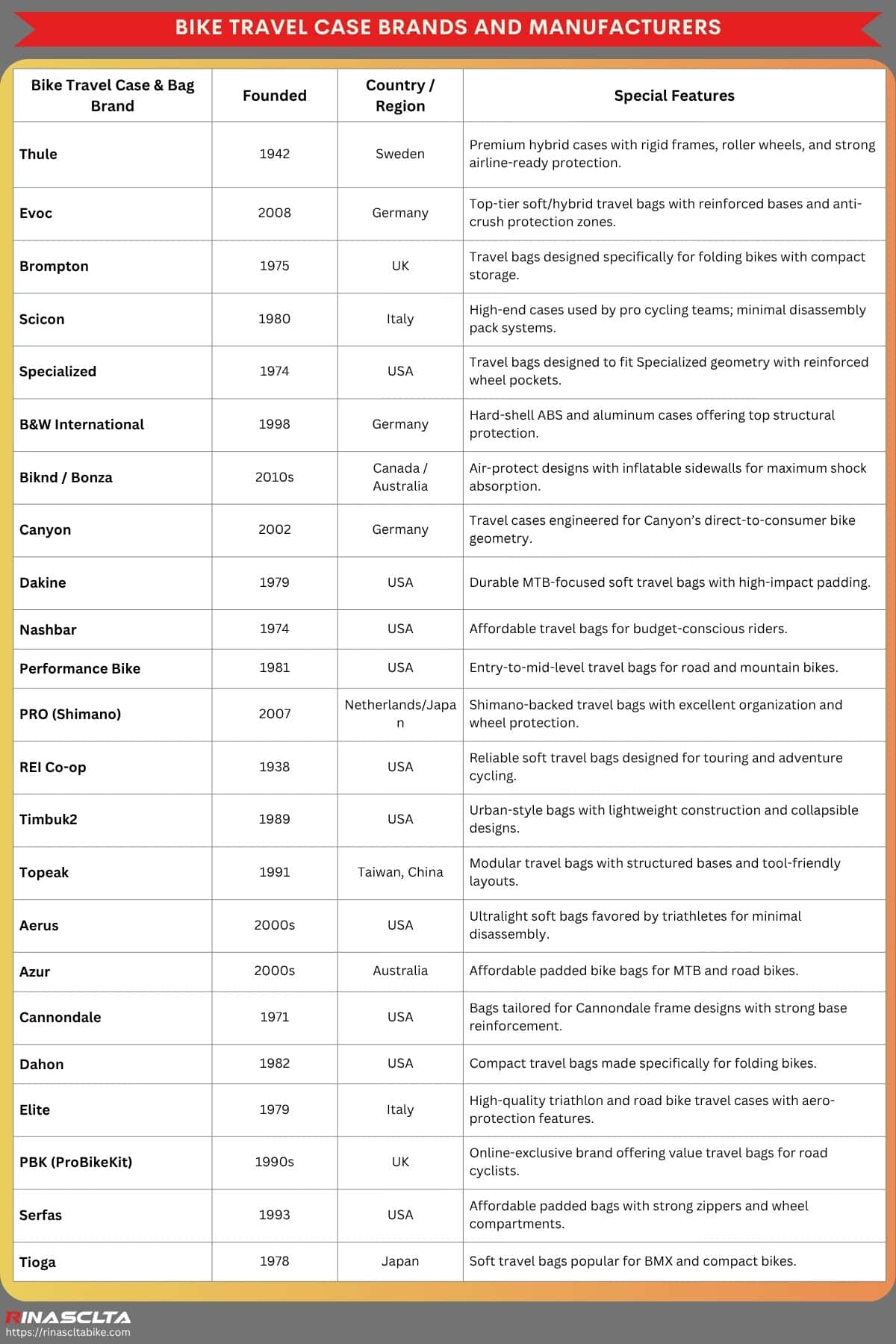
| Bike Travel Case & Bag Brand | Founded | Country / Region | Special Features |
| Thule | 1942 | Sweden | Premium hybrid cases with rigid frames, roller wheels, and strong airline-ready protection. |
| Evoc | 2008 | Germany | Top-tier soft/hybrid travel bags with reinforced bases and anti-crush protection zones. |
| Brompton | 1975 | UK | Travel bags designed specifically for folding bikes with compact storage. |
| Scicon | 1980 | Italy | High-end cases used by pro cycling teams; minimal disassembly pack systems. |
| Specialized | 1974 | USA | Travel bags designed to fit Specialized geometry with reinforced wheel pockets. |
| B&W International | 1998 | Germany | Hard-shell ABS and aluminum cases offering top structural protection. |
| Biknd / Bonza | 2010s | Canada / Australia | Air-protect designs with inflatable sidewalls for maximum shock absorption. |
| Canyon | 2002 | Germany | Travel cases engineered for Canyon’s direct-to-consumer bike geometry. |
| Dakine | 1979 | USA | Durable MTB-focused soft travel bags with high-impact padding. |
| Nashbar | 1974 | USA | Affordable travel bags for budget-conscious riders. |
| Performance Bike | 1981 | USA | Entry-to-mid-level travel bags for road and mountain bikes. |
| PRO (Shimano) | 2007 | Netherlands/Japan | Shimano-backed travel bags with excellent organization and wheel protection. |
| REI Co-op | 1938 | USA | Reliable soft travel bags designed for touring and adventure cycling. |
| Timbuk2 | 1989 | USA | Urban-style bags with lightweight construction and collapsible designs. |
| Topeak | 1991 | Taiwan, China | Modular travel bags with structured bases and tool-friendly layouts. |
| Aerus | 2000s | USA | Ultralight soft bags favored by triathletes for minimal disassembly. |
| Azur | 2000s | Australia | Affordable padded bike bags for MTB and road bikes. |
| Cannondale | 1971 | USA | Bags tailored for Cannondale frame designs with strong base reinforcement. |
| Dahon | 1982 | USA | Compact travel bags made specifically for folding bikes. |
| Elite | 1979 | Italy | High-quality triathlon and road bike travel cases with aero-protection features. |
| PBK (ProBikeKit) | 1990s | UK | Online-exclusive brand offering value travel bags for road cyclists. |
| Serfas | 1993 | USA | Affordable padded bags with strong zippers and wheel compartments. |
| Tioga | 1978 | Japan | Soft travel bags popular for BMX and compact bikes. |