What are gravel bike shoes?
Gravel bike shoes are specialized cycling shoes designed for mixed-surface riding that combine the pedaling efficiency of road shoes with the walkability and durability of mountain bike shoes, typically using a recessed two-bolt cleat system (SPD) and a treaded outsole. Emerging with the rise of gravel cycling in the 2010s, they are used by riders in gravel racing, bikepacking, and adventure cycling, where routes include pavement, dirt roads, and off-road sections. They work by connecting the foot to the pedal system through a cleat, positioning it over the pedal axle and crankset, while features such as moderately stiff soles, durable uppers, and grippy tread patterns allow efficient power transfer and reliable traction when walking, providing value in versatility, comfort, and performance across varied terrain.
What are SPD gravel bike shoes?
SPD gravel bike shoes are cycling shoes designed for gravel riding that use a two-bolt SPD (Shimano Pedaling Dynamics) cleat system, allowing the shoe to clip into compatible pedals while maintaining walkability. Developed alongside the growth of gravel cycling in the 2010s, and based on earlier MTB SPD systems introduced by Shimano in the 1990s, these shoes are widely used in gravel racing, bikepacking, commuting, and mixed-terrain riding. They work by engaging the recessed SPD cleat with the pedal’s spring-loaded mechanism, positioning the foot over the pedal axle and crankset for efficient power transfer, while the treaded outsole and moderate sole stiffness provide traction and comfort when walking, offering value in versatility, durability, and performance across both on-road and off-road conditions.
Do gravel biking shoes make a difference?
Yes, gravel biking shoes make a difference because they provide a balance of power transfer, pedal stability, and walkability through features like recessed SPD cleats, moderately stiff soles, and treaded outsoles, improving efficiency over the pedal axle, crankset, and drivetrain, but the performance gain depends on terrain and riding style compared to standard MTB or road shoes.
Are gravel biking shoes comfortable?
Yes, gravel biking shoes are comfortable because they are designed with moderate stiffness, ergonomic fit, and walkable tread patterns, allowing both efficient pedaling and comfort during off-bike sections, but comfort still depends on fit, width, closure system, and ride duration.
How do gravel bike shoes work?
Gravel bike shoes work by connecting the rider’s foot to the pedal system using a recessed cleat (typically SPD), allowing efficient power transfer while maintaining the ability to walk on mixed terrain. The cleat is mounted into the sole and engages with the pedal’s spring-loaded mechanism, positioning the foot over the pedal axle and crank arm, so pedaling force is transmitted through the crankset, chain, cassette, and drivetrain. At the same time, the moderately stiff sole and treaded outsole provide a balance of efficiency and traction, enabling riders to handle both riding and off-bike sections in gravel environments.
How do gravel bike pedals and shoes work?
Gravel bike pedals and shoes work together by forming a clipless interface between the SPD cleat on the shoe and the pedal mechanism, allowing the rider to securely clip in for stable and efficient pedaling. When the rider steps down, the cleat locks into the pedal’s retention system, aligning the foot over the pedal axle and crankset for effective force transfer through the drivetrain, while releasing is done by twisting the heel outward. This system combines pedaling efficiency, control, and easy engagement/disengagement, making it suitable for the varied conditions of gravel riding.
Why do I need bike shoes for a gravel bike?
You need bike shoes for a gravel bike because they provide a secure connection between your foot and the pedal system—typically through an SPD cleat interface—which improves power transfer, stability, and pedaling efficiency over mixed terrain. Gravel riding often involves transitions between pavement, dirt, and walking sections, so gravel shoes combine moderate sole stiffness for efficient force transfer through the pedal, crankset, and drivetrain with treaded outsoles for traction and walkability, giving you better control, comfort, and versatility during long-distance and variable-surface rides.
What are gravel bike shoes made of?
Gravel bike shoes are made of rubber outsoles, nylon or carbon-composite midsoles, synthetic leather or microfiber uppers, mesh panels, reinforced toe and heel protection, closure systems (BOA dials, laces, or straps), metal cleat inserts, and internal padding materials, because these materials are chosen to balance power transfer, durability, comfort, and walkability across mixed terrain conditions.
- Rubber outsole: Provides traction and grip on dirt, gravel, and uneven surfaces, improving stability when walking or hiking sections
- Nylon or carbon-composite midsole: Delivers a balance of stiffness for efficient power transfer and flexibility for comfort and off-bike movement
- Synthetic leather or microfiber upper: Lightweight and abrasion-resistant materials that offer a secure fit and durability in rough riding environments
- Mesh panels: Enhance ventilation and moisture control, keeping the foot cool and reducing sweat buildup during long rides
- Reinforced toe and heel protection: Protects the foot from rocks, impacts, and trail obstacles, increasing durability and safety
- Closure systems (BOA dials, laces, or straps): Allow adjustable fit and even pressure distribution for foot stability and comfort during pedaling
- Cleat inserts (metal): Embedded in the sole to securely mount SPD cleats, ensuring reliable engagement with the pedal mechanism
- Internal padding and insole: Provide cushioning, arch support, and pressure distribution to improve long-distance comfort and reduce fatigue
What are the different sole materials used for gravel & CX shoes?
Gravel and cyclocross (CX) shoes use different sole materials to balance power transfer, walkability, traction, and durability, because riders need efficiency on the bike while also handling hike-a-bike sections, mud, and mixed terrain. The main sole materials include carbon fiber, carbon-composite, nylon (polyamide), rubber outsoles, and TPU or reinforced polymer layers, each offering different levels of stiffness, grip, and comfort.
| Sole Material | Key Characteristics | Advantages | Limitations | Typical Use |
| Carbon fiber | Ultra-stiff, lightweight sole material | Maximum power transfer efficiency, minimal energy loss through the pedal and crankset | Expensive, less comfortable for walking, lower impact tolerance | Racing, high-performance gravel and CX |
| Carbon-composite | Blend of carbon and polymer materials | High stiffness with improved durability and cost efficiency compared to full carbon | Slightly less efficient than full carbon | Performance gravel and CX |
| Nylon (polyamide) | Flexible and durable plastic-based sole | Better comfort, shock absorption, and walkability | Lower stiffness reduces maximum power transfer | Entry-level to mid-range shoes |
| Rubber outsole | High-friction tread layer added to sole | Excellent traction and grip for walking on mud, rocks, and uneven terrain | Adds weight, not responsible for stiffness | All gravel and CX shoes |
| TPU / reinforced polymers | Structural reinforcement layers | Improve durability, impact resistance, and structural support | Slightly heavier than pure carbon systems |
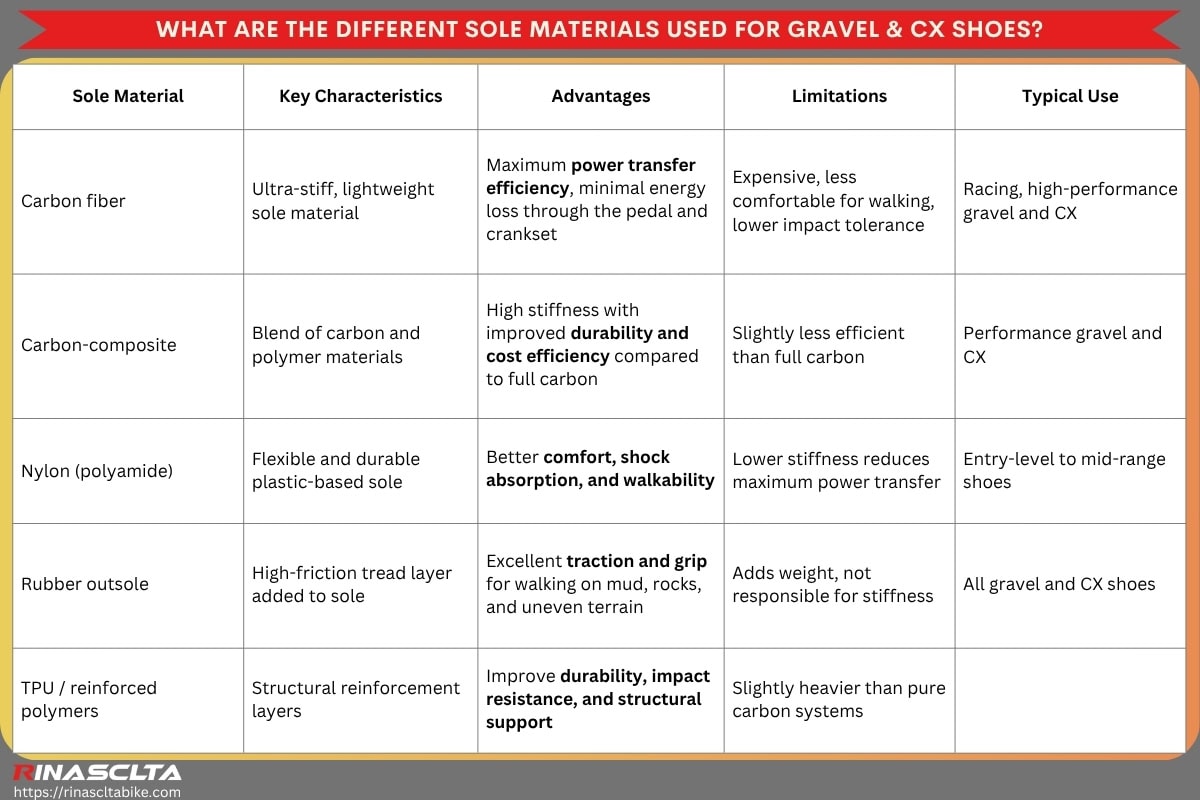
In practice, gravel and CX shoes combine these materials—for example, a carbon or nylon midsole for stiffness and a rubber outsole for traction—to create a balance between efficient pedaling through the drivetrain and practical off-bike performance in varied conditions.
How are gravel bike shoes produced?
Gravel bike shoes are produced through a series of processes including design and engineering, material selection, upper cutting and construction, sole manufacturing, reinforcement integration, bonding and assembly, cleat insert installation, closure system installation, and finishing and quality control, because these steps ensure the shoes achieve the right balance of power transfer, durability, traction, and comfort for mixed-terrain riding.
- Design and engineering: The shoe is designed based on requirements such as cleat compatibility (SPD), sole stiffness, tread pattern, and terrain versatility for gravel and cyclocross use
- Material selection: Materials like carbon or nylon composites, rubber outsoles, microfiber uppers, and protective reinforcements are chosen to balance weight, strength, and performance
- Upper cutting and construction: The upper materials are cut and stitched or bonded to form a structure that provides support, breathability, and abrasion resistance
- Sole manufacturing: The sole is produced using composite molding and rubber tread integration, creating a combination of stiffness for pedaling and grip for walking
- Reinforcement integration: Protective elements such as toe caps, heel guards, and side reinforcements are added to improve durability in rough conditions
- Bonding and assembly: The upper is attached to the sole through lasting and bonding processes, ensuring structural integrity and correct alignment
- Cleat insert installation: Metal inserts are integrated into the sole to support SPD cleat mounting and secure pedal engagement
- Closure system installation: Systems such as BOA dials, laces, or straps are installed to allow adjustable fit and stable foot retention
- Finishing and quality control: The final shoes are inspected for fit, durability, stiffness, traction, and cleat compatibility before distribution
What are the types of gravel bike shoes?
Gravel bike shoes can be categorized based on sole material (carbon, carbon-composite, nylon), gender (men’s, women’s, kids’), cleat type (2-bolt SPD systems), closure type (BOA dials, rotary ratchets, laces, single/dual dials, hook-and-loop straps), width (standard, wide, narrow), and size range, because gravel riding requires a balance of power transfer, walkability, durability, and fit across mixed terrain conditions. These classifications help riders choose the right shoes based on pedal compatibility, foot anatomy, comfort preferences, and riding style, while also addressing practical considerations such as whether women can wear men’s shoes, which fastening system offers the best fit and adjustability, and how sizing and tightness affect long-distance performance and control.
Gravel bike shoes types based on sole material
Gravel bike shoes types based on sole material include carbon-composite soles, carbon-composite with TPU reinforcement, nylon-composite with rubber outsoles, and full carbon fiber soles, because different sole constructions determine the balance between power transfer efficiency, durability, impact resistance, and walkability across mixed terrain.
- Carbon-composite sole: Combines carbon fibers with polymer materials to provide high stiffness for efficient power transfer through the pedal, crankset, and drivetrain while maintaining better durability than full carbon
- Carbon-composite with TPU reinforcement: Adds TPU (thermoplastic polyurethane) layers to improve impact resistance, structural support, and durability in rough gravel conditions
- Nylon-composite with rubber outsole: Uses a nylon midsole for moderate stiffness and a rubber tread for grip, offering comfort, flexibility, and traction when walking on gravel or dirt
- Full carbon fiber sole: Provides maximum stiffness and minimal flex for elite-level power transfer and lightweight performance, but with reduced walkability and higher cost
Gravel bike shoes types based on gender
Gravel bike shoes types based on gender include men’s gravel bike shoes, women’s gravel bike shoes, and kids’ gravel bike shoes, because different riders have variations in foot shape, width, volume, and sizing, which affect comfort, stability, and pedaling efficiency on mixed terrain.
- Men’s gravel bike shoes: Designed with a generally wider forefoot, higher volume fit, and larger size range to match typical male foot anatomy
- Women’s gravel bike shoes: Built with a narrower heel, lower volume profile, and adjusted arch support, improving fit and reducing foot movement for many female riders
- Kids’ gravel bike shoes: Made with smaller sizes, durable materials, and simple closure systems, supporting growing feet and ease of use for young riders
Can women wear men’s gravel bike shoes?
Yes, women can wear men’s gravel bike shoes if the fit matches their foot shape, width, and volume, because the core function—such as SPD cleat compatibility, pedal interface, and power transfer through the crankset and drivetrain—is the same. But men’s shoes typically have a wider forefoot and higher internal volume, so if the fit is too loose it can reduce foot stability, pressure distribution, and pedaling efficiency, especially on mixed terrain where control and comfort are critical.
Gravel bike shoes types based on cleat type
Gravel bike shoes use 2-bolt cleat systems (MTB/SPD style) because this standard provides the best balance of pedaling efficiency, walkability, durability, and versatility required for mixed-surface riding. The 2-bolt SPD system was originally developed by Shimano in the 1990s for mountain biking, where riders needed a cleat that could be recessed into the sole, allowing them to walk, hike, and handle rough terrain without damaging the cleat or slipping. As gravel cycling emerged in the 2010s as a hybrid discipline between road and off-road riding, this SPD system naturally became the standard because gravel riders often encounter dirt roads, loose surfaces, mud, and off-bike sections, making walkability and durability essential.
Unlike road-specific 3-bolt systems (such as SPD-SL or Look Keo) that prioritize maximum surface contact and stiffness for pure efficiency, the 2-bolt SPD design is compact, recessed, and protected by treaded outsoles, allowing riders to maintain traction when walking while still providing reliable engagement with the pedal mechanism, pedal axle, and crankset. This is why gravel bike shoes almost exclusively use the 2-bolt system—because it offers the most practical combination of performance, control, and real-world usability across varied terrain, which aligns perfectly with the demands of gravel riding.
Gravel bike shoes types based on closure type
Gravel bike shoes types based on closure type include BOA dial systems, rotary ratchet buckles, dial systems (single and dual), lace systems, hook-and-loop (Velcro) straps, and hybrid closure systems, because different closure mechanisms affect fit precision, pressure distribution, adjustability, durability, and ease of use across long-distance and mixed-terrain riding.
- BOA dial system: Uses a micro-adjustable dial and cable system to provide precise tension control and even pressure distribution for stable foot positioning during pedaling
- Rotary ratchet buckle: A mechanical closure that allows incremental tightening and secure locking, offering strong foot retention for rough terrain
- Dial system (single and dual): Uses one or two adjustment dials to control different zones of the shoe (forefoot and midfoot) for improved fit customization and comfort
- Lace system: Provides even pressure distribution and flexibility, often preferred for comfort and simplicity during long gravel rides
- Hook-and-loop (Velcro) straps: Lightweight and easy-to-use straps that allow quick adjustment, commonly used in entry-level or versatile gravel shoes
- Hybrid closure systems: Combine multiple systems such as BOA + strap or lace + strap to balance precision, comfort, and durability in varied riding conditions
What are the best gravel bike shoes fastening systems?
The best gravel bike shoes fastening systems are dual BOA dial systems, hybrid closure systems (BOA + strap), and well-designed lace systems, because they provide the optimal balance of fit precision, pressure distribution, adjustability, comfort, and durability required for long-distance mixed-terrain riding. Dual BOA systems allow independent micro-adjustment of forefoot and midfoot zones, hybrid systems improve foot lockdown and stability on rough surfaces, and lace systems offer even tension and comfort with fewer pressure points, all of which help maintain secure foot positioning over the cleat, pedal axle, crankset, and drivetrain, improving efficiency, control, and endurance performance on gravel terrain.
Are laces better than dials for gravel bike shoes?
Yes, laces are better than dials if you prioritize comfort, even pressure distribution, and simplicity for long-distance gravel riding, because they reduce pressure points, hotspots, and foot fatigue while maintaining stable contact over the cleat, pedal axle, and crankset, but dial systems (such as BOA) are better than laces if you need precise, quick, and on-the-fly adjustment, because they allow micro-adjustable tension control, improving fit precision, foot stability, and power transfer efficiency in changing terrain and riding conditions.
Gravel bike shoes types based on width
Gravel bike shoes types based on width include narrow fit, standard fit, wide fit, and extra-wide fit, because different riders have variations in forefoot width, foot volume, and toe box shape, which directly affect comfort, pressure distribution, pedal stability, and control on mixed terrain.
- Narrow fit: Designed for riders with slimmer feet and lower volume, providing a snug fit that improves foot stability and reduces movement over rough surfaces
- Standard fit: The most common option, suitable for average foot shapes, offering a balance of comfort, support, and efficient power transfer
- Wide fit: Built with a broader toe box and increased internal volume to accommodate wider feet, reducing pressure points and improving comfort during long gravel rides
- Extra-wide fit: Provides maximum internal space for riders with very wide feet or specific fit needs, helping prevent numbness, hotspots, and discomfort in extended mixed-terrain riding
Should gravel bike shoes be tight or loose?
Gravel bike shoes should be snug but not overly tight because a secure fit keeps the foot stable over the SPD cleat, pedal axle, and crankset, improving power transfer and control on mixed terrain, while preventing excessive movement that can reduce efficiency. At the same time, they should not be too tight, because excessive pressure can restrict blood flow, cause numbness, hotspots, and discomfort, especially during long gravel rides or walking sections, so the ideal fit provides firm heel retention, even pressure distribution, and enough toe room for comfort and versatility.
How do you choose gravel bike shoes?
Choosing gravel bike shoes depends on budget, upper material and construction, closure system, sole stiffness (insole and outsole), tread design, pedal and cleat compatibility, width and fit, weight, durability, and ventilation, because these factors determine how effectively the shoe balances power transfer, comfort, walkability, and control across mixed terrain.
- Budget: Determines the level of materials and features, from entry-level nylon soles to high-end carbon-composite designs, affecting performance and durability
- Upper material and construction: Materials like microfiber, synthetic leather, and mesh influence comfort, breathability, and resistance to abrasion in rough conditions
- Closure system: Systems such as BOA dials, laces, or straps affect fit precision, adjustability, and pressure distribution across the foot
- Sole stiffness (insole and outsole): The stiffness level controls how efficiently force is transferred through the cleat, pedal axle, and crankset, while still allowing some flexibility for walking
- Tread design: Rubber outsoles with tread patterns provide traction and grip when walking on gravel, dirt, or uneven terrain
- Pedal and cleat type: Compatibility with 2-bolt SPD systems ensures proper engagement with the pedal and reliable performance
- Width and fit: Correct width (narrow, standard, wide) ensures foot stability, comfort, and prevention of hotspots or numbness
- Weight: Lighter shoes reduce fatigue and improve efficiency during long-distance gravel riding
- Durability: Reinforced areas and strong materials improve resistance to wear, impacts, and harsh terrain conditions
- Ventilation: Breathable designs help regulate temperature and moisture, improving comfort during extended rides

Do I need Gravel or CX specific cycling shoes?
Yes, you may need gravel or CX specific cycling shoes because they are optimized for mixed terrain, walkability, and durability, but MTB shoes can also work since they use the same SPD cleat system and pedal interface.
Should gravel shoes be stiff?
Yes, gravel shoes should be moderately stiff because they need efficient power transfer through the cleat, pedal axle, and crankset, but not as stiff as road shoes to allow walking comfort and terrain adaptability.
Do gravel bike shoes come with cleats?
Yes, gravel bike shoes can come with cleats if sold as a bundle, but most are sold without cleats because SPD cleats must match the pedal system and rider preference.
Can you ride a gravel bike with normal shoes?
Yes, you can ride a gravel bike with normal shoes because flat pedals allow basic riding, but you lose efficiency, stability, and control compared to clipless systems.
Do all gravel bike shoes fit all pedals?
Yes, gravel bike shoes can fit pedals if the cleat system matches, but most use 2-bolt SPD cleats, so compatibility depends on the pedal interface.
Do I need toe spikes for gravel riding?
Yes, you may need toe spikes for gravel riding if you ride in muddy or cyclocross conditions, but they are usually unnecessary for typical gravel riding.
Do I need heat-molded shoes?
Yes, you may need heat-molded shoes if you want a custom fit for better comfort, pressure distribution, and power transfer, but standard shoes are sufficient for most riders.
Do gravel bike shoes make a difference?
Yes, gravel bike shoes make a difference because they improve power transfer, stability, and walkability, enhancing performance on mixed terrain.
Do gravel bike shoes work with Peloton?
Yes, gravel bike shoes can work with Peloton if the pedals support SPD cleats, but standard Peloton pedals use Look Delta, so compatibility varies.
Can I use Peloton shoes on a gravel bike?
Yes, you can use Peloton shoes on a gravel bike if your pedals support Look Delta cleats, but most gravel pedals use SPD, so they are usually not compatible.
Can gravel bike shoes be used for spinning?
Yes, gravel bike shoes can be used for spinning if the indoor bike supports SPD cleats, which many gym bikes do.
Can I use mountain bike shoes for a gravel bike?
Yes, you can use mountain bike shoes for a gravel bike because both use SPD cleat systems, offering similar pedal compatibility and performance.
Can you put mountain bike cleats on gravel shoes?
Yes, you can put mountain bike cleats on gravel shoes because both use 2-bolt SPD systems, making them fully compatible.
Can you put gravel cleats on mountain bike shoes?
Yes, you can put gravel cleats on mountain bike shoes because they use the same SPD cleat standard and mounting interface.
Are gravel shoes faster than mountain bike shoes?
Yes, gravel shoes can be faster than mountain bike shoes because they often have stiffer soles and lighter construction, but differences are usually small.
Can you use mountain bike shoes with gravel bike pedals?
Yes, you can use mountain bike shoes with gravel bike pedals because both typically use SPD cleat systems, ensuring full compatibility.
Why are gravel bike shoes different from mountain bike shoes?
Gravel bike shoes are different from mountain bike shoes because they are designed to balance pedaling efficiency and long-distance comfort with moderate walkability, using features like lighter construction, less aggressive tread, and slightly stiffer soles, while MTB shoes prioritize maximum grip, protection, and durability for technical terrain and frequent off-bike use.
What is the difference between mountain bike and gravel bike shoes?
The difference between mountain bike and gravel bike shoes lies in tread design, stiffness, weight, and intended terrain, where MTB shoes have more aggressive rubber outsoles, added protection, and flexibility for off-road control, while gravel shoes are typically lighter, smoother, and more efficient for sustained pedaling over mixed surfaces.
What is the difference between road bike and gravel bike shoes?
The difference between road bike and gravel bike shoes is mainly in cleat system, walkability, and versatility, where road shoes use 3-bolt cleats and very stiff, smooth soles for maximum power transfer, while gravel shoes use 2-bolt SPD cleats with treaded outsoles, allowing efficient pedaling plus traction and comfort for walking on varied terrain.
What is the best bike shoe for gravel roads?
The best bike shoe for gravel roads is a gravel-specific SPD (2-bolt) cycling shoe with a carbon-composite or stiff nylon sole, durable upper, and treaded rubber outsole, because it provides the optimal balance of power transfer, walkability, comfort, and durability required for mixed-terrain riding. A good gravel shoe should feature moderate-to-high sole stiffness for efficient force transfer through the cleat, pedal axle, and crankset, combined with a recessed SPD cleat system for easy walking, a grippy tread for traction on dirt and loose surfaces, and a secure closure system (such as BOA or laces) for stable foot positioning; this combination ensures efficient pedaling on pavement while maintaining control and comfort during off-bike sections and long-distance gravel rides.
How should gravel bike shoes fit?
You should choose gravel bike shoes that fit snugly with secure heel retention and even pressure across the forefoot, because a proper fit stabilizes the foot over the SPD cleat, pedal axle, and crankset, improving power transfer and control while still allowing enough toe room to prevent numbness and discomfort during long rides and walking sections.
How tight should my gravel bike shoes be?
You should tighten gravel bike shoes until they feel firm and secure without causing pressure points, because proper tension from BOA dials, laces, or straps ensures stable foot positioning and efficient pedaling while maintaining blood circulation and comfort over mixed terrain.
How to install cleats on gravel bike shoes?
You should install cleats by aligning the 2-bolt SPD cleat with the mounting slots in the sole, positioning it under the ball of the foot, and tightening the bolts evenly, because correct installation ensures proper engagement with the pedal mechanism and efficient force transfer through the drivetrain.
How to install SPD cleats on gravel bike shoes?
You should install SPD cleats by placing the two-bolt cleat into the recessed mounting area, aligning it correctly under the forefoot, and tightening securely, because SPD systems require accurate positioning for stable clipping, smooth release, and efficient pedaling.
How to position cleats on gravel bike shoes?
You should position cleats so that the pedal axle aligns with the ball of your foot (metatarsal area) and the angle matches your natural foot alignment, because proper positioning improves pedaling efficiency, knee alignment, comfort, and control, especially during long-distance gravel riding.
Do I need custom insoles in my gravel bike shoes?
Yes, you may need custom insoles in your gravel bike shoes because they improve arch support, foot alignment, and pressure distribution, enhancing stability over the SPD cleat, pedal axle, and crankset, but they are not always necessary if the stock insoles already provide sufficient comfort and support.
Should I try gravel bike shoes on before I buy them?
Yes, you should try gravel bike shoes on before buying because proper fit affects comfort, power transfer, and foot stability, and different brands vary in size, width, volume, and closure system, which can significantly impact performance and long-distance comfort.
Can I walk in gravel bike shoes?
Yes, you can walk in gravel bike shoes because they use recessed SPD cleats and treaded rubber outsoles, providing traction and stability on mixed terrain, but walking comfort still depends on the shoe’s sole stiffness and tread design.
How to adjust gravel bike shoes’ cleats?
You should adjust gravel bike shoes’ cleats by loosening the 2-bolt SPD cleat bolts, then aligning the cleat so the pedal axle sits under the ball of your foot (metatarsal area) and setting the angle to match your natural foot position, before tightening the bolts evenly, because proper adjustment improves power transfer through the crankset and drivetrain, knee alignment, and pedaling comfort.
How to unclip gravel bike shoes?
You should unclip gravel bike shoes by rotating your heel outward to release the cleat from the pedal’s spring-loaded retention mechanism, because this motion disengages the SPD interface while maintaining secure attachment during riding and controlled release for safety.
How long do gravel bike shoes last?
You should expect gravel bike shoes to last around 2 to 5 years or roughly 8,000–15,000 km depending on usage, because their lifespan depends on terrain, walking frequency, sole wear, cleat interface condition, and material durability, which affect performance and comfort over time.
How do I care for and clean my gravel bike shoes?
You should clean gravel bike shoes by wiping them with a damp cloth, mild soap, and soft brush, removing dirt from the upper, tread, and cleat area, and allowing them to air dry away from direct heat, because proper care maintains cleat engagement, material integrity, ventilation, and long-term durability.
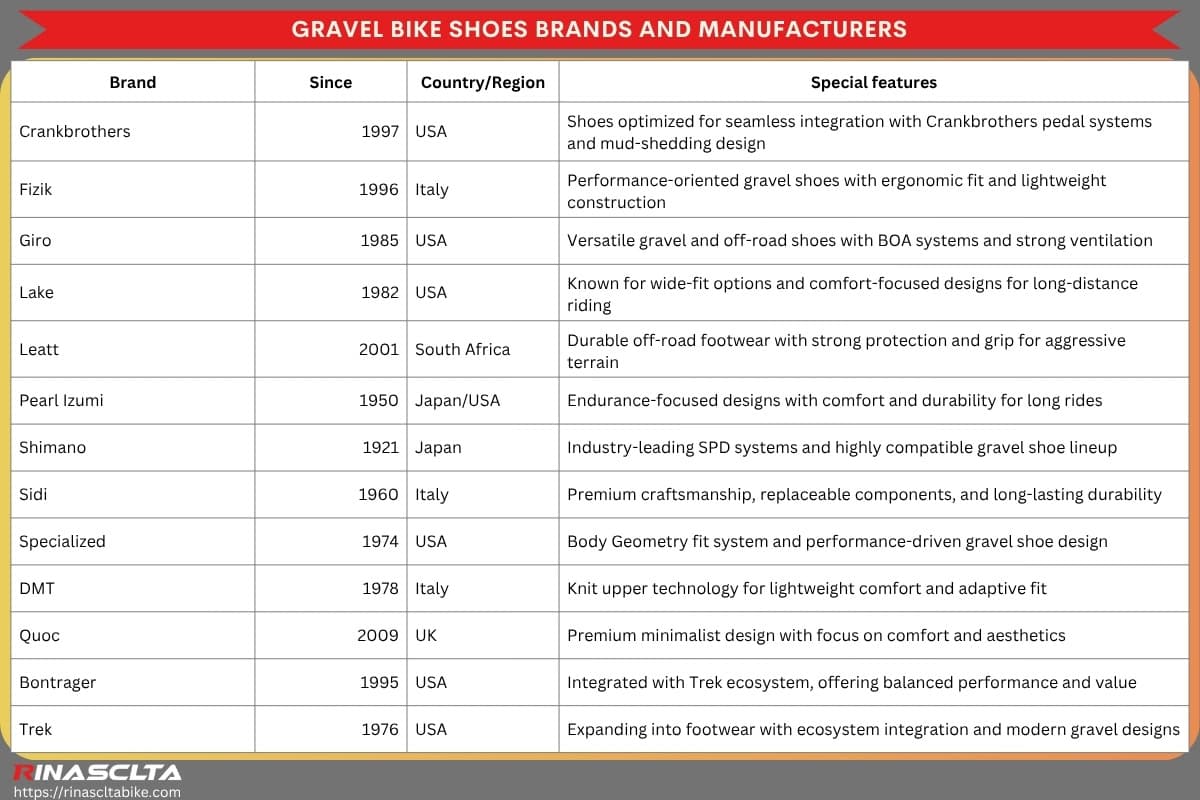
Gravel bike shoes brands and manufacturers
Gravel bike shoe brands and manufacturers operate at the intersection of road performance and off-road durability, developing footwear that balances power transfer, walkability, comfort, and protection for mixed-terrain riding. The industry includes both dedicated cycling footwear specialists and major bike component brands, with continuous innovation in SPD cleat compatibility, sole materials (carbon vs nylon), tread design, and closure systems (BOA, laces, hybrid) to meet the growing demands of gravel racing, bikepacking, and endurance cycling.
| Brand | Since | Country/Region | Special features |
| Crankbrothers | 1997 | USA | Shoes optimized for seamless integration with Crankbrothers pedal systems and mud-shedding design |
| Fizik | 1996 | Italy | Performance-oriented gravel shoes with ergonomic fit and lightweight construction |
| Giro | 1985 | USA | Versatile gravel and off-road shoes with BOA systems and strong ventilation |
| Lake | 1982 | USA | Known for wide-fit options and comfort-focused designs for long-distance riding |
| Leatt | 2001 | South Africa | Durable off-road footwear with strong protection and grip for aggressive terrain |
| Pearl Izumi | 1950 | Japan/USA | Endurance-focused designs with comfort and durability for long rides |
| Shimano | 1921 | Japan | Industry-leading SPD systems and highly compatible gravel shoe lineup |
| Sidi | 1960 | Italy | Premium craftsmanship, replaceable components, and long-lasting durability |
| Specialized | 1974 | USA | Body Geometry fit system and performance-driven gravel shoe design |
| DMT | 1978 | Italy | Knit upper technology for lightweight comfort and adaptive fit |
| Quoc | 2009 | UK | Premium minimalist design with focus on comfort and aesthetics |
| Bontrager | 1995 | USA | Integrated with Trek ecosystem, offering balanced performance and value |
| Trek | 1976 | USA | Expanding into footwear with ecosystem integration and modern gravel designs |