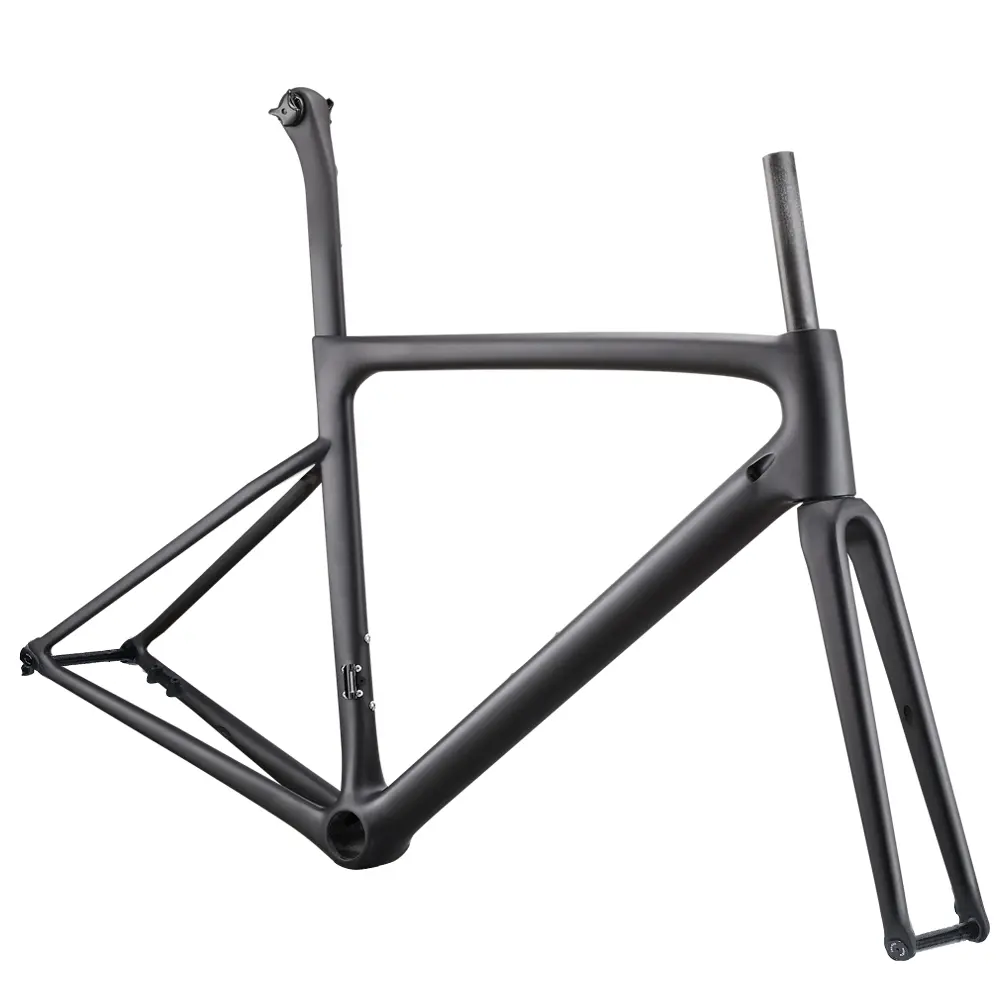
What are bike disc brake rotors?
Bike disc brake rotors are round, flat metal discs mounted to the hubs of bicycle wheels, providing a braking surface for calipers to clamp onto, converting kinetic energy into heat and slowing the bike. First introduced in mountain biking in the 1990s by brands like Hope (UK) and Shimano (Japan) to improve braking in muddy, steep, and unpredictable terrain, rotors have since evolved into high-performance components with vented, floating, and multi-material designs (e.g., Shimano ICE-Tech) for better heat dissipation, modulation, and reliability; today, they are standard on mountain, gravel, and even high-end road bikes, and the future points toward lighter, quieter, and more aerodynamic rotor systems with better pad-rotor compatibility and less maintenance.
How do bike brake rotors work?
Bike brake rotors work by providing a dedicated braking surface for disc brake calipers, which clamp brake pads against the rotor using hydraulic or mechanical force, generating friction that slows the wheel’s rotation. The system efficiently converts kinetic energy into heat, with the rotor’s material, thickness, diameter, and venting design playing key roles in managing braking power, heat dissipation, and modulation—making it highly effective across a wide range of terrains and weather conditions.
Are all rotors on bike brakes the same size?
No, not all rotors on bike brakes are the same size because rotors come in different diameters—commonly 140 mm, 160 mm, 180 mm, and 203 mm—to match the specific braking force, riding style, and bike type. Larger rotors offer better heat management and stopping power, especially for mountain bikes, e-bikes, or heavier riders, while smaller rotors are lighter and more aerodynamic for road bikes.
Are brake discs and rotors the same thing?
No, brake discs and rotors are not different because they refer to the same component—the round metal plate attached to the hub that brake pads clamp onto in a disc brake system. The terms are used interchangeably in cycling, though “rotor” is more common in the bike industry.
Are the front and back rotors the same?
No, the front and back rotors are not always the same because the front rotor is often larger (e.g., 180 mm front, 160 mm rear) to provide more braking power and manage greater weight transfer during deceleration. Using different rotor sizes helps balance braking performance, heat dissipation, and bike control.
What are disc brake rotors usually made of?
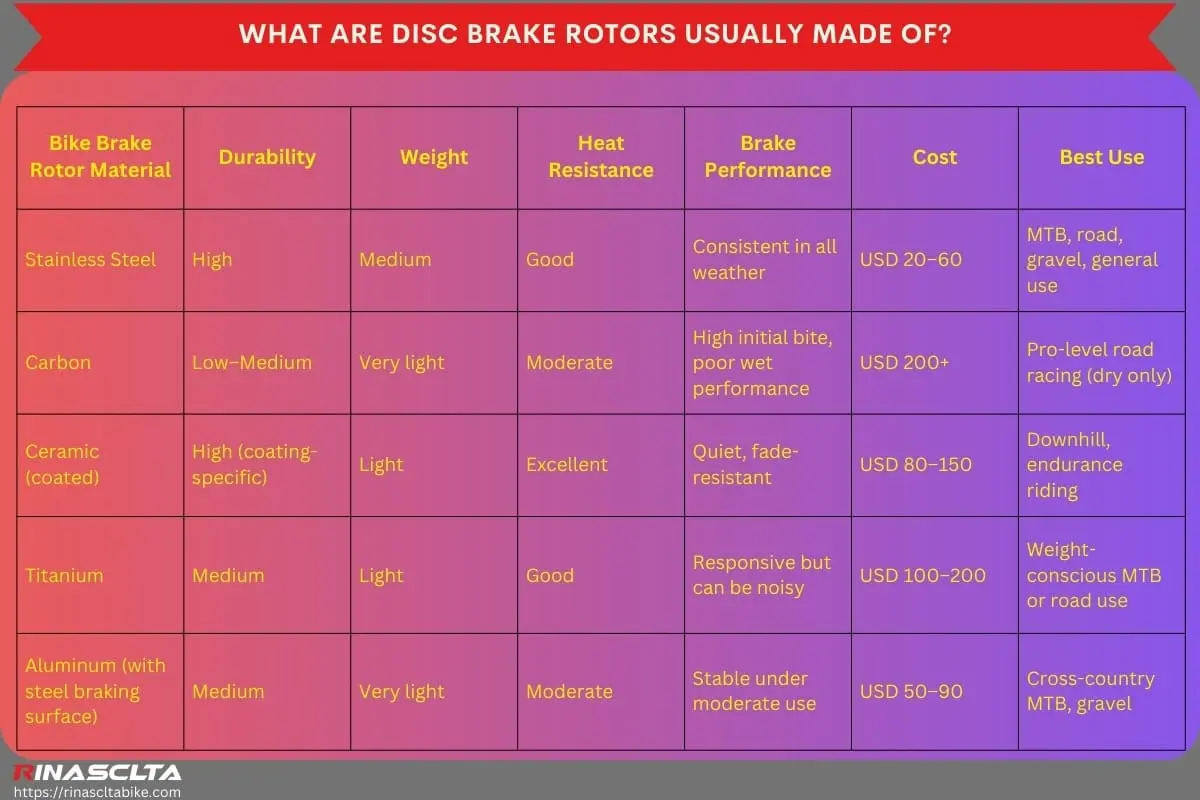
Disc brake rotors are usually made of stainless steel, but high-performance or experimental rotors may also incorporate carbon, ceramic, titanium, or aluminum—each chosen for their unique balance of weight, heat resistance, durability, and braking efficiency. These materials are selected based on the rider’s discipline (e.g., road, MTB, downhill, racing), rotor size, and expected braking conditions such as wet terrain or extended descents.
| Bike Brake Rotor Material | Durability | Weight | Heat Resistance | Brake Performance | Cost | Best Use |
| Stainless Steel | High | Medium | Good | Consistent in all weather | USD 20–60 | MTB, road, gravel, general use |
| Carbon | Low–Medium | Very light | Moderate | High initial bite, poor wet performance | USD 200+ | Pro-level road racing (dry only) |
| Ceramic (coated) | High (coating-specific) | Light | Excellent | Quiet, fade-resistant | USD 80–150 | Downhill, endurance riding |
| Titanium | Medium | Light | Good | Responsive but can be noisy | USD 100–200 | Weight-conscious MTB or road use |
| Aluminum (with steel braking surface) | Medium | Very light | Moderate | Stable under moderate use | USD 50–90 | Cross-country MTB, gravel |
How much do brake rotors weigh?
Bike brake rotors typically weigh between 80 grams and 200 grams, depending on their diameter (e.g., 140 mm to 203 mm), thickness, and material. Lighter materials like carbon and titanium reduce weight for performance, while steel and ceramic-coated rotors prioritize heat resistance and durability.
| Bike Brake Rotor Material | Typical Size | Weight Range (grams) |
| Stainless Steel | 160–203 mm | 100–180 g |
| Aluminum (with steel braking track) | 160–180 mm | 90–150 g |
| Ceramic-Coated Steel | 160–203 mm | 110–170 g |
| Titanium | 160 mm | 80–130 g |
| Carbon (race-only) | 140–160 mm | 60–110 g |

Bike disc brake rotor size chart
Bike disc brake rotor sizes commonly range from 140 mm to 203 mm, with niche or experimental rotors reaching up to 300 mm. These sizes exist to match the rider’s braking demands—smaller rotors (like 140 mm or 160 mm) are ideal for lighter bikes and road use due to lower weight and better aerodynamics, while larger rotors (180 mm and above) are designed for mountain bikes, e-bikes, and downhill riding where greater braking force and heat management are critical.
| Rotor Size (mm) | Road Bike | Gravel Bike | MTB (XC) | MTB (Trail) | Downhill MTB | E-Bike | Fat Bike | Cargo Bike |
| 140 mm | ✅ | ✅ | ❌ | ❌ | ❌ | ❌ | ❌ | ❌ |
| 160 mm | ✅ | ✅ | ✅ | ❌ | ❌ | ❌ | ❌ | ❌ |
| 180 mm | ❌ | ✅ | ✅ | ✅ | ❌ | ✅ | ✅ | ✅ |
| 185 mm | ❌ | ❌ | ❌ | ✅ | ✅ | ✅ | ✅ | ✅ |
| 200 mm | ❌ | ❌ | ❌ | ✅ | ✅ | ✅ | ✅ | ✅ |
| 203 mm | ❌ | ❌ | ❌ | ✅ | ✅ | ✅ | ✅ | ✅ |
| 220 mm | ❌ | ❌ | ❌ | ❌ | ✅ | ✅ | ✅ | ✅ |
| 240 mm+ | ❌ | ❌ | ❌ | ❌ | ❌ | ✅ (rare) |

How do you size a bike brake rotor?
You can size a bike brake rotor by measuring its diameter in millimeters—common sizes include 140 mm, 160 mm, 180 mm, and 203 mm—using a tape measure or caliper across the widest point of the rotor. The ideal size depends on your riding style, bike type, rider weight, and braking demands: smaller rotors (140–160 mm) are lighter and suitable for road or XC bikes, while larger ones (180–203+ mm) provide more stopping power and heat dissipation for trail, downhill, or e-bike use. You should also check frame and fork compatibility and the caliper mount type (post mount, flat mount, or IS) before sizing up, and you may need a rotor adapter if changing sizes.
Can you go to a larger brake rotor for a mountain bike?
Yes, you can go to a larger brake rotor for a mountain bike if your frame and fork allow the clearance and you use the correct adapter to reposition the brake caliper for the increased rotor diameter. Upgrading to a larger rotor improves braking power and heat dissipation, which is especially useful for heavier riders, steep descents, or e-bike applications.
Can I upgrade the disc brakes on my mountain bike to a larger rotor?
Yes, you can upgrade the disc brakes on your mountain bike to a larger rotor if your brake calipers and mounting system (post mount or IS) are compatible with rotor adapters and there’s no interference with the fork or seat stay. Be sure to use manufacturer-approved adapters and recheck caliper alignment after installation for safe and efficient braking.
How do you determine rotor size without removing the wheel?
You can determine rotor size without removing the wheel by measuring the rotor diameter directly through the spokes using a ruler or tape measure, placing it across the center of the hub to the outer edge, and doubling the radius to get the full diameter. Most rotors are also laser-etched with size markings (e.g., “160 mm” or “203 mm”) near the mounting bolts or edge, which you can read without disassembly—this ensures quick identification for replacement or upgrade planning without disturbing your brake setup. This method is helpful when checking for caliper compatibility, heat management needs, or whether a larger rotor might be feasible based on frame and fork clearance.
What is the bike disc brake rotor thickness?
The bike disc brake rotor thickness typically ranges from 1.8 mm to 2.0 mm for most standard rotors made of stainless steel, which is the industry norm for both road and mountain bikes. Some high-performance or e-bike-specific rotors may be thicker—up to 2.3 mm or 2.5 mm—to handle greater heat buildup and provide improved stiffness and durability, especially during long descents or heavy braking. Always check the minimum thickness specification stamped on the rotor (commonly 1.5 mm)—if the rotor wears below this limit, it should be replaced to maintain safe braking performance and prevent brake pad misalignment or failure.
Bike brake rotors diagram
A bike brake rotor diagram is essential for understanding how the braking system functions, helping riders, mechanics, and beginners visually identify critical parts like the braking surface, mounting holes, and vent cutouts for proper installation, maintenance, and performance upgrades.

What are the bike brake rotor bolt patterns?
The bike brake rotor bolt patterns include 6-bolt and Center Lock, which are the two main standards used to attach rotors to hubs, each with different compatibility, weight, and installation characteristics.
- 6-Bolt: The bike’s 6-bolt rotor pattern uses six evenly spaced bolts to secure the rotor directly to the hub flange, offering wide compatibility across MTB and gravel bikes and allowing easy field service with a T25 Torx wrench.
- Center Lock: The bike Center Lock system, developed by Shimano, uses a spline interface and a single lockring to secure the rotor to the hub, enabling faster installation and more consistent alignment, often preferred for road and high-end builds.
Both systems are reliable, but 6-bolt offers greater aftermarket availability, while Center Lock emphasizes speed, precision, and lower tool requirements, with each type needing matching hub interfaces.
Types of bike brake rotors
The types of bike brake rotors can be sorted by mounting standards and bike types, as these classifications reflect rotor compatibility, design purpose, and braking performance for different riding demands. This structure helps riders choose the right rotor based on hub interface and specific bike usage—whether lightweight efficiency for road or maximum stopping power for downhill.
Bike brake rotors sorted by mounting standards
Bike brake rotors sorted by mounting standards include Center Lock, 6-bolt, and 4-bolt, categorized this way because each type uses a different interface to attach the rotor to the hub, affecting installation method, tool compatibility, and brake system compatibility with various calipers, pads, and wheelsets.
- Center Lock: Center Lock rotors use a splined hub interface with a single lockring (similar to a cassette) for quick installation and removal, commonly paired with Shimano calipers and pads, and favored on road, gravel, and higher-end MTB bikes for their precision and cleaner appearance.
- 6-Bolt: 6-bolt rotors are secured to the hub with six evenly spaced Torx bolts, offering wide compatibility with most brake calipers (Shimano, SRAM, Magura, TRP) and excellent field serviceability; they are popular across mountain biking disciplines due to their reliability and availability.
- 4-Bolt: 4-bolt rotors are a legacy system used on older or niche bikes (such as some trials or retro MTB setups), with limited compatibility and aftermarket support; they work with select calipers and require careful sourcing of matching pads and hardware.
Bike brake rotors sorted by bike type
Bike brake rotors sorted by bike type include road bikes, gravel bikes, XC bikes, downcountry bikes, trail bikes, electric bikes, enduro bikes, and downhill bikes, grouped this way because each bike category requires specific braking characteristics such as heat management, weight savings, modulation, or stopping power. This classification helps riders match the right rotor size, mounting standard (Center Lock, 6-bolt, or 4-bolt), and performance features to their terrain and riding style.
| Bike Type | Typical Rotor Size | Mounting Standard | Key Features |
| Road Bikes | 140–160 mm | Center Lock | Lightweight, aerodynamic, low heat load |
| Gravel Bikes | 160 mm | Center Lock or 6-Bolt | Modulation, heat control, mixed terrain performance |
| XC Bikes | 160–180 mm | 6-Bolt | Lightweight, fast engagement, dry condition tuning |
| Downcountry Bikes | 180 mm | 6-Bolt | Balance of climbing weight and descending control |
| Trail Bikes | 180–200 mm | 6-Bolt or Center Lock | Increased power, heat resistance, durability |
| Electric Bikes | 180–203 mm | 6-Bolt or Center Lock | High braking torque, reinforced materials, e-bike specific rotors |
| Enduro Bikes | 200–203 mm | 6-Bolt | Powerful braking, steep descents, long runs |
| Downhill Bikes | 203–220 mm | 6-Bolt | Maximum heat management and braking power |

How do you choose the correct bike brake rotors?
You can choose the correct bike brake rotors by considering rotor size, mounting standard, bike type, riding style, rider weight, brake caliper compatibility, heat management, and terrain, because each of these factors directly affects braking performance, safety, durability, and overall ride quality.
- Rotor Size: You can select rotor size (e.g., 140 mm, 160 mm, 180 mm, 203 mm) based on your need for braking power—larger rotors improve heat dissipation and stopping force for heavy riders or steep terrain.
- Mounting Standard: You can choose between Center Lock, 6-bolt, or 4-bolt rotors depending on your hub type, as the rotor must match the interface to install securely and perform correctly.
- Bike Type: You can match rotor design to your bike type—road bikes typically use 140–160 mm rotors, while mountain or e-bikes often use 180–203 mm for added control and power.
- Riding Style: You can adjust rotor choice based on your riding demands—XC riders may prefer lighter, smaller rotors, while downhill riders need larger, more robust ones.
- Rider Weight: You can size up if you’re a heavier rider, as larger rotors resist brake fade better under higher loads and prolong pad and rotor life.
- Brake Caliper Compatibility: You can ensure that the rotor thickness and diameter are compatible with your calipers, since mismatch can cause rubbing, underperformance, or safety risks.
- Heat Management: You can prioritize rotors with vented designs, like Shimano ICE-Tech or floating rotors, if you do long descents or ride in high-temperature conditions.
- Terrain: You can select rotors suited for the terrain—technical trails and steep mountain roads benefit from larger rotors, while flat or urban environments may do fine with smaller ones.

How do you choose road bike brake rotors?
You can choose road bike brake rotors by prioritizing lighter weight, aerodynamic efficiency, and caliper compatibility, typically opting for 140 mm or 160 mm sizes. Most riders choose Center Lock rotors for faster installation and cleaner aesthetics, while 160 mm offers more braking power for heavier riders or hilly terrain, and 140 mm suits flat courses and lightweight builds.
How do you choose mountain bike brake rotors?
You can choose mountain bike brake rotors based on riding style, terrain, and heat management, with common sizes being 160 mm to 203 mm, and even 220 mm for enduro or downhill. Trail and enduro riders benefit from 6-bolt rotors with floating or vented designs for better cooling and modulation, while larger rotors (180–203 mm) provide better control during steep descents and technical terrain.
How do I know which disc brake rotors I need?
You can determine which disc brake rotors you need by checking your hub’s mounting standard (Center Lock or 6-bolt), verifying your brake caliper’s rotor size compatibility, and considering your bike type, riding style, and terrain, then selecting a rotor that matches these requirements in both diameter and thickness for optimal performance and safety.
Do brake rotors come in pairs?
No, brake rotors are not sold in pairs because they are typically sold individually to allow riders to choose different rotor sizes for the front and rear wheels based on their specific bike setup, weight distribution, and braking needs. This flexibility lets you, for example, run a 180 mm rotor up front for more stopping power and a 160 mm in the rear for weight savings and control.
How do you choose brake pads for different rotors?
You can choose brake pads for different rotors by matching the pad compound (resin, semi-metallic, metallic, or ceramic) with the rotor’s intended compatibility, checking the rotor’s label or manufacturer guidelines for resin-only or universal use. For example, resin pads provide quieter braking and less rotor wear, ideal for resin-compatible rotors, while metallic pads offer higher heat resistance and stopping power but can wear down softer rotors more quickly—making them best suited for hardened steel or vented rotors like Shimano ICE-Tech or SRAM HS2. Always confirm the caliper model, pad shape, and rotor material before choosing pads to ensure optimal performance, safety, and longevity.
How do you install bike brake rotors?
You can install bike brake rotors by choosing the correct mounting standard, aligning the rotor on the hub, securing it with bolts or a lockring, tightening to the correct torque, and checking rotor clearance and alignment—each step ensures safe braking performance and proper compatibility with your wheel and brake system.
- Choose the Mounting Standard: You can identify whether your hub uses a 6-bolt or Center Lock interface, as this determines the type of rotor and hardware you need.
- Align the Rotor: You can place the rotor onto the hub’s mounting interface, ensuring the arrow on the rotor faces in the correct rotation direction.
- Secure the Rotor: You can attach the rotor using 6 evenly spaced bolts for 6-bolt systems (with a T25 Torx wrench) or a lockring tool for Center Lock rotors, depending on the standard.
- Tighten to Correct Torque: You can tighten the bolts or lockrings to the manufacturer’s recommended torque setting (typically 4–6 Nm for bolts, 40 Nm for lockrings) to prevent warping or loosening.
- Check Rotor Alignment: You can spin the wheel and look for wobble or rubbing, ensuring the rotor is centered and not contacting the brake pads—adjust if needed for smooth, safe operation.
What side do you mount brake rotors on a mountain bike?
You mount brake rotors on the left side (non-drive side) of the wheel, which aligns with the brake caliper on the fork or frame. This standard placement ensures compatibility with disc brake mounts and protects the rotor from drivetrain interference.
What are the bike brake rotor torques?
You torque 6-bolt brake rotor bolts to 4–6 Nm using a T25 Torx wrench, and Center Lock lockrings to 40 Nm with a cassette or bottom bracket tool. Correct torque ensures the rotor is secure without warping, which maintains consistent braking performance and rotor alignment.
How do you remove a disc brake rotor bike?
You can remove a disc brake rotor by taking off the wheel, then using a T25 Torx key (for 6-bolt rotors) or a lockring tool (for Center Lock rotors) to loosen and remove the fasteners. Always clean the rotor mounting surface and inspect the hub before reinstallation or replacement.
What are the worst bike rotor disc brake combinations?
You should avoid using metallic pads on resin-only rotors, as this leads to excessive rotor wear, heat damage, and poor braking feel. Also, mixing thick rotors with narrow calipers (or vice versa) can cause pad misalignment, rubbing, or total brake failure—always match pad type, caliper model, and rotor spec (diameter and thickness) according to manufacturer recommendations.
How do you adjust bike brake rotors?
You can adjust bike brake rotors by first checking for rotor rub or warping, then using a rotor truing tool or an adjustable wrench to gently bend the rotor at the affected point, applying light pressure between the rotor arms. Spin the wheel and observe the rotor’s movement about the brake caliper; repeat the truing process as needed until the rotor spins freely without contacting the brake pads, ensuring smoother braking and preventing noise or uneven wear.
Why does my bike brake rotor keep rubbing?
Your bike brake rotor keeps rubbing because the rotor may be slightly warped, improperly centered, or the caliper alignment is off—causing it to make contact with the brake pads during rotation. This can also occur if the brake pistons aren’t retracting fully, especially on hydraulic systems, or if the wheel isn’t seated correctly in the dropouts.
Why does my bike’s brake rotor make noise when driving?
Your bike’s brake rotor makes noise when riding because it may be contaminated with oil, dirt, or moisture, or the rotor is slightly misaligned and lightly rubbing against the brake pads. Additionally, glazed pads, improper bedding-in, or using the wrong pad compound for the rotor type can cause squeaking, pulsing, or scraping sounds.
How do you tell if the bike disc rotors are too big for the brakes?
You can tell if the bike disc rotors are too big for the brakes by checking whether the brake caliper cannot fully cover or align with the rotor braking surface, resulting in partial pad contact or pad overhang. If you notice excessive pad misalignment, caliper spacing issues, or the need for oversized adapters beyond manufacturer specs, the rotor is likely too large for your caliper model or frame/fork clearance, which can compromise braking efficiency and safety.
Can you sand bike brake rotors?
Yes, you can sand bike brake rotors if they are lightly glazed or contaminated, to restore surface friction and improve pad contact—but it should be done carefully with fine-grit sandpaper (e.g., 120–220 grit) and in a uniform circular motion to avoid uneven surfaces. However, sanding is only a temporary fix and won’t repair deep grooves, warping, or structural damage, so heavily worn or damaged rotors should be replaced to maintain braking safety and performance.
Why do I keep bending my mountain bike brake rotor?
Your bike brake rotor keeps bending because it may be subjected to side impacts, such as during transport, crashes, or improper handling, or it’s too thin or soft for aggressive riding conditions. Using undersized rotors, riding technical trails, or frequent overheating without proper heat dissipation (e.g., no venting or insufficient rotor size) can also lead to repeated warping or deformation.
How do you change bike disc brake rotors?
You can change bike disc brake rotors by removing the wheel, unscrewing the existing rotor using a T25 Torx wrench (for 6-bolt) or a lockring tool (for Center Lock), aligning the new rotor with the hub’s mounting interface, and tightening it to the correct torque specification before reinstalling the wheel and checking rotor alignment with the brake caliper and pads.
Can you true a bent rotor?
Yes, you can true a bent rotor if the bend is minor and the rotor is not cracked or excessively worn, using a rotor truing tool or an adjustable wrench to gently realign it between the calipers. But if the rotor has severe warping, deep grooves, or structural damage, it’s safer and more effective to replace it entirely to ensure consistent braking performance and rider safety.
How do you clean bike brake rotors?
You can clean bike brake rotors by wiping them with a clean, lint-free cloth soaked in isopropyl alcohol (90% or higher) or using a bike-specific disc brake cleaner to remove dirt, oil, and residue. For best results, clean both sides of the rotor and avoid touching the braking surface with bare fingers afterward to prevent re-contamination.
Can bike brake rotors get contaminated?
Yes, bike brake rotors can get contaminated because they are exposed to oils, grease, cleaning sprays, road grime, or even fingerprints, all of which reduce friction and cause squeaking, poor braking performance, or glazing of pads. But, with regular cleaning using isopropyl alcohol or disc brake cleaner, and careful handling, contamination can be prevented or resolved to maintain safe and effective braking.
How do you clean contaminated bike brake rotors?
You can clean contaminated bike brake rotors by first removing them from the wheel, then scrubbing with isopropyl alcohol and a non-metallic brush or Scotch-Brite pad, followed by sanding lightly with fine-grit sandpaper (120–220 grit) if necessary. After cleaning, rinse with alcohol again, let them dry completely, and consider replacing the brake pads if contamination persists.
When do you replace bike brake rotors?
You should replace bike brake rotors after approximately 15,000–20,000 km (9,300–12,400 miles) for road bikes and around 5,000–10,000 km (3,100–6,200 miles) for mountain bikes, depending on riding conditions, rotor material, and pad compound. High-intensity use, like downhill, enduro, or e-bike riding, may require earlier replacement due to greater heat buildup and wear. You should also replace rotors if they reach or go below the minimum thickness, usually 1.5 mm, which is often etched on the rotor. Worn rotors lose braking efficiency, cause uneven pad wear, and increase the risk of rotor warping or failure under load.
What is the cost to fix a bent brake rotor bike?
The cost to fix a bent brake rotor on a bike is typically around USD 15–40 / EUR 15–35 / GBP 12–30, depending on whether you do it yourself with a rotor truing tool (around USD 20) or have it done by a mechanic, which may include labor costs of USD 10–20.
What is the cost to change a hub brake to a disc brake?
The cost to change a hub brake to a disc brake is significantly higher, usually USD 150–400 / EUR 140–370 / GBP 130–350, as it requires a new disc-compatible frame or fork, disc hubs or wheels, rotors, calipers, and possibly a new groupset or brake levers—plus labor if done professionally.
Bike brake rotors brands and manufacturers
Bike brake rotors brands and manufacturers have played a vital role in advancing braking performance, safety, and ride quality across all cycling disciplines. From early innovations in mountain biking to cutting-edge disc brake systems for road and gravel, these companies have continuously refined rotor design through improvements in material composition, heat management, mounting systems, and compatibility. Brands like Shimano and SRAM dominate the global OEM market, while others like Hope Technology, Galfer, and Magura push the boundaries in specialized rotor technology for aggressive trail and downhill use. Together, these bike manufacturers have shaped modern disc brake standards and helped riders gain better control across diverse terrain and conditions.
| Bike Brake Rotor Brand | Since | Country/Region | Special Features |
| Avid | 1991 | USA | Known for easy-to-service mechanical and hydraulic rotors under SRAM |
| Campagnolo | 1933 | Italy | High-end road rotors with unique design aesthetics and lightweight construction |
| Formula | 1972 | Italy | Pioneers in hydraulic disc brake rotors for mountain bikes and racing use |
| Galfer | 1952 | Spain | Motorcycle-grade rotor technology adapted for MTB; known for high heat resistance |
| Hayes | 1946 | USA | Heavy-duty MTB rotors; popular in downhill and freeride applications |
| Hope Technology | 1989 | UK | Precision-machined floating rotors with iconic vent patterns and color options |
| Magura | 1893 | Germany | Innovative lightweight rotors designed for high-end MTB and e-MTB braking |
| Shimano | 1921 | Japan | Leader in rotor technology with ICE-Tech and Center Lock systems for heat control |
| SRAM | 1987 | USA | Offers a wide range of MTB and road rotors, including HS2 and Centerline designs |
| TRP | 2006 | Taiwan, China | Race-focused rotors for cyclocross, enduro, and e-bike with oversized options |
| Wolf Tooth Components | 2013 | USA | Lightweight precision rotors with laser-etched markings and strong aesthetics |